
Zechariah 9:9 · Matthew 21 · Story · Featured Study
The Entry into Jerusalem
All four Gospels tell how Jesus rode into Jerusalem on a young donkey while the crowds hailed Him as king.
More than five hundred years after Zechariah wrote, the King he promised came on the animal the prophet had named.
- Where
- Jericho, Bethany, Bethphage, Mount of Olives, Jerusalem
- Who
- Jesus of Nazareth, Lazarus
- When
- the week before the Passover at which Jesus was crucified
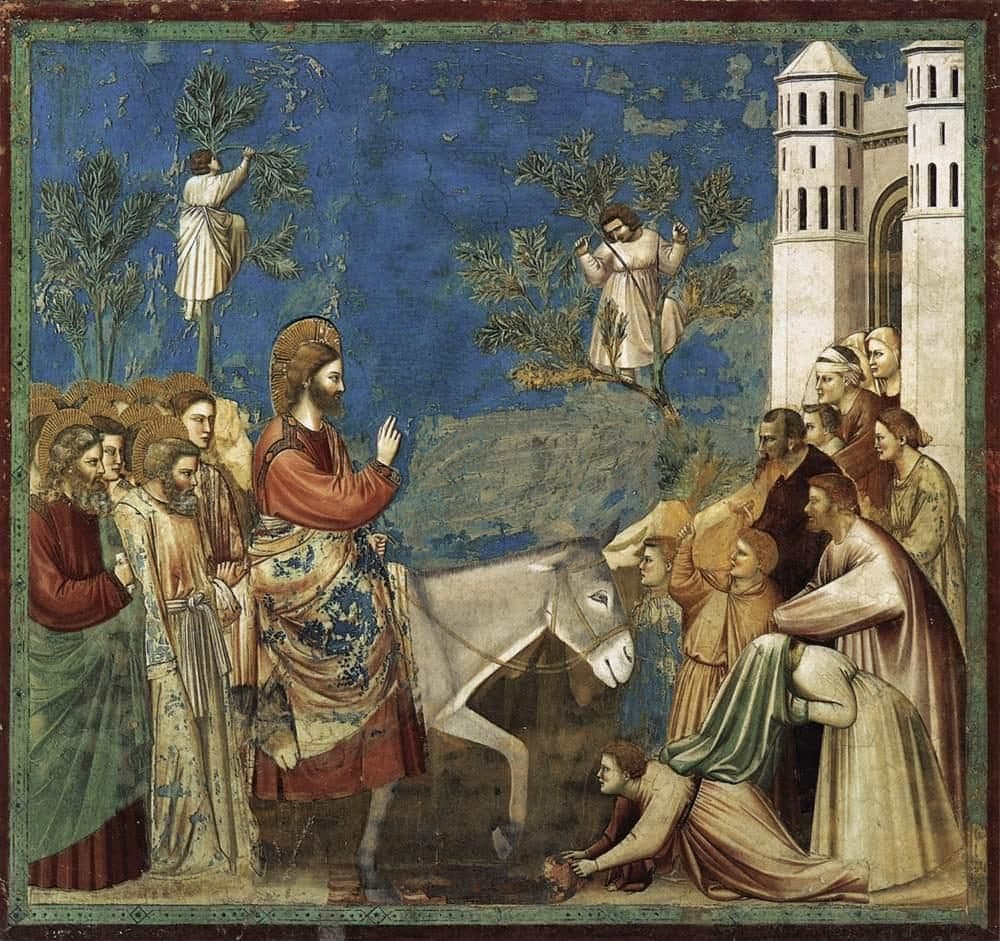
Giotto di Bondone, Entry into Jerusalem, fresco in the Scrovegni Chapel, Padua, 1304 to 1306. Public domain, via Wikimedia Commons.
THE ARTWORKGiotto painted one man spreading his cloak under the donkey's feet while two others climb trees for branches. The fresco is one of the scenes of the life of Christ on the chapel walls.
Summary
A few days before the Passover, Jesus sent two disciples for a colt and came down the Mount of Olives while a festival crowd cried hosanna.
- Matthew and John each quote Zechariah's prophecy over the ride.
- The crowd's words come from Psalm 118, which the Mishnah shows in use at the feast of Tabernacles.
- John ties the size of the crowd to the raising of Lazarus at Bethany.
- Luke alone tells that Jesus wept over the city as he came near it.
- Matthew names two animals where Mark, Luke and John name one, and readers explain it in three ways.
The Ride from Bethphage
The account as the four Gospels tell it
As they approached Jerusalem and came to Bethphage and Bethany at the Mount of Olives, Jesus sent out two of His disciples and said to them, “Go into the village ahead of you, and as soon as you enter it, you will find a colt tied there, on which no one has ever sat. Untie it and bring it here.Jesus chooses the animal himself, a colt that no one has ever sat on.
So those who were sent went out and found it just as Jesus had told them. As they were untying the colt, its owners asked, “Why are you untying the colt?” “The Lord needs it,” they answered.Everything on the errand happens as Jesus foretold, so the entry follows his plan.
Then they led the colt to Jesus and threw their cloaks over it, and He sat on it.This is the one ride of Jesus that the Gospels record.
Meanwhile, many people continued to testify that they had been with Jesus when He called Lazarus from the tomb and raised him from the dead. That is also why the crowd went out to meet Him, because they heard that He had performed this sign.The welcome on the road grew out of the witness of those who saw the dead man called out.
The crowds that went ahead of Him and those that followed were shouting: “Hosanna to the Son of David!” “Blessed is He who comes in the name of the Lord!” “Hosanna in the highest!”The crowds hail Jesus as the Son of David, the line of Israel's promised king.
Then Jesus entered Jerusalem and went into the temple courts. He looked around at everything, but since it was already late, He went out to Bethany with the Twelve.The entry ends in the temple courts, where Jesus teaches every day of the week that follows.
The Road from Jericho
From Jericho by way of Bethany to the slope of the Mount of Olives
John 11:18 sets Bethany a little less than two miles from Jerusalem.
Four Gospels, One Entry
The animal, the cloaks and branches, and what each Gospel alone records
| Gospel | The animal | The cloaks and branches | Found only here |
|---|---|---|---|
| Matthew | A donkey and her colt | Cloaks and branches from the trees | The city asks who he is, and the crowds name him the prophet from Nazareth |
| Mark | A colt never ridden | Cloaks and branches cut from the fields | The cry for the coming kingdom of David |
| Luke | A colt never ridden | Cloaks on the road | The Pharisees' rebuke, and the stones that would cry out |
| John | A young donkey | Palm branches carried out to meet him | The disciples understand only after he is glorified |
- Gospel
- Matthew
- The animal
- A donkey and her colt
- The cloaks and branches
- Cloaks and branches from the trees
- Found only here
- The city asks who he is, and the crowds name him the prophet from Nazareth
- Gospel
- Mark
- The animal
- A colt never ridden
- The cloaks and branches
- Cloaks and branches cut from the fields
- Found only here
- The cry for the coming kingdom of David
- Gospel
- Luke
- The animal
- A colt never ridden
- The cloaks and branches
- Cloaks on the road
- Found only here
- The Pharisees' rebuke, and the stones that would cry out
- Gospel
- John
- The animal
- A young donkey
- The cloaks and branches
- Palm branches carried out to meet him
- Found only here
- The disciples understand only after he is glorified
The King on a Donkey
Zechariah's prophecy and the signs of a king in Israel
Zechariah 9 opens with judgments on Damascus, Tyre and the cities of the Philistines, and then turns to Jerusalem and her king.
Rejoice greatly, O Daughter of Zion! Shout in triumph, O Daughter of Jerusalem! See, your King comes to you, righteous and victorious, humble and riding on a donkey, on a colt, the foal of a donkey.Jesus acts out this verse when he sends for the animal and rides it into the city.
And I will cut off the chariot from Ephraim and the horse from Jerusalem, and the bow of war will be broken. Then He will proclaim peace to the nations. His dominion will extend from sea to sea, and from the Euphrates to the ends of the earth.The next verse shows why this king rides a donkey: he comes to end war.
The Hebrew words of the prophecyani, noshah, chamor, ayir, aton
The Hebrew word for humble is ani, which the lexicon defines as afflicted or lowly. The word for victorious is noshah, a form of the verb to save, so it can also be read as saved.
The animals are named three ways. Chamor is a male donkey, ayir is a young donkey, and aton is a she-donkey, so the colt is the foal of she-donkeys.
Rashi and the TalmudSanhedrin 98a
Rashi says the verse can only mean the King Messiah and calls the donkey a sign of humility. The Talmud sets the donkey beside the clouds of Daniel 7:13, the clouds if Israel is worthy and the donkey if it is not.
The Greek words of the Gospelspraus, polos, baion
Matthew gives the king's humility as praus, gentle, the word Jesus uses of himself in Matthew 11:29. Every account calls the colt polos, a foal.
John's palm branches are baion, a palm twig, a word found only in this verse of the New Testament.
John quotes Zechariah in a shorter form that begins do not be afraid.
Then Zadok the priest, Nathan the prophet, and Benaiah son of Jehoiada, along with the Cherethites and Pelethites, went down and set Solomon on King David’s mule, and they escorted him to Gihon. Zadok the priest took the horn of oil from the tabernacle and anointed Solomon. Then they blew the ram’s horn, and all the people proclaimed, “Long live King Solomon!”A royal heir on his way to be crowned gets the welcome the crowd now gives Jesus.
Quickly, each man took his garment and put it under Jehu on the bare steps. Then they blew the ram’s horn and proclaimed, “Jehu is king!”Each man puts his garment under the new king, as the crowd spreads cloaks before Jesus.
Justin Martyr, in his Dialogue with Trypho 53, reads Jacob's blessing of Judah in Genesis 49:11 as a sign of the colt the disciples untied.
The Festival Crowd and Its Psalm
The crowd's psalm, the feast of Tabernacles, the palms of a victory and the size of the Passover crowd
The crowd's cry is Psalm 118:25 to 26. The Hebrew hoshia na means save us, we pray, and the Greek hosanna carries those words over.
The Mishnah shows how the psalm was used at the feast of Tabernacles. The people waved their palm branches at save us, we pray, and each day they circled the altar saying the same verse.
O LORD, save us, we pray. We beseech You, O LORD, cause us to prosper! Blessed is he who comes in the name of the LORD. From the house of the LORD we bless you.Its blessing is spoken from the house of the LORD, the temple Jesus enters that evening.
The next day the great crowd that had come to the feast heard that Jesus was coming to Jerusalem. They took palm branches and went out to meet Him, shouting: “Hosanna!” “Blessed is He who comes in the name of the Lord!” “Blessed is the King of Israel!”The crowd adds a royal title to the psalm, so its blessing becomes a king's welcome.
Palm branches for a victor1 Maccabees 13:51
First Maccabees records that Simon entered the citadel of Jerusalem with thanksgiving, palm branches, harps and songs, because a great enemy had been destroyed out of Israel.
The size of the Passover crowdJosephus, The Wars of the Jews 6.9.3
Josephus reports that the high priests once counted 256,500 Passover sacrifices so that Cestius could report the number to Nero, and he reckoned them at 2,700,200 people.
What the Text Leaves Unsaid
Three questions the accounts leave open
The Gospels give the day no name. The church names it Palm Sunday by counting from John's date for the arrival at Bethany, since John sets the entry on the next day.
No Gospel says that the crowd who cried hosanna was the crowd who later cried for his death.
Matthew sets the clearing of the temple on the day of the entry, and Mark on the day after. Neither Gospel explains the difference.
The King Who Wept
Luke sets the lament inside the procession, before it reached the city.
As Jesus approached Jerusalem and saw the city, He wept over it and said, “If only you had known on this day what would bring you peace! But now it is hidden from your eyes. For the days will come upon you when your enemies will barricade you and surround you and hem you in on every side. They will level you to the ground—you and the children within your walls. They will not leave one stone on another, because you did not recognize the time of your visitation from God.”Here the day of praise turns to a warning of judgment.
Voices on the Entry
Four voices from the fourth century to the nineteenth
AugustineBishop of Hippo
“‘On the next day much people that were come to the feast, when they heard that Jesus was coming to Jerusalem, took branches of palm trees and went forth to meet Him, and cried, Hosanna: blessed is He that cometh in the name of the Lord as the King of Israel.’ The branches of palm trees are laudatory emblems, significant of victory, because the Lord was about to overcome death by dying, and by the trophy of His cross to triumph over the devil, the prince of death.”
Augustine of Hippo · Tractates on John 51 · on John 12:12Patristic
John ChrysostomPreacher at Antioch
“But these things He did, not as displaying any pomp, but at once, as I have said, both fulfilling a prophecy, and teaching self-denial, and at the same time also comforting His disciples, who were grieving for His death, and showing them that He suffers all these things willingly. And mark thou, I pray thee, the accuracy of the prophet, how he foretold all things. And some things David, some things Zechariah, had proclaimed beforehand. Let us also do likewise, and let us sing hymns, and give up our garments to them that bear Him. For what should we deserve, when some clothe the ass on which He was set, and others strew the garments even under her feet; but we, seeing him naked, and not being even commanded to strip ourselves, but to spend of what is laid by, not even so are liberal? And when they indeed attend upon Him before and behind, but we, when He cometh unto us, send Him away, and thrust Him off and insult Him.”
John Chrysostom · Homily on the Gospel of Matthew 66 · on Matthew 21:1 to 9Patristic
John WesleyLeader of the Methodist revival, on the words Say to the Daughter of Zion
“That is, the inhabitants of Jerusalem: the first words of the passage are cited from Isaiah lxii, 11; the rest from Zech. ix, 9. The ancient Jewish doctors were wont to apply these prophecies to the Messiah.”
John Wesley · Explanatory Notes upon the New Testament · on Matthew 21:5Evangelical
Jamieson, Fausset & BrownCommentators of Scotland and Ireland
“The Hebrew is reflexive in sense, ‘showing Himself a Saviour; . . . having salvation in Himself’ for us. Endowed with a salvation which He bestows as a king. Compare Margin, ‘saving Himself.’ Compare Matthew 1:21, in the Greek, ‘Himself shall save His people’; that is, not by any other, but by Himself shall He save.”
Jamieson, Fausset & Brown · Commentary Critical and Explanatory on the Whole Bible · on Zechariah 9:9Reformed
Where Readers Differ
Three questions and the readers who hold each answer
One animal or twoJohn Calvin, John Chrysostom, Jerome, David Friedrich Strauss
They brought the donkey and the colt and laid their cloaks on them, and Jesus sat on them.Every reading of the two animals has to explain the donkey and the colt of this verse.
John Calvin, in his Harmony of the Evangelists, reads Matthew's plural as a figure of speech in which two are named for one. He holds that Jesus rode the colt only and that Zechariah repeats one animal in Hebrew fashion.
John Chrysostom, in Homily 66 on Matthew, reads the colt as the nations and the donkey that follows as Israel. Jerome, in his Commentary on Matthew, also reads the animals as figures and says Jesus could not have sat on both over so short a road.
David Friedrich Strauss, in The Life of Jesus Critically Examined, argued that Matthew read Zechariah's two parallel lines as two animals. His strongest point is Matthew's own phrase that Jesus sat on them.
Against Strauss, Matthew sets the colt beside its mother in the errand itself, before he quotes the prophet.
What hosanna meant on the roadCharles Spurgeon, Augustine
Charles Spurgeon, in his sermon The Blessed Christ, renders hosanna both save, Lord and bless, Lord. Augustine, in his Tractates on John 51, heard it as a cry of feeling, like an exclamation of joy.
Against the prayer reading, Matthew 21:9 adds in the highest, which is praise. Against Augustine, the crowd took the word from a prayer, Psalm 118:25.
Daniel's weeks and this daySir Robert Anderson
Sir Robert Anderson, in The Coming Prince, took the weeks of Daniel 9:25 as sixty-nine weeks of years. He counted 173,880 days from 14 March 445 BC to 6 April AD 32 and named that day the entry.
Anderson's count rests on two premises, a prophetic year of 360 days and a crucifixion in AD 32, and his date stands only where both are granted.
Know and understand this: From the issuance of the decree to restore and rebuild Jerusalem, until the Messiah, the Prince, there will be seven weeks and sixty-two weeks. It will be rebuilt with streets and a trench, but in times of distress.Anderson counts his days from the decree to restore and rebuild Jerusalem that this verse names.
Books on the Entry
Commentary on a Harmony of the Evangelists, Volume 2
John Calvin, translated by William Pringle · 1845
Calvin reads the four accounts together and explains why a poor procession shows the kingdom.
Read it free at CCELThe Coming Prince
Sir Robert Anderson · 1900
The book sets out Anderson's reading of the prophecies of Daniel.
Read it free at the Internet ArchiveThe Wars of the Jews
Flavius Josephus, translated by William Whiston · 1737
Josephus wrote the history of the war with Rome that ended in the fall of Jerusalem.
Read it free at Project GutenbergYour King Is Coming
On the road up, Jesus had told the Twelve that in Jerusalem he would be condemned to death, and still he sent for the colt and rode in.
Keep studying
Studies5