
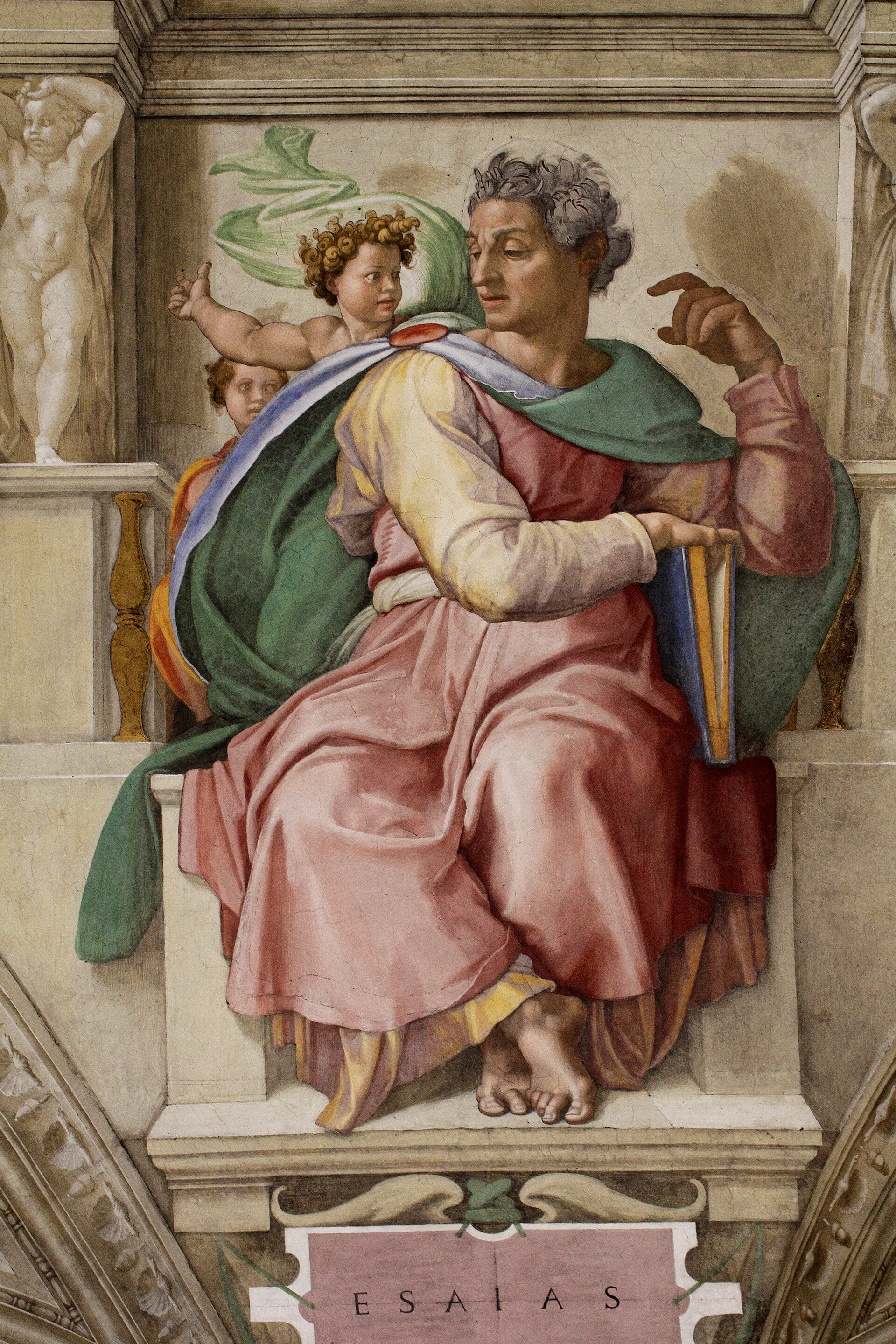
I saw the Lord sitting upon a throne, high and lifted up, and his train filled the temple. The verse begins with a dead king and ends with a living one — the throne of Judah is empty, and the throne above it is not. Around Him stand the seraphim, the burning ones, six-winged: with two they cover their faces, with two their feet, and with two they fly. Even they will not look.
Isaiah 6 · The Throne-Vision · Featured Study
The Holy One of Israel
Every book has a centre of gravity. Isaiah's is a throne-room. In the year a king died, the prophet saw the King who does not, heard the burning ones cry Holy, holy, holy, and came apart — Woe is me, for I am undone. What happens next is the whole book in miniature: a coal from the altar, an iniquity taken away, and a man sent. And the name Isaiah takes out of that room — the Holy One of Israel — he will use for God about twenty-five times across sixty-six chapters, on both sides of the seam that scholars say divides the book.
The Throne-Room, in Five Beats
— Isaiah 6 — the shape of every true encounter with God- SeenIsaiah 6:1–2 →
- HeardIsaiah 6:3–4 →
And one cried unto another, and said, Holy, holy, holy, is Jehovah of hosts: the whole earth is full of his glory. The foundations of the thresholds shake at the voice, and the house fills with smoke. This is the only attribute of God that Scripture ever triples — Hebrew has no superlative suffix, so it says a thing three times when it means it absolutely.
- UndoneIsaiah 6:5 →
Then said I, Woe is me! for I am undone; because I am a man of unclean lips, and I dwell in the midst of a people of unclean lips: for mine eyes have seen the King, Jehovah of hosts. The prophet has spent five chapters pronouncing woe on everyone else. Confronted with holiness, he pronounces the sixth woe on himself — and the word he chooses means to be unravelled, come apart at the seams.
- CleansedIsaiah 6:6–7 →
Then flew one of the seraphim unto me, having a live coal in his hand, which he had taken with the tongs from off the altar. The remedy comes from the altar — the place of sacrifice — and it comes to the exact point of the confession: he touches the unclean lips. Thine iniquity is taken away, and thy sin forgiven. The prophet does not cleanse himself; he is cleansed, and it burns.
- SentIsaiah 6:8–13 →
Only now does God ask a question, and He does not ask it of Isaiah — Whom shall I send, and who will go for us? The cleansed man volunteers into an overheard conversation: Here am I; send me. And the commission is brutal: preach to a people who will not hear, until the cities are waste. The chapter ends on ten words of mercy — the holy seed is the stock thereof. A stump is not nothing.
The order is not negotiable and it is not decorative. Nobody in this chapter volunteers before he is cleansed, and nobody is cleansed before he is undone, and nobody is undone until he has seen. Ministry begins at the end of the sequence, not the start of it.
Holy, Holy, Holy
— the only attribute of God that Scripture triplesBiblical Hebrew has no word for most and no ending for -est. To say a thing absolutely, it repeats the word. Scripture never says God is love, love, love, or mighty, mighty, mighty. It says holy, holy, holy — once here, in Isaiah 6, and once again in the throne-room of Revelation 4, where the living creatures rest not day and night saying the same three words. Whatever else is true of God, this is the thing the beings who stand nearest to Him cannot stop saying.
And the second half of the cry refuses to leave holiness in heaven: the whole earth is full of his glory. The prophet is not told that God is far away. He is told that the ground he has been walking on all his life is saturated with a glory he had not noticed — which is a far more disturbing thing to learn.
The seraphim
Named nowhere else in Scripture. The word means burning ones. Four of their six wings are spent on covering themselves — creatures of fire, and still they hide their faces.
Not chiefly moral
The root of qadosh is separation — otherness before it is purity. Moral perfection follows from it; it is not the whole of it. God is not simply the best of our kind. He is not of our kind.
The Refrain's Ledger
— where the title falls across all sixty-six chaptersIsaiah walks out of the throne-room with a name for God, and he does not put it down. The Holy One of Israel appears about twenty-five times in this book and only a handful of times in the rest of the Old Testament — the density is the fingerprint. Below, every chapter of Isaiah as one cell; the lit ones are where the title falls.
Twelve occurrences before the seam, thirteen after it. The critical case for two or three Isaiahs rests on a change of setting and idiom at chapter 40 — a real change, honestly described. But the book's most distinctive phrase for God does not observe the boundary; it runs straight through it at almost identical density. That is not a knock-down argument, and MannaFest does not present it as one. It is a fact about the text that any theory of the book has to account for. Chapter 29:23 adds the variant the Holy One of Jacob.
In the Year That King Uzziah Died
— why the date is the first thing in the chapterUzziah reigned in Jerusalem for about fifty-two years — long enough that most people alive had never known another king. He was a good king who ended badly: struck with leprosy for forcing his way into the temple to burn incense, and living out his last years in isolation. When he died, around 739 BC, the security of two generations died with him, and Assyria was rising in the north.
That is the year Isaiah says he saw the Lord sitting upon a throne. The chapter dates itself for a reason. One throne had just been emptied by a leprous king who died outside the house of God; the other was occupied, and its occupant filled the temple. The vision is not an escape from the political moment. It is the answer to it.
c. 739 BC
The call, in the year of Uzziah's death — the opening of a ministry that runs through Jotham, Ahaz, and Hezekiah, to Sennacherib's siege in 701 BC and beyond.
Chapter 6, not chapter 1
The call-narrative sits five chapters in, after the indictment and the vineyard song. Isaiah puts the charges first and the credentials second — the reader meets the case before meeting the man.
The sixth woe
Chapter 5 pronounces a series of woes on other people. Chapter 6 pronounces one more, and the prophet says it about himself. The arrangement is deliberate.
Whose Glory Isaiah Saw
— the New Testament's answer, and the hardest commission in the bookHe saw his glory, and he spake of him
John, having quoted Isaiah 53:1 and then Isaiah 6:10 back to back, adds a sentence that changes what the throne-room is: these things said Isaiah, because he saw his glory; and he spake of him(Jn 12:41). The antecedent in the passage is Jesus. On the apostle's reading, the enthroned Lord of hosts whose train filled the temple was the pre-incarnate Son — which makes Isaiah 6 a Christophany, and makes the seraphim's cry a description of the One who would later have His face struck and His beard plucked.
Go, and tell this people
The commission of 6:9–13 is the hardest sentence given to any prophet: preach until hearing does not hear and seeing does not see. It is also the Old Testament passage the New Testament reaches for most often when explaining unbelief — quoted or echoed by all four Gospels, by Paul at the end of Acts, and by Romans 11. Isaiah asks Lord, how long? and is told: until the cities are waste. Then the last clause, and it is the entire hope of the book — the holy seed is the stock thereof. Cut the tree down; the stump is holy, and a Branch will come out of it (11:1).
The Voices on This Chapter
— the roster applied — the specific work named, so you can go to itThe Holiness of God (1985)
The whole book grows out of this chapter. Sproul's argument, in brief: holiness is not one attribute among others but God's otherness — and the reason Isaiah disintegrates is that a creature has met the uncreated. He calls the moment the trauma of holiness meeting sinful humanity, and reads our lost sense of awe as the root of our lost sense of dependence. Cite-only ≤50w; his amillennial and cessationist frame is not MannaFest's flag — the holiness emphasis is what we carry.
The Knowledge of the Holy (1961)
Tozer opens with the sentence that has become the standard diagnostic: what comes into our minds when we think about God is the most important thing about us. That is the Isaiah 6 question turned on the reader — the vision does not begin with what Isaiah did, but with what he saw. Cite-only ≤50w.
The Fear of the Lord; The Awe of God (2023)
The same undoing, argued in a charismatic and continuationist register: holy fear is not terror of punishment but the reverence that makes intimacy safe. Bevere and Sproul come at Isaiah 6 from opposite ends of the room and arrive at the same throne. Cite-only ≤50w.
Sermons on Isaiah 6 (Metropolitan Tabernacle Pulpit)
The public-domain pulpit voice on the chapter — the live coal from the altar preached as the gospel in miniature: the cleansing comes from the place of sacrifice, and it is applied precisely where the confession was made.
Isaiah (Koinonia House commentary)
Marcus Brown's formative teacher, reading chapter 6 as the structural axis of the book and pressing John 12:41 hard: the enthroned Lord of hosts whom Isaiah saw is identified by the apostle John as Christ. Cite-only ≤50w.
Marcus Brown's own commentary leads above all; within a tier, all voices are equal.
