
Exodus 34:6-7 · Doctrine · Featured Study
When God relents, and the gracious and compassionate formula
The LORD's name at Exodus 34:6-7 recurs in eight later passages, and Exodus, Amos and Jonah say He relented from a disaster He had announced.
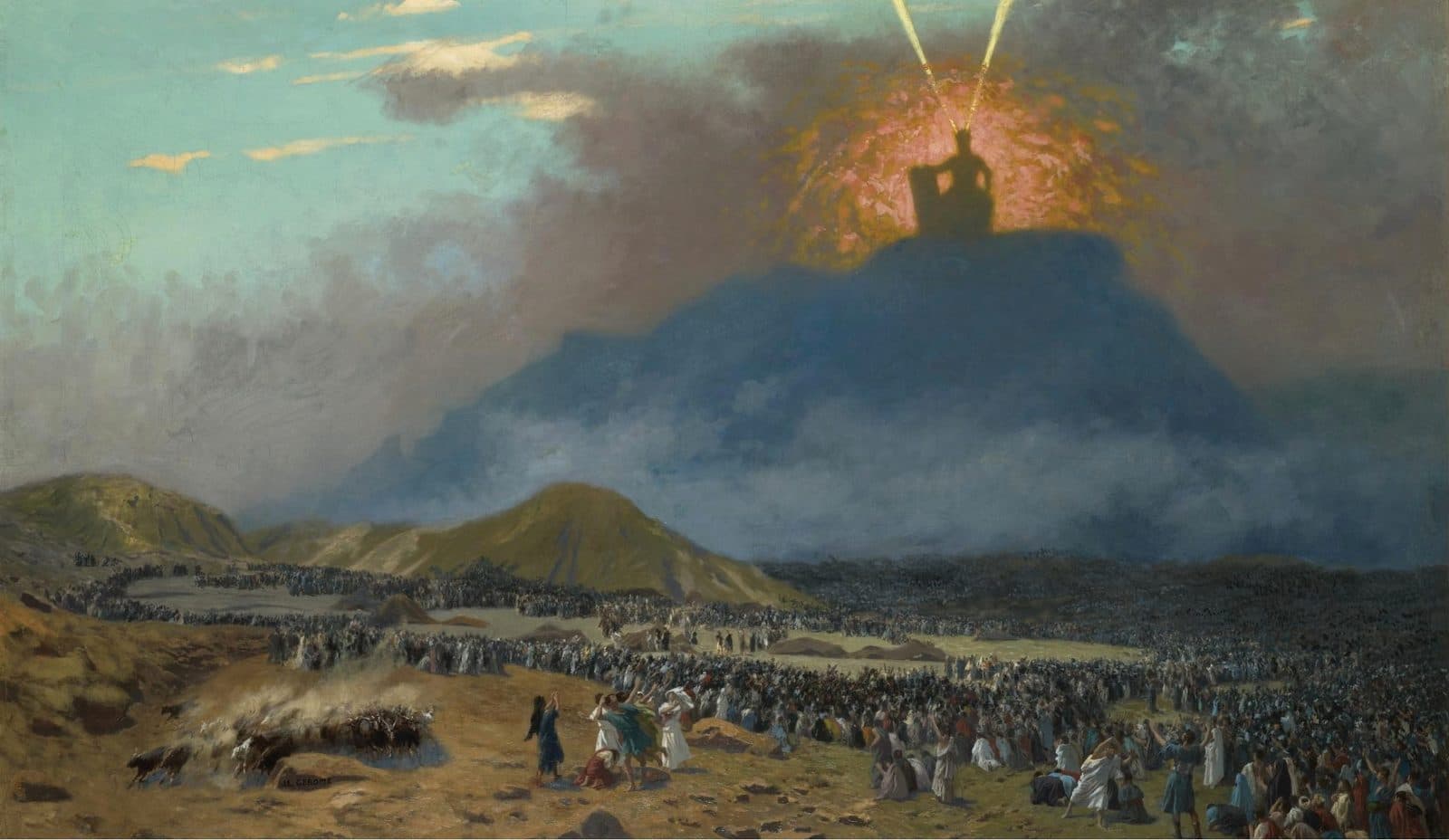
Jean-Léon Gérôme, Moses on Mount Sinai, 1895 to 1900. Public domain.
THE ARTWORKGérôme painted Moses alone on the summit in red fire and cloud, with the whole camp of Israel waiting on the plain below.
After the golden calf, the LORD called out His own name before Moses, and later prophets prayed those words back to Him.
Summary
The LORD calls Himself compassionate and gracious, slow to anger, abounding in loving devotion and faithfulness, and He still will by no means leave the guilty unpunished.
- He spoke these words on Sinai when Moses had cut two new tablets.
- Joel and Jonah add a last line: He relents from sending disaster.
- Jeremiah 18 gives the rule: a nation that turns from its evil is spared the disaster announced against it.
- Three readings explain how a God who does not change His mind can relent, and each has named holders.
The Name Proclaimed on Sinai
Exodus 34:5-7, after the golden calf
The words come after the golden calf. Moses saw the calf and the dancing, threw down the tablets and broke them at the foot of the mountain.
Then the LORD said to Moses, “Chisel out two stone tablets like the originals, and I will write on them the words that were on the first tablets, which you broke.The LORD orders new tablets to replace the ones Moses broke.
Moses climbed the mountain again with the new tablets, and the LORD came down in a cloud and proclaimed His name.
And the LORD descended in a cloud, stood with him there, and proclaimed His name, the LORD. Then the LORD passed in front of Moses and called out: “The LORD, the LORD God, is compassionate and gracious, slow to anger, abounding in loving devotion and faithfulness, maintaining loving devotion to a thousand generations, forgiving iniquity, transgression, and sin. Yet He will by no means leave the guilty unpunished; He will visit the iniquity of the fathers on their children and grandchildren to the third and fourth generations.”The LORD's own words for Himself, mercy first and judgment after it.
Moses bowed to the ground. He asked the LORD to go with a stiff-necked people and to forgive their iniquity and sin.
COMPASSIONATE, RACHUM
The name puts rachum, compassionate, before channun, gracious, and the lexicon counts 13 uses of each.
GRACIOUS, CHANNUN
Joel and Jonah set channun, gracious, first and rachum second.
SLOW TO ANGER, EREK APPAYIM
The phrase reads literally long of anger, and the lexicon glosses erek as slow.
LOVING DEVOTION, CHESED
The Berean text renders chesed as loving devotion, which the LORD keeps to a thousand generations, and the lexicon counts 247 uses.
FAITHFULNESS, EMET
The lexicon glosses emet as stability, and the Berean text renders it faithfulness.
FORGIVING, NASA
The verb nasa means to lift; here it lifts away iniquity, transgression and sin.
UNPUNISHED, NAQAH
The guilt clause doubles the verb naqah, to make clean, so it reads literally that in clearing He will not clear.
RELENT, NACHAM
The lexicon gives nacham the senses to be sorry and to comfort, and the story of the golden calf uses it of the LORD.
The Formula Across the Canon
Nine passages from Exodus to Nahum
| Passage | Who speaks | The opening terms | The guilt clause | What it adds |
|---|---|---|---|---|
| Exodus 34:6-7 | The LORD, on Sinai after the golden calf | Compassionate and gracious | Kept | Nothing; it is the source |
| Numbers 14:18 | Moses, praying after the people refused to enter the land | Slow to anger | Kept | A plea to pardon this people |
| Nehemiah 9:17 | The Levites, confessing Israel's history | Gracious and compassionate | Left out | A forgiving God |
| Psalm 86:15 | The psalmist, praying for help | Compassionate and gracious | Left out | Nothing |
| Psalm 103:8 | The psalmist, blessing the LORD | Compassionate and gracious | Left out | Nothing |
| Psalm 145:8 | The psalmist, in praise | Gracious and compassionate | Left out | Nothing |
| Joel 2:13 | Joel, calling Judah to return | Gracious and compassionate | Left out | He relents from sending disaster |
| Jonah 4:2 | Jonah, angry that Nineveh was spared | Gracious and compassionate | Left out | One who relents from sending disaster |
| Nahum 1:3 | Nahum, in the burden against Nineveh | Slow to anger, with no mercy terms | Kept | Great in power |
- Passage
- Exodus 34:6-7
- Who speaks
- The LORD, on Sinai after the golden calf
- The opening terms
- Compassionate and gracious
- The guilt clause
- Kept
- What it adds
- Nothing; it is the source
- Passage
- Numbers 14:18
- Who speaks
- Moses, praying after the people refused to enter the land
- The opening terms
- Slow to anger
- The guilt clause
- Kept
- What it adds
- A plea to pardon this people
- Passage
- Nehemiah 9:17
- Who speaks
- The Levites, confessing Israel's history
- The opening terms
- Gracious and compassionate
- The guilt clause
- Left out
- What it adds
- A forgiving God
- Passage
- Psalm 86:15
- Who speaks
- The psalmist, praying for help
- The opening terms
- Compassionate and gracious
- The guilt clause
- Left out
- What it adds
- Nothing
- Passage
- Psalm 103:8
- Who speaks
- The psalmist, blessing the LORD
- The opening terms
- Compassionate and gracious
- The guilt clause
- Left out
- What it adds
- Nothing
- Passage
- Psalm 145:8
- Who speaks
- The psalmist, in praise
- The opening terms
- Gracious and compassionate
- The guilt clause
- Left out
- What it adds
- Nothing
- Passage
- Joel 2:13
- Who speaks
- Joel, calling Judah to return
- The opening terms
- Gracious and compassionate
- The guilt clause
- Left out
- What it adds
- He relents from sending disaster
- Passage
- Jonah 4:2
- Who speaks
- Jonah, angry that Nineveh was spared
- The opening terms
- Gracious and compassionate
- The guilt clause
- Left out
- What it adds
- One who relents from sending disaster
- Passage
- Nahum 1:3
- Who speaks
- Nahum, in the burden against Nineveh
- The opening terms
- Slow to anger, with no mercy terms
- The guilt clause
- Kept
- What it adds
- Great in power
Relenting from Sinai to Nineveh
Exodus 32, Amos 7, Joel 2 and Jonah 3 and 4
The LORD relented on the mountain before He proclaimed His name. When He threatened to consume the people, Moses prayed, and the LORD relented.
So the LORD relented from the calamity He had threatened to bring on His people.The verb here, nacham, is the one Joel and Jonah later use.
Amos saw two judgments coming on Israel and prayed, and twice the LORD relented and said they would not happen.
Joel makes the formula the reason to return. Judah is to tear the heart and come back, because the LORD is gracious and compassionate and relents from sending disaster.
So rend your hearts and not your garments, and return to the LORD your God. For He is gracious and compassionate, slow to anger, abounding in loving devotion. And He relents from sending disaster.The call to return, with the formula as its ground.
When God saw their actions—that they had turned from their evil ways—He relented from the disaster He had threatened to bring upon them.God sees Nineveh turn and spares the city.
So he prayed to the LORD, saying, “O LORD, is this not what I said while I was still in my own country? This is why I was so quick to flee toward Tarshish. I knew that You are a gracious and compassionate God, slow to anger, abounding in loving devotion—One who relents from sending disaster.Jonah names the mercy he had run from.
What the Formula Says of Judgment
Two misreadings set beside the verses that answer them, and one Jewish reading of the name
The formula is mercy only
The name ends with judgment on the guilty, and two later passages carry that clause into their own words.
‘The LORD is slow to anger and abounding in loving devotion, forgiving iniquity and transgression. Yet He will by no means leave the guilty unpunished; He will visit the iniquity of the fathers upon their children to the third and fourth generation.’Moses prays the whole formula, the guilt clause with it.
The LORD is slow to anger and great in power; the LORD will by no means leave the guilty unpunished. His path is in the whirlwind and storm, and clouds are the dust beneath His feet.Nahum keeps patience and judgment and leaves out the mercy terms.
Children bear their fathers' guilt
The last line of the name visits iniquity on the third and fourth generation. Two other verses set the bounds of that line.
You shall not bow down to them or worship them; for I, the LORD your God, am a jealous God, visiting the iniquity of the fathers on their children to the third and fourth generations of those who hate Me,The visiting falls on the generations of those who hate Him.
The soul who sins is the one who will die. A son will not bear the iniquity of his father, and a father will not bear the iniquity of his son. The righteousness of the righteous man will fall upon him, and the wickedness of the wicked man will fall upon him.Each soul bears its own sin.
The LORD, the LORD: mercy before and after sin
Rashi reads the doubled name at Exodus 34:6 as mercy twice over: mercy on the sinner before he sins, and mercy after he has sinned and repented. He takes the reading from the Talmud, at Rosh Hashanah 17b.
The Prophets Who Repeat the Words
Jonah, Nahum, Micah and Joel in their times
Jonah son of Amittai prophesied in the reign of Jeroboam II of Israel, who restored Israel's border by the word the LORD spoke through him.
This Jeroboam restored the boundary of Israel from Lebo-hamath to the Sea of the Arabah, according to the word that the LORD, the God of Israel, had spoken through His servant Jonah son of Amittai, the prophet from Gath-hepher.Jonah's word to Israel under Jeroboam, before Nineveh.
Nineveh is the city of two books. Jonah was sent to preach against it, and the book of Nahum is a burden against it.
Micah prophesied in the days of Jotham, Ahaz and Hezekiah. In the reign of Jehoiakim the elders of the land recalled that when Hezekiah sought the LORD's favor, the LORD relented of the disaster Micah had pronounced.
“Micah the Moreshite prophesied in the days of Hezekiah king of Judah and told all the people of Judah that this is what the LORD of Hosts says: ‘Zion will be plowed like a field, Jerusalem will become a heap of rubble, and the temple mount a wooded ridge.’ Did Hezekiah king of Judah or anyone else in Judah put him to death? Did Hezekiah not fear the LORD and seek His favor, and did not the LORD relent of the disaster He had pronounced against them? But we are about to bring great harm on ourselves!”The elders cite Micah's warning and the LORD's relenting in Jeremiah's defense.
What the Text Leaves Unsaid
Three questions the relenting texts leave open
The Rule in Jeremiah 18
An announced disaster, and a nation that turns
Jeremiah 18 states the rule the relenting texts follow. An announced disaster is relented if the nation turns from its evil, and an announced good is withdrawn if the nation does evil.
At any time I might announce that a nation or kingdom will be uprooted, torn down, and destroyed. But if that nation I warned turns from its evil, then I will relent of the disaster I had planned to bring. And if at another time I announce that I will build up and establish a nation or kingdom, and if it does evil in My sight and does not listen to My voice, then I will relent of the good I had intended for it.The LORD's own statement of how His warnings work.
Micah closes his book with the verbs of Sinai. His God who pardons iniquity uses nasa, the verb of forgiving in the name, and passes over transgression with avar, the verb of the LORD passing before Moses on Sinai.
Who is a God like You, who pardons iniquity and passes over the transgression of the remnant of His inheritance—who does not retain His anger forever, because He delights in loving devotion? He will again have compassion on us; He will vanquish our iniquities. You will cast out all our sins into the depths of the sea. You will show faithfulness to Jacob and loving devotion to Abraham, as You swore to our fathers from the days of old.Micah's last words: the sins cast into the depths of the sea.
Five Teachers on the Formula
Calvin, Wesley, Clarke, Jamieson, Fausset and Brown, and Spurgeon
John Calvin
Though the beginning may not have been wrong, yet excess was sinful. But he confesses that there was excess, and want of moderation in his grief: since then he accuses himself in plain words what good is it, by false and invented pretenses, to cover what we clearly see cannot be excused?
John Calvin · Commentaries · on Jonah 4:1Reformed
John Wesley
John Wesley, on Exodus 34:6, reads pardon as the mercy that opens every other gift.
Mercy entailed upon thousands of generations, even to those upon whom the ends of the world are come; nay, the line of it is drawn parallel with that of eternity itself. 6thly, He forgiveth iniquity, transgression and sin - Pardoning mercy is instanced in, because in that divine grace is most magnified, and because that it is that opens the door to all other gifts of grace.
John Wesley · Explanatory Notes upon the Old Testament · on Exodus 34:6Evangelical
Adam Clarke
Adam Clarke, on Exodus 34:7, sets out the doubled verb of the guilt clause and the Samaritan reading of it.
That will by no means clear the guilty - This last clause is rather difficult; literally translated it signifies, in clearing he will not clear. But the Samaritan, reading לו lo, to him, instead of the negative לא lo, not, renders the clause thus: With whom the innocent shall be innocent; i.e., an innocent or holy person shall never be treated as if he were a transgressor, by this just and holy God.
Adam Clarke · Commentary on the Bible · on Exodus 34:7Evangelical
Jamieson, Fausset and Brown
Jamieson, Fausset and Brown, on Jonah 4:2, hold that Jonah had Exodus 34:6 in mind and that Joel quotes Jonah.
my saying--my thought, or feeling. fled before--I anticipated by fleeing, the disappointment of my design through Thy long-suffering mercy. gracious . . . and merciful, &c.--Jonah here has before his mind Ex 34:6; as Joel (Joe 2:13) in his turn quotes from Jonah.
Jamieson, Fausset & Brown · Commentary Critical and Explanatory on the Whole Bible · on Jonah 4:2Reformed
Charles Spurgeon
Charles Spurgeon, preaching on Exodus 32:14, reads the LORD's relenting as speech after the manner of men.
I SUPPOSE that I need not say that this verse speaks after the manner of men. I do not know after what other manner we can speak. To speak of God after the manner of God is reserved for God, Himself, and mortal men could not comprehend such speech. In this sense, the Lord often speaks, not according to literal fact, but according to the appearance of things to us, in order that we may understand so far as the human can comprehend the Divine. The Lord's purposes never really change.
Charles Spurgeon · The Metropolitan Tabernacle Pulpit, Sermon No. 2398: “Mediation of Moses” (lightly modernized text, CCEL edition) · on Exodus 32:14
How Relenting Stands with an Unchanging God
Three readings, each with its holders and the strongest objection
Numbers 23:19 and 1 Samuel 15:29 say God does not change His mind, and the same verb, nacham, says that the LORD relented. Three readings hold the two together.
God is not a man, that He should lie, or a son of man, that He should change His mind. Does He speak and not act? Does He promise and not fulfill?Balaam's oracle: God is not a man, that He should change His mind.
Moreover, the Glory of Israel does not lie or change His mind, for He is not a man, that He should change His mind.”Samuel says the same of the Glory of Israel.
Accommodation
Augustine reads the words God repented as speech about how events appear to people, while the decisions of God stand.
Though we sometimes hear the expression "God changed his mind" or even read in the figurative language of Scripture that "God repented," we interpret these sayings not in reference to the decisions determined on by almighty God but in reference to the expectations of man or to the order of natural causes.
Augustine of Hippo · City of God 14.11 · on Exodus 32:14Patristic
The objection: Exodus 32 and Jonah 3 tell the relenting as an event in the story, after a prayer and after a city turned.
The conditional warning
John Chrysostom reads Nineveh's rescue by the law of Jeremiah 18, so the prophecy against the city did not fail.
For God even preferred that His own prediction should fall to the ground, so that the city should not fall. Or rather, the prophecy did not even so fall to the ground. For if indeed while the men continued in the same wickedness, the sentence had not taken effect, some one perhaps might have brought a charge against what was uttered. But if when they had changed, and desisted from their iniquity, God also desisted from His wrath, who shall be able any longer to find fault with the prophecy, or to convict the things spoken of falsehood. The same law indeed which God had laid down from the beginning, publishing it to all men by the prophet, was on that occasion strictly observed. What then is this law? "I shall speak a sentence," saith He, "concerning a nation or a kingdom, to pluck up, and to pull down, and to destroy it; and it shall be, that if they repent of their evil, I will also repent of the wrath which I said I would do unto them." Guarding then this law, he saved those who were converted and released from His wrath those who desisted from their wickedness.
John Chrysostom · Homilies Concerning the Statues 5 · on Jonah 3:10Patristic
Real responsiveness
Terence Fretheim in The Repentance of God (1988), John Sanders in The God Who Risks (1998) and Gregory Boyd in God of the Possible (2000) take nacham in its plain sense in the story. First Samuel 15 sets verse 29 between two verses that use the same verb of the LORD.
The objection: if the relenting is a change of plan, Balaam's oracle loses its plain sense.
“I regret that I have made Saul king, for he has turned away from following Me and has not carried out My instructions.” And Samuel was distressed and cried out to the LORD all that night.The LORD regrets making Saul king.
And to the day of his death, Samuel never again visited Saul. Samuel mourned for Saul, and the LORD regretted that He had made Saul king over Israel.The chapter closes on the same regret.
Books to Read Next
Six works in the public domain
Homilies Concerning the Statues
John Chrysostom · fourth century
The fifth homily holds up the Ninevites, who repented on uncertain grounds, for its hearers to imitate.
The City of God
Augustine of Hippo · fifth century
His passage on God repenting stands in book 14, chapter 11.
Commentaries on the Twelve Minor Prophets
John Calvin · 1554
In his commentary on Jonah 4:1 Calvin holds that the prophet's grief ran to excess.
Explanatory Notes upon the Old Testament
John Wesley · 1765
In his notes on Exodus 34 Wesley takes each term of the name in turn.
Commentary on the Bible
Adam Clarke · 1832
His note on Exodus 34:7 gives the Samaritan reading of the guilt clause.
The Treasury of David, volume 7
Charles Spurgeon · 1885
In his notes on Psalm 145:8 Spurgeon hears the words the LORD gave Moses.
The Name Made Flesh
John says the Word became flesh full of grace and truth, and that grace and truth came through Jesus Christ as the law came through Moses.
The text asks the reader what Joel asked of Judah: to return to the LORD, who is gracious and compassionate.
The Word became flesh and made His dwelling among us. We have seen His glory, the glory of the one and only Son from the Father, full of grace and truth.The glory Moses asked to see, seen in the Son.
Keep studying
Places2
Symbols2