
God himself the first subject of study
He opened the printed series of his sermons with the unchanging God and called the knowledge of God the highest science.[4]
Seen in The Immutability of God, Sermon No. 1, on Malachi 3:6, 1855
Voices and influences
An English Baptist preacher who preached at the Metropolitan Tabernacle in London from its opening in 1861, and whose printed sermons fill sixty-three volumes.[1][4]
Reformed Baptist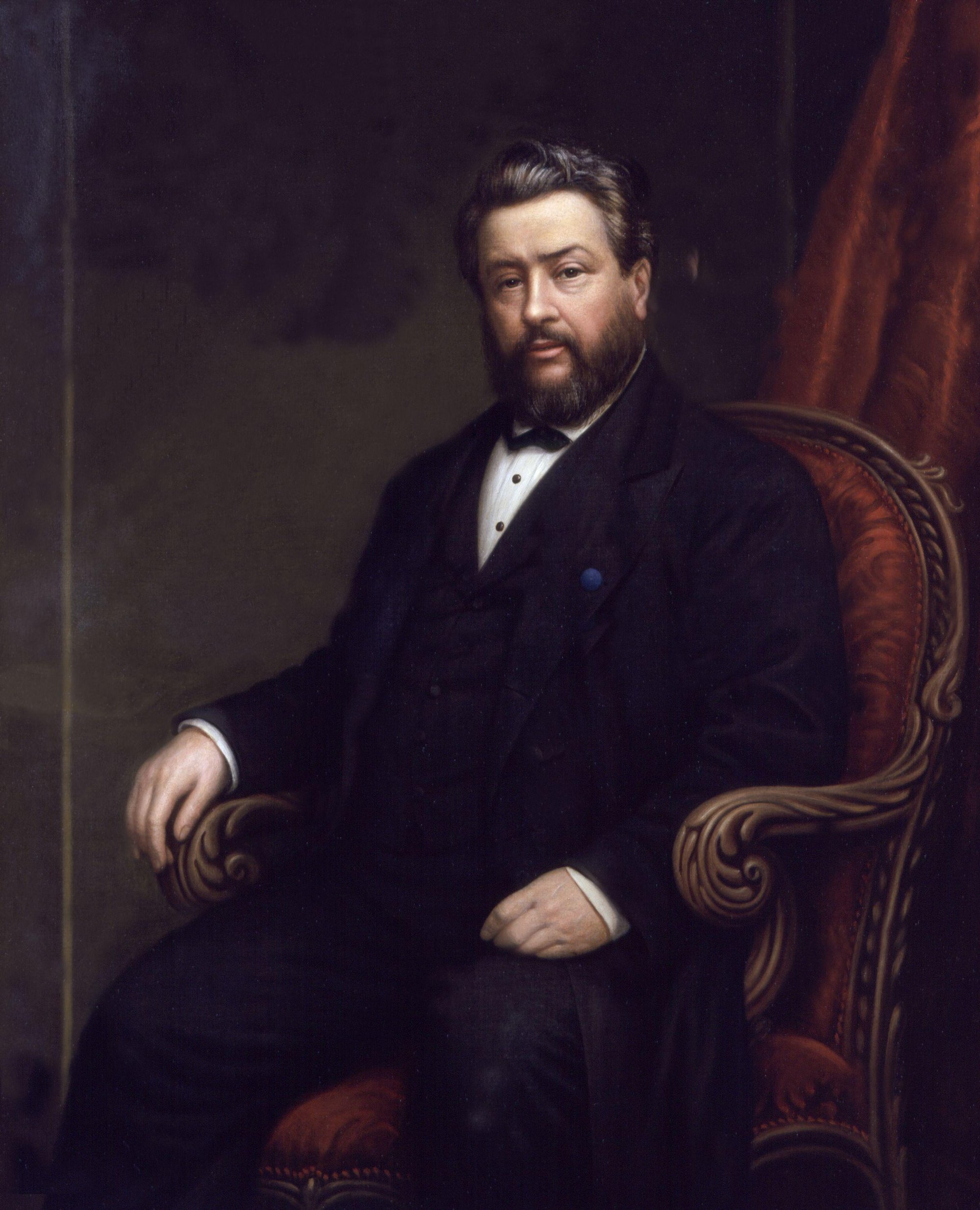
Charles Haddon Spurgeon was born on 19 June 1834 at Kelvedon, Essex, the eldest of seventeen children.[1][2] On 6 January 1850, aged fifteen, he came to faith in a chapel in Colchester on hearing Isaiah 45:22 read, "Look unto me, and be ye saved".[1][4] He was baptized on 3 May 1850 in the river Lark at Isleham.[2]
At seventeen he became pastor at Waterbeach, and at nineteen pastor of New Park Street Chapel in Southwark, whose 1,200 seats were soon too few.[1] The printed sermons begin with one he preached there on 7 January 1855.[4] He married Susannah Thompson on 8 January 1856, and in the same year he founded the Pastors' College.[2][1]
The Metropolitan Tabernacle opened in 1861 with seating for 5,600, and by the Spurgeon Library's account it stayed full for thirty-one years.[1] By the same account his weekly sermons sold 25,000 copies each, and the Metropolitan Tabernacle Pulpit runs to sixty-three volumes.[1][4] In 1867 he opened the Stockwell Orphanage.[1][2]
In the Down-Grade Controversy he withdrew from the Baptist Union in October 1887, and in January 1888 the Union's Council passed what was called a vote of censure.[3] He preached his last sermon at the Tabernacle on 7 June 1891.[4] He died at Menton, France, on 31 January 1892, aged fifty-seven, and was buried at West Norwood Cemetery.[1][2]
He opened the printed series of his sermons with the unchanging God and called the knowledge of God the highest science.[4]
Seen in The Immutability of God, Sermon No. 1, on Malachi 3:6, 1855
He held every word of the Bible to be the writing of the living God, and he taught that Scripture widens the more it is studied.[4]
Seen in The Bible, Sermon No. 15, on Hosea 8:12, 1855
He preached election, particular redemption and the bondage of the will, and he called Calvinism the gospel.[4][8]
Seen in Sermons No. 41, 52 and 181; C. H. Spurgeon's Autobiography, volume 1
He taught both that God predestines and that man is responsible, and he refused to force the two into a system.[8]
Seen in C. H. Spurgeon's Autobiography, volume 1
He pressed the call to look to Christ on every hearer, as in his sermon Compel Them to Come In.[4]
Seen in Sovereignty and Salvation, Sermon No. 60, on Isaiah 45:22; Compel Them to Come In, Sermon No. 227
He taught his students that the preacher is above all a man of prayer, and his daily readings press private prayer on every believer.[7][4]
Seen in Lectures to My Students, Lecture III, 1875; Morning and Evening, 22 March
Morning and Evening
It gives a reading for every morning and evening of the year, each on a verse.
All of Grace
It sets out the gospel for a seeking reader.
Lectures to My Students, First Series
1875 · Passmore and Alabaster[7]
It prints his lectures to the Pastors' College on the preacher's life, his prayer and his sermons.
Lectures to My Students, Second Series
1877 · Passmore and Alabaster
It gives further lectures, among them lectures on the voice and on gesture.
Lectures to My Students, Third Series: The Art of Illustration
It treats illustration in preaching.
Faith's Checkbook
It gives a promise of Scripture for each day.
Till He Come
It gathers his addresses at the Lord's Supper.
A Puritan Catechism
He wrote this catechism for families.
The Treasury of David
From 1869 · Passmore and Alabaster; Marshall Brothers[5][4]
It expounds the Psalms verse by verse, with notes gathered from older writers.
Read volume one free at GutenbergRead volume two free at GutenbergSee every volume at CCEL
Commenting and Commentaries
1876 · Passmore and Alabaster[4]
It gives two lectures and a catalogue of commentaries on every book of the Bible.
The New Park Street Pulpit and The Metropolitan Tabernacle Pulpit
1855 to 1917 · Passmore and Alabaster[4][1]
They hold about 3,563 sermons, each on a text of Scripture.
Read free at CCEL, from volume oneRead at the Spurgeon Center
C. H. Spurgeon's Autobiography, volume 1
1897 · Passmore and Alabaster[8]
It gives his own account of his early life to 1854, compiled after his death by his wife and his secretary.
C. H. Spurgeon's Autobiography, volume 4
It covers his later years, among them the Down-Grade.
“Unbelief shudders at the Jordan which still rolls between us and the goodly land, but let us rest assured that we have already experienced more ills than death at its worst can cause us.”
“This Psalm may be regarded as THE PREFACE PSALM, having in it a notification of the contents of the entire Book. It is the psalmist’s desire to teach us the way to blessedness, and to warn us of the sure destruction of sinners.”
“It is David’s Heavenly Pastoral; a surpassing ode, which none of the daughters of music can excel. The clarion of war here gives place to the pipe of peace, and he who so lately bewailed the woes of the Shepherd tunefully rehearses the joys of the flock.”
“It is quite right to say that you have not any righteousness; but it is quite wrong to look for any. It is, ‘Look unto me.’”
Sovereignty and Salvation, Sermon No. 60, 6 January 1856; p. 14 of the American printing
“His precious ‘shalls’ and ‘wills’ are better than men’s oaths.”
“You know the way of salvation, you read it in the Bible, you hear it from the pulpit, it is explained to you by friends, and yet you neglect it, and therefore are not saved.”
“This volume is the writing of the living God: each letter was penned with an Almighty finger; each word in it dropped from the everlasting lips; each sentence was dictated by the Holy Spirit.”
The Bible, Sermon No. 15, 18 March 1855; p. 26 of the American printing
“The child lisping, ‘Abba, Father,’ grows into the cherub crying, ‘Holy, Holy, Holy.’”
“Believer, be much in solitary prayer, especially in times of trial. Family prayer, social prayer, prayer in the Church, will not suffice; these are very precious, but the best beaten spice will smoke in your censer in your private devotions, where no ear hears but God’s.”
“He makes those just who are unjust, forgives those who deserve to be punished, and favors those who deserve no favor.”
“Jesus did not die for our righteousness, but he died for our sins. He did not come to save us because we were worth the saving, but because we were utterly worthless, ruined, and undone.”
“Faith is the simplest of all things, and perhaps because of its simplicity it is the more difficult to explain. What is faith? It is made up of three things—knowledge, belief, and trust.”
“No promise is of private interpretation. Whatever God has said to any one saint, He has said to all. When He opens a well for one, it is that all may drink.”
“It seems odd, that certain men who talk so much of what the Holy Spirit reveals to themselves, should think so little of what he has revealed to others.”
Commenting and Commentaries, Lecture I, "A Chat about Commentaries", p. 1, 1876
“We are, in a certain sense, our own tools, and therefore must keep ourselves in order.”
Lectures to My Students, First Series, Lecture I, "The Minister's Self-watch", p. 1, 1875
“Of course the preacher is above all others distinguished as a man of prayer. He prays as an ordinary Christian, else he were a hypocrite. He prays more than ordinary Christians, else he were disqualified for the office which he has undertaken.”
Lectures to My Students, First Series, Lecture III, "The Preacher's Private Prayer", p. 40, 1875
Every work cited on MannaFest is listed with its terms in the sources registry.
Pages that name Charles Spurgeon403
People and groups45
Places10
Symbols37
Doctrines117
Passages and psalms74
Stories49
Values23
Trials of life15
Debates11
Peoples and groups10
Books of the Bible9