
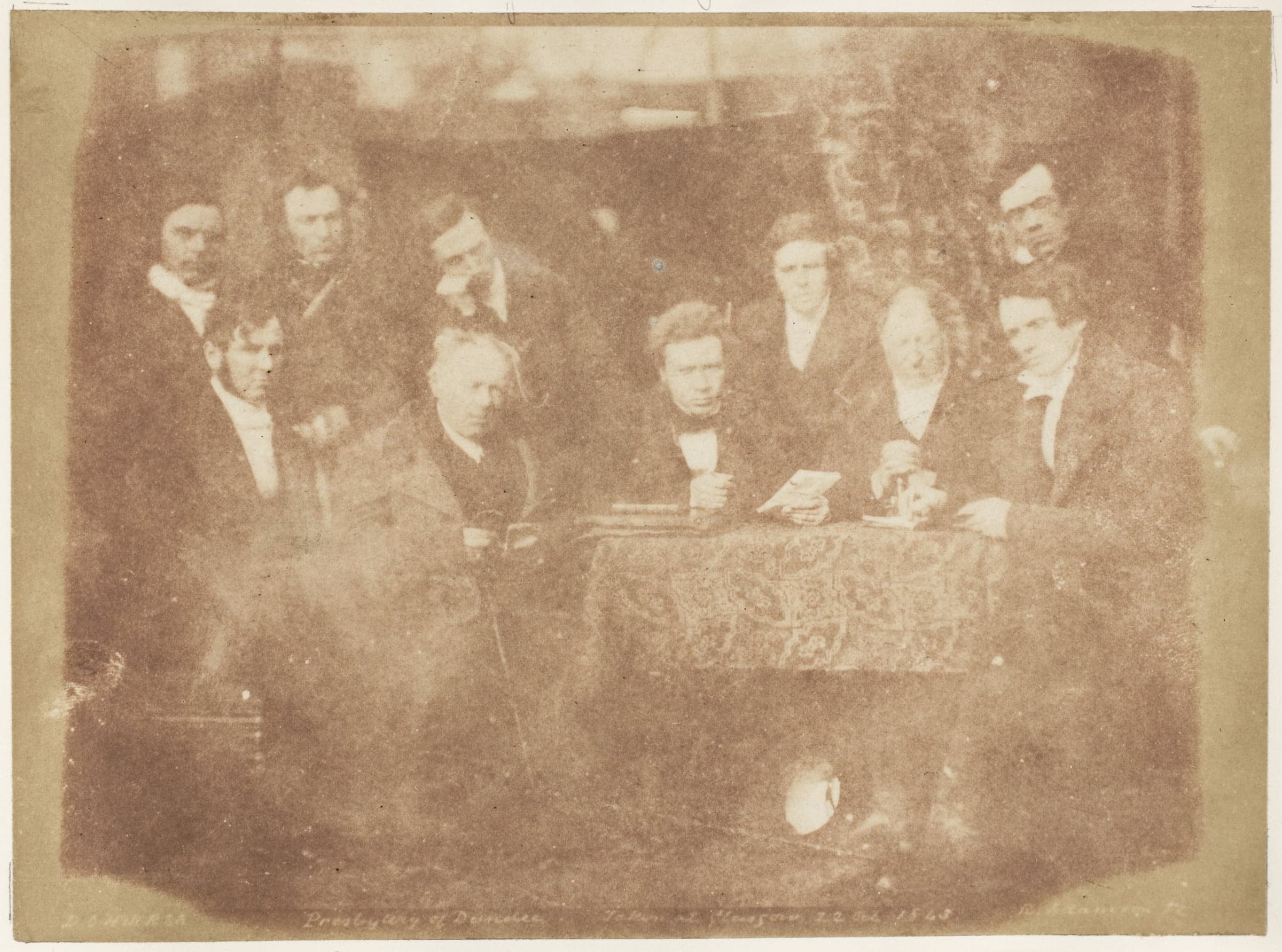
Presbytery of Dundee, David Octavius Hill and Robert Adamson, 1843 to 1847. CC0.
The revival at Kilsyth and Dundee · Story · Featured Study
Kilsyth, 1839
A young preacher's sermon in a Stirlingshire parish began a revival that reached Dundee within a month.
- When
- 21 July 1839 to 26 March 1841
The minister of Kilsyth told his presbytery that his people had been “awakened from a dream of a hundred years.”
Your people shall be willing on Your day of battle. Arrayed in holy splendor, from the womb of the dawn, to You belongs the dew of Your youth.
Summary
William Chalmers Burns, the son of the parish minister, preached at Kilsyth during the summer communion, and the people broke into weeping. He then preached at Robert Murray M'Cheyne's church in Dundee.
- Kilsyth's last revival had come in 1742, under James Robe.
- The crowd at the second communion that summer was put at twelve to fifteen thousand.
- Andrew Bonar's book on M'Cheyne, first printed in 1844, made the Dundee story known.
- Burns sailed for China in 1847, and Hudson Taylor later travelled with him there.
The Texts of the Revival
Four more verses stand beside the Tuesday's text in the record of the revival.
I will give you a new heart and put a new spirit within you; I will remove your heart of stone and give you a heart of flesh. And I will put My Spirit within you and cause you to walk in My statutes and to carefully observe My ordinances.These were the words of John Livingstone's sermon at Shotts in 1630, the revival Burns set before his hearers.
I will enter in the strength of the Lord GOD; I will proclaim Your righteousness—Yours alone.Burns took it for his text in the Market Square on the Thursday after the Tuesday sermon.
The land will mourn, each clan on its own: the clan of the house of David and their wives, the clan of the house of Nathan and their wives,Bonar's memoir likens the Dundee families who mourned apart to these words.
When the people heard this, they were cut to the heart and asked Peter and the other apostles, “Brothers, what shall we do?”M'Cheyne gave the crowd's question as the cry he wished every slumbering congregation would raise.
Zechariah 12:12, Acts 2:37
Who Recorded the Revival
Three of the four records come from the revival's friends, and the fourth from a newspaper.
The family wrote two of the records.
| Record | Its printing | Who wrote it |
|---|---|---|
| The minister's report to his presbytery | His son printed it in The Pastor of Kilsyth in 1860. | The preacher's father wrote it as minister of Kilsyth. |
| The account the preacher wrote of the Tuesday | His brother printed it in a memoir of 1870. | The preacher wrote it himself a year later. |
| M'Cheyne's letters and his answers to the Presbytery of Aberdeen | Bonar printed them from 1844. | M'Cheyne wrote them as minister of St Peter's. |
| The Aberdeen Herald's report of the meetings at Aberdeen | The Aberdeen committee's questions cite it. | A newspaper of Aberdeen printed it. |
From the Communion to the Churchyard
The week ran from the communion Sabbath to a meeting of four thousand among the graves.
The communion was held, as usual, on the third Sabbath of July, the 21st.
On the Tuesday the service was announced for the Market Place. The day was cloudy and rainy, and the crowd was invited into the parish church, which was soon crowded to overflowing.
Acts 2 was read without comment, and Burns preached from Psalm 110:3.
His father wrote that the hearers' feelings broke out as Burns told of a revival two centuries before, on the Monday after a communion.
Burns wrote that some were screaming out in agony, and that some, strong men among them, “fell to the ground as if they had been dead.”
For a time, his father wrote, the preacher's voice could not be heard, and a psalm was sung “tremulously by the precentor.”
The father spoke to the people by way of caution and direction, not encouraging what he called animal excitement.
The meeting closed at three in the afternoon and met again at six.
On the Thursday Burns preached in the Market Square to upwards of three thousand, by his father's estimate.
On the Sabbath of 28 July they met in the churchyard, where the father counted not fewer than four thousand.
Dundee While M'Cheyne Was Away
Dundee was the second town the work reached, as Bonar tells it.
In March M'Cheyne had asked Burns to keep his pulpit at St Peter's while he joined the Church of Scotland's mission of inquiry to the Jews.
Burns returned to Dundee on 8 August, Bonar writes.
At the meeting on the Thursday after his return, about a hundred stayed behind, and in the vestry some fell to the ground weeping and crying for mercy.
Sailing up the Thames on 6 November, M'Cheyne wrote that he had seen the work at Kilsyth “noticed in one of the newspapers.”
He reached Dundee on a Thursday afternoon later that month and preached for above an hour on 1 Corinthians 2:1 to 4.
What the Critics Wrote
The revival's opponents are known only through the friends who answered them.
Islay Burns calls the newspaper accounts that later moved a presbytery's inquiry into the revivals “very unfair and one-sided.”
A friend of the work called an article in Galignani's Messenger “a bitter and sneering caricature.”
Bonar wrote of Dundee that many believers doubted and the ungodly raged.
The Aberdeen Questions
M'Cheyne's written answers give his own counts of the work and his cautions about it.
In December 1840 the Presbytery of Aberdeen appointed a committee to inquire into the revivals, and M'Cheyne dated his answers the next March.
He wrote that not fewer than six or seven hundred people had come to the ministers to talk about their souls.
He counted thirty-nine prayer meetings held each week, and wrote that five of them were “conducted and attended entirely by little children.”
He knew of no more than two converts who had openly given the lie to their profession.
Of the cries and faintings he wrote, “I am far from believing that these signs of deep alarm always issue in conversion.”
How the Key Verse Was Taught
Augustine, Matthew Henry, Charles Spurgeon, and Jamieson, Fausset & Brown each read Psalm 110:3.
Augustine of Hippo (died 430)
Exposition on Psalm 110, on Psalm 110:3
Augustine's psalter read the verse's first line differently, and he asked what it could mean.
“What is this day of His power, when is there beginning with Him, or what beginning, or in what sense is there beginning with Him, since He is the Beginning?”
Patristic
Matthew Henry (1662 to 1714)
Commentary on the Whole Bible
Matthew Henry read the verse as a promise about conversion.
“And there is also a particular power, the power of the Spirit, going along with the power of the word, to the people of Christ, which is effectual to make them willing. The former leaves sinners without matter of excuse; this leaves saints without matter of boasting. Whoever are willing to be Christ's people, it is the free and mighty grace of God that makes them so.”
on Psalm 110:3Puritan
Charles Spurgeon (1834 to 1892)
The New Park Street Pulpit, Sermon No. 74, A Willing People and an Immutable Leader, on Psalm 110:3
Spurgeon began a sermon on the verse by owning that he could not see how its words hang together.
“Never verse in the Scripture has puzzled me more than this to find out its meaning and its connection.”
Particular Baptist
Jamieson, Fausset & Brown (1802 to 1910)
Commentary Critical and Explanatory on the Whole Bible
Jamieson, Fausset & Brown read the verse's last line as a portrait of the King.
“The Messiah, then, as leading His people, is represented as continually in the vigor of youth, refreshed and strengthened by the early dew of God's grace and Spirit. Thus the phrase corresponds as a member of a parallelism with ‘the day of thy power’ in the first clause.”
on Psalm 110:3Reformed
Charles Spurgeon, Jamieson, Fausset & Brown
In Their Own Words
The preacher and the minister of St Peter's left these words in letters, accounts and answers.
Robert Murray M'Cheyne (1813 to 1843)
On W. C. Burns's preaching at St Peter's, in Andrew A. Bonar, Memoir and Remains of the Rev. Robert Murray M'Cheyne, the Memoir, chapter 6
Clear and commanding
“His views of Divine truth are clear and commanding. . . . In private, he is deeply prayerful, and seems to feel his danger of falling into pride.”
Church of Scotland
About this saying1 paragraph
M'Cheyne wrote this to a friend in 1839, a few weeks after he came home to Dundee.
Robert Murray M'Cheyne
Answers to the questions of the Presbytery of Aberdeen, 26 March 1841, in Andrew A. Bonar, Memoir and Remains of the Rev. Robert Murray M'Cheyne, the Remains
A place of weepers
“At that time, there were many seasons of remarkable solemnity, when the house of God literally became ‘a Bochim, a place of weepers.’”
Church of Scotland
About this saying1 paragraph
M'Cheyne recalled here the autumn of 1839 at St Peter's.
William Chalmers Burns (1815 to 1868)
Account of the revival at Kilsyth, written July 1840, in Islay Burns, Memoir of the Rev. Wm. C. Burns, chapter 4
Perfectly calm
“To my own astonishment during the progress of this wonderful scene, when almost all present were overpowered, it pleased the Lord to keep my soul perfectly calm.”
Scottish Presbyterian
About this saying1 paragraph
Burns looked back a year later on the meeting of 1839 in his father's church.
William Chalmers Burns
Words in the sermon at Kilsyth, 23 July 1839, in Islay Burns, Memoir of the Rev. Wm. C. Burns, chapter 4
The cry in the sermon
“No cross, no crown.”
Scottish Presbyterian
About this saying1 paragraph
Burns cried this out as he preached in 1839, by his father's report as well as his brother's.
William Chalmers Burns, William Chalmers Burns
Where Historians Disagree
The friends of the revival and its critics read the same days in two ways.
A work of God or an excitement?2 paragraphs
M'Cheyne in his answers of 1841 and the minister of Kilsyth in his report held it a work of God, like Shotts in 1630 and Cambuslang in 1742.
The revival's enemies at Dundee, as M'Cheyne reports them, put a death down to religious excitement, and Islay Burns, on the friends' side, granted that the dangers of excitement, often exaggerated, “are nevertheless real.”
Who began the work at Dundee?2 paragraphs
Bonar wrote that Burns was “honoured of God to open the flood-gate at Dundee, as well as at Kilsyth.”
M'Cheyne himself dated the work at St Peter's from November 1836 and called it “much more remarkable in the autumn of 1839, when I was abroad.”
Books to Read Next
The Pastor of Kilsyth
Islay Burns · 1860
The son gives his father's sermons from before and during the revival beside the report.
Free at the Internet ArchiveMemoir of the Rev. Wm. C. Burns
Islay Burns · 1870
The brother gives the preacher's letters and journals from his whole ministry.
Free at the Internet ArchiveMemoir and Remains of the Rev. Robert Murray M'Cheyne
Andrew A. Bonar · 1844
Bonar's memoir is the record of M'Cheyne's life and ministry at Dundee.
Free at the Internet ArchiveWhat Kilsyth Left
At Kilsyth the revival left nearly ninety-nine new communicants at the second communion, by the minister's own count.
Sources
Scripture is the Berean Standard Bible.
- The Holy Bible, Berean Standard Bible (read 2026)
- Islay Burns, The Pastor of Kilsyth: Memorials of the Life and Times of the Rev. W. H. Burns (London, Edinburgh and New York: T. Nelson and Sons, 1860), the report of 1839 and the appendix of sermons.
- Islay Burns, Memoir of the Rev. Wm. C. Burns, M.A. (New York: Robert Carter and Brothers, 1870), chapters 4 and 6 and the dates at the end.
- Andrew A. Bonar, Memoir and Remains of the Rev. Robert Murray M'Cheyne (Dundee: William Middleton, 1848; first edition 1844), the Memoir's chapters on 1839 and the answers to the Presbytery of Aberdeen.
- James Robe, Narrative of the Revival of Religion at Kilsyth, Cambuslang and Other Places in 1742, with an introductory essay by Robert Buchanan (Glasgow: William Collins, 1840)
- Dr. and Mrs. Howard Taylor, Hudson Taylor in Early Years: The Growth of a Soul (London and New York, 1911; the New York printing of 1912)
- Augustine of Hippo, Exposition on Psalm 110, on Psalm 110:3.
- Matthew Henry, Commentary on the Whole Bible (1710)
- Charles Spurgeon, The New Park Street Pulpit, Sermon No. 74, A Willing People and an Immutable Leader, on Psalm 110:3 (1856)
- Jamieson, Fausset & Brown, Commentary Critical and Explanatory on the Whole Bible (1871)
Keep Studying
People and groups8
Doctrines1
Subjects1
Church history3