

Genesis 49 · Symbol · Featured Study
The Sceptre
The sceptre of Judah, the gold sceptre of Esther, the royal psalms and Revelation, with the Hebrew words and the readings in dispute.
The Hebrew word for a king's sceptre is also the word for a tribe of Israel.
- The word
- שֵׁבֶט (shebet), H7626
- First appears
- Genesis 49:10 “The scepter will not depart from Judah, nor…”
Peter Paul Rubens, Ahasuerus Holds Out His Golden Sceptre to Esther, 1620. Public domain.
Summary
A sceptre is the rod a ruler holds as the sign of his right to rule. Scripture gives one to Judah in Jacob's blessing, puts a gold one in the hand of the Persian king in Esther, and gives one in the royal psalms to the king God anoints.
- Esther's sceptre has its own Hebrew word, sharbit, which stands only in the book of Esther.
- Revelation gives the iron sceptre of Psalm 2:9 to Jesus and promises a share in it to the one who overcomes.
- Readers divide over whether Psalm 45:6 calls the king God or calls a human ruler a judge.
The Sceptre Will Not Depart
Genesis and Numbers hold the two promises of a sceptre in the five books of Moses.
Genesis and Numbers each give one promise of a sceptre, and both use the Hebrew word shebet. Jacob speaks the first as he blesses his twelve sons before his death, and he gives Judah rule over his brothers. Balaam speaks the second from the top of Peor, where Balak, the king of Moab, had taken him to curse Israel. Both oracles look ahead to a ruler who had not yet come.
The scepter will not depart from Judah, nor the staff from between his feet, until Shiloh comes and the allegiance of the nations is his.The promise holds until Shiloh comes, and the meaning of that name is disputed.
I see him, but not now; I behold him, but not near. A star will come forth from Jacob, and a scepter will arise from Israel. He will crush the skulls of Moab and strike down all the sons of Sheth.Balaam names the coming ruler by two signs of royalty.
The Gold Sceptre Held Out
Rubens sets Esther 4:11 to 5:2 in one hall of the Persian palace.
Rubens sets the throne high above the stair, so that the king leans down toward the queen.
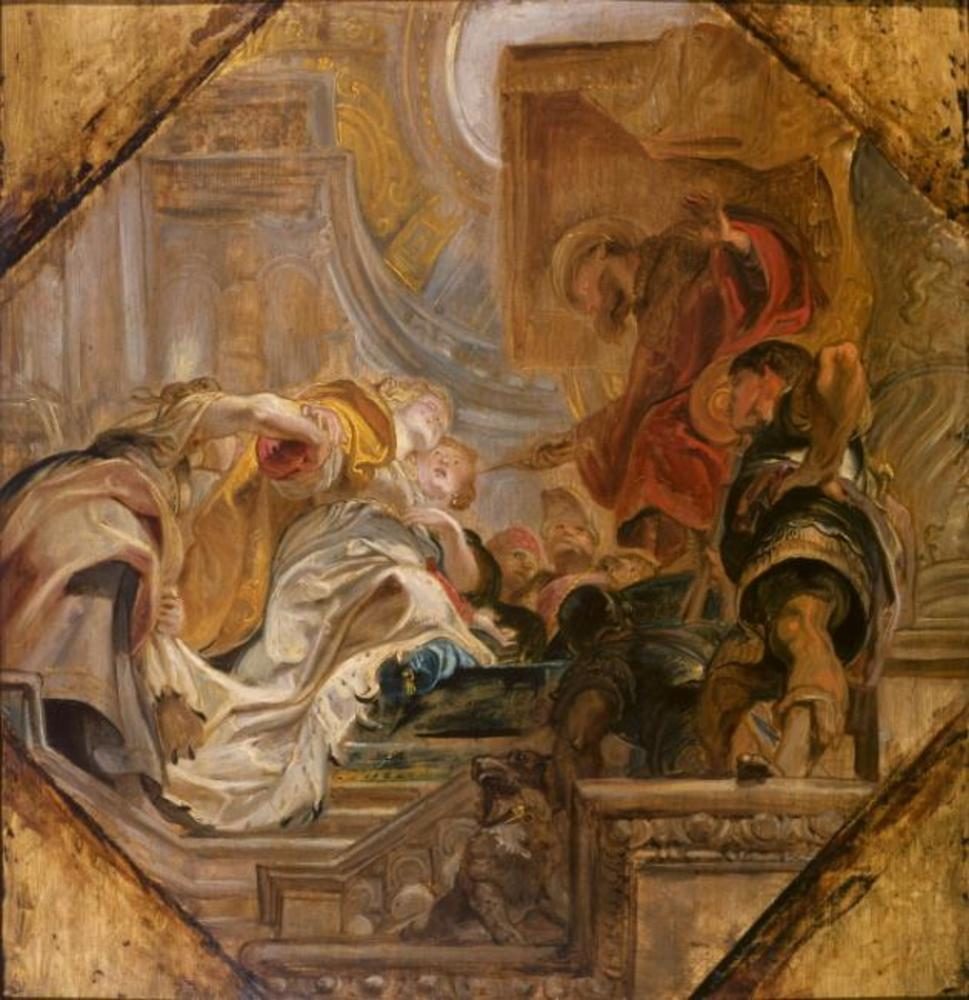
- The kingAhasuerus leans forward from his high seat in a red robe.Esther 5:1
- The gold sceptreA thin gold rod runs from the king's hand toward the queen.Esther 5:2
- EstherThe queen in white and gold leans back with her face lifted.Esther 4:16
- The maidsThe queen's two maids hold her up from behind.Esther 4:16
- The guardAn armoured man stands on the stair beneath the throne.Esther 4:11
- The palaceColumns and a great arch rise behind the figures.Esther 5:1
Peter Paul Rubens, Ahasuerus Holds Out His Golden Sceptre to Esther, 1620. Public domain.
Six parts of the painting, each numbered where it stands, with the verse it answers to.
Sceptres Through Scripture
Eight scenes from Genesis to Hebrews, each with the one who holds the sceptre.
From Jacob's blessing to Hebrews, the sceptre passes to the one God appoints to rule.
| Scene | Who holds the sceptre | What the text says of it |
|---|---|---|
| Jacob's blessing | Judah | It will not depart until Shiloh comes. |
| Balaam's oracle | a ruler rising from Israel | He will crush the skulls of Moab. |
| The Persian court | King Ahasuerus | It is held out to Esther, and she touches its tip. |
| The love song of Psalm 45 | the king the psalm calls God | Justice is the sceptre of his kingdom. |
| The LORD's anointed | the Son of Psalm 2 | An iron sceptre breaks the nations. |
| Zion | the king at the LORD's right hand | The LORD extends it from Zion. |
| Ezekiel's lament | the vine of Judah | No branch is left fit for a ruler's sceptre. |
| The letter to the Hebrews | the Son | The psalm's throne and sceptre belong to Him. |
Ezekiel's lament, The letter to the Hebrews
What the Sceptre Signifies
Three things the texts say a sceptre stands for, each with its verse.
THE RIGHT TO RULE
Jacob says that his brothers will bow down to Judah.
LIFE AT THE KING'S WORD
In the Persian court a person who came unsummoned lived only if the king held out the sceptre.
POWER THE LORD CAN BREAK
Isaiah counts the sceptre of Babylon's rulers among the things the LORD has broken, and Zechariah foresees the sceptre of Egypt departing.
The iron sceptre and the shepherd's rodPsalm 2:9; Psalm 23:4; Revelation 19:15
In Revelation 19:15 the Greek verb that the Berean text renders as rule means to tend a flock, as Jamieson, Fausset and Brown note. They add that the verse uses it in the sense of punishment.
Even though I walk through the valley of the shadow of death, I will fear no evil, for You are with me; Your rod and Your staff, they comfort me.Here the shebet of Psalm 2:9 is a shepherd's rod, the sense the Greek verb of Revelation 19:15 also carries.
Shebet, Sharbit and Rhabdos
The three words the Berean text renders as sceptre, counted across the canon.
Shebet, the word of Jacob's blessing, is the common word for the sceptre, and the other two are rare.
The three counts as a table
| Word | Uses |
|---|---|
| shebet, rod, sceptre and tribe, H7626 | 190 |
| rhabdos, rod and sceptre, G4464 | 12 |
| sharbit, sceptre, H8275 | 4 |
Uses of each word in the canon, from James Strong's Exhaustive Concordance.
Shebet as a tribe in Genesis 49Genesis 49:16 and 28
Dan shall provide justice for his people as one of the tribes of Israel.Here the word that named Judah's sceptre names one of the tribes of Israel.
These are the tribes of Israel, twelve in all, and this was what their father said to them. He blessed them, and he blessed each one with a suitable blessing.The blessing closes by counting the sons as twelve tribes with the same word.
What the Texts Leave Open
Three questions about the sceptre that Scripture does not answer.
Scripture names who holds the sceptre and leaves its form and some of its history unstated.
| The question | What the verse does say |
|---|---|
| What was Judah's sceptre made of? | Genesis names a sceptre and a staff between his feet and describes neither. |
| Why had Ahasuerus not summoned Esther for thirty days? | Esther says only that she has not been summoned for the past thirty days. |
| What was the length of the gold sceptre? | Esther names its metal and says the king held it in his hand. |
The Sceptre Given to the Son
Three chapters of Revelation take up the iron sceptre of the second psalm.
Hebrews 1 builds its case that the Son is greater than the angels on a chain of psalms that includes Psalm 45:6. In this way the sceptre of the royal psalms passes to Jesus.
And she gave birth to a son, a male child, who will rule all the nations with an iron scepter. And her child was caught up to God and to His throne.The vision gives the iron sceptre to the child born to the woman.
And from His mouth proceeds a sharp sword with which to strike down the nations, and He will rule them with an iron scepter. He treads the winepress of the fury of the wrath of God the Almighty.The third quotation comes in the vision of the rider called Faithful and True.
He will rule them with an iron scepter and shatter them like pottery—just as I have received authority from My Father.Jesus promises the one who overcomes at Thyatira the authority His Father gave Him.
Voices on the Sceptre
Three teachers from the ninth century to the eighteenth, each with the work named.
died 856 · Rabanus Maurus
“The supreme king holds out his golden scepter toward the queen as she pleads with him, because he is lavishing on her the mercy of his righteousness.”
Rabanus Maurus · Commentary on Esther · on Esther 8:4Patristic
1662 to 1714 · Matthew Henry
“It is not thus in the court of the King of kings; to the footstool of his throne of grace we may at any time come boldly, and may be sure of an answer of peace to the prayer of faith. We are welcome, not only into the inner court, but even into the holiest, through the blood of Jesus.”
Matthew Henry · Commentary on the Whole Bible · on Esther 4:11Puritan
1703 to 1791 · John Wesley
“This was in part fulfilled, when the Jews who persisted in unbelief, were destroyed by the Roman power: And in the destruction of the Pagan power, when the Christian religion came to be established. But it will not be compleatly fulfilled, 'till all opposing power and principality be put down.”
John Wesley · Explanatory Notes upon the Old Testament · on Psalm 2:9Evangelical
Whom Psalm 45:6 Addresses
The verse Hebrews quotes is read as an address to the king as God or to a ruler called a judge.
The king addressed as GodHebrews 1:8; Irenaeus; Albert Barnes
Hebrews 1:8 introduces the verse with the words but about the Son He says, so that God speaks it to the Son. Albert Barnes, in his Notes on the Psalms, holds that the psalm addresses the king as one to whom the name God may properly be applied, and that its use in Hebrews proves Christ divine.
“‘Thy throne, O God, is for ever and ever; the sceptre of Thy kingdom is a right sceptre. Thou hast loved righteousness, and hated iniquity: therefore God, Thy God, hath anointed Thee.’ For the Spirit designates both [of them] by the name of God-both Him who is anointed as Son, and Him who does anoint, that is, the Father.”
Irenaeus · Against Heresies 3:6.1 · on Psalm 45:7Patristic
The objection rests on Psalm 45:7, where God, the king's God, anoints him above his companions, which sets the one addressed under God.
A ruler called a judgeRashi, on the verse numbered 45:7 in the Hebrew Bible
Rashi reads the Hebrew elohim of this verse as judge and prince, as in Exodus 7:1, where the LORD makes Moses like God to Pharaoh. On his reading the sceptre of justice shows that the king's judgments are true and that he is fit to govern.
The objection: Hebrews 1:8 quotes the verse as spoken about the Son, and the throne it names endures forever and ever.
Books to Read Next
Three works a student reads next, each free to read.
The Treasury of David
Charles Spurgeon · 1869 to 1885
His volumes on Psalms 2, 45 and 110 read each royal psalm verse by verse.
Read his notes on the PsalmsNotes, Explanatory and Practical
Albert Barnes · 1832 to 1869
His notes on Psalm 45 send the reader to his longer notes on Hebrews 1:8.
Read Barnes on the PsalmsCommentary on the Whole Bible
Matthew Henry · 1708 to 1710
His notes on Esther 4 and 5 follow the queen into the inner court.
Read his Esther notesThe Son's Sceptre
The last verse of Psalm 2 tells the rulers of the earth how to stand before the King.
Kiss the Son, lest He be angry and you perish in your rebellion, when His wrath ignites in an instant. Blessed are all who take refuge in Him.The charge to the kings closes the psalm that gave the iron sceptre.
Sources
Scripture is the Berean Standard Bible.
- James Strong, Exhaustive Concordance of the Bible, 1890, entries H7626, H8275 and G4464, with their occurrence counts and their uses by verse.
- Rashi on Psalms 45:7, The Judaica Press complete Tanach with Rashi, translated by A. J. Rosenberg (CC-BY), via Sefaria.
- Albert Barnes, Notes, Explanatory and Practical, on Psalm 45:6.
- Albert Barnes, Notes, Explanatory and Practical, on Numbers 24:17.
- Jamieson, Fausset and Brown, Commentary Critical and Explanatory, 1871, on Revelation 19:15.
- Irenaeus, Against Heresies 3.6.1, on Psalm 45:6 to 7.
- Rabanus Maurus, Commentary on Esther, on Esther 8:4.
- Matthew Henry, Commentary on the Whole Bible, 1710, on Esther 4:11.
- Charles Spurgeon, The Treasury of David, volume 5, on Psalm 110:2.
- John Wesley, Explanatory Notes upon the Old Testament, 1765, on Psalm 2:9.
Keep Studying
Studies4
People and groups5
Doctrines2