

Stefan Lochner, The Last Judgement, about 1435. Public domain.
Genesis 18:25 · Symbol · Featured Study
The Judge
A symbol study of the title from Genesis 18 to Revelation 20, with the Hebrew and Greek words and two readings in dispute.
Abraham pleaded with the Judge of all the earth for a city, from fifty righteous people down to ten.
Abraham stepped forward and said, “Will You really sweep away the righteous with the wicked?
- The word
- שֹׁפֵט (shophet), H8199
- First appears
- Genesis 18:25 “…from You! Will not the Judge of all…”
Abraham pleaded with the Judge of all the earth for a city, from fifty righteous people down to ten.
Summary
Scripture calls God the Judge, the one who hears a case, decides it and puts the wrong right.
- The Hebrew title is shophet, from a verb used 202 times in the Old Testament.
- Moses sat to judge the people in Exodus 18:13, and Jethro told him to set judges under him.
- Paul tells Athens in Acts 17:31 that God has set a day, and that raising Jesus from the dead is the proof.
The Judge of All the Earth
Genesis 18:23 and Genesis 16:5, Abraham's plea for Sodom and Sarai's complaint against Abram.
Abraham stepped forward and said, “Will You really sweep away the righteous with the wicked?Abraham's first question opens the plea that ends with the title Judge of all the earth.
Then Sarai said to Abram, “May the wrong done to me be upon you! I delivered my servant into your arms, and ever since she saw that she was pregnant, she has treated me with contempt. May the LORD judge between you and me.”Sarai's words are the first time Genesis asks the LORD to judge between two people.
Then Sarai said to Abram, “May the wrong done to me be upon you! I delivered my servant into your arms, and ever since she saw that she was pregnant, she has treated me with contempt. May the LORD judge between you and me.”Sarai's words are the first time Genesis asks the LORD to judge between two people.
Genesis has no judges and no courts, and still seven speakers in its pages use the words of judging.
Each of the seven turns on a wrong to be put right.
| Verse | Who speaks | What is asked or promised |
|---|---|---|
| Genesis 15:14 | The LORD to Abram | God will judge the nation that enslaves Abram's offspring. |
| Genesis 16:5 | Sarai to Abram | The LORD is asked to judge between husband and wife. |
| Genesis 18:25 | Abraham to the LORD | Abraham pleads that the righteous not be swept away with the wicked. |
| Genesis 19:9 | The men of Sodom | They mocked Lot, a foreigner, for acting like a judge. |
| Genesis 30:6 | Rachel | She names her son Dan because God has vindicated her. |
| Genesis 31:53 | Laban to Jacob | The God of Abraham and of Nahor is asked to judge between them. |
| Genesis 49:16 | Jacob over Dan | Dan will provide justice for his people as one of the tribes. |
The Judge on the Rainbow
The panel in Cologne, read part by part with the verse each part answers to.
Lochner set the Judge on a rainbow above the dead, with the saved led away at His right hand and the condemned at His left.
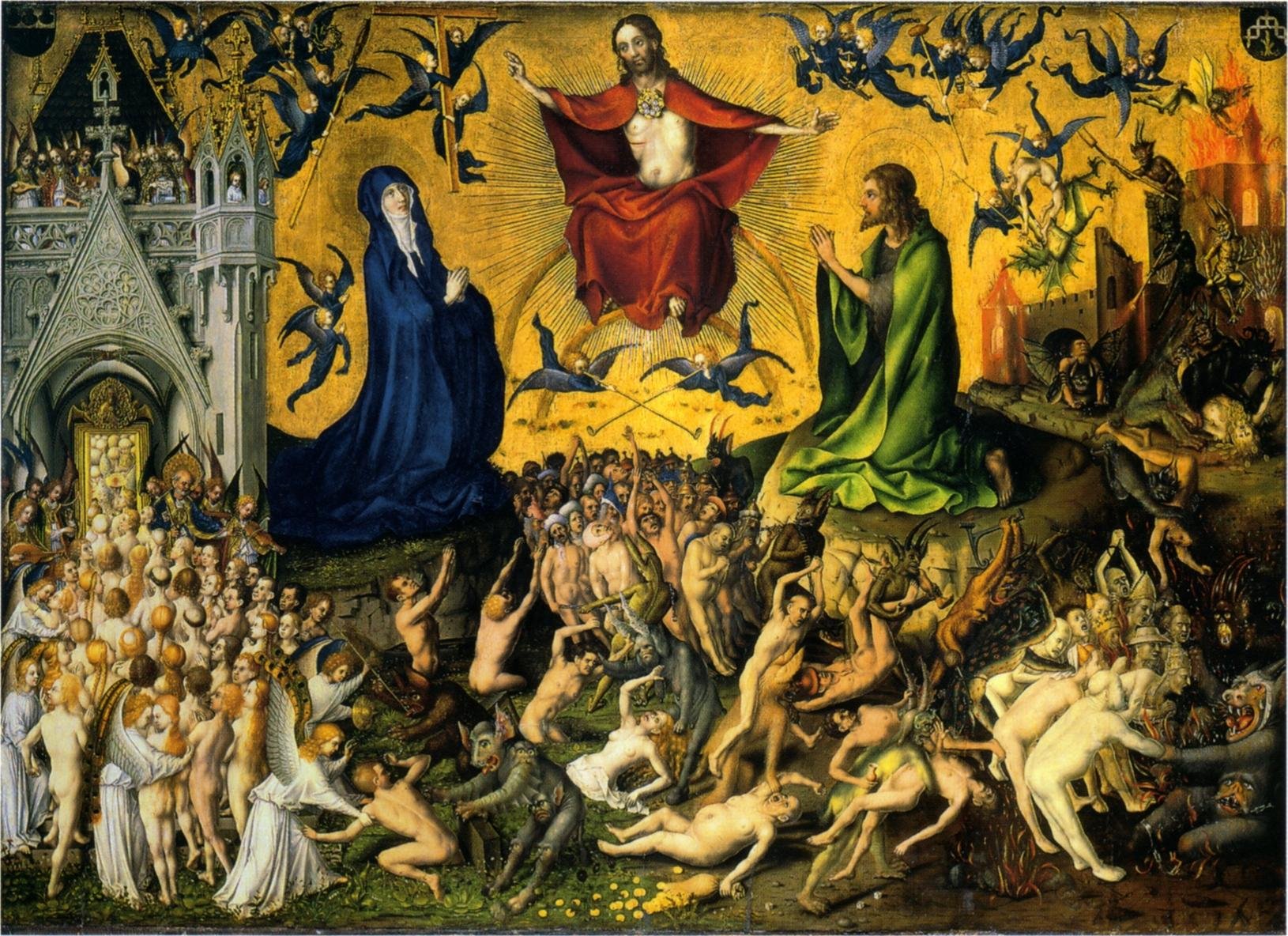
- The JudgeChrist sits in a red cloak with both hands raised and the wounds in them showing.John 5:22
- The rainbowA rainbow arches beneath Him against the gold sky.Revelation 4:3
- The trumpetsTwo angels under the throne sound long trumpets over the earth.Matthew 24:31
- The dead raisedThe dead have risen from the ground and fill the middle of the picture.John 5:28 to 29
- The gate of the blessedAngels lead the saved at the Judge's right hand into a Gothic gate.Matthew 25:34
- The fireDemons drive the condemned at His left toward a burning city.Matthew 25:41
Stefan Lochner, The Last Judgement, about 1435. Public domain.
Oil on oak, about 1435, Wallraf-Richartz-Museum, Cologne.
The Judge Through Scripture
Twelve places in canon order, from Abraham's plea to the open books of Revelation 20.
The title Abraham used in Genesis 18 is given in the end to the Man God appointed.
- GenesisThe Judge of all the earth, Genesis 18:25
- ExodusMoses takes his seat to judge, Exodus 18:13
- DeuteronomyJudgment belongs to God, Deuteronomy 1:17
- Judges 2The LORD raises up judges, Judges 2:16
- Judges 11The LORD, the Judge, decides, Judges 11:27
- 1 SamuelA king to judge us, 1 Samuel 8:5
- PsalmsGod brings down one and exalts another, Psalm 75:7
- IsaiahOur Judge, lawgiver and King, Isaiah 33:22
- JohnJesus answers His accusers, John 5:22
- ActsA day and a Man appointed, Acts 17:31
- JamesThe Judge at the door, James 5:9
- RevelationThe dead judged by the books, Revelation 20:12
Each stop opens its verse in the reader.
The courts Moses set up in Exodus 18Exodus 18:21 to 22 and Deuteronomy 1:17
Furthermore, select capable men from among the people—God-fearing, trustworthy men who are averse to dishonest gain. Appoint them over the people as leaders of thousands, of hundreds, of fifties, and of tens. Have these men judge the people at all times. Then they can bring you any major issue, but all minor cases they can judge on their own, so that your load may be lightened as they share it with you.The plan answers Jethro's warning that Moses would wear himself out judging alone.
Show no partiality in judging; hear both small and great alike. Do not be intimidated by anyone, for judgment belongs to God. And bring to me any case too difficult for you, and I will hear it.”The verse gives the reason a judge in Israel could face the powerful without fear.
Said Outright, and Heard by Readers
Three verses that state who the Judge is, and two readings often heard.
A RIGHTEOUS JUDGE
The psalmist joins God's righteousness to the indignation He feels each day.
JUDGE, LAWGIVER AND KING
Isaiah names three offices of the LORD and ends with salvation.
ONE LAWGIVER AND JUDGE
James uses the title to stop believers judging a neighbor.
Two verses on judging, set beside their contextMatthew 7:1 and John 8:15
Two verses are often read as a ban on all judging, and their context reads otherwise.
| Verse | The reading | What the text says |
|---|---|---|
| Matthew 7:1 | A disciple may never assess another person's conduct. | Matthew 7:5 tells the hearer to take the beam out of his own eye and then see clearly to help his brother, and John 7:24 commands judging justly. |
| John 8:15 | Jesus judges no one, so there is no judgment to come. | Jesus speaks in John 5:28 to 29 of the hour when all who are in their graves will come out, some to a resurrection of judgment. |
Judges in Israel
The judge in the town gate and the judge raised up to save.
Deuteronomy 16:18 orders judges and officials in every town, and Ruth 4:1 shows the town gate where a case was heard. The judges of the book of Judges did more than hear cases. Judges 2:16 says the LORD raised them up to save Israel from those who plundered it, so the Hebrew title carried rescue as well as verdict.
And she would sit under the Palm of Deborah between Ramah and Bethel in the hill country of Ephraim, where the Israelites would go up to her for judgment.The verse shows a judge at work in one fixed seat, where the people came to her.
I have not sinned against you, but you have done me wrong by waging war against me. May the LORD, the Judge, decide today between the Israelites and the Ammonites.”Jephthah hands the quarrel with Ammon to the LORD as Judge before he fights.
Shaphat, Mishpat and Krites
The Hebrew verb and noun of judging and the Greek words for judge and to judge, with their counts.
James Strong's concordance gives the Hebrew verb a range that runs from pronouncing sentence to vindicating, punishing and governing. Its participle names God in Genesis 18:25 and, in the plural shophetim, the judges the LORD raised up in Judges 2:16. The Greek noun for a judge is used of God in Hebrews 12:23, the Judge of all, and of the Lord in James 5:9, where the Judge is standing at the door.
shaphat
to judge, to vindicate or punish, to govern
mishpat
a verdict, a sentence, justice
krino
to judge, to try, to condemn
krites
a judge
The lexicon in full1 table or figure
The noun mishpat is more than twice as common as the verb it comes from.
| Word | Meaning | Uses |
|---|---|---|
| shaphat, H8199 | to judge, to vindicate or punish, to govern | 202 |
| mishpat, H4941 | a verdict, a sentence, justice | 422 |
| krino, G2919 | to judge, to try, to condemn | 114 |
| krites, G2923 | a judge | 19 |
What Scripture Does Not Say
Three things about the Judge that the text leaves open.
Genesis 18 never says how many righteous people Sodom held. Revelation 20:12 says the dead were judged according to their deeds, as recorded in the open books, and it describes no court beyond the throne and the books. Lochner sets Mary and John the Baptist on their knees beside the Judge as intercessors, and no verse of Scripture places them there.
The Man God Appointed
John 5:22 and Acts 17:31, the Son and the Man God appointed.
Furthermore, the Father judges no one, but has assigned all judgment to the Son,Jesus says this after healing on the Sabbath, when He is accused of making Himself equal with God.
For He has set a day when He will judge the world with justice by the Man He has appointed. He has given proof of this to everyone by raising Him from the dead.”Paul ends his speech to the council of the Areopagus with the day of judgment.
“But there is fear that the judge may be more severe. Consider who the judge is. Indeed, the Father has given all judgment to Christ. Therefore, can that very one condemn you, whom he redeemed from death, for whom he offered himself, and whose life he knows to be the reward of his own death?”
Ambrose of Milan · On Jacob and the Blessed Life 1.6.26 · on John 5:22Patristic
The Judge of the living and the deadActs 10:42 and Polycarp of Smyrna
And He commanded us to preach to the people and to testify that He is the One appointed by God to judge the living and the dead.Peter says this in the house of a Roman centurion, so the first Gentile hearers learned of the Judge.
“‘Wherefore, girding up your loins,’ ‘serve the Lord in fear’ and truth, as those who have forsaken the vain, empty talk and error of the multitude, and ‘believed in Him who raised up our Lord Jesus Christ from the dead, and gave Him glory,’ and a throne at His right hand. To Him all things in heaven and on earth are subject. Him every spirit serves. He comes as the Judge of the living and the dead. His blood will God require of those who do not believe in Him.”
Polycarp of Smyrna · Epistle to the Philippians 2 · on Acts 17:31Patristic
Voices on the Judge
Five teachers from the early church to the nineteenth century on God as Judge.
died 220 · Tertullian
Tertullian, in Against Praxeas, holds that the Son has administered judgment from the beginning, throwing down the tower of Babel, punishing the world by the flood and raining fire on Sodom and Gomorrah.
died 373 · Ephrem the Syrian
Ephrem the Syrian, in his Commentary on Genesis, reasons from Genesis 49:16 that if one from Dan judges his people, the one from Judah to whom the kingdom belongs will judge all the nations.
1662 to 1714 · Matthew Henry
Matthew Henry, in his Commentary on the Whole Bible, on Genesis 18:25, holds that the righteous God will not destroy the righteous with the wicked, though they live mingled together in this world.
1703 to 1791 · John Wesley
John Wesley, in his Explanatory Notes upon the Old Testament, on Genesis 15:14, writes that the punishing of persecutors is the judging of them, a righteous act of God for His people.
1834 to 1892 · Charles Spurgeon
Charles Spurgeon, in The Treasury of David, on Psalm 75:7, writes that God is judging even now, that His seat is not vacant and that empires rise and fall at His bidding.
Matthew Henry, John Wesley, Charles Spurgeon
Where Careful Readers Differ
Two questions about the Judge that readers answer in different ways.
Who sits on the great white throneAdam Clarke; Jamieson, Fausset and Brown; John Wesley
Adam Clarke, in his Commentary on the Bible, on Revelation 20:11, calls the One seated there the indescribable Jehovah, before whose face the universe dissolves. The objection is that Revelation 20:12 sets the dead before the throne as Matthew 25:31 to 32 sets the nations before the Son of Man.
Jamieson, Fausset and Brown, in their Commentary Critical and Explanatory, read the One seated as the Son, in whom the Father is represented. John Wesley, in his Explanatory Notes upon the New Testament, names Him Jesus Christ. The objection is that Revelation 20 names no Lamb at the throne, where Revelation 22:1 names God and the Lamb together.
The judge from the tribe of DanMatthew Henry, John Wesley and Ambrose of Milan
Dan shall provide justice for his people as one of the tribes of Israel. He will be a snake by the road, a viper in the path that bites the horse’s heels so that its rider tumbles backward.The blessing of Dan joins justice for his people with danger on the road.
Matthew Henry, in his Commentary on the Whole Bible, reads the promise of the tribe as a whole, which would have judges of its own though Dan was a son of a servant. John Wesley, in his Explanatory Notes upon the Old Testament, reads it the same way. The objection is that the reading leaves Genesis 49:17 unexplained.
Ambrose of Milan, in On the Blessings of the Patriarchs, takes the simple meaning to be Samson, a judge from Dan. He reads the prophecy itself of the Antichrist, a fierce judge who will come from the same tribe. The objection is that no verse of Scripture names Dan as the Antichrist's tribe.
Books to Read Next
Two public domain works, each with a free copy to read.
Expositions on the Psalms
Augustine of Hippo · before 430
His exposition of Psalm 75 reads the Judge who brings down one and exalts another through the Pharisee and the tax collector of Luke 18.
Read at New AdventThe Treasury of David
Charles Spurgeon · 1874
His notes on Psalm 96:13 read the Lord's coming to judge the earth as a cause for present rejoicing.
Read at CCELThe Judge Will Do Right
Paul ended his last letter waiting for the Judge, sure of the crown He would give.
From now on there is laid up for me the crown of righteousness, which the Lord, the righteous Judge, will award to me on that day—and not only to me, but to all who crave His appearing.The text asks the reader to long for His appearing, as Paul did.
Sources
Scripture is the Berean Standard Bible.
- James Strong, Exhaustive Concordance of the Bible, 1890, entries H8199, H4941, G2919 and G2923.
- Tertullian, Against Praxeas 16, on John 5:22.
- Matthew Henry, Commentary on the Whole Bible, 1710, on Genesis 15:14; on Genesis 18:25; on Genesis 49:16.
- Charles Spurgeon, The Treasury of David, on Psalm 96:13; on Psalm 75:7.
- Ephrem the Syrian, Commentary on Genesis 43.6, on Genesis 49:16.
- Augustine of Hippo, Exposition on Psalm 75, on Psalm 75:7.
- John Wesley, Explanatory Notes upon the Old Testament, 1765, on Genesis 15:14; on Genesis 49:16.
- Ambrose of Milan, On Jacob and the Blessed Life 1.6.26, on John 5:22.
- Polycarp of Smyrna, Epistle to the Philippians 2.
- Adam Clarke, Commentary on the Bible, 1832, on Revelation 20:11.
- Jamieson, Fausset and Brown, Commentary Critical and Explanatory on the Whole Bible, 1871, on Revelation 20:11.
- John Wesley, Explanatory Notes upon the New Testament, 1755, on Revelation 20:11.
- Ambrose of Milan, On the Blessings of the Patriarchs, on Genesis 49:16.
Keep Studying
Studies5
People and groups7