
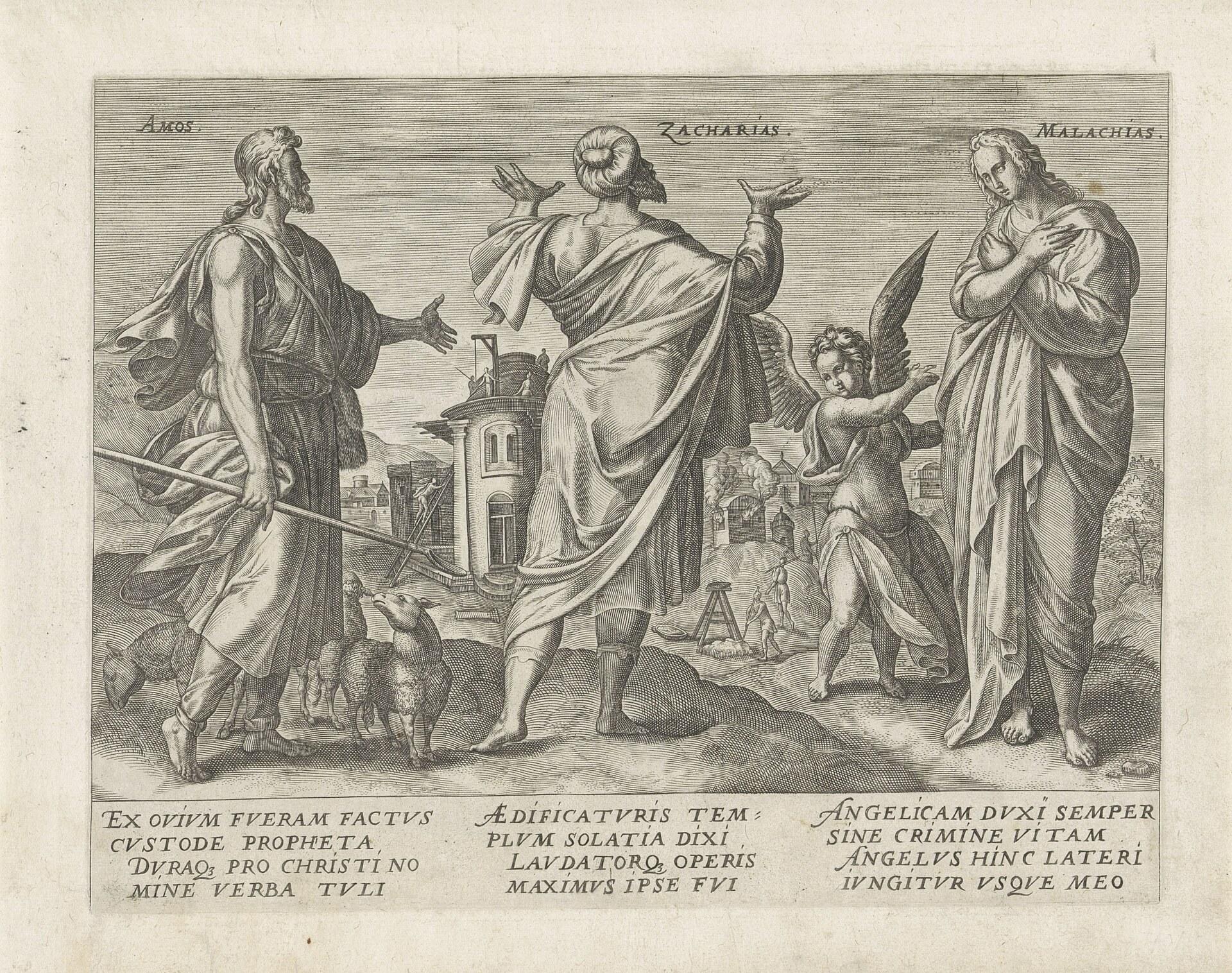
The prophets Amos, Zechariah and Malachi, 1579. CC0.
Amos 7:7 and Amos 7:8 · Symbol · Featured Study
The Plumb Line
Amos saw the plumb line in the third of his five visions, beside a wall built true.
“Amos, what do you see?” asked the LORD. “A plumb line,” I replied. “Behold,” said the Lord, “I am setting a plumb line among My people Israel; I will no longer spare them:
- The word
- אֲנָךְ (anak), H594
- First appears
- Amos 7:7 “…by a wall true to plumb, with a…”
A builder's cord with a lead weight became the sign that God would judge His people by His own measure.
Summary
A plumb line is a cord with a weight on its end. It hangs straight down, so a builder can see if a wall is upright. Amos saw one in the hand of the Lord.
- Amos was a herdsman whom the LORD sent to preach at the king's shrine at Bethel.
- After two visions Amos begged for Jacob, and the LORD relented.
- Kings and Isaiah use the same pair of tools for judgment on a city.
- Zechariah 4:10 puts a plumb line in the hand of Zerubbabel, who was rebuilding the temple.
A Cord and a Weight
The Hebrew word for the plumb line, anak, stands only in Amos 7:7 and Amos 7:8.
This is what He showed me: Behold, the Lord was standing by a wall true to plumb, with a plumb line in His hand.The vision opens on the tool before any word is spoken.
Strong's lexicon, the numbered index of the Bible's Hebrew and Greek words, gives its sense as a plumb line.
Albert Barnes, in his Notes on Isaiah 28:17, describes the tool: a piece of lead tied to a string, which a carpenter uses to find a line that is perpendicular.
The Parts of a Plumb Line
Amos names the hand, the line and the wall, and a builder's line hangs from a lead weight.
The cord shows any lean in the wall it hangs beside.
2 cubits, about 90 cm (3 feet)
Amos gives no measures; the drawing shows a wall seven cubits high and the cord hung beside its face.
A plumb line held beside a wall, with its four parts numbered.
The Third of Five Visions
The five visions run from locusts and fire to a basket of fruit and the Lord at the altar.
The LORD's answers change after the second vision.
- Swarms of locustsLord GOD, please forgive!It will not happen.Amos 7:1 to 3
- Judgment by fireLord GOD, please stop!It will not happen either.Amos 7:4 to 6
- A plumb lineA plumb line.The high places of Isaac will be deserted.Amos 7:7 to 9
- A basket of summer fruitA basket of summer fruit.The end has come for My people Israel.Amos 8:1 to 3
- The Lord beside the altarAmos records no words of his own.None of the fugitives will escape.Amos 9:1
The five visions of Amos 7 to 9, each with what Amos said and the LORD's answer, in the Berean words where Amos records them.
Jamieson, Fausset and Brown note that builders used the line to pull a house down as well as to build one. They read the line set in the midst of Israel as judgment that would reach the centre of the nation.
The next verses tell how Amaziah, the priest of Bethel, sent Amos away, and how Amos answered him.
“I was not a prophet,” Amos replied, “nor was I the son of a prophet; rather, I was a herdsman and a tender of sycamore-fig trees. But the LORD took me from following the flock and said to me, ‘Go, prophesy to My people Israel.’The herdsman explains why he speaks at the king's sanctuary.
The Line Over a City
The prophets speak of a measuring line and a plumb line stretched over Jerusalem, Edom and Israel.
Five verses put the line in the LORD's hand, one leaves the hand unnamed, and one gives it to Zerubbabel.
| What it measures | Who holds the line | Verse |
|---|---|---|
| Jerusalem, by the line used against Samaria | The LORD | 2 Kings 21:13 |
| Justice as the measuring line and righteousness as the level | The LORD | Isaiah 28:17 |
| Edom, with a line of chaos and a plumb line of destruction | The LORD | Isaiah 34:11 |
| The wall of the Daughter of Zion | The LORD | Lamentations 2:8 |
| His people Israel | The Lord | Amos 7:8 |
| Jerusalem, where His house will be rebuilt | Unnamed, in a promise of the LORD | Zechariah 1:16 |
| The house whose foundation he laid | Zerubbabel | Zechariah 4:10 |
The LORD determined to destroy the wall of the Daughter of Zion. He stretched out a measuring line and did not withdraw His hand from destroying. He made the ramparts and walls lament; together they waste away.The poet looks back on a judgment already carried out.
Matthew Henry explained why Kings names Samaria and the house of Ahab beside Jerusalem.
“When God lays righteousness to the line it shall be the line of Samaria, measuring out to Jerusalem that which had been the lot of Samaria; when he lays judgment to the plummet it shall be the plummet of the house of Ahab, marking out for the same ruin to which that wretched family was devoted.”
Matthew Henry · Commentary on the Whole Bible · on 2 Kings 21:13Puritan
A Plumb Line or a Trowel
Readers have rendered the word anak in two ways since the fifth century.
A mason's trowelJerome, Commentary on Amos
Jerome rendered the vision as the Lord standing on a wall of stones with a mason's trowel in His hand. His commentary on Amos 7:7 to 9 follows that reading.
A plumb lineAlbert Barnes, Notes; Adam Clarke, Commentary on the Bible
Albert Barnes rendered the words of Amos 7:7 as a wall of a plumb line, a wall made straight by the line. Adam Clarke took the plumb line as an emblem of strict justice.
The Plumb Line in Zerubbabel's Hand
After the exile the prophet promised that Zerubbabel's hands would finish the house they began.
“The hands of Zerubbabel have laid the foundation of this house, and his hands will complete it. Then you will know that the LORD of Hosts has sent me to you. For who has despised the day of small things? But these seven eyes of the LORD, which scan the whole earth, will rejoice when they see the plumb line in the hand of Zerubbabel.”A builder's tool marks the work God promises to finish.
The Hebrew of Zechariah 4:10 uses other words than anak, and the Berean text renders them as plumb line.
A Sermon on the Plumb Line
A sermon of the Metropolitan Tabernacle Pulpit draws a rule for teachers from the herdsman's vision.
Charles Spurgeon (1834 to 1892)
Charles Spurgeon tied the plainness of the vision to the trade of the man who saw it.
“GOD usually speaks by men according to their natural capacity. Amos was a herdsman. He was not a man of noble and priestly rank, like Ezekiel, nor a man of gigantic intellect and mighty eloquence, like Isaiah. He was a simple herdsman and, therefore, God did not cause him to see the visions of Isaiah, or dazzle his mind with the wondrous revelations that were given to Ezekiel. God's rule is, ‘Every man in his own order’ and if we depart from that, we get out of place and we are apt to try to make others do that which they are not fit to do and then blame them when they fail to accomplish what they should never have attempted! God always uses His servants in the best possible way and as they ought to be used. And so, when the herdsman Amos had a vision, he simply saw a piece of string with a plumb of lead at the bottom of it—a plumb line—a thing which he could easily understand. There was a mystery about the vision, but the vision itself was not mysterious. It was a very simple emblem, indeed, exactly suited to the mind of Amos, just as the visions of Ezekiel and Isaiah were adapted to the more poetic minds of men of another class. You and I, dear Brothers and Sisters, may be very thankful if God should use us as he did Amos and, if He does, we must not be envying the Isaiahs and Ezekiels. If we see a plumb line, let us preach about a plumb line! And if God should ever enable us to understand the visions of Zechariah or Ezekiel, then let us preach about them. Let every preacher or teacher testify according to the measure of the Light of God and Grace that God has given him—then we shall do well. Amos can see a plumb line and he sees it well—and when he has seen it, he tells what he has seen—and leaves God to set His seal upon his testimony. Now, on this occasion we have nothing before us but this plumb line, but there is a great deal to be learned from it.”
Charles Spurgeon · The Metropolitan Tabernacle Pulpit, Sermon No. 2904: “The Plumb Line” (lightly modernized text, CCEL edition) · on Amos 7:7 to 8Particular Baptist
The Line and the Wall
Isaiah sets the builder's tools beside a sure foundation in Zion.
So this is what the Lord GOD says: “See, I lay a stone in Zion, a tested stone, a precious cornerstone, a sure foundation; the one who believes will never be shaken.The tested stone is laid where the line of justice will measure.
Sources
Scripture is the Berean Standard Bible.
- Strong's Concordance, entries H594 (anak) and H4949 (mishqeleth)
- Albert Barnes, Notes, Explanatory and Practical (1832 to 1869), on Amos 7:7 and on Isaiah 28:17.
- Adam Clarke, Commentary on the Bible (1832), on Amos 7:7.
- Jamieson, Fausset and Brown, Commentary Critical and Explanatory on the Whole Bible (1871), on Amos 7:8.
- Jerome, Commentary on Amos (about 406), on Amos 7:7 to 9.
- Matthew Henry, Commentary on the Whole Bible (1710), on 2 Kings 21:13.
- Charles Spurgeon, The Plumb Line, Metropolitan Tabernacle Pulpit, sermon 2904 (1904)
Keep Studying
Places1