
2 Kings 18 to 19 · Story · Featured Study
Hezekiah and Sennacherib
Sennacherib of Assyria marched against Hezekiah of Judah in 701 BC.
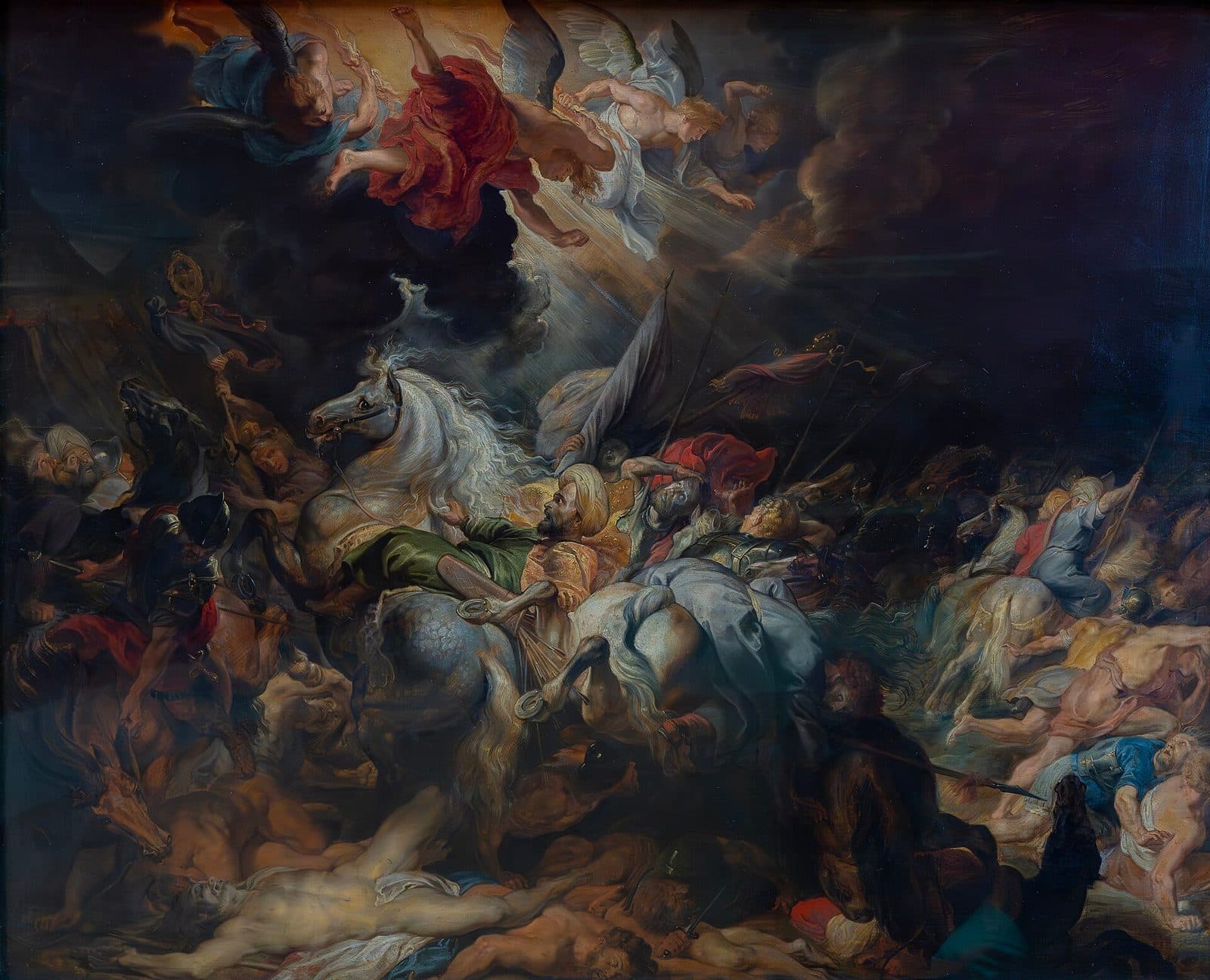
Peter Paul Rubens, The Defeat of Sennacherib, about 1614, oil on panel, Alte Pinakothek, Munich. Public domain, via Wikimedia Commons.
THE ARTWORKRubens painted Sennacherib in a gold turban falling from a rearing white horse as angels come down from a break in the clouds. Around him his horsemen are thrown down, and the dead lie across the foreground.
Sennacherib's prism says he shut Hezekiah up in Jerusalem like a bird in a cage, and it never says he took the city.
Summary
Hezekiah answered the Assyrian threat with prayer. The angel of the LORD struck the Assyrian camp in one night.
- Three books tell the story: 2 Kings 18 to 19, Isaiah 36 to 37 and 2 Chronicles 32.
- Hezekiah paid silver and gold, and the army still came.
- Three finds from the ground stand beside the account.
- Readers differ on how the camp was struck and where it stood.
One Campaign in Three Books
Where each of the three books begins
Chronicles tells the campaign in twenty-three verses, where Kings and Isaiah each give it about sixty.
In the fourteenth year of Hezekiah’s reign, Sennacherib king of Assyria attacked and captured all the fortified cities of Judah.Isaiah opens the account with the sentence that opens it in 2 Kings 18:13, word for word.
After all these acts of faithfulness, Sennacherib king of Assyria came and invaded Judah. He laid siege to the fortified cities, intending to conquer them for himself.The acts of faithfulness are Hezekiah's reforms in 2 Chronicles 29 to 31.
The Campaign in Order
From the fortified cities of Judah to the temple of Nisroch, in nine steps
- The cities of JudahSennacherib takes the fortified cities, 2 Kings 18:13
- LachishHezekiah pays the tribute, 2 Kings 18:14
- The upper poolThe Rabshakeh's speech to the city, 2 Kings 18:17
- The house of the LORDHezekiah in sackcloth, 2 Kings 19:1
- LibnahThe king of Assyria fights there, 2 Kings 19:8
- The house of the LORDHezekiah spreads the letter before the LORD, 2 Kings 19:14
- The campThe angel of the LORD strikes it, 2 Kings 19:35
- NinevehSennacherib goes home, 2 Kings 19:36
- The temple of NisrochHis sons kill him, 2 Kings 19:37
Each card names the place, what happened there and the verse of 2 Kings that tells it.
The Story Told Plainly
What was paid, said and promised along the way, in the account in Kings
Hezekiah sent word to Sennacherib at Lachish and confessed that he had done wrong. The king of Assyria set the price at three hundred talents of silver and thirty talents of gold. Hezekiah met it from the temple and palace treasuries and with the gold stripped from the temple doors.
The Rabshakeh, the king's officer, spoke from beside the aqueduct in Hebrew. When Hezekiah's officials asked him to use Aramaic, he kept to Hebrew so that the people on the wall would hear.
Who among all the gods of these lands has delivered his land from my hand? How then can the LORD deliver Jerusalem from my hand?”The account turns on this question.
From the house of the LORD Hezekiah sent his officials to the prophet Isaiah. Isaiah answered that the king of Assyria would hear a rumor, go home, and fall by the sword in his own land.
Warned that Tirhakah king of Cush was marching against him, Sennacherib sent Hezekiah a message that his God would not save Jerusalem.
Through Isaiah the LORD answered that the king of Assyria would not enter the city or shoot an arrow into it.
What a Retelling Tends to Lose
Two details from Kings and Chronicles, and a date a commentator gives
HEZEKIAH PAID FIRST
The tribute did not turn the army back: the Rabshakeh came to the wall after it was paid.
HEZEKIAH MADE THE CITY READY
Chronicles records that when Sennacherib came, Hezekiah stopped the springs outside the city, rebuilt the wall and made weapons and shields.
SENNACHERIB DIED LATER
Albert Barnes dates his death to 680 BC, many years after the campaign.
Three Witnesses from the Ground
Two records from Assyria and one from Judah
| Witness | Where and when | What it records |
|---|---|---|
| The Taylor Prism | About 691 BC; acquired in 1830; the British Museum | Sennacherib's annals of the campaign, with the cities taken and the tribute |
| The Lachish reliefs | About 700 to 681 BC; carved for Sennacherib's palace at Nineveh; the British Museum | The siege ramp, the archers, the battering rams and the people of Lachish led away |
| The Siloam inscription | About 700 BC; found in 1880; the Istanbul Archaeological Museums | The two teams of diggers meeting inside the rock |
- Witness
- The Taylor Prism
- Where and when
- About 691 BC; acquired in 1830; the British Museum
- What it records
- Sennacherib's annals of the campaign, with the cities taken and the tribute
- Witness
- The Lachish reliefs
- Where and when
- About 700 to 681 BC; carved for Sennacherib's palace at Nineveh; the British Museum
- What it records
- The siege ramp, the archers, the battering rams and the people of Lachish led away
- Witness
- The Siloam inscription
- Where and when
- About 700 BC; found in 1880; the Istanbul Archaeological Museums
- What it records
- The two teams of diggers meeting inside the rock
The prism claims forty-six walled cities of Judah.
Barnes notes that Sennacherib's own account sets the silver at eight hundred talents, five hundred more than Kings records.
Austen Henry Layard excavated the Lachish reliefs between 1845 and 1847. At Tel Lachish itself the excavators found the siege ramp and a burnt destruction layer.
The Siloam inscription is six lines of paleo-Hebrew cut into the wall of a tunnel that runs about 533 metres from the Gihon Spring to the Pool of Siloam.
It was Hezekiah who blocked the upper outlet of the Spring of Gihon and channeled it down to the west side of the City of David. And Hezekiah prospered in all that he did.The verse names Hezekiah as the builder of the channel the inscription records.
Why Assyria Came
The causes Kings gives, and a date Barnes questions
Hezekiah rebelled against the king of Assyria and refused to serve him. He also defeated the Philistines as far as Gaza.
The Rabshakeh mocked Judah for trusting in Egypt, a splintered reed that pierces the hand of anyone who leans on it.
Barnes notes that the fourteenth year of Hezekiah does not agree with the Assyrian dates, which set the campaign twenty-one years after the fall of Samaria.
What the Text Leaves Unsaid
Where the accounts and the annal are silent
Kings names no place for the camp.
Sennacherib's annal records no loss in the camp and gives no reason for his return to Nineveh.
Barnes reads the words of 2 Kings 19:35 about the morning to mean that the camp raised no alarm in the night.
Who Can Deliver Jerusalem
The prayer and the LORD's sign in 2 Kings 19, and the words of 2 Chronicles 32
Hezekiah's answer to the Rabshakeh's question was a prayer.
And Hezekiah prayed before the LORD: “O LORD, God of Israel, enthroned between the cherubim, You alone are God over all the kingdoms of the earth. You made the heavens and the earth.The prayer begins with who God is, before it asks for anything.
And now, O LORD our God, please save us from his hand, so that all the kingdoms of the earth may know that You alone, O LORD, are God.”Hezekiah ends by setting the LORD apart from the gods the Rabshakeh named.
And this will be a sign to you, O Hezekiah: This year you will eat what grows on its own, and in the second year what springs from the same. But in the third year you will sow and reap; you will plant vineyards and eat their fruit. And the surviving remnant of the house of Judah will again take root below and bear fruit above.Isaiah sent this word from the LORD to Hezekiah in answer to his prayer.
In Chronicles Hezekiah's answer comes in his words to his commanders in the square of the city gate.
With him is only the arm of flesh, but with us is the LORD our God to help us and to fight our battles.” So the people were strengthened by the words of Hezekiah king of Judah.Hezekiah spoke these words before Sennacherib sent his servants to Jerusalem from Lachish.
Voices of the Church
Three commentators, from the fourth century to the nineteenth
Ephrem the Syrian, in his commentary On the Second Book of Kings, reads Sennacherib as a type of the devil.
John Wesley, in his Explanatory Notes upon the Old Testament, reads the remnant Hezekiah asks Isaiah to pray for as Judah and Jerusalem, left after the ten tribes were gone.
“The blast, the rumor, the fall by the sword, contained a brief prediction that was soon fulfilled in all the three particulars--namely, the alarm that hastened his retreat, the destruction that overtook his army, and the violent death that suddenly ended his career.”
Jamieson, Fausset & Brown · Commentary Critical and Explanatory on the Whole Bible · on 2 Kings 19:6Reformed
The Night of the Angel
Three readings of the night, each with its holders
Chronicles adds that the angel cut off every mighty man, leader and commander in the camp.
A stroke of the angel's own powerAthanasius, John Gill
Athanasius sets the angel sent against the Assyrians beside the empty show of demons.
“Since the evil spirits have no power, they play as on a stage, changing their shapes and frightening children by the apparition of crowds and by their changed forms. This is why they are to be despised the more for their powerlessness. The true angel sent by the Lord against the Assyrians had no need of crowds or apparitions from without, or loud noises or clappings, but he used his power quietly and destroyed 185,000 at one time. Powerless demons such as these, however, try to frighten, if only by empty phantoms.”
Athanasius of Alexandria · Life of St. Anthony 28.9-10 · on 2 Kings 19:35Patristic
John Gill writes on Chronicles that no stroke was struck but by the LORD.
The objection, from the pestilence reading: in David's day the angel of the LORD struck the people by a plague, so naming the angel need not rule out a means.
So the LORD sent a plague upon Israel from that morning until the appointed time, and seventy thousand of the people from Dan to Beersheba died. But when the angel stretched out his hand to destroy Jerusalem, the LORD relented from the calamity and said to the angel who was destroying the people, “Enough! Withdraw your hand now!” At that time the angel of the LORD was by the threshing floor of Araunah the Jebusite.This plague followed David's census.
A pestilence sent through the angelFlavius Josephus, Charles Spurgeon
Josephus, in book 10 of his Antiquities, calls the stroke a pestilence sent by God.
“The stouthearted are spoiled. They came to spoil, and lo! they are spoiled themselves. Their stout hearts are cold in death, the angel of the pestilence has dried up their life blood, their very heart is taken from them. They have slept their sleep. Their last sleep—the sleep of death. And none of the men of might have found their hands. Their arms are palsied, they cannot lift a finger, for the rigour of death has stiffened them. What a scene was that when Sennacherib's host was utterly destroyed in one night.”
Charles Spurgeon · The Treasury of David, Vol. 3 · on Psalms 76:5
The objection, from the first reading: the word pestilence comes from Josephus and Spurgeon, and none of the three books uses it.
And that very night the angel of the LORD went out and struck down 185,000 men in the camp of the Assyrians. When the people got up the next morning, there were all the dead bodies!Every reading of the night begins from this verse.
The camp struck at PelusiumJerome, Albert Barnes
“And just as he had said to the people, ‘Do not let Hezekiah deceive you,’ he speaks the same blasphemy to the king, saying, ‘Do not let your God deceive you.’ And he gives examples from the past, how their gods were unable to deliver other lands from their hands, and therefore Jerusalem will not be able to be delivered either.… We pass over what is clear, so that we may dwell on uncertainties. Herodotus relates that Sennacherib, the king of the Assyrians, fought against the Egyptians and besieged Pelusium.”
Jerome · Commentary on Isaiah · on Isaiah 37:11Patristic
In the account of Herodotus, mice gnawed the Assyrian bowstrings at Pelusium, on the border of Egypt.
Barnes places the camp at Pelusium if Herodotus is to be trusted, and at least some way from Jerusalem.
The objection: Jamieson, Fausset and Brown read Isaiah to say the army was destroyed on the mountains near Jerusalem.
I will break Assyria in My land; I will trample him on My mountain. His yoke will be taken off My people, and his burden removed from their shoulders.”Books to Read Next
The Annals of Sennacherib
Daniel David Luckenbill · 1924
Luckenbill's translation of 1924 gives the prism's text in English.
Notes, Explanatory and Practical, on the Old Testament
Albert Barnes · 1832 to 1869
Barnes comments on 2 Kings 18 to 19 verse by verse.
For My Own Sake and for David
The LORD gave His reason for saving the city: for His own sake and for the sake of His servant David. Hezekiah stands in Matthew's line of David's sons, the line that ends in Jesus, who is called Christ.
The account asks its reader to bring a threat to the LORD in prayer, as Hezekiah brought his.
Keep studying
Read it5
Studies6
Symbols1
Doctrines2