
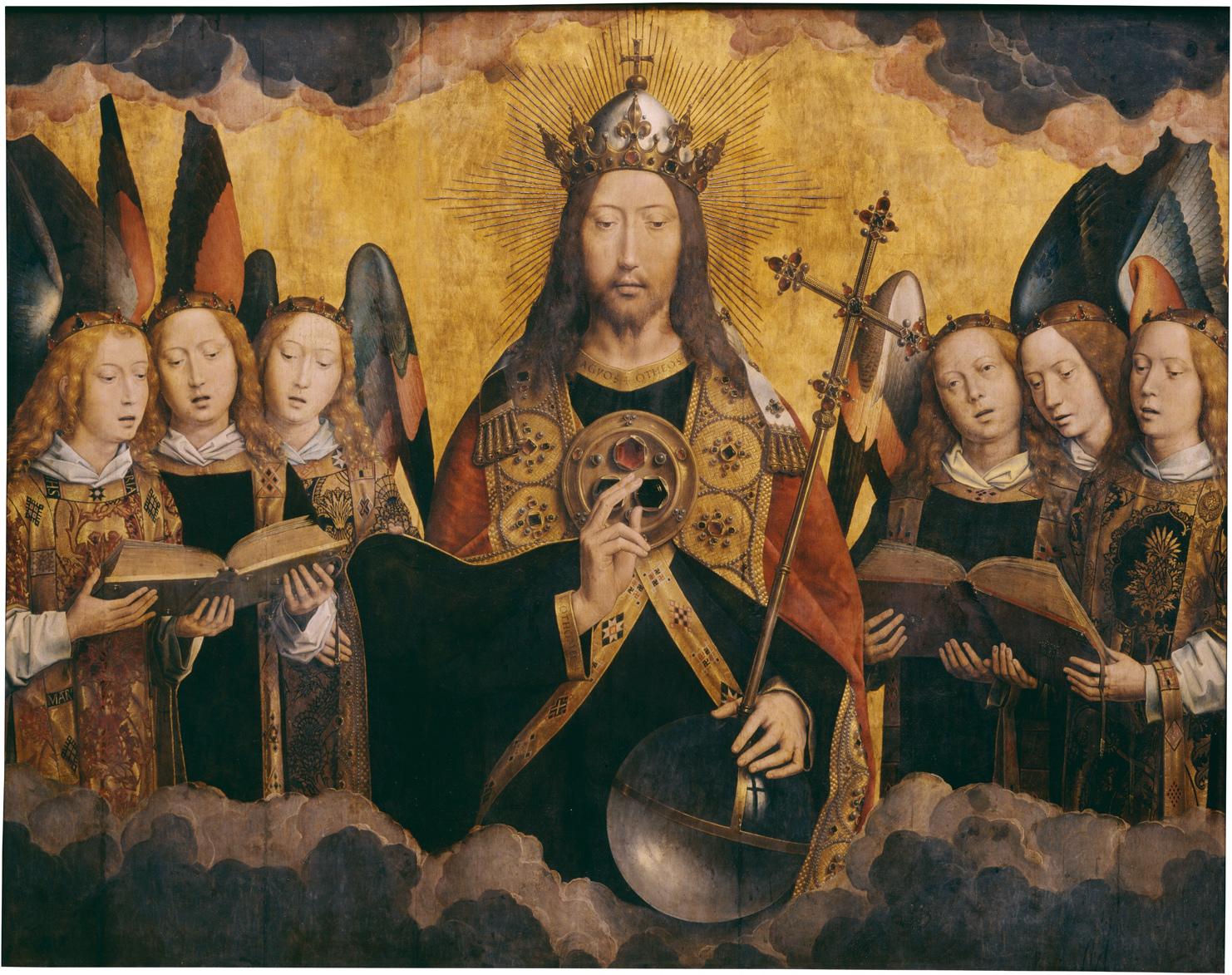
Hans Memling, Christ with Singing Angels, 1480s. Public domain.
Psalms 93 and 95 to 99 · Subject · Featured Study
The Enthronement Psalms: 93 and 95 to 99
Six psalms of the fourth book praise the LORD as King over the floods, the gods, the nations and the earth He comes to judge.
The LORD reigns! He is robed in majesty; the LORD has clothed and armed Himself with strength. The world indeed is firmly established; it cannot be moved.
- Book
- Psalms
- Hold in memory
- Psalm 93:1
The Book of Common Prayer of 1662 sets Psalm 95, the Venite, before the psalms of Morning Prayer.
Summary
Readers have heard in these psalms a Temple festival, a song of the last day, the kingdom of Christ, or the Psalter's answer to the fall of David's throne.
- Hermann Gunkel named Psalms 47, 93, 97 and 99 songs of the LORD's enthronement in his commentary of 1926
- 1 Chronicles 16:23 to 33 carries the words of Psalm 96 in the song David gave to Asaph
- The six psalms hold 59 verses in the Berean text
The LORD Is King
The group opens with the King robed in majesty, higher than the sea.
“God is described as a King entering on His reign, and, for robes of royalty, investing Himself with the glorious attributes of His nature. The result of His thus reigning is the durability of the world.”
Jamieson, Fausset & Brown · Commentary Critical and Explanatory on the Whole Bible · on Psalm 93:1Reformed
The floodwaters have risen, O LORD; the rivers have raised their voice; the seas lift up their pounding waves. Above the roar of many waters— the mighty breakers of the sea— the LORD on high is majestic.The psalm sets the LORD's height against the noise of the sea.
For the LORD is a great God, a great King above all gods.This verse gives the reason for the call to worship in Psalm 95:1.
Spurgeon, in The Treasury of David, says the nations took the LORD for a local god. The psalmist, he says, claims for Him the chief place.
The Hebrew word for king, and the LORD as King through Scripture, are taught on their own page.
Six Psalms of the King
Each psalm of the group gives the King a work of His own.
The six psalms move from the King's throne to His coming to judge and His holiness.
| Psalm | Verses | The call | What the King does |
|---|---|---|---|
| Psalm 93 | 5 | None; the psalm states the reign | Holds His throne from eternity above the floods |
| Psalm 95 | 11 | Come, let us sing and bow down | Rules the depths and the peaks, and warns His people at Meribah |
| Psalm 96 | 13 | Sing a new song | Made the heavens, and comes to judge the earth |
| Psalm 97 | 12 | Let the earth rejoice | Reigns in clouds and darkness, on righteousness and justice |
| Psalm 98 | 9 | Sing a new song | Has won the victory, and comes to judge the world |
| Psalm 99 | 9 | Let the nations tremble | Sits enthroned above the cherubim, and is holy |
The Psalms in Use
Preachers and the New Testament took up Psalm 95.
Charles Spurgeon preached Psalm 95:7 to 8 in 1880, in a sermon whose title repeats the word Today three times. He noted that the psalm opens as a burst of praise and closes in solemn warning.
The letter to the Hebrews quotes the warning of Psalm 95, and the page of the messianic psalms reads those quotations.
Reigns, or Has Become King?
One Hebrew verb carries two senses, and the commentators divide over it.
The verb at Psalm 93:1, Psalm 96:10, Psalm 97:1 and Psalm 99:1 is malak. Strong's lexicon, the dictionary keyed by number, gives it a second sense beside to reign: with a beginning in view, to ascend the throne.
Ellicott renders it Jehovah has become king, the usual term for taking a throne. He cites 2 Samuel 15:10 and 2 Kings 9:13. The Pulpit Commentary agrees, and notes that the Septuagint, the old Greek translation, has ebasileusen. Keil and Delitzsch read it as the LORD entering on the kingship and now reigning.
The Cambridge Bible reads it as the LORD proclaiming Himself king. Albert Barnes keeps the plain sense, the LORD is king.
Jerome, in his Homily 26, on the psalm he numbers 98, notes that three psalms share this opening and end their first line three different ways.
Four Readings of the Group
Each reading is named with its holders and its strongest objection.
A yearly festival of the LORD's enthronementSigmund Mowinckel; Hermann Gunkel on Psalm 97
Mowinckel, in his Psalmenstudien II of 1922, related more than forty psalms to a New Year festival in autumn, the Enthronement Festival of Yahweh. Gunkel, on Psalm 97, allowed that the enthronement songs were sung at a yearly feast of the LORD's ascent to the throne. He cited Mowinckel's study.
The objection: the festival is a reconstruction, and no verse of the six psalms names a feast or a day. Mowinckel's reading of Psalm 47 at the new year is weighed on the page of Rosh Hashanah.
The King of the last dayHermann Gunkel; Charles Spurgeon
Gunkel read Psalm 93 eschatologically, of the day when the LORD will have become King. Spurgeon heard the coming of Psalm 98:9 as the second advent, when trumpets suit a judge.
before the LORD, for He comes to judge the earth. He will judge the world with righteousness and the peoples with equity.Psalm 98 ends, as Psalm 96 does, on the LORD's coming as judge.
The objection: the Cambridge Bible reads the verbs as an act. It sets the group among the Psalms of the Restoration.
The kingdom of Christ set up by the gospelJohn Gill; Matthew Henry; John Wesley
Gill, in his Exposition of the Old Testament, reads the LORD who reigns in Psalm 93:1 as the King Messiah. Henry, in his Commentary on the Whole Bible, reads the judging of Psalm 96:13 first of Christ's coming. He sees in it the setting up of His kingdom by the gospel. Wesley, in his Explanatory Notes, reads Psalm 96:10 of God's kingdom set up in the world.
The objection: none of the six psalms names an anointed king or a son of David. The psalms the New Testament reads of the Messiah are taught on their own page.
The Psalter's answer to the fall of David's throneGerald H. Wilson
William Pohl, in the Journal of the Evangelical Theological Society of 2015, sums up the thesis of Wilson's The Editing of the Hebrew Psalter (1985). Book IV, in that reading, answers the failure of David's covenant by returning to a hope resting on the LORD's kingship. Pohl notes that Wilson elsewhere calls the failure apparent.
The objection: the reading rests on the order of the five books, and no verse of the six psalms refers to Psalm 89.
Holy Is He
The group ends on the holiness of the King.
Psalm 99 calls the King holy three times, at Psalm 99:3, Psalm 99:5 and Psalm 99:9. It names Moses, Aaron and Samuel among those who called on Him and were answered.
Exalt the LORD our God and worship at His holy mountain, for the LORD our God is holy.The last verse of the group turns its praise into a call to worship at the holy mountain.
The gods the psalms set beneath the King, bidden to worship Him in Psalm 97:7, are studied on the page of the heavenly court.
Sources
Scripture is the Berean Standard Bible.
- Strong's Hebrew lexicon, H4427, malak.
- Ellicott's Commentary for English Readers; the Cambridge Bible for Schools and Colleges; the Pulpit Commentary; Keil and Delitzsch; Albert Barnes, Notes; each on Psalm 93:1, 97:1 and 99:1.
- Hermann Gunkel, Die Psalmen, übersetzt und erklärt, 4th edition (Göttingen: Vandenhoeck und Ruprecht, 1926)
- Sigmund Mowinckel, Psalmenstudien II: Das Thronbesteigungsfest Jahwäs und der Ursprung der Eschatologie (1922), as the reference article on Mowinckel describes it.
- William C. Pohl IV, A Messianic Reading of Psalm 89: A Canonical and Intertextual Study, JETS 58/3 (2015) 507 to 525, citing Gerald H. Wilson, The Editing of the Hebrew Psalter (1985), p. 215.
- The Book of Common Prayer (1662), The Order for Morning Prayer.
Keep Studying
Read it7
Words1
Symbols2
Subjects2