
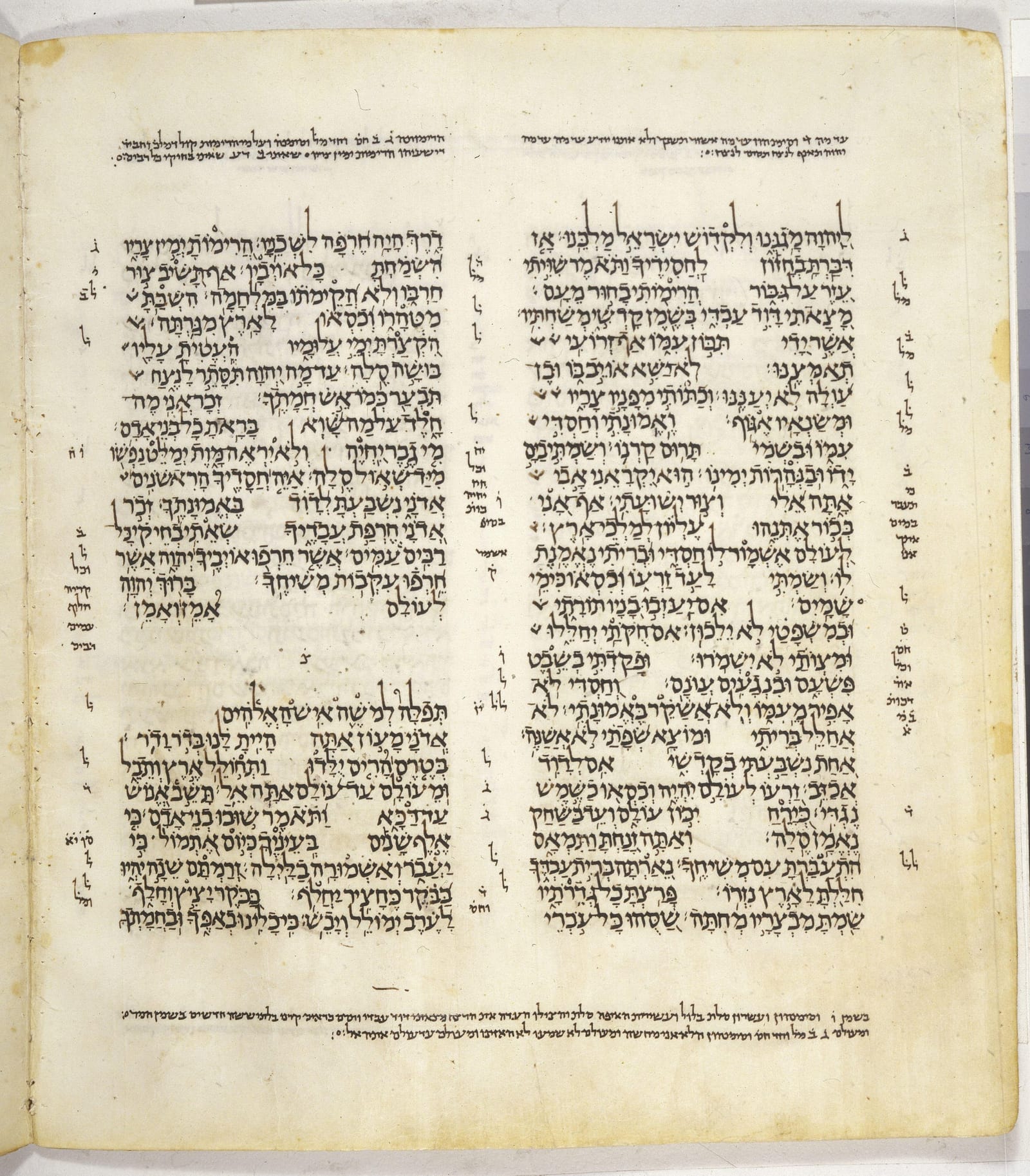
The Leningrad Codex, folio 384b, 1008 to 1011. Public domain.
Psalms 41, 72, 89, 106 and 150 · Passage · Featured Study
The Five Books of the Psalter and Their Seams
The Psalter is divided into five books, and each of the first four closes with a blessing of the LORD and an amen.
The fifth book ends in Psalm 150, which calls for praise eleven times.
Blessed be the LORD, the God of Israel, from everlasting to everlasting. Amen and Amen.
- Book
- Psalms
- Hold in memory
- Psalm 41:13
Summary
The Psalter gathers its psalms into five smaller books, and each seam between them is marked by the same kind of verse. Jewish and Christian readers have counted the five books since at least the fourth century, and they differ on what the division means.
- Book V holds 701 verses in the Berean text, more than Books III and IV together.
- Four of the five closings begin with the words Blessed be the LORD.
- Psalms headed for David stand in Books III, IV and V, after the line that closes his prayers.
A Book of Five Books
The blessings that close Book I and Book IV use the same words.
The Five Books of the Psalter and Their Seams takes up the places where the Psalter divides. The question it answers is what stands at each division and what readers have made of it. It sets the closing verses side by side and counts the five books from the Hebrew. It follows the move from the third book to the fourth and gives the Jewish reading of the number five. It ends with four readings of why the book has five parts, each with the objection it meets.
Blessed be the LORD God, the God of Israel, who alone does marvelous deeds. And blessed be His glorious name forever; may all the earth be filled with His glory. Amen and amen.The second seam adds a prayer for the whole earth to the blessing.
Blessed be the LORD, the God of Israel, from everlasting to everlasting. Let all the people say, “Amen!” Hallelujah!The fourth seam gives the people their own part in the blessing.
The Books in Numbers
Book V is the longest of the five, with 44 psalms.
Books II and III name God, Elohim, more often than the LORD, and Books I, IV and V name the LORD far more often.
5 columns, scroll sideways
| Book | Psalms | Verses | The LORD, YHWH | God, Elohim |
|---|---|---|---|---|
| Book I | Psalms 1 to 41 | 616 | 274 | 49 |
| Book II | Psalms 42 to 72 | 465 | 28 | 198 |
| Book III | Psalms 73 to 89 | 358 | 43 | 63 |
| Book IV | Psalms 90 to 106 | 321 | 104 | 23 |
| Book V | Psalms 107 to 150 | 701 | 234 | 31 |
The Five Closings
Each closing stands in the last verse or verses of its book's last psalm.
THE END OF BOOK I
The first seam sets the pattern that the third and fourth closings repeat.
THE END OF BOOK II
A line on the prayers of David follows the blessing and closes the book.
THE END OF BOOK III
The shortest of the four blessings closes the third book.
THE END OF BOOK IV
The blessing closes a psalm that ends by asking God to gather His people from the nations.
THE END OF BOOK V
The last book takes a whole psalm for its close, where the other four take one verse or three.
The end of Book III, The end of Book IV, The end of Book V
From Psalm 89 to Psalm 90
A prayer of Moses opens the fourth book, after Psalm 89 closes the third.
Now, however, You have spurned and rejected him; You are enraged by Your anointed one. You have renounced the covenant with Your servant and sullied his crown in the dust.These verses bring the third book to its lowest point before its closing blessing.
Lord, You have been our dwelling place through all generations.The fourth book's first line reaches back before the kings of Israel.
Jerome preached on Psalm 90 and began with its place in the book. He counts the psalms as the Greek Bible does, one lower than the Hebrew in this part of the book, so his eighty-ninth psalm is Psalm 90.
“The eighty-ninth psalm has been read, whose title is this: A Prayer of Moses, the man of God. It is the beginning of the fourth book, for we ought to know that the psalter is divided into five books. From the first up to the fortieth is the first book; from the fortieth up to the seventy-first is the second book; from the seventy-first up to the eighty-eighth is the third book; from the eighty-eighth up to the hundred and fifth is the fourth book; from the hundred and fifth to the end is the fifth book. And therefore this is the opening of the fourth book: A Prayer of Moses, the man of God. The Hebrews think that not only this psalm, but also the other ten that follow, since they bear no title, were composed by Moses. And for that reason they think that those which are without a title belong to the same author as the one that has a title, because they seem to lie adjacent to the one that is inscribed with a title.”
Jerome · Homily 67, on Psalm 89 (Alternate Series) · on Psalm 90:1Patristic
The LORD reigns! He is robed in majesty; the LORD has clothed and armed Himself with strength. The world indeed is firmly established; it cannot be moved.Gerald Wilson read this refrain of Book IV as the editors' answer to the fall of David's throne.
Five Books for Five Books
The Midrash on the Psalms names each book by its first words.
The Midrash on the Psalms, at Psalm 1, says that Moses gave Israel the five books of the Torah and David gave them the book of Psalms with five books in it. It names the books by their openings: Blessed is the man, For the leader, A psalm of Asaph, A prayer of Moses, and Let the redeemed say.
Ambrose of Milan tied the end of the first book to Lent and the passion.
“‘So be it, so be it’ is also an indication that you have reached the end of a book. The psalter appears to be divided into five books, and the first book ends with this psalm, namely, the forty-first. The forty-first psalm concludes very fittingly with the passion, just as the forty-day period of Lent concludes with the Lord's passion. This allows the second book to begin with the mysteries of regeneration.”
Ambrose of Milan · Commentary on Twelve Psalms 41:37 · on Psalm 41:13Patristic
What the Text Leaves Unsaid
No verse of the Psalter names its five books or the hand that divided them.
The Psalter gives no title to any of its books and says nothing of when the blessings were set at the seams. Psalm 72:20 is the one line that speaks of a collection, and it names only the prayers of David.
How the Teachers Read It
Charles Spurgeon commented on the first seam in The Treasury of David.
Charles Spurgeon (1834 to 1892)
Spurgeon wrote on the close of Psalm 41 in the second volume of his Treasury.
“The Psalm ends with a doxology. Blessed be the Lord, i.e., let him be glorified. The blessing at the beginning from the mouth of God is returned from the mouth of his servant. We cannot add to the Lord's blessedness, but we can pour out our grateful wishes, and these he accepts, as we receive little presents of flowers from children who love us. Jehovah is the personal name of our God. God of Israel is his covenant title, and shows his special relation to his elect people. From everlasting and to everlasting.”
Charles Spurgeon · The Treasury of David, Vol. 2 · on Psalm 41:13Particular Baptist
Four Readings of the Division
Readers part on whether the five books were shaped, inherited, marked late, or never meant.
The editors shaped the bookGerald H. Wilson, The Editing of the Hebrew Psalter (1985)
Wilson read the psalms at the seams as one line. The covenant with David is set up in Psalm 2, relied on in Psalm 41, handed down in Psalm 72 and failed in Psalm 89.
The objection: Albert Barnes read the line at Psalm 72:20 as the close of an earlier collection, a division made by gathering psalms rather than by one design of the whole.
The five books answer the TorahMidrash Tehillim 1:2
The Midrash reads the number five as David's answer to Moses. Moses blessed Israel with ashreka at the close of Deuteronomy, and David blessed them with ashre at the head of the Psalter.
The objection: Jerome, following the Hebrews, held the Psalter to be one volume and gave the double amen no force as a division.
A later hand marked the divisionsAdam Clarke, Commentary on the Bible (1832); Albert Barnes, Notes on the Old Testament
Clarke held that Psalm 89:52 was added by a later hand to close the third book, and he notes manuscripts that lack the verse or set it apart. Barnes notes that the Syriac version adds the words The end of the Second Book after Psalm 72.
The objection: Clarke grants that every ancient version carries the verse, so if a later hand added it, the hand worked before the versions were made.
The Psalter is one bookJerome, preface to his Psalter from the Hebrew, to Sophronius
Jerome knew readers who divided the Psalter at each double amen. He held it to be one volume, following the Hebrews and the Apostles, who name it the Book of Psalms. He argued that amen also opens sayings, as in the Gospel's Amen, amen, I say to you.
The objection: Ambrose of Milan, writing in Jerome's lifetime, took the double amen of Psalm 41 as the end of the first book.
“For it is written in the book of Psalms: ‘May his place be deserted; let there be no one to dwell in it,’ and, ‘May another take his position.’Peter cites the book of Psalms by that one name.
Jesus said to them, “These are the words I spoke to you while I was still with you: Everything must be fulfilled that is written about Me in the Law of Moses, the Prophets, and the Psalms.”His words treat the Psalms as a single part of Scripture under one name.
Books to Read Next
Two works read the Psalter whole, one psalm by psalm and one by its shape.
The Editing of the Hebrew Psalter
Gerald H. Wilson · 1985
Wilson's study of how the Psalter was edited appeared in the SBL Dissertation Series.
In print: find it wherever books are sold.
The Treasury of David
Charles Spurgeon · 1869 to 1885
Spurgeon reads every psalm verse by verse, the closing blessings with the rest.
READ IT FREE AT CCEL →Everything That Has Breath
The last verse of the Psalter widens the call to praise to all that breathes.
The book opens by blessing one man who delights in the law of the LORD.
Let everything that has breath praise the LORD! Hallelujah!It closes the fifth book where the other four close with a blessing.
Sources
Scripture is the Berean Standard Bible.
- The five books counted: psalms, Berean verses, and the Hebrew words carrying Strong's h3068 and h430.
- Midrash Tehillim 1:2, Hebrew text (public domain) with the Sefaria Community Translation.
- The Hebrew headings of Psalms 86, 101, 103, 108 and 138, Miqra according to the Masorah.
- Jerome, Homily 67, on Psalm 89 (Alternate Series)
- Jerome, preface to the Psalter from the Hebrew, to Sophronius.
- Ambrose of Milan, Commentary on Twelve Psalms, on Psalm 41.
- Adam Clarke, Commentary on the Bible (1832), on Psalm 89:52.
- Albert Barnes, Notes on the Old Testament, on Psalm 72:20.
- Charles Spurgeon, The Treasury of David, volume 2 (1870), on Psalm 41:13.
- Gerald H. Wilson, The Editing of the Hebrew Psalter, SBL Dissertation Series 76 (Chico: Scholars Press, 1985)
- The Septuagint in Brenton's translation (1844)
Keep Studying
Read it7
Studies12
People and groups6
Symbols1
Doctrines2