
Genesis 10 to Acts 8 · Place · Featured Study
Cush in Scripture
The land of Cush lay up the Nile beyond Egypt, and its people met Israel in war, at court and on the road.
Cush gave Scripture soldiers, servants, kings and a queen's treasurer, and each of them met the people of God.
- Region
- The Nile valley south of Egypt
- First named
- Genesis 2:13
- Last named
- Acts 8:27
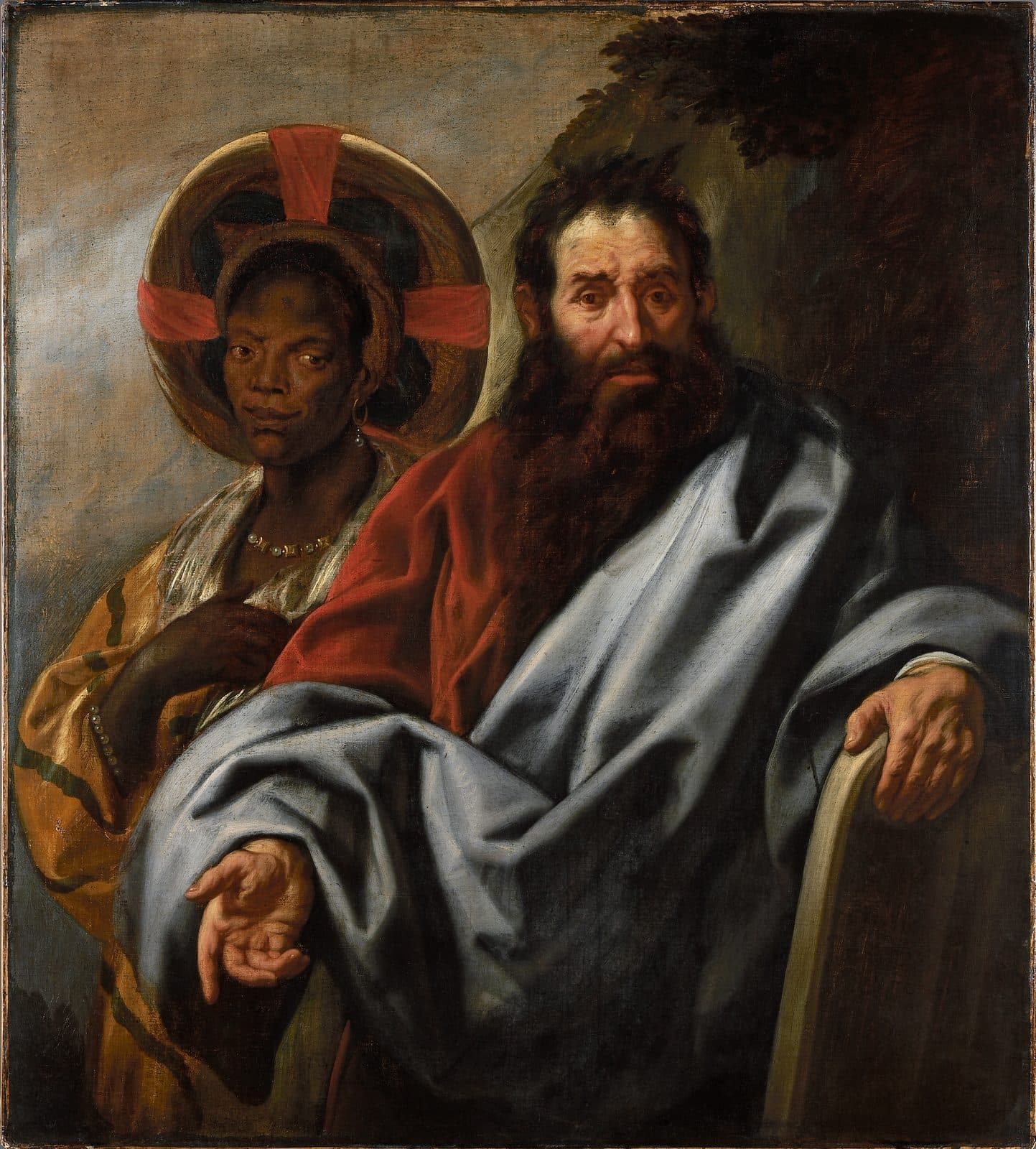
Jacob Jordaens, Moses and His Ethiopian Wife Zipporah, 1650, Rubenshuis, Antwerp. Public domain, via Wikimedia Commons.
THE ARTWORKJacob Jordaens painted Moses with an African woman in a gold robe and a red headdress at his shoulder. His title gives her the name Zipporah.
Summary
Cush is the Hebrew name of the land of the Nile south of Egypt, called after the son of Ham who bore the name, and a Cushite is one of its people.
- Readers have long differed over whether the Cushite wife of Numbers 12:1 was Zipporah.
- The Berean text calls the Cushite an Ethiopian at Jeremiah 13:23 and Acts 8:27, and Jerome wrote that the Hebrews of his day called Cush Ethiopia.
- The psalms and the prophets foretell gifts from Cush to the LORD.
Where Scripture Meets Cush
Genesis names the land of Cush in Eden, and Numbers names a Cushite woman in Moses' house.
The Hebrew word Kush names a son of Ham and the country his descendants held. Kushi, a Cushite, names one of its people, and Strong's Hebrew dictionary counts 29 uses of the first word and 26 of the second.
The name of the second river is Gihon; it winds through the whole land of Cush.The land is named here before Cush the man is born in Genesis 10.
Then Miriam and Aaron criticized Moses because of the Cushite woman he had married, for he had taken a Cushite wife.This is the only verse that names the marriage.
Cush on the Map
Syene marked the end of Egypt, and the Cushites of Scripture travelled north through Egypt to Judah.
Nahum, Jeremiah and Acts set Cushites at Thebes, Jerusalem and Gaza.
- Located: the site is known
- Identified: the point stands for an area, or is rounded
- 1No-Amon (Thebes), Nahum says Cush and Egypt were the city's boundless strength, Nahum 3:9
- 2Jerusalem, Ebed-melech the Cushite served in the king's palace, Jeremiah 38:7
- 3Gaza, Philip met the Ethiopian official on the desert road down to Gaza, Acts 8:26
- 4Cush, The land of the Nile beyond Syene, which Isaiah calls a land divided by rivers, Isaiah 18:2
- 5Syene, The southern end of Egypt, on the border of Cush, Ezekiel 29:10
The coasts and rivers are simplified; each place stands at its place page's coordinates.
Five places of Cush and its people, each with what Scripture sets there and its verse.
Cushites Through the Record
Seven Cushites or armies of Cush stand in the history from Moses to the apostles.
Four of the seven stand in the reigns of the kings of Judah.
- The wildernessMoses' wife, Miriam and Aaron criticized Moses because of the Cushite woman he had marriedNumbers 12:1
- David's reignJoab's runner, He carried the news of Absalom's death to the king2 Samuel 18:21 to 32
- Rehoboam's fifth yearShishak's troops, Cushites marched with Shishak of Egypt against Jerusalem2 Chronicles 12:2 to 3
- Asa's reignZerah, He came with a vast army as far as Mareshah, and the LORD struck the Cushites before Asa2 Chronicles 14:9 to 12
- Hezekiah's reignTirhakah, The king of Cush set out to fight Sennacherib2 Kings 19:9
- Zedekiah's reignEbed-melech, He drew Jeremiah out of the cistern and received the LORD's promise of rescueJeremiah 38:7 to 13
- The first churchCandace's treasurer, He read Isaiah in his chariot, heard the good news about Jesus and was baptizedActs 8:27 to 38
Seven Cushites from Moses' wife to Candace's treasurer, each with the reign or age in which he appears.
Asa and the army of Zerah2 Chronicles 14:9 to 15
Then Asa cried out to the LORD his God: “O LORD, there is no one besides You to help the powerless against the mighty. Help us, O LORD our God, for we rely on You, and in Your name we have come against this multitude. O LORD, You are our God. Do not let a mere mortal prevail against You.”Asa's prayer names the LORD as the help of the powerless, and verse 12 gives the outcome.
Albert Barnes, in his Notes on 2 Chronicles 14:9, took Zerah to be Osorkon II, the third king of Egypt after Shishak. Barnes judged that he may have been a Cushite by birth who reigned in right of his wife.
Aphrahat the Persian Sage held up Asa's prayer as a proof of what prayer can do.
“Asa prayed, and his prayer manifested great power: when Zerah the Indian [Ethiopian] went out against him with an army of one million with him, Asa then prayed, saying, ‘By this shall your power be known, O our God, when you finish off a vast people by means of a small people.’ God heard his prayer and sent his angel to rout them. Thus the vast army was defeated by the power of Asa's prayer.”
Aphrahat the Persian Sage · DEMONSTRATION 4.8 · on 2 Chronicles 14:11 to 12Patristic
Tirhakah, king of Cush2 Kings 19:9
Barnes, in his Notes on 2 Kings 19:9, identified Tirhakah with the Teharka of the hieroglyphics, the last king of the twenty-fifth dynasty, which he calls the Ethiopian dynasty. He judged that Tirhakah ruled Cush before he took the throne of Egypt about 692 BC, and that he still ruled in Egypt in 667 BC.
Those who made Cush their hope and Egypt their boast will be dismayed and ashamed.Isaiah warned Judah in the same years against trusting Cush and Egypt.
Ebed-melech in Zedekiah's palaceJeremiah 38:7 to 13 and 39:15 to 18
Albert Barnes, in his Notes on Jeremiah 38:7, gives the meaning of the name Ebed-melech as the king's slave. He was a court official, and he spoke for the prophet before the king at the Gate of Benjamin.
For I will surely rescue you so that you do not fall by the sword. Because you have trusted in Me, you will escape with your life like a spoil of war, declares the LORD.’”The LORD gives the reason for the rescue: Ebed-melech had trusted in Him.
What the Text Says of Cush
Two questions readers ask of Cush are answered here from their verses.
DOES CUSH STAND OUTSIDE GOD'S PURPOSE?
The psalmist foretells that Cush will stretch out her hands to God, and Psalm 87 counts Cush among the nations born in Zion.
WHAT DOES JEREMIAH 13:23 TEACH?
The proverb of the Cushite's skin and the leopard's spots is a figure for Judah's habit of evil, which the people could no more change by their own power.
The Line and the Land
Genesis 10 gives Cush five sons, two grandsons and Nimrod, and the prophets describe his land by its rivers.
Generation 1
- HamThe son of Noah whose sons are Cush, Mizraim, Put and Canaan
Generation 2
Generation 3
- Seba, Havilah, Sabtah, Raamah, SabtecaThe five sons of Cush
- NimrodThe son of Cush who began to be a mighty one on the earth
Generation 4
- Sheba and DedanThe sons of Raamah
The line of Cush in Genesis 10:6 to 8, by generation from Ham, each with what the chapter records of him.
Adam Clarke, in his Commentary on Isaiah 18:2, noted that the Egyptians used light boats of papyrus on the Nile.
which sends couriers by sea, in papyrus vessels on the waters. Go, swift messengers, to a people tall and smooth-skinned, to a people widely feared, to a powerful nation of strange speech, whose land is divided by rivers.The envoys of this verse are the people the oracle addresses to its end.
The Name in the Record
Jerome and Barnes tie the Hebrew name to the lands their readers knew, and the Jamieson, Fausset and Brown commentary explains the queen's title.
Jerome on the sons of HamHebrew Questions on Genesis, on Genesis 10:6
“(Verse 6) The sons of Ham: Cush, Egypt, Put, and Canaan. Cush, even to this day, is called Ethiopia by the Hebrews; Egypt is called Mizraim, and Put is called Libya. From Put, the river of Mauritania is called as such, and the entire region surrounding it is known as the Putian region. Many Greek and Latin writers attest to this. However, it is not the place or time to discuss why the ancient name of Libya has remained only in a certain part of the region, and the rest of the land is called Africa.”
Jerome · Hebrew Questions on Genesis · on Genesis 10:6Patristic
Barnes on the reach of the nameNotes on the New Testament, on Acts 8:27
“A man of Ethiopia - Gaza was near the confines between Palestine and Egypt. It was in the direct road from Jerusalem to Egypt. ‘Ethiopia’ was one of the great kingdoms of Africa, part of which is now called Abyssinia. It is frequently mentioned in Scripture under the name of ‘Cush.’ But ‘Cush’ comprehended a much larger region, including the southern part of Arabia, and even sometimes the countries adjacent to the Tigris and Euphrates.”
Albert Barnes · Notes, Explanatory and Practical, on the Old and New Testaments (1832-1869) · on Acts 8:27Evangelical
Candace, the queen's titleJamieson, Fausset and Brown, on Acts 8:27
Jamieson, Fausset and Brown took Candace as the family name of the queens of the land, as Pharaoh was the title of Egypt's kings.
So he started out, and on his way he met an Ethiopian eunuch, a court official in charge of the entire treasury of Candace, queen of the Ethiopians. He had gone to Jerusalem to worship,Luke names the queen and the treasury the official kept.
What the Text Leaves Unsaid
Scripture gives the Cushite woman of Numbers 12 neither a name nor a family.
Numbers 12 records the marriage and the complaint and moves at once to the LORD's defence of Moses. The LORD answers the challenge to Moses' office and says nothing of the wife.
The Old Testament gives Ebed-melech no family and no later history after the promise of Jeremiah 39.
Cush Will Stretch Out Her Hands
The prophets name Cush among the nations that will come to worship, and Acts 8 shows the first of them.
At that time gifts will be brought to the LORD of Hosts—from a people tall and smooth-skinned, from a people widely feared, from a powerful nation of strange speech, whose land is divided by rivers—to Mount Zion, the place of the Name of the LORD of Hosts.The same people Isaiah warned in verse 2 bring gifts to Mount Zion at the end of the oracle.
From beyond the rivers of Cush My worshipers, My scattered people, will bring Me an offering.Zephaniah 1:1 names this prophet's father Cushi.
“Are you not like the Cushites to Me, O children of Israel?” declares the LORD. “Did I not bring Israel up from the land of Egypt, the Philistines from Caphtor, and the Arameans from Kir?The LORD reminds Israel that He watches over the Cushites as He watches over them.
Then Philip began with this very Scripture and told him the good news about Jesus. As they traveled along the road and came to some water, the eunuch said, “Look, here is water! What is there to prevent me from being baptized?”Isaiah 53 was the passage the official was reading.
Charles Spurgeon, in The Treasury of David, read Psalm 68:31 as a promise to the nations.
“Princes shall come out of Egypt. Old foes shall be new friends. Solomon shall find a spouse in Pharaoh's house. Christ shall gather a people from the realm of sin. Great sinners shall yield themselves to the sceptre of grace, and great men shall become good men, by coming to God. Ethiopia shall soon stretch out her hands unto God. Cush shall hasten to present peace offerings. Sheba's queen shall come from the far south. Candace's chamberlain shall ask of Him who was led as a lamb to the slaughter.”
Charles Spurgeon · The Treasury of David, Vol. 3 · on Psalm 68:31
Voices on Cush
Origen, Matthew Henry and John Wesley wrote on the Cushites of the prophets and of the wilderness.
Origen on the offering from beyond CushHomilies on Jeremiah 5.4
Origen set Zephaniah 3:10 beside Psalm 68:31 as one promise of the nations serving God under a single yoke.
“If anyone is able, insofar as he found that Israel is saved ‘after the full number of pagan nations,’ let him consider having passed over by reason the remaining period, when it is that ‘all serve God under a single yoke,’ according to what is said in Zephaniah, ‘And from the ends of Ethiopia they offer sacrifices to him,’ when, as it is said in the sixty-seventh psalm, ‘Ethiopia stretches forth its hand to God,’ and ‘to the kings of the earth’ the word commands, saying, ‘Sing to the Lord, raise a psalm to the God of Jacob.’”
Origen of Alexandria · Homilies on Jeremiah 5:4.3 · on Zephaniah 3:10Patristic
Matthew Henry on Ebed-melechCommentary on the Whole Bible (1706 to 1710), on Jeremiah 38:7
“Ebed-melech was an Ethiopian, a stranger to the commonwealth of Israel, and yet had in him more humanity, and more divinity too, than native Israelites had. Christ found more faith among Gentiles than among Jews.”
Matthew Henry · Commentary on the Whole Bible · on Jeremiah 38:7Puritan
John Wesley on ZipporahExplanatory Notes upon the Old Testament (1765), on Numbers 12:1
“Zipporah, who is here called an Ethiopian, in the Hebrew a Cushite, because she was a Midianite: the word Cush being generally used in scripture, not for Ethiopia properly so called below Egypt, but for Arabia.”
John Wesley · Explanatory Notes upon the Old Testament · on Numbers 12:1Evangelical
Who Was the Cushite Wife
Numbers 12:1 names her only by her land, and readers have long differed over who she was.
| Reading | What it rests on | Held by | The strongest objection |
|---|---|---|---|
| She is Zipporah, the Midianite | Cush can name a region of Arabia, as Cushan stands beside Midian in Habakkuk 3:7 | John Wesley, Explanatory Notes (1765); John Gill, Exposition of the Old Testament (1748 to 1763), on Job 28:19; Rashi on Numbers 12:1 and 12:2 | Exodus calls Zipporah the daughter of a priest of Midian and never a Cushite |
| She is a wife from Cush on the Nile | Kushi is the word Scripture uses of Ebed-melech and of Zerah's army, and Josephus tells of a marriage to Tharbis, daughter of the king of the Ethiopians | Josephus, Antiquities of the Jews, book 2, as Adam Clarke reports him in his Commentary on the Bible (1832), on Exodus 2:11 | Scripture records no second marriage of Moses, and the account of Tharbis stands in Josephus alone |
Ambrose of Milan wrote in his Epistle 63 that Miriam murmured because she did not yet know the mystery of the Ethiopian woman.
Moses agreed to stay with the man, and he gave his daughter Zipporah to Moses in marriage.This is the marriage the first reading holds in view.
He Went on His Way Rejoicing
The reader is asked to receive every nation the LORD calls as He receives them, and to trust Him as Ebed-melech did when trust was costly.
Keep studying
Read it4
Doctrines1
Peoples and groups1
Symbols1