
Isaiah to Matthew · Doctrine · Featured Study
Immanuel
The Hebrew name of Isaiah 7 and 8 that Matthew gives to Jesus, with its meaning, its setting under King Ahaz and the readings of what it says of the child.
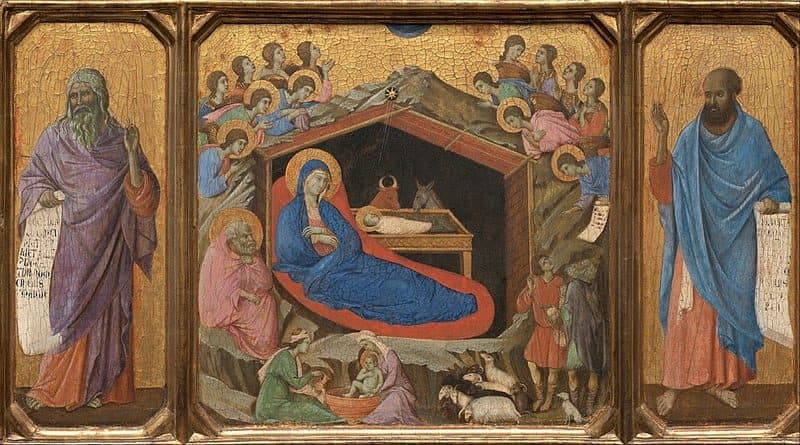
Duccio di Buoninsegna, The Nativity with the Prophets Isaiah and Ezekiel, 1308, National Gallery of Art. Public domain, via Wikimedia Commons.
THE ARTWORKDuccio painted the birth at Bethlehem between two prophets, with Isaiah on the left holding his open scroll beside the child his sign foretold.
A frightened king refused to ask God for a sign, and the prophet gave him one anyway: a son to be called Immanuel.
Summary
Immanuel is a Hebrew name meaning God with us, first given by Isaiah to the royal family of Judah.
- The name stands twice by name in Isaiah, and Isaiah 8:10 gives the same Hebrew words as God is with us.
- Matthew quotes Isaiah at the birth of Jesus and translates the name for his readers.
- Matthew closes his Gospel with Jesus promising to be with his disciples to the end of the age.
The Sign and Its Fulfilment
The sign stands in Isaiah 7 and again in Matthew 1.
Therefore the Lord Himself will give you a sign: Behold, the virgin will be with child and will give birth to a son, and will call Him Immanuel.This is the first verse of the name, and the one Matthew quotes.
All this took place to fulfill what the Lord had said through the prophet: “Behold, the virgin will be with child and will give birth to a son, and they will call Him Immanuel” (which means, “God with us”).Matthew sets Isaiah's sign beside the angel's words to Joseph.
The Name in Four Places
Each verse puts the name to a different use.
| Text | Who speaks | What the name does |
|---|---|---|
| Isaiah 7:14 | Isaiah, to Ahaz's household | the son's name, given as the sign |
| Isaiah 8:8 | The LORD, through Isaiah | the one whose land the Assyrian flood covers |
| Isaiah 8:10 | Isaiah, to the peoples | the confidence that defeats their plans |
| Matthew 1:23 | Matthew, the Gospel writer | the title of Jesus, with its meaning in Greek |
- Text
- Isaiah 7:14
- Who speaks
- Isaiah, to Ahaz's household
- What the name does
- the son's name, given as the sign
- Text
- Isaiah 8:8
- Who speaks
- The LORD, through Isaiah
- What the name does
- the one whose land the Assyrian flood covers
- Text
- Isaiah 8:10
- Who speaks
- Isaiah, to the peoples
- What the name does
- the confidence that defeats their plans
- Text
- Matthew 1:23
- Who speaks
- Matthew, the Gospel writer
- What the name does
- the title of Jesus, with its meaning in Greek
The Case, Text by Text
Isaiah 7, 8 and 9 and Matthew 1 carry the sign from the days of Ahaz to the birth of Jesus.
1. The sign Ahaz refused, Isaiah 7:10 to 162 passages, 3 paragraphs, 1 quotation
“Ask for a sign from the LORD your God, whether from the depths of Sheol or the heights of heaven.” But Ahaz replied, “I will not ask; I will not test the LORD.”When Ahaz refused, Isaiah turned from the king to the whole house of David, and the sign of verse 14 is spoken to them.
For before the boy knows enough to reject evil and choose good, the land of the two kings you dread will be laid waste.The sign carries a time limit that falls within Ahaz's own reign.
The Jewish commentator Rashi reads the Lord Himself as God giving the sign by Himself, against the king's will.
Irenaeus, in Against Heresies, Book 3, chapter 21, reads the words to the house of David as pointing to the eternal King God promised David, the one born of the virgin of David's line.
“Isaiah as yet had given no outward proof that he was from God; but now God has offered a sign, which Ahaz publicly rejects. The sin is therefore now not merely against ‘men,’ but openly against ‘God.’ Isaiah's manner therefore changes from mildness to bold reproof.”
Jamieson, Fausset & Brown · Commentary Critical and Explanatory on the Whole Bible · on Isaiah 7:13Reformed
2. The land of Immanuel, Isaiah 8:5 to 82 passages, 1 paragraph
the Lord will surely bring against them the mighty floodwaters of the Euphrates—the king of Assyria and all his pomp. It will overflow its channels and overrun its banks. It will pour into Judah, swirling and sweeping over it, reaching up to the neck; its spreading streams will cover your entire land, O Immanuel!Isaiah 8:8 is the second verse to carry the name, and it puts Judah's land under Immanuel's claim.
So Ahaz sent messengers to Tiglath-pileser king of Assyria, saying, “I am your servant and your son. Come up and save me from the hands of the kings of Aram and Israel, who are rising up against me.”The Assyrian help Ahaz bought is the flood that now covers Judah.
John Wesley, in his Explanatory Notes upon the Old Testament, calls it Immanuel's land because the Messiah who bears the name was to be born there.
3. God is with us, Isaiah 8:9 to 101 passage
Huddle together, O peoples, and be shattered; pay attention, all you distant lands; prepare for battle, and be shattered; prepare for battle, and be shattered! Devise a plan, but it will be thwarted; state a proposal, but it will not happen. For God is with us.”In verse 10 the Hebrew of the name stands behind the Berean text's last four words.
4. Jesus, called Immanuel, Matthew 1:18 to 252 passages, 2 paragraphs
But after he had pondered these things, an angel of the Lord appeared to him in a dream and said, “Joseph, son of David, do not be afraid to embrace Mary as your wife, for the One conceived in her is from the Holy Spirit. She will give birth to a Son, and you are to give Him the name Jesus, because He will save His people from their sins.”The angel's words give the child his name before Matthew quotes Isaiah.
When Joseph woke up, he did as the angel of the Lord had commanded him, and embraced Mary as his wife. But he had no union with her until she gave birth to a Son. And he gave Him the name Jesus.The account ends with Joseph keeping the angel's word.
Charles Spurgeon preached on Matthew's phrase “which means, God with us” in his Sermon 1270, God With Us. He took the translation as a sign that the name was meant for the Gentiles as well as the Jews.
John Wesley, in his Explanatory Notes upon the New Testament, observes that in Isaiah the mother calls the child Immanuel, while in Matthew “they will call Him” takes in all his people.
5. The child of Isaiah 9, Isaiah 9:6 to 71 passage
For unto us a child is born, unto us a son is given, and the government will be upon His shoulders. And He will be called Wonderful Counselor, Mighty God, Everlasting Father, Prince of Peace. Of the increase of His government and peace there will be no end. He will reign on the throne of David and over his kingdom, to establish and sustain it with justice and righteousness from that time and forevermore. The zeal of the LORD of Hosts will accomplish this.Isaiah's next promise of a child gives him a name that, like Immanuel, speaks of God.
The Meaning of the Name
Matthew's Greek keeps the Hebrew name and gives its meaning.
Immanuel joins two Hebrew words, immanu, with us, and el, God. Strong's Concordance gives the name as H6005, and Matthew's Greek Emmanouel as G1694, which it glosses God with us.
Matthew gives the child two names with two jobs. Jesus is the name the angel gave and Joseph used, and it says what he will do: save his people from their sins. Immanuel is what he would be called, a title beside the name he bore.
Isaiah and His Sons
The prophet's family and his king set the scene for the sign.
Albert Barnes dates the sign about 740 years before Christ, in the reign of Ahaz. Barnes reads the names of Isaiah's sons, Shear-jashub and Maher-shalal-hash-baz, as lessons of the presence and protection of God.
Here am I, and the children the LORD has given me as signs and symbols in Israel from the LORD of Hosts, who dwells on Mount Zion.Hebrews 2:13 later puts the first words of this verse in the mouth of Christ.
What the Text Leaves Unsaid
Isaiah and Matthew leave some questions open.
Isaiah does not name the mother or give the day of the birth. Isaiah 7 calls the son a sign and gives his name, and it leaves the nature of the child to the chapters that follow.
John Gill, in his Exposition of the New Testament, sets aside the readings that make the child Hezekiah or a son of Isaiah. He answers that Hezekiah was already born and that no son of Isaiah was king of Judah.
Ahaz is never said to have seen the sign. In the New Testament no one addresses Jesus as Immanuel, and Matthew 1:23 is the only verse that uses the name.
God With Us, to the End
The promise of the name is kept in Christ and at the end of all things.
The Word became flesh and made His dwelling among us. We have seen His glory, the glory of the one and only Son from the Father, full of grace and truth.John records the Word living among his people, the presence the name promised.
And I heard a loud voice from the throne saying: “Behold, the dwelling place of God is with man, and He will dwell with them. They will be His people, and God Himself will be with them as their God.The last book of the Bible sees the promise of the name kept for ever.
“Christ was born a visible man of a human virgin mother, but he was a hidden God because God was his Father. So the prophet had foretold: ‘Behold, the virgin shall be with child and shall bring forth a son; and they shall call his name Emmanuel, which is interpreted, God with us.’ To prove that he was God, Christ worked many miracles, some of which—as many as seemed necessary to establish his claim—are recorded in the Gospels. Of these miracles the very first was the marvelous manner of his birth; the very last, his ascension into heaven in his body risen from the dead.”
Augustine of Hippo · City of God 18.46 · on Isaiah 7:14Patristic
What the Name Says of the Child
Christians read the name in two ways, each with its holders and its objection.
God present in person in the childAugustine, John Wesley
Augustine and John Wesley take the name as a statement of who the child is: God himself, come to be with his people in human nature. Augustine says so in the City of God, and Wesley in his Explanatory Notes upon the Old Testament.
The objection is that Isaiah 8:18 calls the prophet's own children signs, and Strong's Concordance reads Immanuel as a type name of Isaiah's son.
A pledge that God is with his people, fulfilled in ChristAlbert Barnes, Matthew Henry
Albert Barnes, in his Notes on Isaiah, reads the name first in Ahaz's day, as a pledge to a nation in danger. Matthew Henry, in his Commentary on the Whole Bible, hears the same confidence in Isaiah 8:10 and joins it to the Messiah to be born among the people.
The objection is that Matthew gives the name to a child conceived from the Holy Spirit, and Isaiah 9:6 calls the coming child Mighty God.
Trusting the Sign
The head of Ephraim is Samaria, and the head of Samaria is the son of Remaliah. If you do not stand firm in your faith, then you will not stand at all.’”This is the word of the LORD that Ahaz would not trust.
Isaiah 7 asks the reader for the faith the king withheld, trust in the God whose sign is the child called God with us.
and teaching them to obey all that I have commanded you. And surely I am with you always, even to the end of the age.”The last words of Matthew's Gospel answer its first quotation of Isaiah.
Keep studying
Doctrines6
Peoples and groups1