
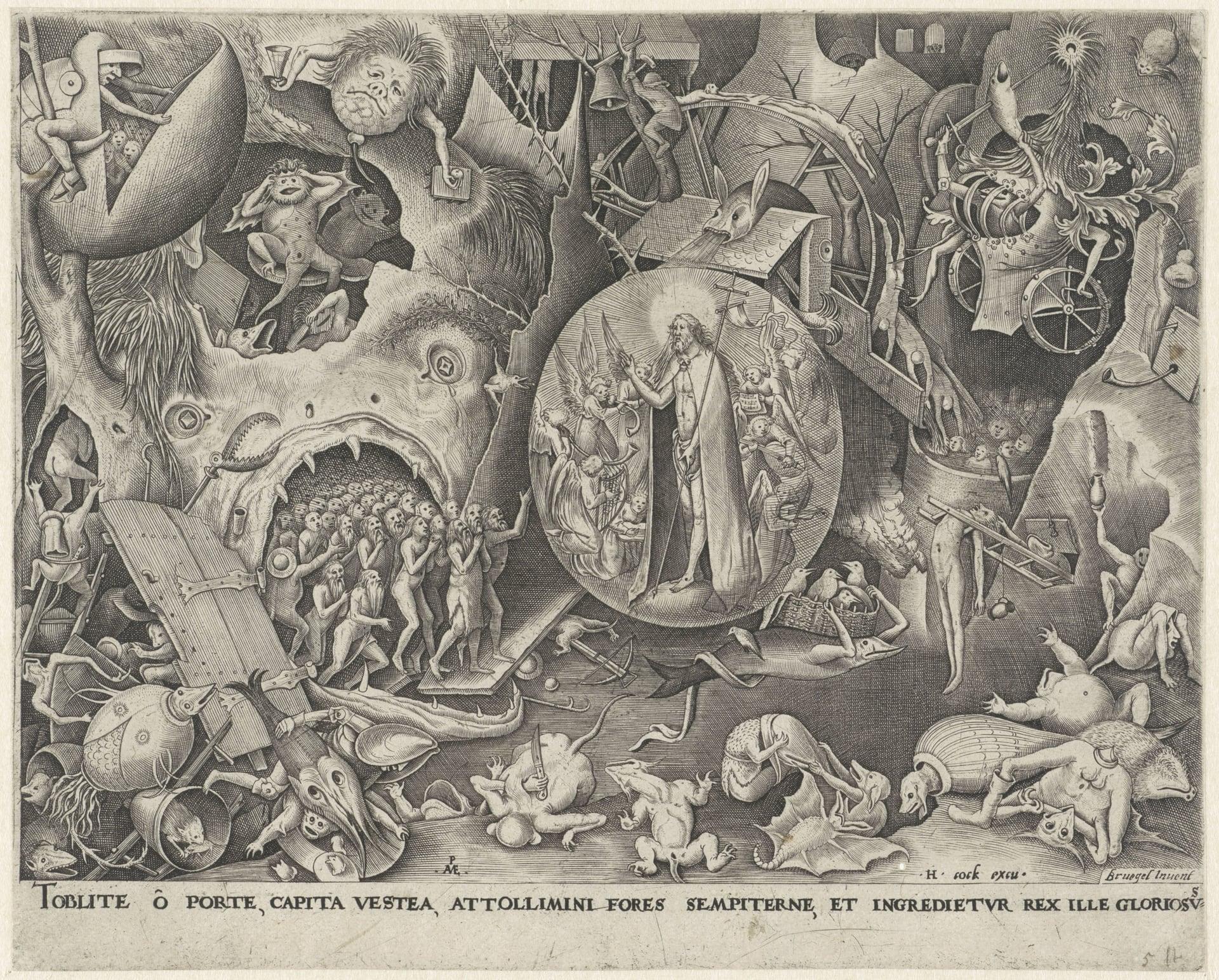
Pieter van der Heyden after Pieter Bruegel the Elder, Christ in Limbo, 1559 to 1563. Public domain.
Hosea 13:14 and 1 Corinthians 15:55 · Subject · Featured Study
Where, O Death, Is Your Sting?
Hosea's line on Death and Sheol returns in 1 Corinthians 15 as the cry over death defeated.
“Where, O Death, is your victory? Where, O Death, is your sting?”
- Books
- Hosea, 1 Corinthians, Isaiah
- Hold in memory
- Hosea 13:14, 1 Corinthians 15:57
Near the end of his chapter on the resurrection, Paul mocks death in words first spoken through Hosea to a kingdom about to fall.
Summary
Hosea 13:14 promises that God will buy His people back from the grave. Yet the verse stands in a chapter of judgment on Israel.
- Two verses later, the chapter ends with the fall of Samaria.
- Paul joins this verse to Isaiah 25:8 in one saying of 1 Corinthians 15.
- Its last line is read as God's firm purpose or as the prophet's own grief.
A Promise Among the Threats
In Hosea 13 God accuses Ephraim of idols and pride, then turns to the promise and back to the threats.
You are destroyed, O Israel, because you are against Me—against your helper.God names the cause of Israel's ruin before He names any rescue.
I will ransom them from the power of Sheol; I will redeem them from Death. Where, O Death, are your plagues? Where, O Sheol, is your sting? Compassion is hidden from My eyes.The promise of ransom follows the charge, and the line on compassion closes it.
Samaria will bear her guilt because she has rebelled against her God. They will fall by the sword; their little ones will be dashed to pieces, and their pregnant women ripped open.This verse shows that the promise did not cancel the judgment on Samaria.
Charles Spurgeon answered the critics of his day in a sermon of 1888.
“This verse stands in the midst of a long line of threats. Like a rock of mercy, it rises in the midst of a sea of wrath. Hence many critics have felt bound to see in it a continuation of threat. I am quite content to accept the united authority of the Authorized and the Revised Versions, and to believe that the mind of the Holy Spirit is fairly expressed in the grand old Bible of our fathers. I regard our text as a promise overflowing with delight.”
Charles Spurgeon · The Metropolitan Tabernacle Pulpit, Sermon No. 2046: “Consolation From Resurrection” (lightly modernized text, CCEL edition) · on Hosea 13:14Particular Baptist
Death Swallowed Up, From Hosea to Revelation
Other books of Scripture carry the same hope that God will put an end to death.
Isaiah, Hebrews and Revelation carry the defeat of death on to the day when God wipes away every tear.
- What it adds
- The Lord GOD swallows up death and wipes the tears from every face.
- What it adds
- By His death Christ destroys the one who holds the power of death.
- What it adds
- The risen Christ holds the keys of Death and of Hades.
- What it adds
- Death and Hades are thrown into the lake of fire.
- What it adds
- Death and mourning are gone when God wipes away every tear.
Five texts in the order of the canon, each with what it adds to the defeat of death.
What the Ransom Rescues From
Adam Clarke, Albert Barnes and the Latin fathers Jerome and Gregory read the rescue three ways.
Adam Clarke read the verse first of Israel's exile, which he likened to Ezekiel's valley of bones.
Albert Barnes read the ransom as the price Christ paid, since He became the near kinsman of those He bought.
Jerome read the verse in Latin as O death, I will be your death, and applied it to Christ among the dead.
Gregory the Great read the same Latin wording. He held that Christ killed death outright in His chosen ones and only bit hell, taking part of its captives and leaving part.
Ransom, Redeem and Where
Four Hebrew words of the verse, each with its count of uses in the Hebrew Bible.
פָּדָה pada
59 uses in the canon
To ransom: to set free by paying a price.
גָּאַל ga'al
104 uses in the canon
To redeem: to act as the next of kin and buy back what a relative lost.
אֱהִי 'ehi
3 uses in the canon
Where: the King James renders it I will be in Hosea 13:10 and Hosea 13:14.
נֹחַם nocham
1 use in the canon
Compassion or regret, which the King James renders repentance.
The lexicon in full1 verse, 1 paragraph
Adam Clarke explained why Paul's lines stand nearer the Greek translation than the Hebrew. The Greek translators read the word as where, and the King James margin of Hosea 13:10 already reads where is thy king.
Where is your king now to save you in all your cities, and the rulers to whom you said, “Give me a king and princes”?The Berean reads the same small word as where in this verse too.
Paul's Use of Hosea in 1 Corinthians 15
Paul's account of the resurrection body ends with Hosea's questions.
When the perishable has been clothed with the imperishable and the mortal with immortality, then the saying that is written will come to pass: “Death has been swallowed up in victory.”The saying belongs to the last trumpet, when the mortal puts on immortality.
Jamieson, Fausset and Brown judged that Paul quoted Hosea in substance and used the words freely, by the warrant of the Spirit.
The sting of death is sin, and the power of sin is the law. But thanks be to God, who gives us the victory through our Lord Jesus Christ!These verses name what gives death its sting and who takes it away.
John Wesley added that no one can resist this sting by his own strength.
Your Labor Is Not in Vain
John Chrysostom drew a picture of Paul in the moment of victory.
“‘O death, where is thy sting? O grave, where is thy victory?’ Seest thou his noble soul? how even as one who is offering sacrifices for victory, having become inspired and seeing already things future as things past, he leaps and tramples upon death fallen at his feet, and shouts a cry of triumph over its head where it lies, exclaiming mightily and saying, ‘O death, where is thy sting? O grave, where is thy victory?’ It is clean gone, it is perished, it is utterly vanished away, and in vain hast thou done all those former things. For He not only disarmed death and vanquished it, but even destroyed it, and made it quite cease from being.”
John Chrysostom · Homily on 1 Corinthians 42 · on 1 Corinthians 15:55Patristic
Therefore, my beloved brothers, be steadfast and immovable. Always excel in the work of the Lord, because you know that your labor in the Lord is not in vain.Paul turns the taunt over death into a charge to keep working.
Sources
Scripture is the Berean Standard Bible.
- The Hebrew words of Hosea 13:10 and 13:14 and the Greek of 1 Corinthians 15:55 with their Strong's numbers, and the lexicon's counts of uses.
- Charles Spurgeon, The Metropolitan Tabernacle Pulpit, Sermon No. 2046, Consolation From Resurrection (1888)
- Adam Clarke, Commentary on the Bible (1832), on Hosea 13:14 and 1 Corinthians 15:55.
- Albert Barnes, Notes, Explanatory and Practical (1832 to 1869), on Hosea 13:14.
- Jamieson, Fausset and Brown, Commentary Critical and Explanatory on the Whole Bible (1871), on Hosea 13:14 and 1 Corinthians 15:55.
- John Wesley, Explanatory Notes upon the Old Testament (1765), on Hosea 13:14, and upon the New Testament (1755), on 1 Corinthians 15:56.
- Jerome, Commentary on Hosea (420), on Hosea 13:14.
- Gregory the Great, Forty Gospel Homilies, Homily 22 (604)
- John Chrysostom, Homilies on 1 Corinthians, Homily 42 (407)
- Pieter van der Heyden after Pieter Bruegel the Elder, Christ in Limbo, engraving, 1559 to 1563, Rijksmuseum RP-P-OB-7386, Public Domain Mark and CC0.
Keep Studying
Read it4
People and groups2
Go further8