
2 Samuel 18 and 19 · Story · Parenting and Its Trials
O Absalom, My Son
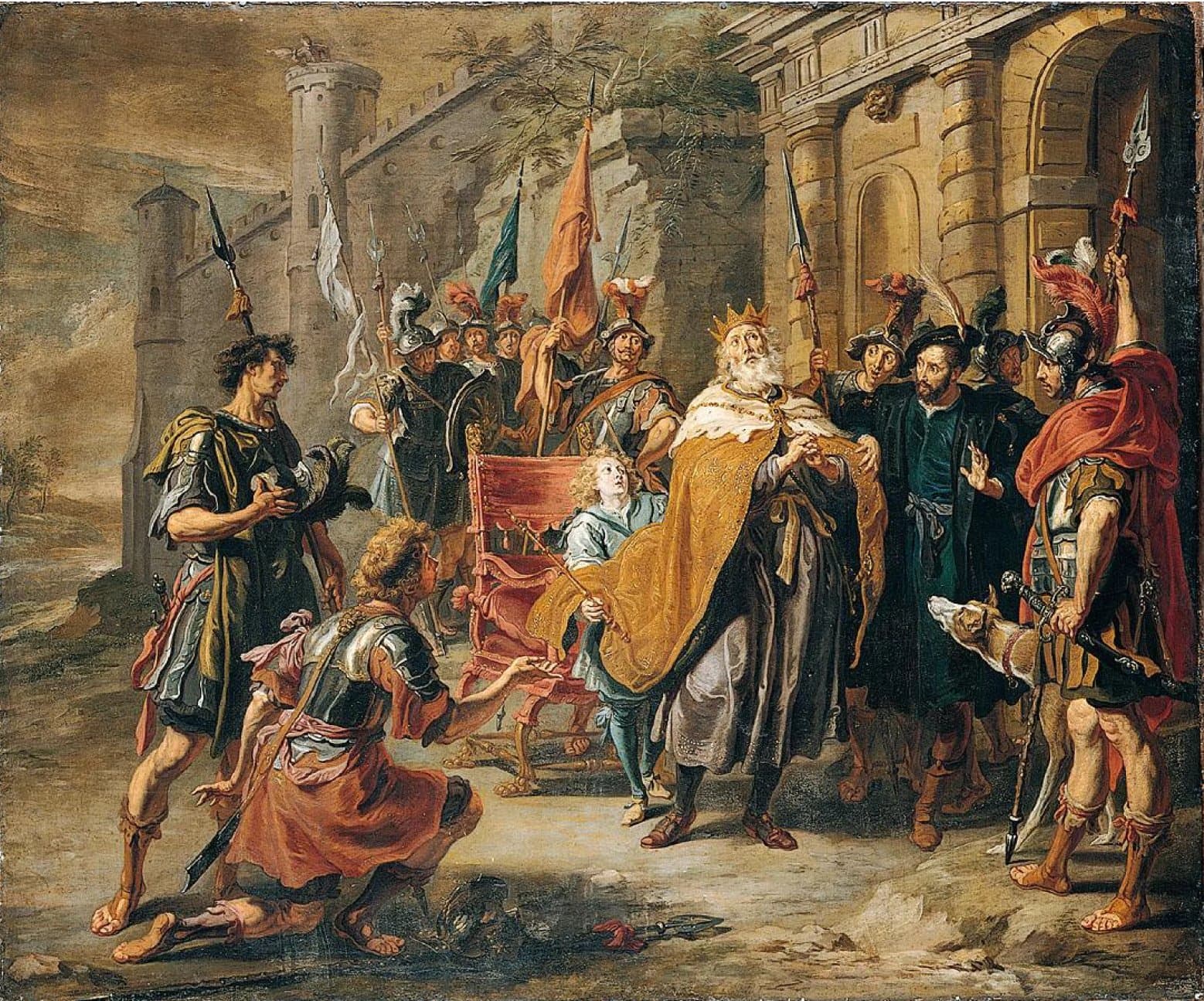
When the runners brought word that Absalom was dead, King David wept for the son who had risen against him.
Absalom was cast into a pit in the forest under a huge mound of stones before his father heard that he was dead.
The king was shaken and went up to the gate chamber and wept. And as he walked, he cried out, “O my son Absalom! My son, my son Absalom! If only I had died instead of you, O Absalom, my son, my son!”
- Who
- David
- When
- The reign of David, after Absalom's revolt (2 Samuel 15 to 18)
Summary
King David's son Absalom made himself king and drove his father from Jerusalem. Joab killed him in the battle that followed. Two runners brought the news of victory to the king where he sat between the gates, and he asked each the same question about his son. When he understood the answer he went up to the gate chamber weeping, until Joab rebuked him for shaming the men who had saved his life.
- Absalom was David's third son, born in Hebron to Maacah, the daughter of King Talmai of Geshur (2 Samuel 3:2 to 3).
- Nathan had told David that the sword would never depart from his house (2 Samuel 12:10).
- After Joab's rebuke the king sat in the gate, and all the people came before him (2 Samuel 19:8).
- Readers differ on whether David's grief was right in a father or a failure in a king.
The Son Who Took the Throne
Absalom's revolt ended in a single battle.
O Absalom, My Son is a story of the trial of parenting from 2 Samuel 18 and 19. It asks how David bore the loss of a son who had made war on him, and what that grief cost him as king.
The study follows the two runners from the battle to the gate and reads the king's mourning and Joab's rebuke in the text's own words. It traces the years in which the rift between father and son grew, and it weighs two readings of David's grief, with the holders of each and the objection to each.
Now the king had commanded Joab, Abishai, and Ittai, “Treat the young man Absalom gently for my sake.” And all the people heard the king’s orders to each of the commanders regarding Absalom.All the people heard the order, so no commander could later say he did not know the king's wish for his son.
In the forest of Ephraim, Absalom's head caught fast in the branches of a large oak (2 Samuel 18:6 to 9).
Joab would not wait, and he thrust three spears through Absalom's heart while he still hung alive in the tree (2 Samuel 18:14).
Two Runners
Ahimaaz son of Zadok and an unnamed Cushite carried the news.
Only the second runner answered the king's question about his son.
| The moment | Ahimaaz son of Zadok | The Cushite |
|---|---|---|
| What the king said as he came | "This is a good man" | "This one also brings good news" |
| His first words | "All is well!" | "May my lord the king hear the good news" |
| The king's question | "Is the young man Absalom all right?" | "Is the young man Absalom all right?" |
| His answer | "I do not know what it was" | "May what has become of the young man happen to the enemies of my lord the king" |
From the Wall to the Gate Chamber
The watchman on the wall saw each runner before the king heard him.
Joab told Ahimaaz son of Zadok that he must carry no news that day, because the king's son was dead (2 Samuel 18:19 to 20).
He sent a Cushite instead, but Ahimaaz pressed to run and outran him by way of the plain (2 Samuel 18:21 to 23).
Now David was sitting between the two gates when the watchman went up to the roof of the gateway by the wall, looked out, and saw a man running alone.The verse places the king at the gate, so every report of the battle comes first to a father waiting for his son.
Charles Spurgeon, preaching on the king's question in 1878, observed that David “does not appear to have asked, ‘How have we won the victory?’”.
Victory Turned to Mourning
The army that had won the day came home as if it had lost.
Then it was reported to Joab, “The king is weeping and mourning over Absalom.” And that day’s victory was turned into mourning for all the people, because on that day they were told, “The king is grieving over his son.” So they returned to the city quietly that day, as people steal away in humiliation after fleeing a battle. But the king covered his face and cried out at the top of his voice, “O my son Absalom! O Absalom, my son, my son!”The verses set the king's mourning beside the people's shame, so the cost of his grief is seen falling first on his own army.
Joab's Rebuke
Joab went into the house where the king was mourning.
Then Joab went into the house and said to the king, “Today you have disgraced all your servants who have saved your life and the lives of your sons and daughters, of your wives, and of your concubines. You love those who hate you and hate those who love you! For you have made it clear today that the commanders and soldiers mean nothing to you. I know today that if Absalom were alive and all of us were dead, it would have pleased you! Now therefore get up! Go out and speak comfort to your servants, for I swear by the LORD that if you do not go out, not a man will remain with you tonight. This will be worse for you than all the adversity that has befallen you from your youth until now!”Joab's speech is the turn of the account, the one voice that calls the king back from his grief.
Years Before the Revolt
2 Samuel 13 and 14 tell how father and son grew apart.
Amnon, David's firstborn, violated his half sister Tamar, Absalom's sister (2 Samuel 13:14).
When King David heard all this, he was furious.The Berean text records the king's anger and no act against Amnon, and the next verses turn at once to Absalom's silent hatred.
Two years later Absalom invited the king's sons to his sheepshearing and had his young men kill Amnon (2 Samuel 13:23 to 29).
He fled to Geshur and stayed there three years (2 Samuel 13:37 to 38).
When he came back to Jerusalem he lived two years without seeing the face of the king, until David summoned him and kissed him (2 Samuel 14:28 and 2 Samuel 14:33).
John Wesley's Explanatory Notes upon the Old Testament (1765) read David's grief against this history.
He wrote that “David himself had by his own sins been the occasion of his death”.
Two Sons Mourned
David wept for two sons in 2 Samuel, and the two griefs ended differently.
Years before, David fasted and wept while his infant son lay dying (2 Samuel 12:22).
When the child died he rose and said, “I will go to him, but he will not return to me” (2 Samuel 12:23).
Ambrose of Milan set the two griefs side by side in his second book On the Decease of His Brother Satyrus.
He wrote of “that same David, I say, who had not wept for the innocent infant, wept for the parricide when dead”.
A Right Grief or a Failure of Office
Two readings weigh David's mourning and Joab's charge against it.
He grieved for his son's sinsAugustine of Hippo
Augustine, in On Christian Doctrine, translated by J. F. Shaw (1887), wrote that David had wished his son spared so that he might repent.
When that failed, “he mourned over his son's death, not because of his own loss, but because he knew to what punishment so impious an adulterer and parricide had been hurried”.
Against this reading, the text gives the king's mourning no reason of its own and records only that he wept for his son.
He failed his men, and Joab was right to say soAdam Clarke; Jamieson, Fausset and Brown
Adam Clarke's Commentary on the Bible (1832) judged that David “acted imprudently at least; and that Joab's firm reproof was necessary to arouse him to a sense of his duty to his people”.
Jamieson, Fausset and Brown wrote in their Commentary Critical and Explanatory (1871), “Joab's remonstrance was right and necessary, but it was made with harshness”.
Against this reading, the rebuke came from Joab, the man who had struck Absalom down (2 Samuel 18:14).
The King in the Gate
David was king as well as father on the day his son died.
The account ends as the grieving father takes up again the work of a king before his people.
Sources
Scripture is the Berean Standard Bible.
- Augustine of Hippo, On Christian Doctrine, Book 3, chapter 21, section 30, translated by J. F. Shaw, Nicene and Post-Nicene Fathers, First Series, volume 2, edited by Philip Schaff (Buffalo: Christian Literature Publishing Co., 1887)
- Adam Clarke, Commentary on the Bible (1832), on 2 Samuel 19:5.
- Robert Jamieson, A. R. Fausset and David Brown, Commentary Critical and Explanatory on the Whole Bible (1871), on 2 Samuel 19:5.
- John Wesley, Explanatory Notes upon the Old Testament (1765), on 2 Samuel 18:33.
- Charles Spurgeon, The Metropolitan Tabernacle Pulpit, Sermon No. 1433, An Anxious Enquiry for a Beloved Son (1878), on 2 Samuel 18:29.
- Ambrose of Milan, On the Decease of His Brother Satyrus, Book 2, section 28.
Keep Studying
Studies1
In this trial7
People and groups7