
1 Kings 1 to 11 · Person · Featured Study
Solomon
The son of David and Bathsheba who built the first temple in Jerusalem.
Solomon asked God for a heart to judge His people, and lived to build high places for the gods of his wives.
- The name means
- Peace, from the Hebrew root of shalom.
- Born
- in Jerusalem, in the reign of his father David
- Died
- after a reign of forty years, buried in the City of David
- Family
- father: David; mother: Bathsheba; brother: Adonijah; wife: the daughter of Pharaoh; wife: Naamah the Ammonite; son: Rehoboam
- Places
- Jerusalem, The Temple, Tyre, Egypt, Mount of Olives
- First named
- 2 Samuel 12:24
- Last named
- Acts 7:47
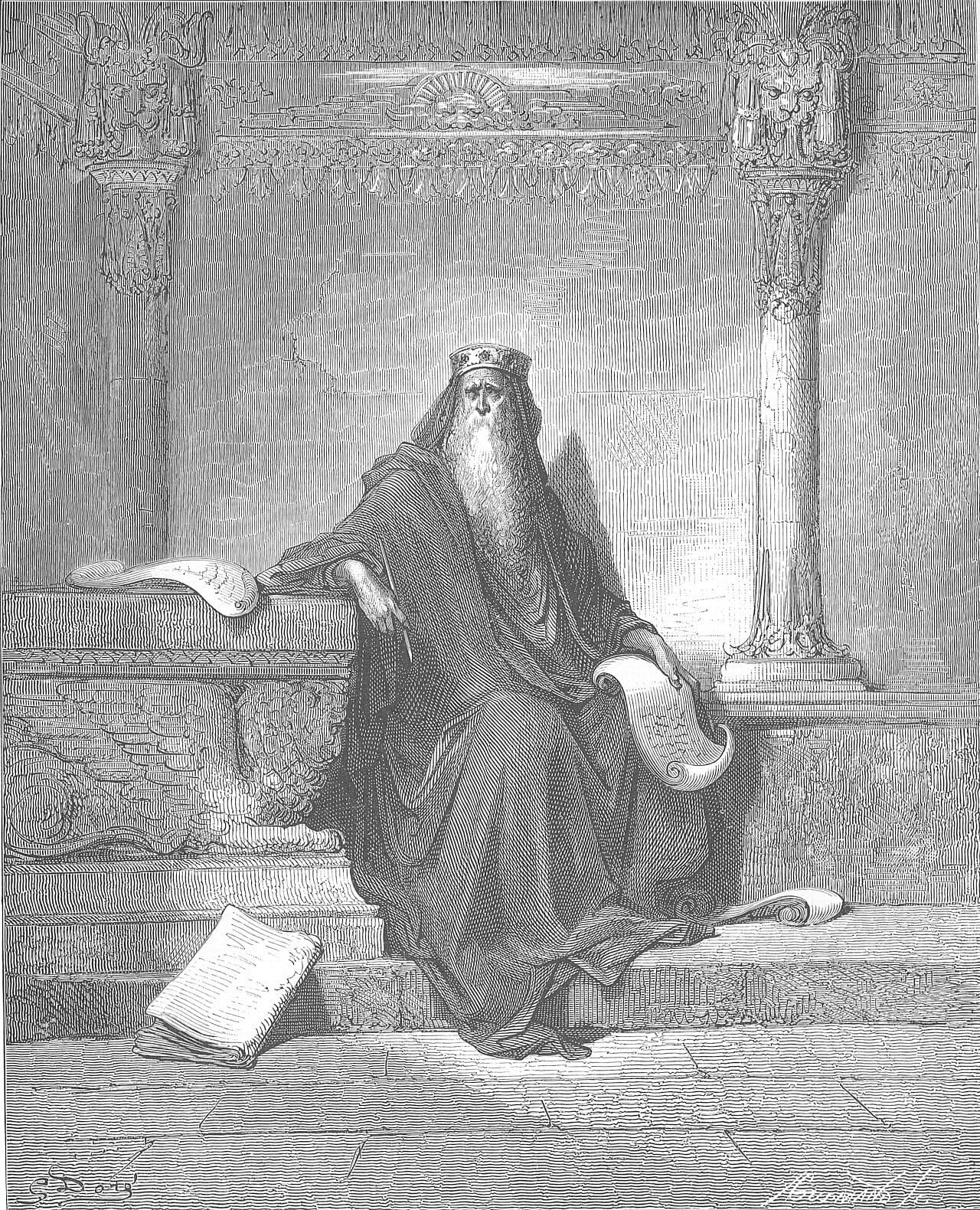
Gustave Doré, King Solomon in Old Age, plate 87 of The Holy Bible (London: Cassell, 1866). Public domain.
THE ARTWORKDoré drew the king at the end of his reign, alone in a hall of carved columns with his scrolls around him.
Summary
Solomon was the last king to reign over all twelve tribes of Israel before the kingdom divided.
- He came to the throne on an oath David swore to his mother, though an older brother had already claimed it.
- Kings credits him with three thousand proverbs and a thousand and five songs.
- His wisdom drew a queen from Sheba and envoys from all the kings of the earth.
Where Solomon Stands in Scripture
His birth in 2 Samuel and his burial in 1 Kings
Then David comforted his wife Bathsheba, and he went to her and lay with her. So she gave birth to a son, and they named him Solomon. Now the LORD loved the child and sent word through Nathan the prophet to name him Jedidiah because the LORD loved him.Nathan brings a second name from God before the child has done anything.
Thus the time that Solomon reigned in Jerusalem over all Israel was forty years. And Solomon rested with his fathers and was buried in the city of his father David. And his son Rehoboam reigned in his place.This is the last line Kings gives him before his son takes the throne.
The Reign, Turn by Turn
Fourteen turns from his naming to his burial
- Born and named JedidiahJerusalem, 2 Samuel 12:24 to 25
- Anointed while Adonijah feastsGihon, 1 Kings 1:39
- His rivals put to death or sent awayJerusalem, 1 Kings 2:46
- Marries the daughter of Pharaohthe City of David, 1 Kings 3:1
- Asks for an understanding heart in a dreamGibeon, 1 Kings 3:5
- Judges between two mothersJerusalem, 1 Kings 3:28
- Makes a treaty with HiramTyre and Jerusalem, 1 Kings 5:12
- Begins the temple in his fourth yearJerusalem, 1 Kings 6:1
- Completes it in his eleventh yearJerusalem, 1 Kings 6:38
- Dedicates the house with a prayerJerusalem, 1 Kings 8:22
- The LORD appears to him a second timeJerusalem, 1 Kings 9:2
- The queen of Sheba visitsJerusalem, 1 Kings 10:1
- Builds shrines for Chemosh and Molechthe hill east of Jerusalem, 1 Kings 11:7
- Dies after forty yearsthe City of David, 1 Kings 11:43
A timeline of the turns of his life in the order 2 Samuel and 1 Kings tell them, each with its reference.
From Gihon to the Hill East of Jerusalem
1 Kings 1 to 11
Kings tells the reign from the oath that made him king to the prophet who tore his cloak into twelve pieces.
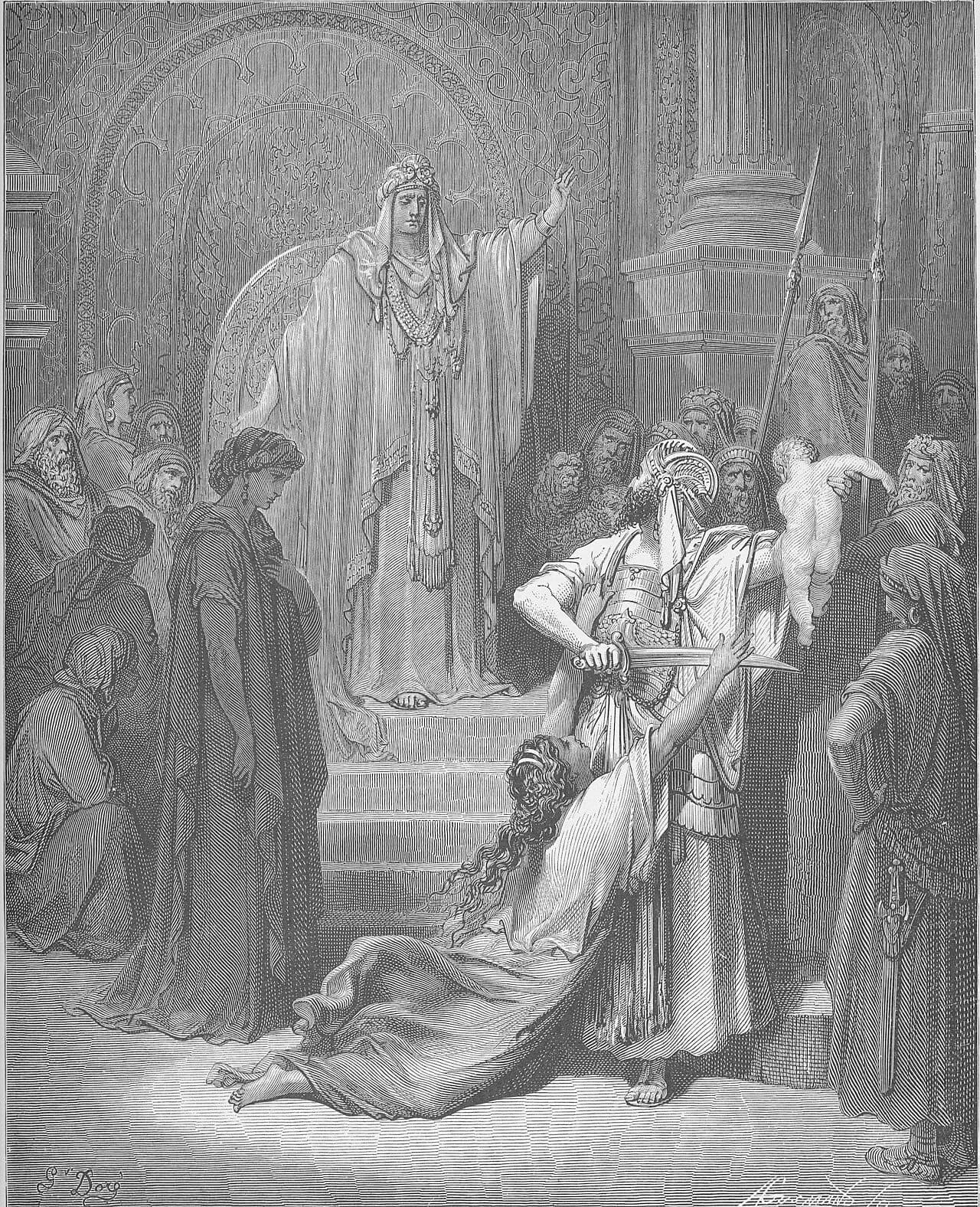
Gustave Doré, The Judgment of Solomon, plate 84 of The Holy Bible (London: Cassell, 1866). Public domain.
Doré drew the moment before the ruling, one mother on her knees catching at the soldier's arm.
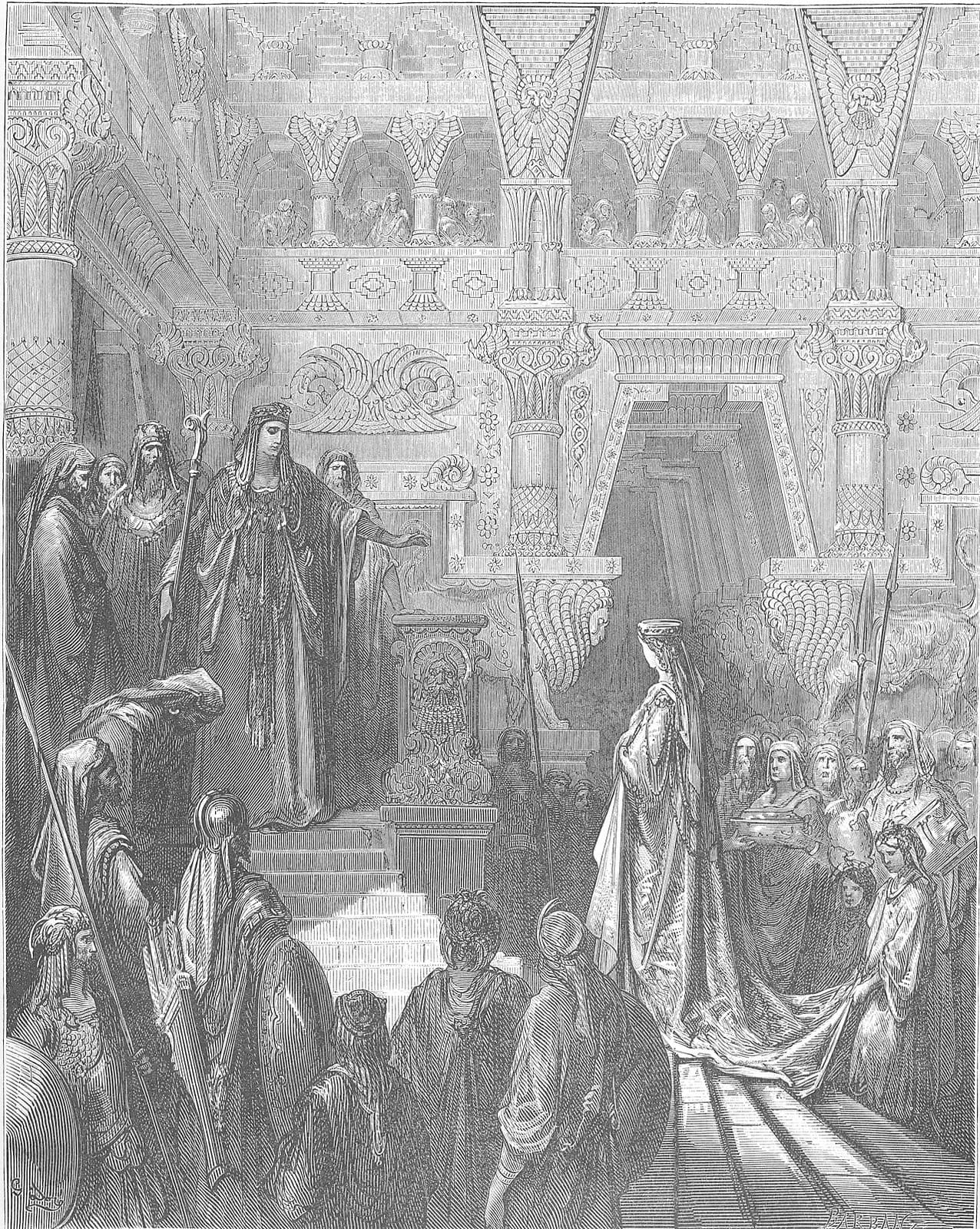
Gustave Doré, Solomon Receives the Queen of Sheba, plate 86 of The Holy Bible (London: Cassell, 1866). Public domain.
Doré set her arrival in a court of winged carvings, the king waiting at the top of a stair.
The oath and the anointing1 Kings 1
Go at once to King David and say, ‘My lord the king, did you not swear to your maidservant, “Surely your son Solomon will reign after me, and he will sit on my throne”? Why then has Adonijah become king?’Nathan's plan turns on a promise David had made and not yet kept.
I will carry out this very day exactly what I swore to you by the LORD, the God of Israel: Surely your son Solomon will reign after me, and he will sit on my throne in my place.”David keeps his word on the very day an older son is feasting as if already crowned.
The kingdom made firm1 Kings 2
And keep the charge of the LORD your God to walk in His ways and to keep His statutes, commandments, ordinances, and decrees, as is written in the Law of Moses, so that you may prosper in all you do and wherever you turn,The first charge laid on the new king is obedience, before any building or wisdom.
Then the king commanded Benaiah son of Jehoiada, and he went out and struck Shimei down, and he died. Thus the kingdom was firmly established in the hand of Solomon.The chapter that opens with that charge closes with Shimei's death, the last of the executions.
The dream at Gibeon1 Kings 3:5 to 15
And now, O LORD my God, You have made Your servant king in my father David’s place. But I am only a little child, not knowing how to go out or come in. Your servant is here among the people You have chosen, a people too numerous to count or number. Therefore give Your servant an understanding heart to judge Your people and to discern between good and evil. For who is able to govern this great people of Yours?”His request comes out of a confession that he is not equal to the throne.
Moreover, I will give you what you did not request—both riches and honor—so that during all your days no man in any kingdom will be your equal. So if you walk in My ways and keep My statutes and commandments, just as your father David did, I will prolong your days.”Only one part of the gift is conditional, and it is the length of his life.
The levy and the building1 Kings 5 to 6
Then King Solomon conscripted a labor force of 30,000 men from all Israel. He sent them to Lebanon in monthly shifts of 10,000 men, so that they would spend one month in Lebanon and two months at home. And Adoniram was in charge of the forced labor. Solomon had 70,000 porters and 80,000 stonecutters in the mountains, not including his 3,300 foremen who supervised the workers.The splendour of the building had a cost in men, and Kings writes down the count.
Albert Barnes, in his Notes on 1 Kings 5:13, held that this was the first time Israel's own people were called to forced labour.
“As for this temple you are building, if you walk in My statutes, carry out My ordinances, and keep all My commandments by walking in them, I will fulfill through you the promise I made to your father David. And I will dwell among the Israelites and will not abandon My people Israel.”In the middle of the work, God makes His presence in the house depend on obedience.
The prayer at the dedication1 Kings 8
And when the priests came out of the Holy Place, the cloud filled the house of the LORD so that the priests could not stand there to minister because of the cloud; for the glory of the LORD filled the house of the LORD.The house is accepted before a word of the prayer is spoken.
But will God indeed dwell upon the earth? Even heaven, the highest heaven, cannot contain You, much less this temple I have built.The builder confesses on the day of dedication that no building can hold the One it is for.
And as for the foreigner who is not of Your people Israel but has come from a distant land because of Your name— for they will hear of Your great name and mighty hand and outstretched arm—when he comes and prays toward this temple, then may You hear from heaven, Your dwelling place, and do according to all for which the foreigner calls to You. Then all the peoples of the earth will know Your name and fear You, as do Your people Israel, and they will know that this house I have built is called by Your Name.The prayer reaches past Israel to people of every nation.
When they sin against You—for there is no one who does not sin—and You become angry with them and deliver them to an enemy who takes them as captives to his own land, whether far or near, and when they come to their senses in the land to which they were taken, and they repent and plead with You in the land of their captors, saying, ‘We have sinned and done wrong; we have acted wickedly,’ and when they return to You with all their heart and soul in the land of the enemies who took them captive, and when they pray to You in the direction of the land that You gave to their fathers, the city You have chosen, and the house I have built for Your Name, then may You hear from heaven, Your dwelling place, their prayer and petition, and may You uphold their cause. May You forgive Your people who have sinned against You and all the transgressions they have committed against You, and may You grant them compassion in the eyes of their captors to show them mercy.Solomon foresees the exile and asks mercy for it in advance.
The second appearance1 Kings 9:1 to 9
And as for you, if you walk before Me as your father David walked, with a heart of integrity and uprightness, doing all I have commanded you, and if you keep My statutes and ordinances, then I will establish your royal throne over Israel forever, as I promised your father David when I said, ‘You will never fail to have a man on the throne of Israel.’The promise of a lasting dynasty is tied to his own obedience.
But if indeed you or your sons turn away from following Me and do not keep the commandments and statutes I have set before you, and if you go off to serve and worship other gods, then I will cut off Israel from the land that I have given them, and I will banish from My presence this temple I have sanctified for My Name. Then Israel will become an object of scorn and ridicule among all peoples.The warning names the exact sin that 1 Kings 11 will record.
The queen of Sheba1 Kings 10:1 to 13
Now when the queen of Sheba heard about the fame of Solomon concerning the name of the LORD, she came to test him with difficult questions.What drew her was a report tied to the name of the LORD.
Blessed be the LORD your God, who has delighted in you to set you on the throne of Israel. Because of the LORD’s eternal love for Israel, He has made you king to carry out justice and righteousness.”A foreign ruler praises Israel's God, the hope of 1 Kings 8:43 met in one visitor.
Ahijah's cloak1 Kings 11:29 to 40
And Ahijah took hold of the new cloak he was wearing, tore it into twelve pieces, and said to Jeroboam, “Take ten pieces for yourself, for this is what the LORD, the God of Israel, says: ‘Behold, I will tear the kingdom out of the hand of Solomon, and I will give you ten tribes.A prophet acts out the division of the kingdom before it happens.
Solomon therefore sought to kill Jeroboam. But Jeroboam arose and fled to Egypt, to Shishak king of Egypt, where he remained until the death of Solomon.Told of the judgment, the king turns his sword on the man named in it.
What Kings Says of Him
Four details a short retelling often loses
HE ASKED TO JUDGE WELL
God named the request discernment to administer justice, in place of long life, wealth or the death of his enemies.
THE HIGH PLACES CAME EARLY
The verse that praises his love for God also records his offerings on the high places.
PHARAOH'S DAUGHTER CAME FIRST
His marriage to Egypt's princess stands before the dream at Gibeon and the founding of the temple.
HIS OWN HOUSE TOOK LONGER
Kings sets the length of his palace directly after the seven years given to God's house.
The law of the king beside the reignDeuteronomy 17:16 to 17
| Deuteronomy forbids | Kings counts | Verse in Kings |
|---|---|---|
| Many horses, or sending the people back to Egypt for them | Horses brought from Egypt and Kue | 1 Kings 10:28 |
| Large amounts of silver and gold | 666 talents of gold a year, and silver counted as nothing | 1 Kings 10:14 and 10:21 |
| Many wives, lest his heart go astray | Seven hundred wives and three hundred concubines | 1 Kings 11:3 |
- Deuteronomy forbids
- Many horses, or sending the people back to Egypt for them
- Kings counts
- Horses brought from Egypt and Kue
- Verse in Kings
- 1 Kings 10:28
- Deuteronomy forbids
- Large amounts of silver and gold
- Kings counts
- 666 talents of gold a year, and silver counted as nothing
- Verse in Kings
- 1 Kings 10:14 and 10:21
- Deuteronomy forbids
- Many wives, lest his heart go astray
- Kings counts
- Seven hundred wives and three hundred concubines
- Verse in Kings
- 1 Kings 11:3
But the king must not acquire many horses for himself or send the people back to Egypt to acquire more horses, for the LORD has said, ‘You are never to go back that way again.’ He must not take many wives for himself, lest his heart go astray. He must not accumulate for himself large amounts of silver and gold.Moses set these limits generations before Israel had a king.
Albert Barnes, in his Notes on 1 Kings 11:1, read the order of 1 Kings 10 and 11 as deliberate. In his reading the writer counts the gold, then the horses, then the wives, with the warning of Moses in mind.
Tyre, Egypt and the Later Record
His neighbours, and what later books remember of him
Hiram of Tyre1 Kings 5 and 9
Pharaoh, Gezer and Shishak1 Kings 9:16 and 14:25 to 26
Pharaoh took Gezer, burned it and gave it as a dowry to his daughter, Solomon's wife, and Solomon rebuilt it with Hazor and Megiddo.
Josiah and the high places2 Kings 23:13
The king also desecrated the high places east of Jerusalem, to the south of the Mount of Corruption, which King Solomon of Israel had built for Ashtoreth the abomination of the Sidonians, for Chemosh the abomination of the Moabites, and for Milcom the abomination of the Ammonites.A later book confirms where the shrines of 1 Kings 11 stood, and who put them there.
Ben Sira's portraitSirach 47:13 to 22
Jesus the son of Sirach, of Jerusalem, gives Solomon a passage of his own in his roll of Israel's famous men. He praises the king who reigned in a time of peace, filled with understanding in his youth, whose songs and proverbs made the countries marvel.
Then he turns: Solomon bowed himself to women, stained his honour and brought wrath on his children, so that the kingdom was divided. He closes on mercy, saying that the Lord would not take away the seed of David and gave a root to David.
The House of Solomon
Eight people of his family, as Samuel and Kings name them
Generation 1
- BathshebaHis mother, given a throne at his right hand.
- AdonijahHis older brother, the son of Haggith.
- The daughter of PharaohHis Egyptian wife, for whom he built a house of her own.
- NaamahHis wife, an Ammonite, the mother of Rehoboam.
- RehoboamHis son, king of Judah for seventeen years.
- TaphathHis daughter, wife of Ben-abinadab.
- BasemathHis daughter, wife of Ahimaaz.
Generation 2
- DavidHis father, king of Israel before him.
A family tree drawn from 2 Samuel 12 and 1 Kings 1 to 14.
The Places of the Reign
Seven places of the reign, four of them in Jerusalem or beside it
about 50 km (31 miles)
- 1Gihon, He rode down on David's mule to be anointed. 1 Kings 1:38
- 2Gibeon, He offered a thousand burnt offerings on its altar. 1 Kings 3:4
- 3Jerusalem, His capital, whose wall he built. 1 Kings 3:1
- 4The temple, Seven years in the building, on the threshing floor of Ornan. 2 Chronicles 3:1
- 5Tyre, Hiram's city on the coast. 1 Kings 5:8
- 6Ezion-geber, His fleet sailed from there to Ophir for gold. 1 Kings 9:26
- 7The Mount of Olives, The ridge east of the city, where the shrines stood. 1 Kings 11:7
Not located: Gihon, Gibeon, The temple, Ezion-geber.
The coastline is simplified; each place stands at its place page's coordinates.
A map of the places in the order the story reaches them, each with what happened there.
Questions the Life Raises
Four questions, with the verses and voices that answer them
Why was David not allowed to build the house?1 Chronicles 22:8 to 10
but this word of the LORD came to me: ‘You have shed much blood and waged great wars. You are not to build a house for My Name because you have shed so much blood on the ground before Me. But a son will be born to you who will be a man of rest. I will give him rest from all his enemies on every side; for his name will be Solomon, and I will grant to Israel peace and quiet during his reign. He is the one who will build a house for My Name. He will be My son, and I will be his Father. And I will establish the throne of his kingdom over Israel forever.’The reason given is the warfare of David's reign, and the peace promised to his son.
Did Solomon write Proverbs, Ecclesiastes and the Song of Songs?Proverbs 25:1; Ecclesiastes 1:1
Proverbs names him at its head and again at its tenth chapter, and it names Agur and King Lemuel as the authors of its last two chapters.
These are additional proverbs of Solomon, which were copied by the men of Hezekiah king of Judah:The book was still being gathered in the reign of a later king of Judah.
The Song of Songs carries his name in its first line.
These are the words of the Teacher, the son of David, king in Jerusalem:The title fits Solomon, and the book never gives his name.
Albert Barnes, on 1 Kings 4:32, wrote that Ecclesiastes would add a hundred or two proverbs to the count if it is Solomon's. He held the Song to be probably one of the thousand and five songs.
Where was Sheba?1 Kings 10:1
“Doubt has arisen whether the ‘queen of Sheba’ was an Ethiopian or an Arabian princess. Both countries profess to have traditions on the subject connecting the queen of Sheba with their history; and in both countries, curiously enough, government by queens was common. But the claims of Arabia decidedly preponderate. The Arabian Sheba was the great spice country of the ancient world; whereas Ethiopia furnished no spices. The Arabian Sheba was an important kingdom. Sheba in Ethiopia was a mere town, subject to Meroe.”
Albert Barnes · Notes, Explanatory and Practical, on the Old and New Testaments (1832-1869) · on 1 Kings 10:1Evangelical
Charles Spurgeon, in Sermon No. 3166, A Greater Than Solomon, said that no one can tell exactly where Sheba lay. He named Arabia for the spices she brought, and noted that the Abyssinians claim her as their queen.
What does 2 Chronicles 7:14 promise, and to whom?2 Chronicles 7:12 to 16
and if My people who are called by My name humble themselves and pray and seek My face and turn from their wicked ways, then I will hear from heaven, forgive their sin, and heal their land.These words are God's answer to Solomon at night, about the house just dedicated and the nation that would pray toward it.
What the Text Leaves Unsaid
Four things Kings does not tell
Kings gives his age neither when he became king nor when he died; he calls himself only a little child.
It records no repentance at the end of his life, and no word of his rejection.
It gives none of the queen of Sheba's questions.
It says nothing of what became of the woman who lied about the child.
One Greater Than Solomon
The son who builds the house, measured by the New Testament
Nathan's promise to David had a near fulfilment and a far one. Solomon built the house, and the everlasting throne waited for another son of David.
He will build a house for My Name, and I will establish the throne of his kingdom forever. I will be his Father, and he will be My son. When he does wrong, I will discipline him with the rod of men and with the blows of the sons of men.Hebrews 1:5 takes these words about Solomon to Christ.
Because of this, I will humble David’s descendants—but not forever.’”The judgment on his house carries its own limit, and the New Testament reads the son of David through it.
Jesus named Solomon twice in His teaching, once for his wisdom and once for his glory.
The Queen of the South will rise at the judgment with this generation and condemn it; for she came from the ends of the earth to hear the wisdom of Solomon, and now One greater than Solomon is here.Jesus sets Himself above the wisest king of Israel.
Yet I tell you that not even Solomon in all his glory was adorned like one of these.Jesus sets a wildflower above the richest king of Israel.
Stephen and the house made with handsActs 7:47 to 48
But it was Solomon who built the house for Him. However, the Most High does not dwell in houses made by human hands. As the prophet says:Stephen answers the charge against him by pointing past the temple Solomon built.
The vine and the fig tree1 Kings 4:25; Micah 4:4
Throughout the days of Solomon, Judah and Israel dwelt securely from Dan to Beersheba, each man under his own vine and his own fig tree.Kings pictures the peace of his reign as a family at rest in its own garden.
And each man will sit under his own vine and under his own fig tree, with no one to frighten him. For the mouth of the LORD of Hosts has spoken.Micah takes the picture of Solomon's reign for the age to come.
Voices on Solomon, Earliest First
Origen, John Chrysostom, Augustine and Matthew Henry
“The Scriptures express astonishment that the queen of Sheba came from ‘the end of the earth to hear Solomon's wisdom.’ When she saw his dinner, his furnishings and the attendants in his place, she was astounded and wholly in a state of wonder.”
Origen of Alexandria · Homilies on the Gospel of Luke 38.6 · on 1 Kings 10:4Patristic
“The son of this David, Solomon by name, was caught by the same snare as his father, and out of complacence to women fell away from the God of his fathers. You see how great an evil it is not to master pleasure, not to upset the ruling principle in nature and for a man to be slave of women. This same Solomon, then, who was formerly righteous and wise but who ran a risk of being deprived of all the kingdom on account of his sin, God permitted to keep the sixth part of the government on account of the renown of his father.”
John Chrysostom · Letter to the Fallen Theodore 2.2 · on 1 Kings 11:13Patristic
“However, in [David's] son Solomon libido was not a passing guest; it reigned as a king. Scripture does not pass this over in silence but blames him as a lover of women. His beginnings were redolent with the desire for wisdom; when he had obtained it through spiritual love, he lost it through carnal love.”
Augustine of Hippo · Christian Instruction 3.21.31 · on 1 Kings 11:1 to 2Patristic
“God's appearing to Solomon was such a sensible confirmation of his faith as should have for ever prevented his worshipping any other god; it was also such a distinguishing favour, and put such an honour upon him, as he ought never to have forgotten, especially considering what God said to him in both these appearances.”
Matthew Henry · Commentary on the Whole Bible · on 1 Kings 11:9Puritan
Where Did Solomon End?
Four readings, each with its holder
Nehemiah 13:26 calls him a king loved by his God. Readers have weighed that verse and the promise to David against 1 Kings 11 in four ways.
Chastened and keptMatthew Henry, Commentary; Albert Barnes, Notes
“God's grace in his people works variously. Thus, though Solomon fell, he was not utterly cast down; what God had said to David concerning him was fulfilled: I will chasten him with the rod of men, but my mercy shall not depart from him, 2 Sam. vii. Though God may suffer those whom he loves to fall into sin, he will not suffer them to lie still in it.”
Matthew Henry · Commentary on the Whole Bible · on 1 Kings 11:13Puritan
Albert Barnes, in his Notes on 1 Kings 11:4, held that Solomon never openly or wholly turned from the LORD. He pointed to the offerings Solomon kept at the temple three times a year.
The strongest point against this reading is 1 Kings 11:9, where the LORD grows angry because Solomon's heart had turned away.
Rejected by GodAugustine, Expositions of the Psalms 127.1
Augustine wrote in his exposition of Psalm 127 that God rejected Solomon. He credited what was good in Solomon's writings to the Spirit who gave it through him.
The strongest point against this reading is the promise of 2 Samuel 7:15 that God's loving devotion would never be removed from David's son.
A question left openAdam Clarke, Commentary on the Bible, on 1 Kings 11:11
Adam Clarke, in his Commentary on the Bible (1832), asked three questions of 1 Kings 11:11 and answered none of them. Was the sentence another warning, might Solomon yet have recovered himself, and was there mercy in it he could have sought?
The point pressed against it is that the reader is given no ground to stand on.
The rabbis on the high placeRashi on 1 Kings 11:7
Rashi, in his commentary on 1 Kings, cites the Talmud's tractate Shabbat and says the high place is called by Solomon's name because he did not protest against his wives.
The strongest point against this reading is 1 Kings 11:5 to 6, which says Solomon followed Ashtoreth and Milcom and did evil in the sight of the LORD.
Books on Solomon
Four works on his life, all in the public domain
Commentary on the Whole Bible, on 1 Kings
Matthew Henry · 1710
Henry comments on the reign from the succession to the burial.
Notes, Explanatory and Practical, on 1 Kings
Albert Barnes · 1832 to 1869
Barnes explains the customs, places and laws behind the verses of the reign.
Commentary on the Bible, on 1 Kings and 1 Chronicles
Adam Clarke · 1832
Clarke gives the Hebrew behind the names, Shelomoh and shalom among them.
The Queen of Sheba, Sermon No. 3351
Charles Spurgeon · 1913
Spurgeon preached on Matthew 12:42 and the two signs Jesus gave, Jonah and the queen of the South.
The Heart That Turned
What his life asks of the reader
The wisdom God gave Solomon did not keep him. His life asks the reader to guard the heart God has given, and to trust the Son of David whose kingdom will never end.
So let your heart be fully devoted to the LORD our God, as it is this day, to walk in His statutes and to keep His commandments.”On the day of the dedication Solomon asks this of the whole nation.
For when Solomon grew old, his wives turned his heart after other gods, and he was not wholeheartedly devoted to the LORD his God, as his father David had been.Kings later finds that Solomon himself fell short of this charge.
Keep studying
Studies9
People7
Show the next 1 title
Places8
Symbols1
Doctrines1