
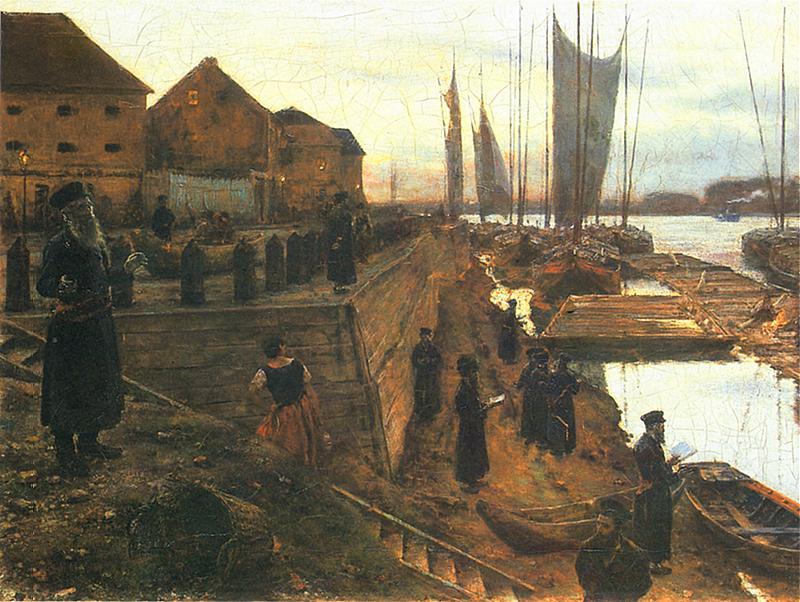
Aleksander Gierymski, Feast of Trumpets, 1890. Public domain.
Psalms 27, 29, 47, 81 and 150 · Subject · Featured Study
Rosh Hashanah in the Psalms
The Talmud names the psalms the Levites sang on Rosh Hashanah. Jewish custom adds Psalm 27 before the day and Psalm 47 before the shofar.
God has ascended amid shouts of joy, the LORD with the sound of the horn.
- Book
- Psalms
- Hold in memory
- Psalm 47:5
A baraita, a code of law and a commentary on the law each gave a psalm its place on the day.
Summary
The rabbis tied psalms to the new year: to the Temple's offerings, to the prayers of the day and to the weeks before it. Christian readers hear one of those psalms, Psalm 47, of the ark and of Christ going up to heaven.
- Psalm 81 was sung at the day's added offering, and Psalm 29 at the afternoon offering
- In the Talmud the ten praises of Psalm 150 match the ten kingship verses of the day
- Psalm 27 is said each day from the start of Elul, the month before the day
The Levites' Psalms on the Day
A teaching in the Talmud names the psalm sung at each of the day's later offerings.
A baraita cited in the Talmud, Rosh Hashanah 30b, asks which psalm the Levites recited at the additional offering of Rosh Hashanah. It answers with the psalm that opens, in the Talmud's words, Sing aloud to God our strength.
Sing for joy to God our strength; make a joyful noise to the God of Jacob.The Berean text numbers this verse Psalm 81:1; the William Davidson Edition of the Talmud prints it as Psalm 81:2, the Hebrew numbering.
For the afternoon offering the same teaching names Psalm 29, quoting its eighth verse.
The voice of the LORD shakes the wilderness; the LORD shakes the Wilderness of Kadesh.The Talmud names Psalm 29 by this verse.
The horn of Psalm 81:3, and how the Talmud reads its moon, are taught on the page of the Feast of Trumpets.
The Psalms of the Season
The Talmud and later law each set a time for these psalms.
Jewish law and custom set psalms before the day and in its prayers.
| Psalm | When it is said | What the source records | Source |
|---|---|---|---|
| Psalm 27 | Daily, from the start of Elul | Said after prayer morning and evening, until Yom Kippur or Shemini Atzeret | Mishnah Berurah, on section 581 |
| Psalm 47 | Before the shofar is blown | Recited seven times by custom | Arukh HaShulchan 585:4 |
| Psalm 150 | In the additional prayer | Its ten praises answer to the ten kingship verses | Talmud, page 32a |
| Psalms 10, 24 and 99 | In the kingship blessing | Verses the rabbis weighed as kingship verses | Talmud, page 32b |
| Psalm 137 | In the remembrance blessing | Psalm 137:7 allowed as a remembrance verse, where Psalm 78:39 and Psalm 106:4 are set aside | Talmud, page 32b |
Kingship, Remembrances and Shofarot
The additional prayer of the day sets verses of Scripture under three heads.
The Mishnah of the same tractate, in its fourth chapter, gives the order of the blessings of the additional prayer. In Rabbi Akiva's order the blessing of Kingship joins the blessing of the day, and the shofar sounds after it, after Remembrances and after Shofarot.
Its next teaching requires no fewer than ten verses for each of the three blessings. The verses begin with the Torah and end with the Prophets.
On page 32b the rabbis also argue over how the verses of Psalm 24:7 to 10 are to be counted.
What the Psalter Leaves Unsaid
Three kinds of later reader made the ties.
No verse of the Psalms in the Berean text names the seventh month or the new year. Each tie between a psalm and the day comes from the Talmud, from later Jewish law and custom, or from modern scholars such as Mowinckel.
The page of the autumn feasts sets the day beside Yom Kippur and Tabernacles.
God Has Ascended: Readings of Psalm 47:5
Three readings of the verse are named, each with its holders.
The horn of the New YearThe Arukh HaShulchan; Sigmund Mowinckel
The Arukh HaShulchan calls the recital of this psalm before the shofar a custom and no command, and notes that some leave it out. Sigmund Mowinckel, in The Psalms in Israel's Worship, held that this use matches the psalm's first meaning. He took that meaning to be a procession, the usual new year rite of the ancient East.
The objection: Alan Cooper notes that Mowinckel turned the later Jewish use of the psalm to his own advantage. No verse of the psalm names the day.
The ark brought up to ZionJohn Wesley
Wesley, in his Explanatory Notes upon the Old Testament, reads the verse literally of the ark, and points to Psalm 68:18, words he takes from the same occasion.
The objection: the psalm itself names no ark and no city.
Christ's ascensionJohn Wesley; Matthew Henry; Charles Spurgeon
Wesley reads the verse mystically of Christ's ascension, since Ephesians 4:8 applies the like words of Psalm 68:18 to it. Henry, in his Commentary on the Whole Bible, says Christ went up as a Mediator, typified by the ark, into heaven itself. Spurgeon, in The Treasury of David, holds that the words are fully applicable to the ascension of the Redeemer.
The objection: no shout and no trumpet are recorded at the ascension. Henry meets it by pointing to the sons of God who shouted for joy.
The King and the Horn
The kingship verses of the day lead to the psalms of the LORD's reign.
Sing praises to God, sing praises; sing praises to our King, sing praises! For God is King of all the earth; sing profound praises to Him. God reigns over the nations; God is seated on His holy throne.The William Davidson Edition prints these as Psalm 47:7 to 9, and the Talmud weighs them among the kingship verses of the day.
The LORD's kingship in Psalms 93 and 95 to 99, and the readings of those psalms, are taught on their own page.
Sources
Scripture is the Berean Standard Bible.
- The Babylonian Talmud, Rosh Hashanah 30b, William Davidson Edition, from Sefaria.
- The Babylonian Talmud, Rosh Hashanah 32a and 32b, William Davidson Edition, from Sefaria.
- Mishnah Rosh Hashanah 4:5 and 4:6, William Davidson Edition, from Sefaria.
- Yechiel Michel Epstein, Arukh HaShulchan, Orach Chaim 585:4, Sefaria Community Translation.
- Israel Meir Kagan, Mishnah Berurah 581:2, Hebrew; with Kitzur Shulchan Arukh 128:2.
- Alan Cooper, The Psalm of the Shofar: Its Use in Liturgy and Its Meaning in the Bible, TheTorah.com, 2014, citing Sigmund Mowinckel, The Psalms in Israel's Worship, translated by D. R. Ap-Thomas (1962), vol. 1 p. 121.
Keep Studying
People and groups1
Symbols1
Go further3