
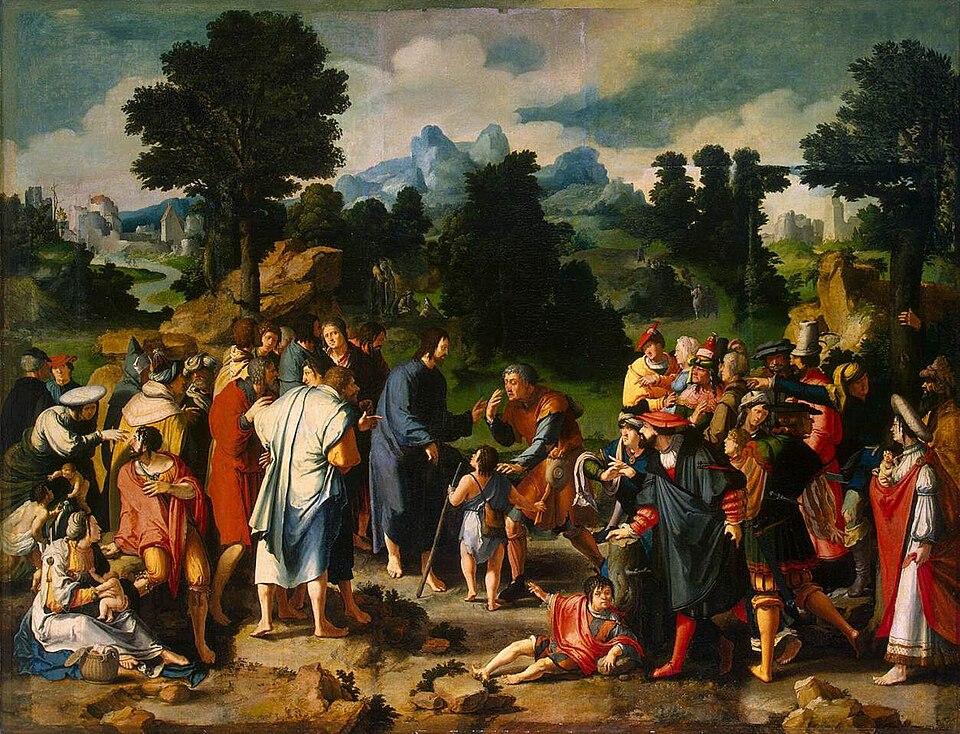
Lucas van Leyden, Healing of the Blind Man of Jericho, 1531. Public domain.
Mark 8:22 to 10:52 · Subject · Featured Study
The Blind Men on the Road
Mark sets a healing of a blind man at each end of the road from Bethsaida to Jericho.
“Go,” said Jesus, “your faith has healed you.” And immediately he received his sight and followed Jesus along the road.
- Book
- Mark
- Hold in memory
- Mark 8:25, Mark 10:52
Bartimaeus was a blind beggar sitting beside the road out of Jericho.
Summary
Mark's middle chapters follow Jesus and the Twelve toward Jerusalem. The disciples learn who He is, and they struggle with what He says about His death.
- Mark alone of the four Gospels tells the healing at Bethsaida.
- Readers have given four answers to why the man at Bethsaida saw by degrees.
- Bartimaeus is the first person in Mark to call Jesus the Son of David.
The Healing in Two Stages
Jesus touched the man at Bethsaida twice before he saw clearly.
So He took the blind man by the hand and led him out of the village. Then He spit on the man’s eyes and placed His hands on him. “Can you see anything?” He asked. The man looked up and said, “I can see the people, but they look like trees walking around.” Once again Jesus placed His hands on the man’s eyes, and when he opened them his sight was restored, and he could see everything clearly.The man answers the question of Jesus with what he saw after the first touch.
J. C. Ryle noted each step Jesus took with the man before his sight came back.
“We do not know the reason of the peculiar means employed by our Lord Jesus Christ, in working the miracle recorded in these verses. We see a blind man miraculously healed. We know that a word from our Lord's mouth, or a touch of His hand would have been sufficient to effect a cure. But we see Jesus taking this blind man by the hand — leading him out of the town — spitting on his eyes — putting His hands on him, and then, and not until then, restoring his sight.”
J.C. Ryle · Expository Thoughts on the Gospels: Mark (lightly modernized text, Grace Gems edition) · on Mark 8:22 to 26Reformed Evangelical
The Road From Bethsaida to Jericho
The word road runs through the scenes between the two healings.
The cross is foretold in each of the three middle scenes.
Each prediction is followed by a failure of the disciples and a word of Jesus about following Him.
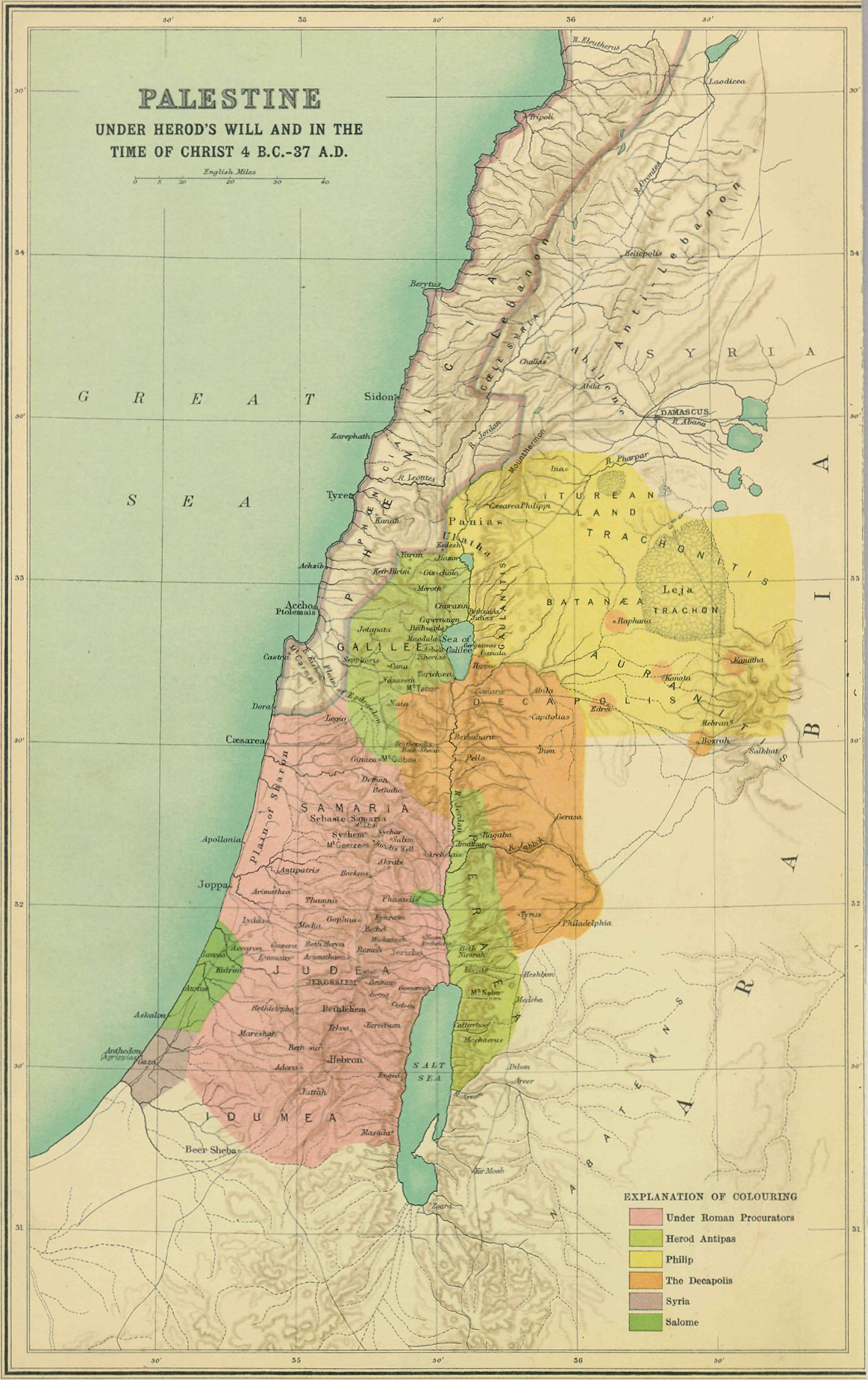
The road runs from Bethsaida north to Caesarea Philippi and then south through Capernaum and Jericho to Jerusalem.
- Known: a score of 800 or more
- Proposed: a score under 500, or a rival site above half the leader's
- The route, in the order the text gives
- 1?Bethsaida, The first of the two healings of the blind. Mark 8:22
- 2Caesarea Philippi, Jesus asked who people said He was. Mark 8:27
- 3Capernaum, Jesus asked what they had argued about on the way. Mark 9:33
- 4Jericho, Bartimaeus received his sight. Mark 10:46
- 5Jerusalem, The end of the road, where Jesus said He would be condemned. Mark 10:33
Base map: Palestine in the time of Christ, George Adam Smith, Atlas of the Historical Geography of the Holy Land (1915), public domain. Places with a place page stand at its coordinates and the others at the point cited for each, set on the plate by Jerusalem and Tyre, as the plate prints them.
Each ring follows the OpenBible.info identification score out of 1,000, as the key gives it, and the site of Bethsaida is the least sure of the five.
Eyes That Do Not See
Just before Bethsaida Jesus asked His disciples whether they still could not see.
Aware of their conversation, Jesus asked them, “Why are you debating about having no bread? Do you still not see or understand? Do you have such hard hearts? ‘Having eyes, do you not see? And having ears, do you not hear?’ And do you not remember?Jesus puts the question of sight to the disciples in the boat, one scene before He opens a blind man's eyes.
On the road Peter named Jesus the Christ (Mark 8:29). Yet when Jesus spoke of His death, Peter took Him aside and rebuked Him (Mark 8:32 to 33).
After the second prediction the disciples did not understand and were afraid to ask (Mark 9:32). On the way they argued about which of them was the greatest (Mark 9:34).
“What do you want Me to do for you?” He inquired.Jesus asks James and John the same question He will ask Bartimaeus a few verses later.
James and John asked for the seats at His right and His left in His glory (Mark 10:37). Bartimaeus asked Him for one thing, to see again (Mark 10:51).
The Beggar Who Called Him Son of David
A blind beggar at Jericho gives Jesus a royal title.
When he heard that it was Jesus of Nazareth, he began to cry out, “Jesus, Son of David, have mercy on me!” Many people admonished him to be silent, but he cried out all the louder, “Son of David, have mercy on me!”The title names the king promised from the line of David (2 Samuel 7:12 to 13).
Matthew Henry linked the cry to the promise that the eyes of the blind would be opened (Isaiah 35:5).
“Misery is the object of mercy, his own miserable case he recommends to the compassion of the Son of David, of whom it was foretold, that, when he should come to save us, the eyes of the blind should be opened, Isa. xxxv. In coming to Christ for help and healing, we should have an eye to him as the promised Messiah, the Trustee of mercy and grace.”
Matthew Henry · Commentary on the Whole Bible · on Mark 10:47Puritan
Gregory the Dialogist, the pope known as Gregory the Great, read the beggar's place beside the road as a picture of a believer who knows the way and must still ask for light.
“This blind man is rightly described as sitting beside the road and being a beggar; for the Truth himself says: ‘I am the way.’ Therefore whoever does not know the brightness of eternal light is blind; but if he already believes in the Redeemer, he sits beside the way; if, however, he already believes but neglects to ask that he might receive eternal light, and ceases from prayers, the blind man indeed sits beside the way but does not beg at all.”
Gregory the Dialogist · Forty Gospel Homilies, Homily 2 · on Mark 10:47Patristic
Three Tellings of the Healing at Jericho
Matthew, Mark and Luke place the healing at Jericho and tell it in three ways.
Matthew: two blind menMatthew 20:29 to 34
And there were two blind men sitting beside the road. When they heard that Jesus was passing by, they cried out, “Lord, Son of David, have mercy on us!”Matthew counts two men beside the road where Mark names one.
Luke: as Jesus drew nearLuke 18:35 to 43
As Jesus drew near to Jericho, a blind man was sitting beside the road, begging.Luke sets the healing on the approach to Jericho, and Mark sets it on the way out.
How the tellings agreeTheophylact of Ohrid, Commentary on Mark, on Mark 10:46
Theophylact of Ohrid explained why the counts differ.
“Matthew speaks of two blind men: and perhaps there were two who were healed; but probably one of them attracted more attention, the one whom Mark now mentions.”
Theophylact of Ohrid · Commentary on Mark · on Mark 10:46Patristic
The Words for Sight and the Road
Four Greek words carry the two healings and the road between them.
τυφλός typhlos
50 uses in the canon
Blind, the word for both men, Bartimaeus and the man at Bethsaida.
ἀναβλέπω anablepō
25 uses in the canon
To look up or to see again, used of the man at Bethsaida and of Bartimaeus.
διαβλέπω diablepō
3 uses in the canon
To see clearly, the second stage of the healing at Bethsaida.
ὁδός hodos
101 uses in the canon
Road or way, where Jesus questions the disciples and where Bartimaeus follows Him.
Why Did Sight Come by Degrees?
From Jerome to Spurgeon, readers have explained the second touch in four ways.
Sight in step with faithTheophylact of Ohrid, Commentary on Mark, on Mark 8:24 to 25
“But the blind man himself also did not have perfect faith. Therefore the Lord does not give him sight all at once, but gradually, as to a man whose faith is not complete, for healings are given in proportion to faith.”
Theophylact of Ohrid · Commentary on Mark · on Mark 8:24 to 25Patristic
The objection: Mark says nothing of the man's faith, and the people who brought him were the ones who begged Jesus to touch him (Mark 8:22).
A slow cure to build weak faithAlbert Barnes, Notes on the New Testament, on Mark 8:24
Albert Barnes held that Jesus did not restore the man's sight at once, so that He might strengthen the man's faith.
In his reading the partial sight was proof that Jesus could heal the man wholly, and it led him to trust again.
The objection: the text gives no reason for the second touch, and Jesus asks only whether the man can see (Mark 8:23).
A picture of the disciplesKlostermann, as The Expositor's Greek Testament reports him, on Mark 8:26; Hilgenfeld, as H. A. W. Meyer reports him, on Mark 8:22 to 26
The Expositor's Greek Testament reports Klostermann's reading. In it the slow return of sight stands for the slowness of the Twelve to see who Jesus is.
H. A. W. Meyer reports Hilgenfeld's view that Mark meant the healing to show the disciples passing from blindness to sight.
The objection: Meyer answered that the reading makes the healing an invention of Mark.
A picture of the soulJerome, Tractate on the Gospel of Mark, Homily 5; Charles Spurgeon, Sermon 701, 1866
“Christ laid his hands upon his eyes that he might see all things clearly, so through visible things he might understand things invisible, which the eye has not seen, that after the film of sin is removed, he might clearly behold the state of his soul with the eye of a clean heart.”
Jerome · Tractate on the Gospel of Mark, Homily 5 · on Mark 8:25Patristic
Charles Spurgeon preached the miracle in 1866 as the healing of a darkened understanding, brought into the light by degrees.
The objection: the reading draws a lesson the passage leaves unstated, and it says nothing of the man himself.
From Jericho to the City
The beggar's royal title leads into the next scene in Mark.
At the entry into the city the crowd hails the coming kingdom of our father David (Mark 11:9 to 10).
Sources
Scripture is the Berean Standard Bible.
- J. C. Ryle, Expository Thoughts on the Gospels: Mark (1857), on Mark 8:22 to 26.
- Matthew Henry, Commentary on the Whole Bible (1710), on Mark 10:47.
- Gregory the Dialogist (Gregory the Great), Forty Gospel Homilies, Homily 2, on the blind man near Jericho.
- Theophylact of Ohrid, Commentary on Mark, on Mark 8:24 to 25 and Mark 10:46.
- Albert Barnes, Notes, Explanatory and Practical, on the New Testament, on Mark 8:24.
- Jerome, Tractate on the Gospel of Mark, Homily 5, on Mark 8:25.
- The Expositor's Greek Testament, on Mark 8:26, reporting Klostermann.
- H. A. W. Meyer, Critical and Exegetical Handbook to the Gospels of Mark and Luke, on Mark 8:22 to 26, reporting Hilgenfeld.
- Charles Spurgeon, Metropolitan Tabernacle Pulpit, Sermon 701, Seeing and Not Seeing, or Men as Trees Walking (1866).
- Strong's lexicon entries g5185, g308, g1227 and g3598, with their counts of uses.
- OpenBible.info Bible-Geocoding-Data, ancient.jsonl, the identification scores of Bethsaida and Caesarea Philippi.
Keep Studying
Read it5
Symbols1
People and groups2
Doctrines2
Go further7