
Genesis 4:16 to 5:32 · Subject · Featured Study
The Two Lines of Cain and Seth
The descendants of Adam through Cain and through Seth, which Genesis 4 and 5 record and Luke 3 carries on to Jesus.
Two sons of Adam each father a line, and each line has an Enoch and a Lamech.
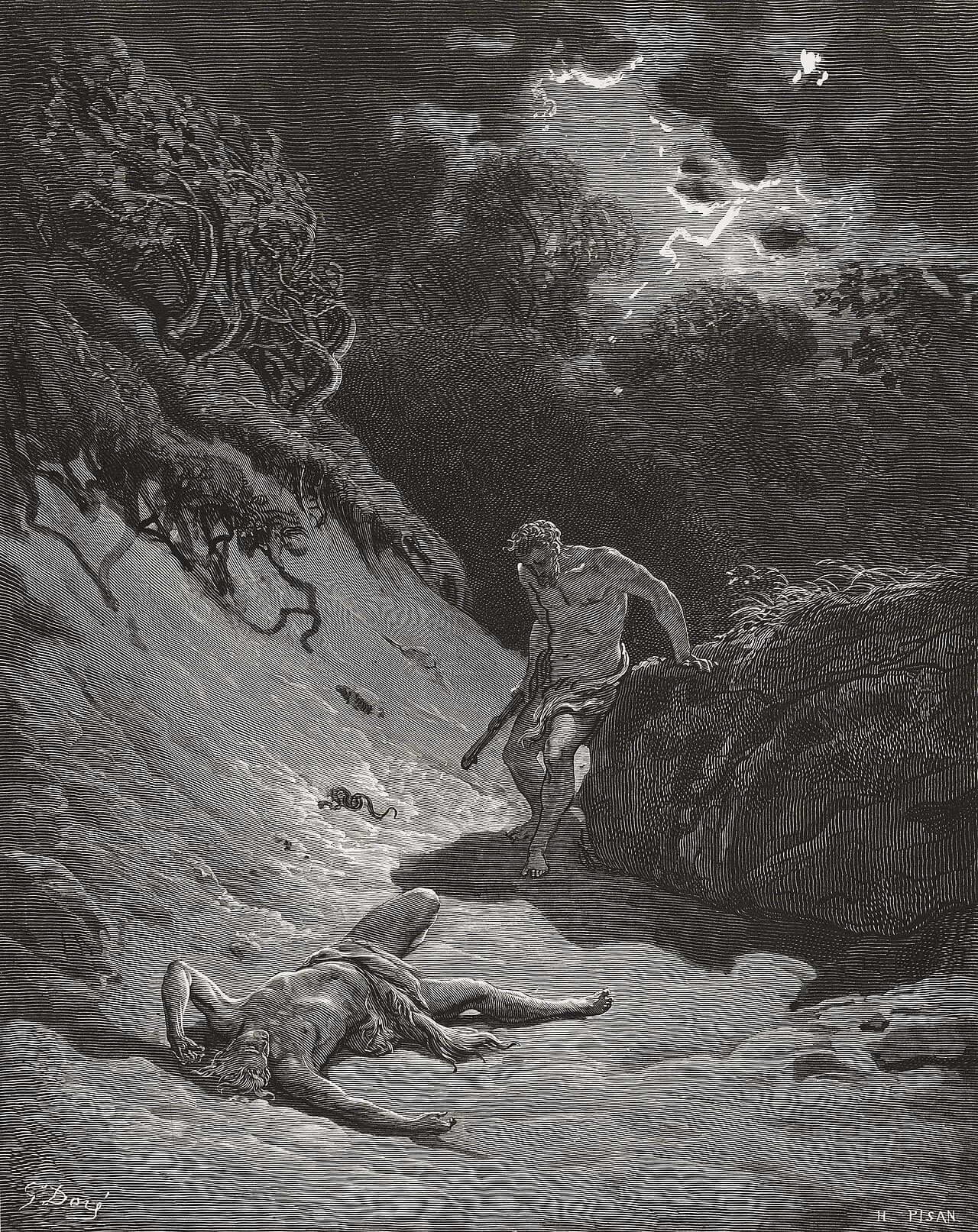
Gustave Doré, Cain Slays Abel, 1866. Public domain, via Wikimedia Commons.
THE ARTWORKDoré engraved Genesis 4:8, with the body of Abel in the light of the open ground and Cain walking off toward the shadow of the rocks. Both lines of Genesis 4 and 5 go back to this scene, one through the killer and the other through the son born in the dead man's place.
Summary
Genesis 4 traces Cain's descendants to the eighth generation from Adam, and Genesis 5 traces Seth's to Noah and his three sons.
- Cain builds a city, and his descendants are the first herdsmen in tents, musicians and smiths.
- Cain's Lamech boasts of a killing, and Seth's Lamech names Noah in hope of comfort.
- Cain's Enoch gives his name to a city, and Seth's Enoch walks with God until God takes him.
- Readers differ on whether the two lists are two lines set in contrast or two forms of one list.
Two Sons, Two Lines
Genesis 4:16 to 5:3, from Cain's going out to Seth's birth
The record of Cain's family opens where he settled.
So Cain went out from the presence of the LORD and settled in the land of Nod, east of Eden. And Cain had relations with his wife, and she conceived and gave birth to Enoch. Then Cain built a city and named it after his son Enoch. Now to Enoch was born Irad, and Irad was the father of Mehujael, and Mehujael was the father of Methusael, and Methusael was the father of Lamech.Five generations after Cain are named in these verses.
The last father named in Cain's line speaks to his two wives in verse.
Then Lamech said to his wives: “Adah and Zillah, hear my voice; wives of Lamech, listen to my speech. For I have slain a man for wounding me, a young man for striking me. If Cain is avenged sevenfold, then Lamech seventy-sevenfold.”Lamech turns the LORD's protection of Cain into a claim of greater vengeance for himself.
The chapter then returns to Adam and Eve.
And Adam again had relations with his wife, and she gave birth to a son and named him Seth, saying, “God has granted me another seed in place of Abel, since Cain killed him.”Eve gives the credit for this birth to God.
Genesis 5 opens a new record of Adam's descendants with his creation in God's likeness.
This is the book of the generations of Adam. In the day that God created man, He made him in His own likeness. Male and female He created them, and He blessed them. And in the day they were created, He called them “man.” When Adam was 130 years old, he had a son in his own likeness, after his own image; and he named him Seth.Adam and Seth open the ten generations that end with Noah.
The Two Lines Side by Side
Ten generations from Adam in Genesis 4:17 to 5:32
| Generation | Cain's line | Seth's line | What the text says |
|---|---|---|---|
| 1 | Adam, Genesis 4:1 | Adam, Genesis 5:3 | Adam fathers Cain and Abel, and then Seth after Abel's death. |
| 2 | Cain, Genesis 4:1 | Seth, Genesis 4:25 | Cain kills his brother, and Seth is named as another seed in Abel's place. |
| 3 | Enoch, Genesis 4:17 | Enosh, Genesis 4:26 | Cain builds a city and names it after Enoch; in the days of Enosh men begin to call upon the name of the LORD. |
| 4 | Irad, Genesis 4:18 | Kenan, Genesis 5:9 | Kenan lives 910 years. |
| 5 | Mehujael, Genesis 4:18 | Mahalalel, Genesis 5:12 | Mahalalel lives 895 years. |
| 6 | Methusael, Genesis 4:18 | Jared, Genesis 5:15 | Jared lives 962 years. |
| 7 | Lamech, Genesis 4:18 | Enoch, Genesis 5:18 | Cain's Lamech takes two wives and boasts of a killing; Seth's Enoch walks with God, and God takes him away. |
| 8 | Jabal, Jubal, Tubal-cain and Naamah, Genesis 4:20 to 22 | Methuselah, Genesis 5:21 | Jabal fathers herdsmen in tents, Jubal players of harp and flute, and Tubal-cain forges bronze and iron; Methuselah lives 969 years, the longest life in Genesis 5. |
| 9 | None named | Lamech, Genesis 5:25 | Seth's Lamech names his son Noah and hopes he will bring comfort from the toil of the cursed ground. |
| 10 | None named | Noah, Genesis 5:29 | Noah becomes the father of Shem, Ham and Japheth after he is 500 years old. |
- Generation
- 1
- Cain's line
- Adam, Genesis 4:1
- Seth's line
- Adam, Genesis 5:3
- What the text says
- Adam fathers Cain and Abel, and then Seth after Abel's death.
- Generation
- 2
- Cain's line
- Cain, Genesis 4:1
- Seth's line
- Seth, Genesis 4:25
- What the text says
- Cain kills his brother, and Seth is named as another seed in Abel's place.
- Generation
- 3
- Cain's line
- Enoch, Genesis 4:17
- Seth's line
- Enosh, Genesis 4:26
- What the text says
- Cain builds a city and names it after Enoch; in the days of Enosh men begin to call upon the name of the LORD.
- Generation
- 4
- Cain's line
- Irad, Genesis 4:18
- Seth's line
- Kenan, Genesis 5:9
- What the text says
- Kenan lives 910 years.
- Generation
- 5
- Cain's line
- Mehujael, Genesis 4:18
- Seth's line
- Mahalalel, Genesis 5:12
- What the text says
- Mahalalel lives 895 years.
- Generation
- 6
- Cain's line
- Methusael, Genesis 4:18
- Seth's line
- Jared, Genesis 5:15
- What the text says
- Jared lives 962 years.
- Generation
- 7
- Cain's line
- Lamech, Genesis 4:18
- Seth's line
- Enoch, Genesis 5:18
- What the text says
- Cain's Lamech takes two wives and boasts of a killing; Seth's Enoch walks with God, and God takes him away.
- Generation
- 8
- Cain's line
- Jabal, Jubal, Tubal-cain and Naamah, Genesis 4:20 to 22
- Seth's line
- Methuselah, Genesis 5:21
- What the text says
- Jabal fathers herdsmen in tents, Jubal players of harp and flute, and Tubal-cain forges bronze and iron; Methuselah lives 969 years, the longest life in Genesis 5.
- Generation
- 9
- Cain's line
- None named
- Seth's line
- Lamech, Genesis 5:25
- What the text says
- Seth's Lamech names his son Noah and hopes he will bring comfort from the toil of the cursed ground.
- Generation
- 10
- Cain's line
- None named
- Seth's line
- Noah, Genesis 5:29
- What the text says
- Noah becomes the father of Shem, Ham and Japheth after he is 500 years old.
Zera, the Other Seed
Zera, shat and Shet in Genesis 4:25, and the name Noah in Genesis 5:29
Eve's word for Seth is zera, seed or offspring.
And I will put enmity between you and the woman, and between your seed and her seed. He will crush your head, and you will strike his heel.”The same noun names the woman's offspring here, the one who will crush the serpent's head.
In Genesis 4:25 the verb shat, he has appointed, stands just after the name Shet, Seth, and sounds like it.
Jerome, in his Hebrew Questions on Genesis, explains the name by that verb and says God had set Seth in Abel's place.
Noah's name in Genesis 5:29 is Noach, and his father's words use the verb nacham, he will comfort us.
Adam Clarke, in his Commentary on the Bible, derives the name from nuach, to rest, where others derive it from nacham.
What the Text Leaves Unsaid
Cain's wife, Lamech's victim, the end of Cain's line and the end of Enoch
Genesis does not name Cain's wife or say whose daughter she was.
And after he had become the father of Seth, Adam lived 800 years and had other sons and daughters.Adam's other sons and daughters are the only people the text supplies.
The next silence is in Lamech's speech of Genesis 4:23.
“This passage is extremely obscure. We know not whom he slew, or on what occasion: neither what ground he had to be so confident of the Divine protection.”
John Wesley · Explanatory Notes upon the Old Testament · on Genesis 4:23Evangelical
Basil of Caesarea, in his Letter 260, rejects the reading in which Lamech killed Cain, and holds that Lamech killed two men.
Cain's line stops with Lamech's four children, and Genesis records no age and no death for anyone in it.
Of Enoch's end Genesis says only that God took him away.
By faith Enoch was taken up so that he did not see death: “He could not be found, because God had taken him away.” For before he was taken, he was commended as one who pleased God.Hebrews reads the taking as a passage without death.
Rashi, in his commentary on Genesis, reads the taking as an early death, sent before a righteous man could turn to wickedness.
The Seed Through Seth
Luke 3:36 to 38 and 1 John 3:12
Luke gives the ancestry of Jesus through Seth's line, and Cain's line has no place in it.
the son of Cainan, the son of Arphaxad, the son of Shem, the son of Noah, the son of Lamech, the son of Methuselah, the son of Enoch, the son of Jared, the son of Mahalalel, the son of Cainan, the son of Enosh, the son of Seth, the son of Adam, the son of God.The line given in Abel's place is the line through which the woman's offspring of Genesis 3:15 came.
The New Testament names Cain once more as the pattern of hatred between brothers.
Do not be like Cain, who belonged to the evil one and murdered his brother. And why did Cain slay him? Because his own deeds were evil, while those of his brother were righteous.Three Voices on the Two Lines
Bede, Matthew Henry and John Wesley, earliest first
Bede, in his Homilies on the Gospels, reads Enoch's place as the seventh from Adam as a sign of the Lord's conception by the Holy Spirit.
Matthew Henry, in his Commentary on the Whole Bible, sets Cain's city on earth against the tents of those who looked for a heavenly city.
John Wesley, in his Explanatory Notes upon the Old Testament, reads Genesis 4:26 as the start of worship in public assemblies.
Contrast or Common Source
Genesis 4:17 to 18 beside Genesis 5:6 to 32, and the sons of God of Genesis 6:2
Several names in Cain's line sound like names in Seth's: Irad and Jared, Mehujael and Mahalalel, Methusael and Methuselah.
Readers ask whether the two lists are two families or one family remembered twice, and whether Genesis 6:2 joins them in marriage.
Two lines set in contrastJohn Wesley; Charles Spurgeon
John Wesley, in his Explanatory Notes upon the Old Testament, says Cain's son Enoch bore the name of the Enoch who walked with God but not his character.
Charles Spurgeon, in his sermon Enoch of 1876, sets the Enoch who walked with God apart from the other Enoch of the line of Cain.
The objection: the names of the two lists match in sound and in order, which a contrast between two families does not explain.
Two forms of one listJohn Skinner
John Skinner, in A Critical and Exegetical Commentary on Genesis of 1910, proposes that the Cainite list and the core of the Sethite list are variants of a single original. He credits Buttmann's Mythologus of 1828 with first noticing the likeness of the names.
Sons of Seth in Genesis 6:2Ephrem the Syrian; Augustine; Adam Clarke
Now when men began to multiply on the face of the earth and daughters were born to them, the sons of God saw that the daughters of men were beautiful, and they took as wives whomever they chose.Ephrem the Syrian, in his Commentary on Genesis, names both lines in this verse.
“Because the sons of Seth were going into the daughters of Cain, they turned away from their first wives whom they had previously taken.”
Ephrem the Syrian · Commentary on Genesis 6.3.3 · on Genesis 6:2Patristic
Augustine, in The City of God, reads the two phrases as two peoples. Adam Clarke, in his Commentary on the Bible, takes the sons of God as Seth's worshipping line in his notes on Genesis 4:26 and 6:4.
The objection: the daughters of Genesis 6:1 are born to all mankind, and the sons of God of Job 1:6 stand before the LORD.
Michael S. Heiser, in his article on the ancient Near Eastern context of Genesis 6:1 to 4 of 2015, holds that no human reading of the sons of God fits that context.
MannaFest's own tradition, Wesleyan-Pentecostal, holds the Watchers reading of Genesis 6:1 to 4, which its page The Watchers and the Nephilim sets out.
Books on the Two Lines
Three works that read Genesis 4 and 5 at length
The City of God, Book 15
Augustine of Hippo · c. 426
Augustine traces the two lines as the beginnings of the two cities his work describes.
Enoch, Sermon 1307
Charles Spurgeon · 1876
Spurgeon preached on Enoch from three passages of Scripture, which he called all the authentic information there is on him.
A Critical and Exegetical Commentary on Genesis
John Skinner · 1910
Skinner sets the names of the two lists in a table and weighs where they came from.
Read it free at the Internet ArchiveCalling on the Name of the LORD
Seth's line begins with worship.
And to Seth also a son was born, and he called him Enosh. At that time men began to call upon the name of the LORD.Paul names the Lord on whom the reader is to call, and he names Him as Jesus.
that if you confess with your mouth, “Jesus is Lord,” and believe in your heart that God raised Him from the dead, you will be saved. For with your heart you believe and are justified, and with your mouth you confess and are saved. It is just as the Scripture says: “Anyone who believes in Him will never be put to shame.” For there is no difference between Jew and Greek: The same Lord is Lord of all, and gives richly to all who call on Him, for, “Everyone who calls on the name of the Lord will be saved.”Keep studying
Peoples and groups2
Symbols1