
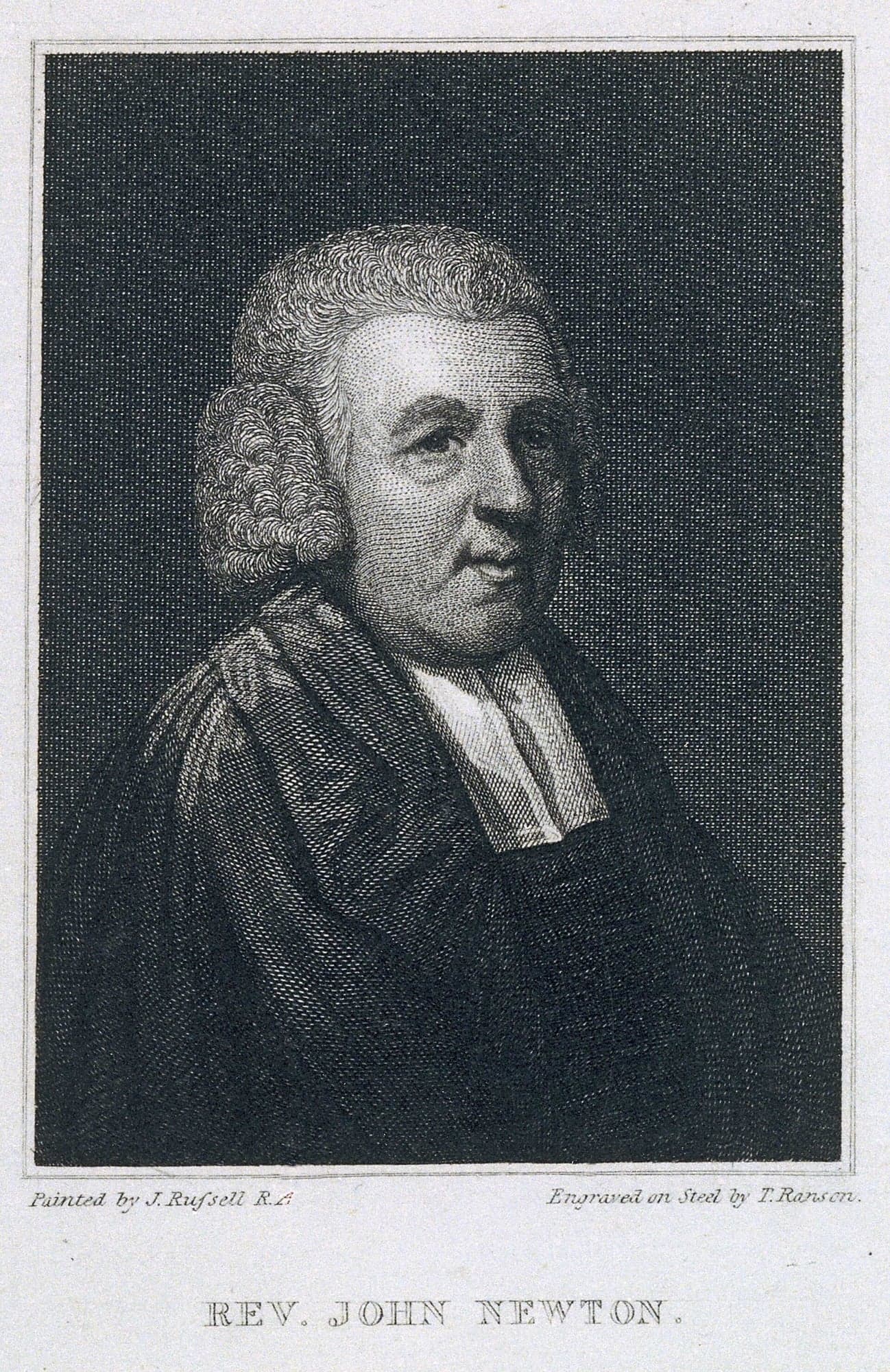
Rev. John Newton, Thomas Frazer Ranson after John Russell, early 19th century. Public domain.
Liverpool, Olney and London, 1725 to 1807 · Person · Featured Study
John Newton
He sailed in the slave trade, and later he served as a minister of the Church of England until his death in 1807.
He commanded slave ships after his conversion, and in 1788 he called the trade a business at which his heart now shuddered.
Remember that you were slaves in the land of Egypt, and the LORD your God redeemed you; that is why I am giving you this command today.
Remember that you were slaves in the land of Egypt, and the LORD your God redeemed you; that is why I am giving you this command today.
- Born
- 24 July 1725
- Died
- 21 December 1807; buried in the vault of St Mary Woolnoth on 31 December
- Family
- father: a commander in the Mediterranean trade, not named in the Narrative; wife: Mary Catlett, married 1 February 1750, died 15 December 1790
- Places
- the Plantanes, off the coast of Sierra Leone, Liverpool, Olney, St Mary Woolnoth, London
Summary
John Newton was born in 1725 and went to sea with his father at eleven. He was forced into the navy and flogged after he deserted. For about eighteen months he lived as a captive among slave traders in West Africa. A storm at sea in March 1748 began his return to God, yet he ran slave ships until 1754. He was made a minister in 1764. He served sixteen years at Olney and the rest of his life in London, and in 1788 he confessed his part in the slave trade in print.
- His hymn that opens "Amazing grace" was first printed in 1779, in the hymn book he made with William Cowper.
- His Narrative says he felt no doubt about the slave trade while he was in it.
- His epitaph, which he wrote himself, calls him "A servant of slaves in Africa".
Remember You Were a Slave
Deuteronomy 15 tells Israel to remember that it was a slave in Egypt, and 1 Chronicles 17 is the text of Amazing Grace.
No verse of Scripture names him. Spurgeon tells, from William Jay's autobiography, that Newton wrote Deuteronomy 15:15 in very large letters over the desk where he wrote his sermons.
The question of this life is how a man saved from the sea stayed on in the slave trade. His own Narrative and his later Thoughts answer it in two different ways.
Then King David went in, sat before the LORD, and said, “Who am I, O LORD God, and what is my house, that You have brought me this far?Hymn 41 of his hymn book is set on this verse and the next.
The Life in Order
His Narrative gives the years at sea, and the later Life gives the rest.
Six years passed between the storm and his last voyage in the slave trade.
- 24 July 1725BirthNarrative, Letter 1
- 11 July 1732His mother's deathThe same letter
- No date givenPressed into the navyNarrative
- After his desertionFloggedNarrative, on the Harwich
- 1745First sight of GuineaThoughts (1788), page 3
- About eighteen monthsA captive on the coastThoughts (1788), page 2
- March 1748The stormNarrative, page 43
- May 1748Home againThoughts (1788), page 3
- 1 February 1750MarriageHis epitaph
- August 1750First commandNarrative
- 1754The fitNarrative, page 70
- 1755Customs postNarrative, the last letter
- 29 April 1764OrdainedLife of 1830, page 79
- 1779The hymn bookIts title page
- After OlneyRector in LondonLife of 1830, page 84
- 1788ThoughtsThe book's title page
- 15 December 1790Mary's deathThe epitaph
- 21 December 1807DeathLife of 1830, page 110
Each step of the life stands with its witness.
March 1748, May 1748, 1 February 1750, August 1750, 1754, 1755, 29 April 1764, 1779 and 4 more
From the Sea to the London Pulpit
His Narrative tells the years at sea, his Thoughts tell the trade, and the Life tells the years of his ministry.
Newton was born in 1725. His mother died when he was not yet seven, and his father was then at sea as a commander in the Mediterranean trade.
As a young man he was impressed into the navy and put aboard the Harwich man-of-war. He deserted, was brought back, and was "publicly stripped and whipped" and degraded from his office.
He was let go from the navy into a Guinea ship in exchange for two of its men, and he stayed on the coast of Africa. Years later, in his Thoughts, he wrote that for about eighteen months he was, "in effect, though without the name, a Captive and a Slave".
On the voyage home a storm nearly sank the ship. He kept the day ever after, 10 March in the old style and 21 March in the new. On that day, he wrote, "the Lord sent from on high and delivered me out of deep waters."
He reached Liverpool in May 1748 and went back to Africa as mate of a ship. In 1750 he married Mary Catlett, and in August he sailed from Liverpool as a commander. He made three voyages to the Windward Coast for slaves.
In 1754, two days before he was to sail again, he was seized with a fit, and the doctors told him not to go. He resigned his command, and in 1755 he became tide-surveyor at Liverpool.
He was ordained deacon in 1764 and took the curacy of Olney, where he stayed nearly sixteen years. The poet William Cowper lived there, and the two wrote the Olney Hymns, printed in 1779.
He then became rector of St Mary Woolnoth in London. Later he published Thoughts upon the African Slave Trade, and he died in 1807.
Read John Newton and Amazing Grace, the story of his turning
The Narrative and the Thoughts
His own two accounts, twenty-four years apart, judge the slave trade differently.
His Authentic Narrative is a set of letters to the Rev. T. Haweis. The Life printed by the American Tract Society in 1830 gives the letters and adds the years at Olney and in London.
In the Narrative he wrote that while he was in the trade he "never had the least scruple as to its lawfulness". He also wrote that he thought of himself as "a sort of gaoler or turnkey" and was sometimes shocked by the chains and shackles.
In the Thoughts he wrote that silence "would, in me, be criminal". He put Matthew 7:12 on the title page of the Thoughts.
In Their Own Words
His hymn, two judgments on the slave trade, and his epitaph.
John Newton (1725 to 1807)
Olney Hymns, in Three Books (London, 1779), book 1, hymn 41, Faith's review and expectation, page 53
Faith's review and expectation
“Amazing grace! (how sweet the sound) That sav'd a wretch like me! I once was lost, but now am found, Was blind, but now I see.”
Anglican evangelical
About this saying1 paragraph
Hymn 41 of the book, printed in London in 1779, is set on 1 Chronicles 17:16 and 17 under the title Faith's review and expectation.
A business at which my heart now shudders1 quotation, 1 paragraph
He wrote this at the opening of Thoughts upon the African Slave Trade in 1788, thirty-four years after his last voyage.
Till a considerable time afterward1 quotation, 1 paragraph
He wrote this in the Narrative of 1764, of the storm of March 1748.
A servant of slaves in Africa1 quotation, 1 paragraph
Before his death in 1807 he left this epitaph in a letter for his executors, to be put on a plain marble tablet near the vestry door of his church.
The People Around Him
The sources name his wife, the poet who shared his parish, and the men he served and wrote to.
Mary Catlett is the one person named in his epitaph besides himself.
| Person | Tie to Newton | The witness |
|---|---|---|
| His father | He took the boy to sea at eleven. | Narrative's opening |
| Mary Catlett | His wife for forty years. | The tablet he planned |
| The trader of the Plantanes | Newton served him on the largest of the Plantane islands, and the trader was much under the direction of a woman who lived with him as a wife. | Narrative |
| T. Haweis | The Narrative was written as letters to him. | Life of 1830, the note before Letter 1 |
| William Cowper | The friend whose verses share the hymn book. | The book's preface |
| John Thornton | His friend, who presented him to his London parish. | Life of 1830 |
Cowper's hymn Light shining out of darkness stands in Book 3 of the same collection.
The Places of His Life
His life ran from the coast of Africa to Liverpool, then to Olney and London.
The coast of Africa holds both his captivity and his trade.
| Place | What the sources say | The witness |
|---|---|---|
| The Plantanes | He lived on the largest of these low sandy islands with the trader he served. | Narrative |
| Between Sierra Leone and Cape Mount | White men were settled there to buy slaves, and he lived among them. | Thoughts (1788), pages 2 and 3 |
| Liverpool | His home port, first at sea and then ashore. | Narrative, letters 12 to 14 |
| Olney | His first parish. | Life, page 79 |
| St Mary Woolnoth, London | His church to the end, and his grave. | Life, page 110 |
What He Confessed
In the Thoughts he named his own part in the slave trade and called his confession too late.
Newton wrote that he was bound "to take shame to myself by a public confession". He added that it "comes too late to prevent, or repair, the misery and mischief to which I have, formerly, been accessory."
His epitaph sets his years in Africa beside the mercy that "Preserved, restored, pardoned" him. He asked that no other monument be made for him.
How the Key Verse Was Taught
Matthew Henry and Albert Barnes read the verse within the law of release.
Matthew Henry (1662 to 1714)
Commentary on the Whole Bible
Matthew Henry read the law of release, which this verse grounds, as a charter of liberty for Israel.
“And, if the year of jubilee happened before they served out their time, that would be their discharge. God's Israel were a free people, and must not be compelled to perpetual slavery; thus are God's spiritual Israel called unto liberty.”
on Deuteronomy 15:12Puritan
Albert Barnes (1798 to 1870)
Notes, Explanatory and Practical, on the Old and New Testaments (1832-1869)
Albert Barnes set the verse in the law of the Hebrew servant.
“The commands here are repeated from Exo 21:2-6, with amplifications relative to the maidservant Deu 15:12 and to the making (Deu 15:13 ff) liberal provision for launching the freedman on an independent course of life. The release of the servant is connected with the sabbatical principle though not with the sabbatical year. It is noteworthy also that the prospect of a gift of this sort, the amount of which was left to the master’s discretion, would be likely to encourage diligence and faithfulness during the years of servitude.”
on Deuteronomy 15:15Evangelical
What the Sources Leave Open
The sources leave open the date of his conversion, the year he wrote the hymn and his part in Cowper's illness.
When he was convertedNewton, in the Narrative
In his own words the storm of 1748 was the beginning of his return to God. He also wrote that he could not count himself a believer in the full sense until "a considerable time afterward". He went on in the slave trade for six more years.
When the hymn was writtenJulian's Dictionary of Hymnology
Julian's Dictionary of Hymnology gives the collection of 1779 as its first printing. The year he wrote it is not known.
His part in Cowper's illnessLeslie Stephen, Dictionary of National Biography (1887)
Stephen held that the facts are wanting to say how far Newton's direction helped or harmed Cowper. He judged Newton not alive enough to the danger and called it unfair to say that Newton caused the gloom.
Books to Read Next
The Life of the Rev. John Newton
Newton, with further particulars added · 1830
It holds the Authentic Narrative and the account of Olney, his London parish and his death.
Read the Life free at the Internet ArchiveThoughts upon the African Slave Trade
Newton · 1788
This is his confession and his witness against the trade.
Read the Thoughts free at the Internet ArchiveOlney Hymns, in Three Books
Newton and Cowper · 1779
Book 1, hymn 41, is his hymn on grace.
Read the Olney Hymns free at CCELWhat Newton Left
Newton left his hymns, his Narrative and his confession against the slave trade.
Sources
Scripture is the Berean Standard Bible.
- The Holy Bible, Berean Standard Bible (read 2026)
- John Newton, An Authentic Narrative (first published 1764), Letters I to XIV to the Rev. T. Haweis, in The Life of the Rev. John Newton, Rector of St. Mary Woolnoth, London (New York: American Tract Society, 1830)
- The Life of the Rev. John Newton (New York: American Tract Society, 1830), the further particulars: Olney, St Mary Woolnoth, his death, the epitaph and the will.
- John Newton, Thoughts upon the African Slave Trade (London: J. Buckland and J. Johnson, 1788), the title page and pages 1 to 4.
- John Newton and William Cowper, Olney Hymns, in Three Books (London: W. Oliver, 1779), Book 1, hymn 41.
- Albert Barnes, Notes, Explanatory and Practical, on the Old Testament, on Deuteronomy 15:15.
- Matthew Henry, Commentary on the Whole Bible, volume 1 (Genesis to Deuteronomy), on Deuteronomy 15:12 to 18.
- Charles Spurgeon, The Metropolitan Tabernacle Pulpit, Sermon No. 1406, on Deuteronomy 15:15.
Keep Studying
Studies3
People and groups8
Go further2
Church history1