
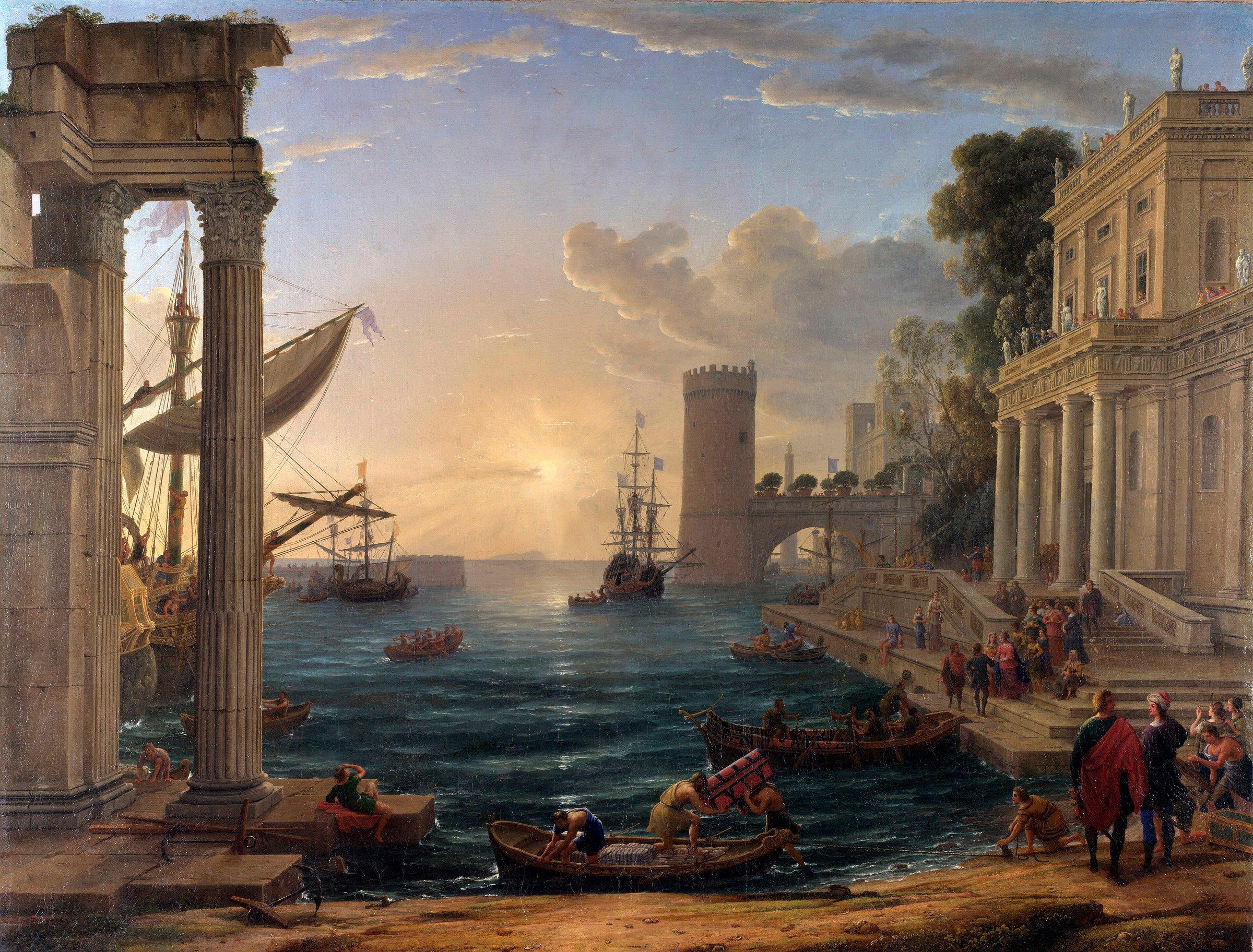
Claude Lorrain, Seaport with the Embarkation of the Queen of Sheba, 1648. Public domain.
1 Kings 10 · Person · Featured Study
The Queen of Sheba
A queen from far to the south tested the wisdom of Solomon.
Now when the queen of Sheba heard about the fame of Solomon concerning the name of the LORD, she came to test him with difficult questions.
- Places
- Jerusalem
- First named
- 1 Kings 10:1 “Now when the queen of Sheba…”
- Last named
- Luke 11:31 “The Queen of the…”
What she saw at Solomon's court took her breath away.
Summary
The queen of Sheba heard of Solomon's fame and brought a great caravan to Jerusalem. She went home having blessed the LORD, the God of Israel. Scripture does not give her name.
- An Ethiopian tradition gives her a son by Solomon.
- Genesis names three men called Sheba.
- Commentators differ over where her kingdom lay.
Where She Stands in Scripture
Sheba stands in twenty-three verses of nine books.
Her visit is told in 1 Kings 10:1 to 13 and again in 2 Chronicles 9:1 to 12. Jesus names her in Matthew 12:42 and Luke 11:31.
It is the name of three men in Genesis and of a people known for trade in gold and spices.
the Sabeans swooped down and took them away. They put the servants to the sword, and I alone have escaped to tell you!”Strong's entry H7614 gives Sabeans as a rendering of the same name.
Her Visit, Turn by Turn
The visit runs from the report she heard to the words of Jesus about her.
She came because of what she heard, and went home saying the report fell short.
- Hears of Solomon's fameher own country
- Arrives with a caravan of camelsJerusalem1 Kings 10:2
- Solomon answers all her questionsJerusalem1 Kings 10:3
- Sees his house, his table and his offeringsJerusalem1 Kings 10:4 to 5
- Blesses the LORD who made him kingJerusalem1 Kings 10:9
- Gives 120 talents of gold and a great store of spicesJerusalem1 Kings 10:10
- Receives all she asked, and goes homeback to her own country1 Kings 10:13
- Named by Jesus as a witness at the judgmentin the GospelsMatthew 12:42
Jesus spoke of her in two Gospels.
Receives all she asked, and goes home, Named by Jesus as a witness at the judgment
From the Report to the Throne
The account runs through 1 Kings 10:1 to 13.
Second Chronicles 9:1 to 12 tells the same visit in nearly the same words.
The hard questions1 Kings 10:2 to 3, with Adam Clarke
She arrived in Jerusalem with a very large caravan—with camels bearing spices, gold in great abundance, and precious stones. So she came to Solomon and spoke to him all that was on her mind. And Solomon answered all her questions; nothing was too difficult for the king to explain.The same Hebrew word for a hard question is Samson's riddle in Judges 14:12.
Adam Clarke, in his Commentary on 1 Kings 10:3, sets her questions among the riddles, problems and fables that formed the chief part of the wisdom of the East.
What took her breath away1 Kings 10:4 to 7, with Albert Barnes
She said to the king, “The report I heard in my own country about your words and wisdom is true. But I did not believe these things until I came and saw with my own eyes. Indeed, not even half was told to me. Your wisdom and prosperity have far exceeded the report I heard.Her words answer the doubt she had held until she came.
Albert Barnes, in his Notes on 1 Kings 10:5, compares the court she saw with the Assyrian banquet scenes of guests in fine robes, attendants behind them and costly drinking cups.
The gifts1 Kings 10:10 to 13
Then she gave the king 120 talents of gold, a great quantity of spices, and precious stones. Never again was such an abundance of spices brought in as those the queen of Sheba gave to King Solomon.Hiram's gift in 1 Kings 9:14 was the same weight.
Solomon gave her all she desired, besides his royal gifts.
Sheba in Scripture
Job, Jeremiah and Psalm 72 name Sheba for its caravans, its frankincense and its gifts.
The caravans of Tema look for water; the travelers of Sheba hope to find it.Job compares his friends to seasonal streams that fail, by Job 6:15.
What use to Me is frankincense from Sheba or sweet cane from a distant land? Your burnt offerings are not acceptable; your sacrifices do not please Me.”The LORD says in Jeremiah 6:19 that the people have rejected His instruction.
May the kings of Tarshish and distant shores bring tribute; may the kings of Sheba and Seba offer gifts.The psalm prays for the king and the son of the king, by Psalm 72:1.
The Three Shebas of Genesis
Eight people stand in three lines, each ending in a man named Sheba.
One Sheba descends from Ham, one from Shem and one from Abraham and Keturah.
Generation 1
Generation 2
- RaamahSon of Cush
- Sheba son of JoktanThe second Sheba
- JokshanSon of Abraham and Keturah
Generation 3
- Sheba son of RaamahThe first Sheba
- Sheba son of JokshanThe third Sheba
Generations are counted from the head of each line; the text does not say from which line the queen's people came.
The Places of Her Visit
Jerusalem stands with the two lands proposed for Sheba.
Both lands proposed for her kingdom lie far south of Jerusalem.
- Located: the site is known
- Identified: the point stands for an area, or is rounded
- Proposed: one candidate among several
- 1Jerusalem, She came to Solomon there. 1 Kings 10:2
- 2Sheba in south-west Arabia, The land of the Sabaeans, with its capital Saba.
- 3?Ethiopia, Proposed as her land.
The coasts and rivers are simplified; places with a place page stand at its coordinates and the others at the point cited for each.
The Arabian point is drawn as identified and the Ethiopian as proposed, each where OpenBible.info places the name.
Questions Her Visit Raises
Her faith and her son raise two questions.
Did she come to faith in the LORD?1 Kings 10:9, with Jamieson, Fausset and Brown and Albert Barnes
Blessed be the LORD your God, who has delighted in you to set you on the throne of Israel. Because of the LORD’s eternal love for Israel, He has made you king to carry out justice and righteousness.”Hiram of Tyre had blessed the LORD in nearly the same words in 1 Kings 5:7.
Jamieson, Fausset and Brown think it quite possible, as Jewish writers say, that she was converted, though no gift of hers to the temple is recorded. Albert Barnes holds that her words admit no more than the LORD's power as the God of the Jews and their land.
Did she bear Solomon a son?1 Kings 10:13, with Adam Clarke and the Kebra Nagast
Adam Clarke, in his Commentary on 1 Kings 10:13, reports traditions that she had a son by Solomon who reigned after her and brought in the Jewish religion. The Kebra Nagast tells this story and names the queen Makeda.
First Kings 10:13 says only that she went home with her servants.
What the Text Leaves Unsaid
The text leaves four things about her unsaid.
How Scripture Reads Her
Jesus set her search for wisdom against the unbelief of His own generation.
The Queen of the South will rise at the judgment with the men of this generation and condemn them; for she came from the ends of the earth to hear the wisdom of Solomon, and now One greater than Solomon is here.Jesus spoke this as the crowds asked Him for a sign, by Luke 11:29.
Matthew Henry, in his Commentary on her visit in 1 Kings 10, reads her coming as a rebuke to all who will not ask of God through Christ.
Voices on the Queen of Sheba
Ambrose of Milan read her as a figure of the church.
Ambrose of Milan (died 397)
Exposition of the Gospel of Luke, 7.96
Ambrose of Milan wrote on the Queen of the South in his Exposition of the Gospel of Luke.
“In this also is clearly expressed the mystery of the Church, which is gathered from the ends of the earth, in the penance of the Ninevites, and in the seeking of wisdom by the Queen of the South: so that she may know the peaceful words of Solomon, the Queen, indeed, whose kingdom is indivisible, arising from diverse and distant peoples into one body.”
on Luke 11:31 to 32Patristic
Where Was Sheba?
Keil and the Speaker's Commentary place Sheba in Arabia, and Josephus and the Kebra Nagast in Africa.
The merchants of Sheba and Raamah traded with you; for your wares they exchanged gold, the finest of all spices, and precious stones.Ezekiel names the merchants of Sheba beside Raamah, whose son Sheba stands in Genesis 10:7.
South-west ArabiaC. F. Keil and the Speaker's Commentary, 1872, with John Gill and Adam Clarke
Keil holds that Sheba was the kingdom of the Sabaeans, who traded in incense, gold and precious stones and lived in Arabia Felix, with the capital Saba. The Speaker's Commentary finds that the claims of Arabia decidedly preponderate, because the Arabian Sheba was the great spice country of the ancient world. John Gill and Adam Clarke also place her in the south of Arabia.
The objection is that the Abyssinians claim her as their queen, as Charles Spurgeon notes in his sermon A Greater Than Solomon.
EthiopiaJosephus, Antiquities 8.6.5, with the Kebra Nagast and Bede
Josephus calls her a woman queen of Egypt and Ethiopia. The Kebra Nagast, in E. A. Wallis Budge's translation of 1922, says that the Queen of the South of whom Christ spoke was the Queen of Ethiopia. Bede, on Acts 8:27, joins her to the nation ruled by queens called Kandakes.
The objection is that Keil names Josephus and the Abyssinian Christians for this view and sets it aside for the Sabaeans of Arabia.
Books to Read Next
All three works are in the public domain, and each has a free copy to read.
The Books of the Kings
C. F. Keil, translated by James Martin · 1872
Keil gives the case for the Arabian Sheba in his note on the queen's coming.
Read at the Internet ArchiveThe Queen of Sheba and Her Only Son Menyelek
E. A. Wallis Budge · 1922
Budge translates the Kebra Nagast, the Ethiopian account of the queen and her son.
Read at the Internet ArchiveThe Antiquities of the Jews
Flavius Josephus, translated by William Whiston · 1737
Josephus retells her visit in book 8, chapter 6.
Read at Project GutenbergGold and Frankincense
She brought gold and spices to the son of David, and the wise men brought gold and frankincense to the Child, by Matthew 2:11.
Caravans of camels will cover your land, young camels of Midian and Ephah, and all from Sheba will come, bearing gold and frankincense and proclaiming the praises of the LORD.Matthew Henry reads this verse as fulfilled in part when the wise men of the east came.
Sources
Scripture is the Berean Standard Bible.
- James Strong, Exhaustive Concordance of the Bible, 1890, entry H7614.
- C. F. Keil, The Books of the Kings, translated by James Martin, T. and T. Clark, 1872, p. 158 on 1 Kings 10:1.
- The Holy Bible with an Explanatory and Critical Commentary (the Speaker's Commentary), volume 2, ed. F. C. Cook, John Murray, 1872, p. 539 on 1 Kings 10:1.
- Flavius Josephus, Antiquities of the Jews, 8.6.5, translated by William Whiston, 1737.
- E. A. Wallis Budge, The Queen of Sheba and Her Only Son Menyelek (the Kebra Nagast), Medici Society, 1922, chapters 21 and 26.
- OpenBible.info, Bible-Geocoding-Data, ancient.jsonl: Sheba 1, Ethiopia.
- John Gill, Exposition of the Old Testament, 1748 to 1763, on 1 Kings 10:1.
- Adam Clarke, Commentary on the Bible, 1832, on 1 Kings 10:3 and 10:13 and Matthew 12:42.
- Albert Barnes, Notes, Explanatory and Practical, on the Old Testament, on 1 Kings 10:5 and 10:9.
- Jamieson, Fausset and Brown, Commentary Critical and Explanatory on the Whole Bible, 1871, on 1 Kings 10:9.
- Matthew Henry, Commentary on the Whole Bible, 1710, on 1 Kings 10:1.
- Matthew Henry, Commentary on the Whole Bible, 1710, on Isaiah 60:6.
- Charles Spurgeon, Metropolitan Tabernacle Pulpit, Sermon 3166, A Greater Than Solomon, 1909.
- Ambrose of Milan, Exposition of the Gospel of Luke, 7.96.
- Bede, Commentary on Acts 8:27.
Keep Studying
Doctrines1
Go further7