
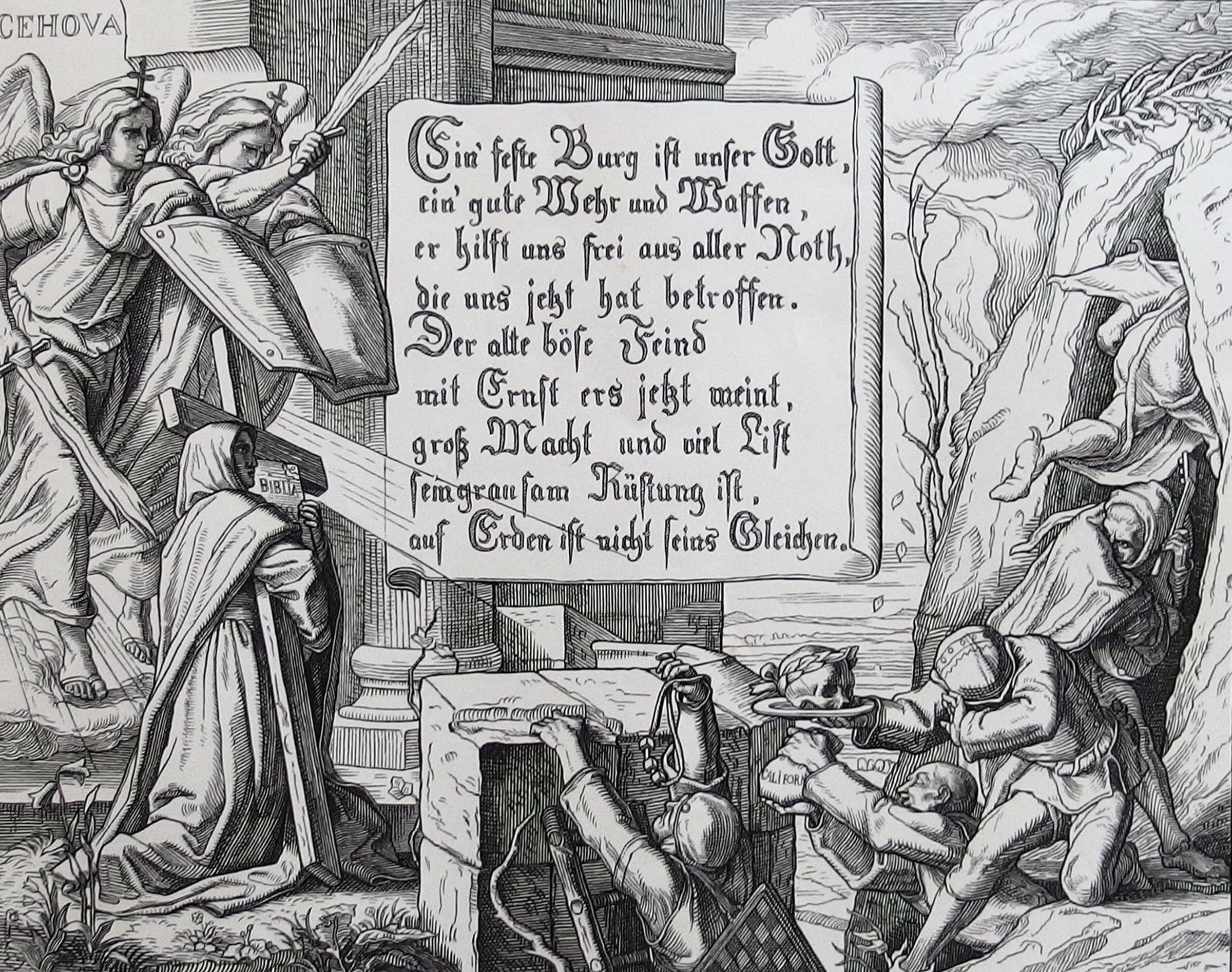
Alfred Rethel, Das Luther-Lied, 1850. Public domain.
Psalm 46, by 1529 · Story · Featured Study
A Mighty Fortress
Luther's hymn on Psalm 46 became a song of the German churches and then of the English.
- When
- 1527 to 1529 (probable)
Gustavus Adolphus had his whole army sing Luther's hymn before the battle of Leipzig in 1631, Julian writes.
God is our refuge and strength, an ever-present help in times of trouble.
Summary
Luther wrote Ein feste Burg ist unser Gott on Psalm 46, and it was in print by 1529. Its year of writing is disputed, and five years from 1521 to 1530 have been proposed.
- Klug's hymnbook headed it with the Latin of the Psalm, Deus noster refugium et virtus.
- Jacobi's Psalmodia Germanica gave the first English in 1722.
- Wackernagel prints it in four early forms, from Augsburg, Wittenberg, Riga and Rostock.
The Psalm Behind the Hymn
Julian sets Luther's German of three verses beside the hymn.
Julian compares phrases of Luther's German Psalter of 1524 with the hymn, and calls the Psalm only a motto, the imagery throughout being entirely original.
Therefore we will not fear, though the earth is transformed and the mountains are toppled into the depths of the seas,Luther's German Psalter of 1524 renders this verse Darum fürchten wir uns nicht, as Julian prints it.
God is within her; she will not be moved. God will help her when morning dawns.Julian prints Luther's German for this verse, Gott ist bei ihr darinnen.
The LORD of Hosts is with us; the God of Jacob is our fortress. SelahLuther's Psalter names the God of Jacob unser Schutz here, Julian notes.
Let the word of Christ richly dwell within you as you teach and admonish one another with all wisdom, and as you sing psalms, hymns, and spiritual songs with gratitude in your hearts to God.Luther's preface to his hymnbook, in Massie's English, sets this command of Paul before its readers.
Psalm 46:7, Colossians 3:16
The Hymn in English
The table gives six of the English versions Julian lists.
Each translator made his own first line from Luther's opening.
| Translator | Year | First line | Printed in |
|---|---|---|---|
| J. C. Jacobi | 1722 | God is our Refuge in Distress | Psalmodia Germanica, and later the Moravian hymnbooks |
| Thomas Carlyle | 1831 | A safe stronghold our God is still | Fraser's Magazine |
| Frederic H. Hedge | 1852 and 1853 | A mighty fortress is our God | Gems of German Verse, then Hymns for the Church of Christ |
| Richard Massie | 1854 | A castle is our God, a tower | Martin Luther's Spiritual Songs |
| Catherine Winkworth | 1855 | God is our stronghold, firm and sure | Lyra Germanica |
| W. Gaskell, altered | 1863 | A sure stronghold our God is He | The Chorale Book for England |
From Wittenberg to the Hymnbooks
The hymn spread through Germany, and in the nineteenth century through England and America.
Julian writes that the hymn “was first pub. in Klug's G. B., Wittenberg, 1529.” Schaff adds a hymnbook of Augsburg of the same year, and an older print “apparently from February, 1528.”
The earliest text Julian could reach in High German is that of 1531. It opens, “Ein feste burg ist unser Gott, ein gute wehr und waffen.”
Julian, following Lauxmann in Koch's history, writes that Luther in 1530 sang it daily at Coburg, and that the Salzburg emigrants of 1732 took it as their travelling hymn.
When Carlyle printed his English in 1831, he called the hymn the one of Luther's songs “universally regarded as the best.”
Julian says that Hedge's English, whole or shortened, “appears in many American hymnals.”
The Tune and Its Later Settings
Luther's tune passed into the music of Bach and Mendelssohn.
Schaff, following Koch, says that “Luther is certainly the author of the tunes to 'Ein feste Burg.'”
Spitta writes that Bach's cantata on the hymn may have been made for a sermon of 1730, and that it may not have been written until 1739. Julian names Mendelssohn's Reformation Symphony of 1830 among the works that use Luther's chorale.
How the Key Verse Was Taught
Three writers of three centuries taught Psalm 46:1.
Augustine of Hippo (died 430)
Exposition on the Book of Psalms, Psalm 46, section 2
From the early church, an exposition of the Psalm.
“Our refuge is not such, but our refuge is strength. When thither we have fled, we shall be firm.”
Patristic
Matthew Henry (1662 to 1714)
Commentary on the Whole Bible, on Psalm 46:1
From the eighteenth century, a commentary on the whole Bible.
“He is a help, to do all that for us which we need, a present help, a help found (so the word is), one whom we have found to be so”
Puritan
Charles Spurgeon (1834 to 1892)
The Treasury of David, Vol. 2
From the nineteenth century, a preacher's book on the Psalms.
“God is our refuge and strength. Not our armies, or our fortresses. Israel's boast is in Jehovah, the only living and true God. Others vaunt their impregnable castles, placed on inaccessible rocks, and secured with gates of iron, but God is a far better refuge from distress than all these: and when the time comes to carry the war into the enemy's territories, the Lord stands his people in better stead than all the valour of legions or the boasted strength of chariot and horse.”
on Psalm 46:1Particular Baptist
In Their Own Words
The hymn stands here in Hedge's English, beside two sayings of Luther on music.
Martin Luther (1483 to 1546)
Ein feste Burg ist unser Gott, in Frederic H. Hedge's English as Luther's Psalm, number 852, in Hymns for the Church of Christ
A bulwark never failing
“A mighty fortress is our God, A bulwark never failing; Our helper he amid the flood Of mortal ills prevailing.”
Other
About this saying1 paragraph
The opening of the hymn as the hymnbook of 1853 printed it.
Martin Luther
Letter to Ludovic Senfel, 4 October 1530, in Jules Michelet, The Life of Luther, the letter to Senfel
The love of music
“The love of music overpowers my fear of being refused, when you shall see a name which, no doubt, you hate.”
Other
About this saying1 paragraph
Luther wrote this in October 1530, asking a musician to set “the In pace in id ipsum” to music, as Michelet gives it in English.
Martin Luther
Table Talk, Of Music, in Jules Michelet, The Life of Luther
A gift of God
“Music is one of the finest and most magnificent of God's gifts.”
Other
About this saying1 paragraph
Luther's table companions reported this saying in the sixteenth century, and Michelet gives it in English.
Where Historians Disagree
Historians differ on when Luther wrote the hymn.
When was it written?3 paragraphs
Heine pictured it in 1834 as the song Luther sang as he entered Worms in 1521. Julian answers that a hymn of 1521 would have been printed with the hymns of 1524.
Linke argued for 1525, and Julian answers that no trustworthy evidence shows it in print before 1529. Schneider fixed 1 November 1527, and Schaff and Köstlin's later editions hold 1527, the plague year.
Julian, Wackernagel and Koch hold 1529, for the Diet of Speyer, and D'Aubigné and Massie put it at Coburg in 1530.
Books to Read Next
A Dictionary of Hymnology
John Julian · 1907
Its article Ein feste Burg weighs every proposed date and lists the English versions.
Free at the Internet ArchiveMartin Luther's Spiritual Songs
Martin Luther, translated by Richard Massie · 1854
It holds the hymns in Massie's English.
Free at the Internet ArchiveWhat the Hymn Left
Julian calls the hymn and its chorale “the true National Hymn of Germany.”
Sources
Scripture is the Berean Standard Bible.
- The Holy Bible, Berean Standard Bible (read 2026)
- John Julian, A Dictionary of Hymnology, second revised edition with new supplement (London: John Murray, 1907), the article Ein feste Burg ist unser Gott.
- Philip Schaff, History of the Christian Church, volume VII, Modern Christianity: The German Reformation, the section on Luther's hymns, with notes 649 to 652.
- F. H. Hedge and F. D. Huntington, eds., Hymns for the Church of Christ (Boston: Crosby, Nichols, 1853), number 852, Luther's Psalm.
- Luther's Psalm, Fraser's Magazine, volume 2, number 12 (London, January 1831), pages 743 to 744, unsigned and named as Carlyle's by Julian.
- Martin Luther's Spiritual Songs, translated by Richard Massie (London, 1854)
- The Chorale Book for England (London, 1863), the index of first lines.
- Heinrich Heine, Religion and Philosophy in Germany, translated by John Snodgrass (London: Trübner, 1882)
- Philipp Spitta, Johann Sebastian Bach, translated by Clara Bell and J. A. Fuller-Maitland, volume III (London, 1885)
- Jules Michelet, The Life of Luther, translated by G. H. Smith (London, 1846, from the French of 1835)
- Augustine, Exposition on the Book of Psalms, Psalm 46, in Nicene and Post-Nicene Fathers, first series, volume 8, ed. Philip Schaff (New York: Christian Literature Publishing Co., 1886)
- Matthew Henry, Commentary on the Whole Bible (1710), on Psalm 46:1.
- Charles Spurgeon, The Treasury of David, volume 2 (1870), on Psalm 46:1.
Keep Studying
Read it1
People and groups6
Doctrines2
Church history1