

Francesco Hayez, The Meeting of Jacob and Esau, 1844. Public domain.
Genesis 3 to Revelation 22 · Symbol · Featured Study
The Face
A symbol study of sixteen places in canon order, the words panim and prosopon, and the readings of face to face.
Adam hides from the face of God in the garden, and the last chapter of the Bible promises that His servants will see it.
Then the man and his wife heard the voice of the LORD God walking in the garden in the breeze of the day, and they hid themselves from the presence of the LORD God among the trees of the garden.
- The word
- פָּנִים (panim), H6440
- First appears
- Genesis 1:2 “Now the earth was formless and void, and…”
Adam hides from the face of God in the garden, and the last chapter of the Bible promises that His servants will see it.
Summary
Scripture uses the face for presence, for favour and for the longing to see God.
- The Hebrew word panim stands behind the presence of the LORD God that Adam and Eve hide from in the garden.
- Jacob names the place where he wrestled Peniel, because there he saw God face to face.
- The blessing of Aaron asks the LORD to make His face shine on Israel.
- Paul writes that the glory of God is known in the face of Jesus Christ.
The Face of God Hidden and Seen
Adam hides from God's face in Genesis 3 and Cain's face falls in Genesis 4:5 to 6, and the verses on seeing God follow.
Then the man and his wife heard the voice of the LORD God walking in the garden in the breeze of the day, and they hid themselves from the presence of the LORD God among the trees of the garden.The first act of the man and woman after their sin is to keep out of God's sight.
but He had no regard for Cain and his offering. So Cain became very angry, and his countenance fell. “Why are you angry,” said the LORD to Cain, “and why has your countenance fallen?God speaks to Cain before Cain acts.
but He had no regard for Cain and his offering. So Cain became very angry, and his countenance fell. “Why are you angry,” said the LORD to Cain, “and why has your countenance fallen?God speaks to Cain before Cain acts.
Cain, sent away in Genesis 4:14, says he will be hidden from God's face.
Scripture says the face of God is seen, and that no one can see it and live.
| Who | What the verse says | Verse |
|---|---|---|
| Jacob at Peniel | Jacob says he saw God face to face and his life was spared. | Genesis 32:30 |
| Moses at the tent | The LORD speaks with Moses as a man speaks to his friend. | Exodus 33:11 |
| Moses on the mountain | God tells Moses that no one can see Him and live. | Exodus 33:20 |
| The servants in the city | They will see His face, with His name on their foreheads. | Revelation 22:4 |
Like Seeing the Face of God
Jacob's road home in Genesis 31 to 33, as Francesco Hayez painted it.
Hayez set the two brothers apart from the household that waits behind Jacob.
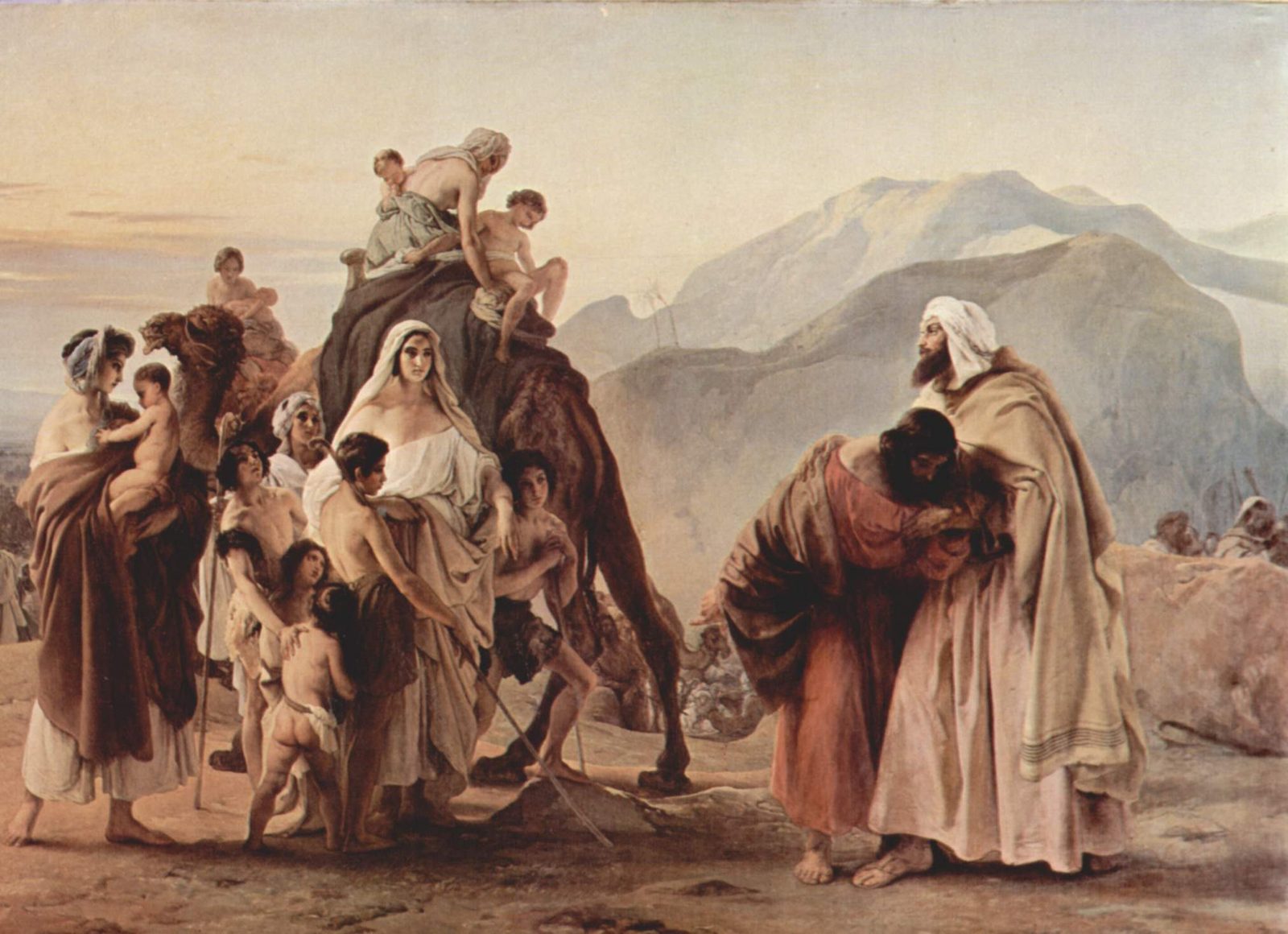
- EsauA man in a white headcloth holds his brother.Genesis 33:4
- JacobJacob bows into his brother's arms.Genesis 33:3
- The householdWomen and children are waiting at the left.Genesis 33:5
- The camelChildren ride high on a loaded camel.Genesis 31:17
- The hillsBare mountains rise behind the brothers.Genesis 33:16
Francesco Hayez, The Meeting of Jacob and Esau, 1844. Public domain.
Five parts of the canvas, each numbered where it stands, with the verse the part answers to.
But Jacob insisted, “No, please! If I have found favor in your sight, then receive this gift from my hand. For indeed, I have seen your face, and it is like seeing the face of God, since you have received me favorably.Jacob speaks this the morning after he wrestled at Peniel.
“It is a very high compliment that he passes upon him: I have seen thy face, as though I had seen the face of God, that is, ‘I have seen thee reconciled to me, and at peace with me, as I desire to see God reconciled.’ Or the meaning is that Jacob saw God's favour to him in Esau's: it was a token for good to him that God had accepted his prayers.”
Matthew Henry · Commentary on the Whole Bible · on Genesis 33:10 to 11Puritan
The Face Through Scripture
Sixteen places in canon order, from the face of the deep to the face His servants will see.
The face of God is hidden from, sought, shining in blessing and at last seen.
- Genesis 1The surface of the deep, panim in Hebrew, Genesis 1:2
- Genesis 3Hiding among the trees, Genesis 3:8
- Genesis 4Cain sent from the presence of the LORD, Genesis 4:14
- Genesis 32Peniel, Genesis 32:30
- Genesis 33Esau's welcome, Genesis 33:10
- Exodus 33The tent of meeting, Exodus 33:11
- Exodus 34The radiant face of Moses, Exodus 34:29
- Numbers 6The blessing of Aaron, Numbers 6:25
- Deuteronomy 31God hides His face, Deuteronomy 31:17
- Psalm 13How long will You hide, Psalm 13:1
- Psalm 27Your face, O LORD, I will seek, Psalm 27:8
- Isaiah 59Sins have hidden His face, Isaiah 59:2
- Matthew 17His face shone like the sun, Matthew 17:2
- 1 Corinthians 13Then face to face, 1 Corinthians 13:12
- 2 Corinthians 4Light out of darkness, 2 Corinthians 4:6
- Revelation 22They will see His face, Revelation 22:4
Each stop opens its verse in the reader.
What the Verses Say About the Face of God
Four verses on seeking and losing the face of God, and the shining face of Moses.
SOUGHT
The psalmist answers God's command with a promise of his own.
HIDDEN
David asks how long God will keep His face away.
HIDDEN BY SIN
Isaiah names what stands between the people and God.
SOUGHT IN REPENTANCE
God joins the healing of the land to a people who turn to Him.
Hidden by sin, Sought in repentance
The shining face of MosesExodus 34:29 to 35; John Wesley
Moses came down from Sinai unaware that his face shone, and Aaron and the people were afraid to come near him. John Wesley, in his Explanatory Notes upon the Old Testament, reads the shining as an honour that kept the people from ever again questioning his mission.
When Moses had finished speaking with them, he put a veil over his face. But whenever Moses went in before the LORD to speak with Him, he would remove the veil until he came out. And when he came out, he would tell the Israelites what he had been commanded, and the Israelites would see that the face of Moses was radiant. So Moses would put the veil back over his face until he went in to speak with the LORD.Paul returns to this scene in 2 Corinthians 3:13.
Panim and Prosopon
The Hebrew and the Greek words for the face, with their counts.
Both words reach from the face to a person's presence.
| Word | Strong's number | Strong's definition | Uses |
|---|---|---|---|
| פָּנִים panim | H6440 | the face, as the part that turns; with a preposition, before | 2123 |
| πρόσωπον prosopon | G4383 | the front, as it is turned toward view; by implication, presence, person | 75 |
Genesis 4:16 shows the second sense, where Cain goes out from the presence of the LORD.
What the Text Does Not Say
Four questions about the face of God the verses leave open.
The verses report each meeting with God's face and leave what was seen undescribed.
| What is not said | What the verse does say |
|---|---|
| What Jacob saw at Peniel | The verse gives the sight no shape. |
| The cause of the shining on the face of Moses | The verses tell that it shone and give no cause. |
| What the face of God looks like | Moses is shown the back and the face is withheld. |
| The sight of God that is to come | Paul promises the sight and gives it no form. |
The LORD Make His Face Shine
Numbers 6:24 to 26, the blessing in three lines, and the face in which it was kept.
Each line of the blessing is two Hebrew words longer than the line before.
The three counts as a table
| Line | Hebrew words |
|---|---|
| Line 1, verse 24 | 3 |
| Line 2, verse 25 | 5 |
| Line 3, verse 26 | 7 |
The Hebrew words in each line of the blessing, on bars from zero.
‘May the LORD bless you and keep you; may the LORD cause His face to shine upon you and be gracious to you; may the LORD lift up His countenance toward you and give you peace.’Aaron and his sons are told to speak these words over Israel.
For God, who said, “Let light shine out of darkness,” made His light shine in our hearts to give us the light of the knowledge of the glory of God in the face of Jesus Christ.Paul ties the light of the first day to what is known in Christ.
Seen at last1 Corinthians 13:12; Andreas of Caesarea
Now we see but a dim reflection as in a mirror; then we shall see face to face. Now I know in part; then I shall know fully, even as I am fully known.Paul sets the partial sight of now against the full sight to come.
“Those who become the throne of God because of the rest of the Lord among them will be the inhabitants of that city. They will see him no longer in shadows but face to face, even as the holy apostles saw him on the holy …”
Andreas of Caesarea · Commentary on the Apocalypse 22:3-4 · on Revelation 22:4Patristic
Voices on the Face
Jerome, Matthew Henry, John Wesley and Charles Spurgeon, each with the work named.
died 420 · Jerome
Homily 1 (on Psalm 1)
A sermon on Psalm 1 turns to the evening walk in the garden.
The quotation1 quotation
“We read in Genesis that when Adam transgressed, when he paid heed to the serpent rather than to God, when he hid himself from the face of God, then God came into the garden and was walking about in the cool of day. Now listen to what the Scripture says. God sought out Adam, not at midday but in the evening. Adam had already lost the sunlight, for his high noon was over.”
Jerome · Homily 1 (on Psalm 1) · on Genesis 3:8Patristic
1662 to 1714 · Matthew Henry
Commentary on the Whole Bible
This commentary of 1710 reads the name Jacob gave the place of his wrestling.
The quotation1 quotation
“He does not say, ‘In this place I wrestled with God, and prevailed;’ but, ‘In this place I saw God face to face, and my life was preserved;’ not, ‘It was my praise that I came off a conqueror, but it was God's mercy that I escaped with my life.’ Note, It becomes those whom God honours to take shame to themselves, and to admire the condescensions of his grace to them.”
Matthew Henry · Commentary on the Whole Bible · on Genesis 32:30Puritan
1703 to 1791 · John Wesley
Explanatory Notes upon the New Testament
These short notes of 1755 describe the face that shone on the mountain.
The quotation1 quotation
“His face shone with Divine majesty, like the sun in its strength; and all his body was so irradiated by it, that his clothes could not conceal its glory, but became white and glittering as the very light, with which he covered himself as with a garment.”
John Wesley · Explanatory Notes upon the New Testament · on Matthew 17:2Evangelical
1834 to 1892 · Charles Spurgeon
The Treasury of David, Vol. 2
The comment reads the call to seek His face as a call to all the saints that one man takes as his own.
The quotation1 quotation
“In this verse we are taught that if we would have the Lord hear our voice, we must be careful to respond to his voice. The true heart should echo the will of God as the rocks among the Alps repeat in sweetest music the notes of the peasant's horn. Observe, that the command was in the plural, to all the saints, Seek ye; but the man of God turned it into the singular by a personal application, Thy face, Lord, will I seek. The voice of the Lord is very effectual where all other voices fail.”
Charles Spurgeon · The Treasury of David, Vol. 2 · on Psalm 27:8
John Wesley, Charles Spurgeon
Where Careful Readers Differ
Three readings of what Moses saw when the LORD spoke with him face to face.
Speech without sightMaximus of Turin, Sermon 35
“Fasting these forty days and nights holy Moses too merited to speak with God, to stand and stay with him and to receive the precepts of the law from his hand. For although this human condition prevented him from seeing God, yet the grace of …”
Maximus of Turin · SERMON 35.3 · on Exodus 33:11Patristic
The objection is Numbers 12:8, which says that Moses sees the form of the LORD.
A form God chose to showAugustine of Hippo, Letter 147
“Hence the answer made to Moses is true that no one can see the face of God and live, that is, no one living in this life can see him as he is. Many have seen, but they saw what his will chose, not what his nature formed, and this is what John said, if he is rightly understood: ‘Dearly beloved, we are the sons of God, and it has not yet appeared what we shall be. We know that when he shall appear, we shall be like to him, because we shall see him as he is’; not as men saw him when he willed under the appearance that he willed; not in his nature under which he lies hidden within himself even when he is seen, but as he is. This is what was asked of him by the one who spoke to him face to face, when he said to him, ‘Show me yourself,’ but no one can at any time experience the fullness of God through the eyes of the body any more than by the mind itself.”
Augustine of Hippo · LETTER 147.8-9 · on Exodus 33:20Patristic
The objection is that Exodus 33:11 sets face to face beside speech between friends and says nothing of a form shown.
The back seen from the rockGregory of Nazianzus, Second Theological Oration
“What is this that has happened to me, O friends and initiates and fellow lovers of the truth? I was running to lay hold on God, and thus I went up into the mount and drew aside the curtain of the cloud and entered away from matter and material things. And as far as I could I withdrew within myself. And then when I looked up, I scarce saw the back parts of God, although I was sheltered by the rock, the Word that was made flesh for us.”
Gregory of Nazianzus · Theological Oration 2:3 · on Exodus 33:22Patristic
The objection is that Exodus 33:22 speaks of a cleft of the rock on the mountain, and Gregory reads the rock as Christ.
Books to Read Next
Three public domain works, each with a free copy to read.
Second Theological Oration (Oration 28)
Gregory of Nazianzus · fourth century
In its third section Gregory puts himself in the place of Moses in the cleft of the rock.
Read at New AdventCommentary on the Whole Bible, volume 1
Matthew Henry · 1708 to 1710
His notes on Genesis 32 and 33 follow Jacob from Peniel to Esau's embrace.
Read at CCELThe Treasury of David, volume 2
Charles Spurgeon · 1870
This volume holds Spurgeon's comment on Psalm 27.
Read at CCELThey Will See His Face
The God Adam hid from and Moses could not look on has made Himself known in His Son, and the text asks the reader to seek Him now and wait for the day of sight.
They will see His face, and His name will be on their foreheads.The face Exodus 33:20 withheld from Moses is the face His servants will see.
Sources
Scripture is the Berean Standard Bible.
- James Strong, Exhaustive Concordance of the Bible, 1890, entries H6440 and G4383, with glosses from STEP Bible (Tyndale House, CC BY 4.0)
- Matthew Henry, Commentary on the Whole Bible, 1710, on Genesis 33:10.
- Matthew Henry, Commentary on the Whole Bible, 1710, on Genesis 32:30.
- John Wesley, Explanatory Notes upon the Old Testament, 1765, on Exodus 34:29.
- Andreas of Caesarea, Commentary on the Apocalypse, on Revelation 22:3 to 4.
- Jerome, Homily 1, on Psalm 1, on Genesis 3:8.
- John Wesley, Explanatory Notes upon the New Testament, 1755, on Matthew 17:2.
- Charles Spurgeon, The Treasury of David, volume 2, 1870, on Psalm 27:8.
- Maximus of Turin, Sermon 35, 3, on Exodus 33:11.
- Augustine of Hippo, Letter 147, 8 to 9, on Exodus 33:20.
- Gregory of Nazianzus, Second Theological Oration (Oration 28), 3, on Exodus 33:22.
Keep Studying
Read it1
Symbols10