
Numidia and Italy, 354 to 430 · Person · Featured Study
Augustine of Hippo
He was bishop of Hippo in North Africa from 395 to 430.
He ran from God for thirty years while his mother prayed, then wrote the book that taught the West how to speak to God honestly.
- Born
- 13 November 354
- Died
- 28 August 430
- Family
- father: Patricius; mother: Monica; son: Adeodatus
- Places
- Tagaste, Carthage, Rome, Milan, Ostia, Hippo Regius
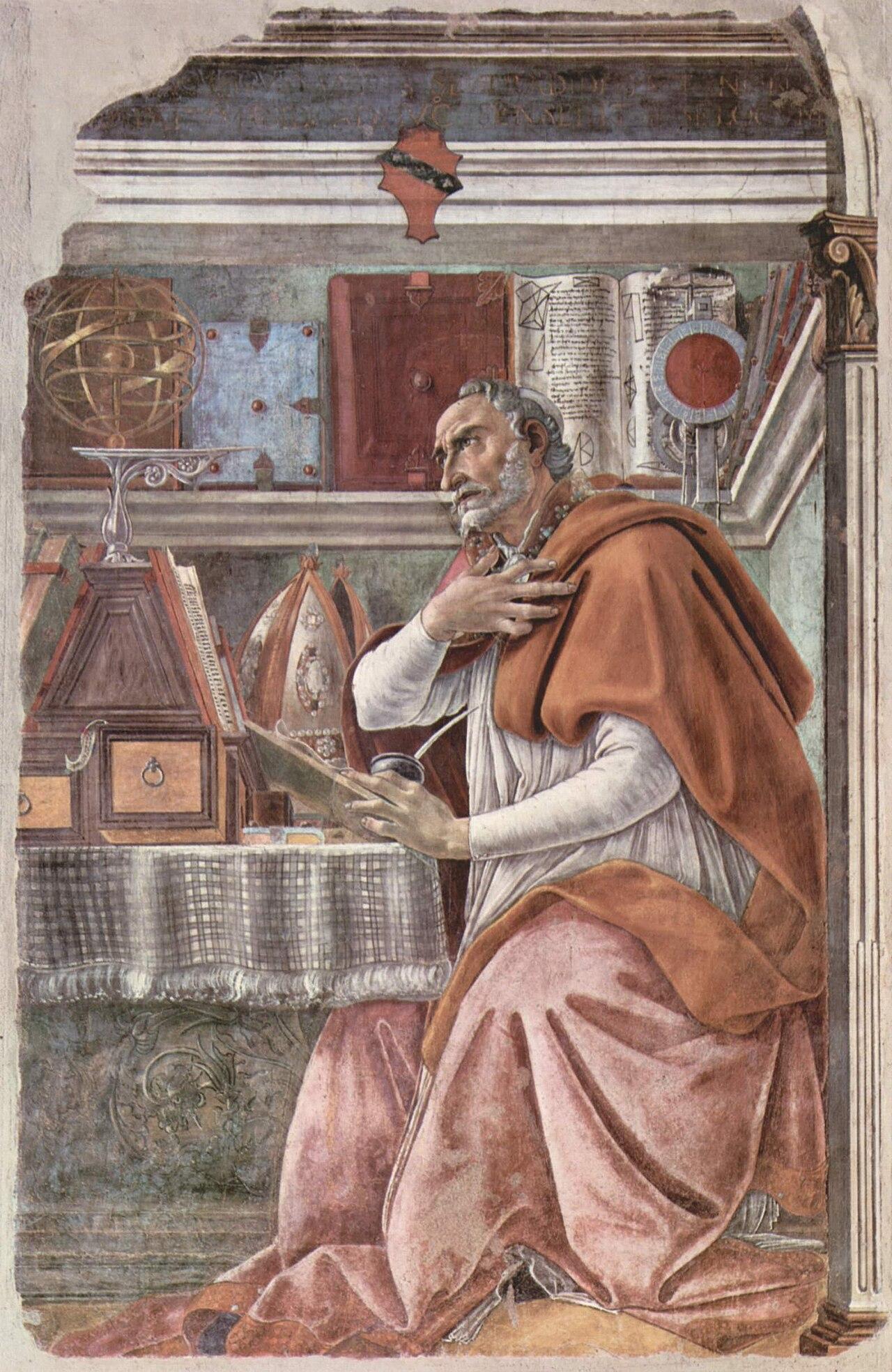
Saint Augustine, Sandro Botticelli, 1480. Public domain.
Instead, clothe yourselves with the Lord Jesus Christ, and make no provision for the desires of the flesh.
Summary
Augustine was born in Roman North Africa in 354 and taught rhetoric at Carthage, Rome and Milan. In 386 he read two verses of Paul in a garden and gave up his career. Ambrose baptized him in 387, and he went home to Africa.
- His Confessions tell his life as a prayer, and he wrote them about 397.
- He answered the Donatists and Pelagius, and the sack of Rome moved him to write The City of God.
- He wrote in 408 that he had changed his mind and had come to approve of compulsion against heretics.
The Verse in the Garden
He read two verses of Romans 13 and stopped reading, and he tells it in book 8 of the Confessions.
The question here is what Augustine's own account of his conversion can tell a reader, and what he did with that grace as a bishop. Augustine is the main witness to his own early years. Possidius, his friend, is the witness to the last. He wrote that he read no further than Romans 13:14.
Let us behave decently, as in the daytime, not in carousing and drunkenness, not in sexual immorality and debauchery, not in dissension and jealousy.These are the first words his eyes fell on, by his own account.
The night is nearly over; the day has drawn near. So let us lay aside the deeds of darkness and put on the armor of light.This verse stands just before the paragraph his eyes fell on.
The Life in Order
The early years stand on the Confessions, and the dates on the chronology and prolegomena of the 1886 edition.
The Confessions stop soon after his baptism, and forty-three years follow them.
- 354He was born at Tagaste in NumidiaSchaff, chronological table (1886)
- 373Cicero's Hortensius woke in him a desire for wisdomConfessions 3.4; Schaff's table
- From his nineteenth yearHe spent nearly nine years with the ManicheesConfessions 3.11 and 4.1
- 384He went to Milan to teach rhetoric and heard AmbroseConfessions 5.13
- 386He read Romans 13 in the gardenConfessions 8.12; Schaff's table
- 387Ambrose baptized him, and Monica died at OstiaConfessions 9.6 and 9.11; Schaff's table
- 391He became a presbyter at HippoSchaff, prolegomena
- 395He was made bishop at HippoSchaff, prolegomena and table
- About 397He wrote the ConfessionsSchaff, prolegomena
- 413 to 426His great answer to the pagans took shapeDods's preface (1887)
- 430He died in the third month of the siege of HippoSchaff's table; Possidius
Each step of the life stands with its witness.
391, 395, About 397, 413 to 426, 430
From Tagaste to Hippo
He gives his early years in his own words, and the sources for the bishop are his letters and Possidius.
Augustine was born on 13 November 354 at Tagaste in the province of Numidia in Roman North Africa. His father Patricius was a pagan freeman of modest means, baptized only at the end of his life. His mother Monica was a Christian, and she prayed for her son through all those years.
He was clever, and the family spent beyond its means to educate him. At Carthage he studied rhetoric, the fast track to a public career, and he also did what a bright, appetite-driven seventeen-year-old does in a port city. He took a mistress and stayed with her, faithfully, for thirteen years, as Schaff counts them. She bore him a son he named Adeodatus, given by God, and he loved the boy.
At nineteen a book turned him. Cicero's Hortensius, an exhortation to philosophy, lit in him a hunger for wisdom itself. He went to the Bible looking for it and put it down in disgust, because the old Latin translation was crude and the patriarchs behaved badly. So he joined the Manichees, who offered a tidy account of evil: two eternal powers, light and dark, locked in war, and none of it your fault. He stayed nine years. When their celebrated teacher Faustus finally came to Carthage and turned out to be charming and empty, Augustine started to leave.
He taught rhetoric at Carthage, then slipped off to Rome, partly to escape his students, partly to escape his mother, who followed him anyway. In 384 he won the public chair of rhetoric at Milan, the imperial capital, and he was about thirty.
Milan had Ambrose in it. Augustine went to hear the bishop preach as a professional, to study the technique, and stayed for the content. Ambrose read the Old Testament figuratively, and the objections that had made the Bible unreadable to Augustine fell away. At the same time he read Latin translations of the Platonists, made, as it happens, by Marius Victorinus, and stopped thinking of God as a kind of vast physical substance.
He knew what he ought to do and could not make himself do it. He records the prayer of his youth without flinching, "Grant me chastity and continency, but not yet". His mother, now in Milan, arranged a respectable marriage; he sent the mother of his son back to Africa and called it, later, a wound that did not heal.
The break came in the garden of his lodging in 386. He was thirty-one, in pieces, weeping under a fig tree, when he heard a child's voice from a neighbouring house repeating, take up and read. He opened Paul's letters and read the paragraph on which his eyes first fell, Romans 13:13 and 14. He wrote that it was as if light poured in and every shadow of doubt went out. He resigned his chair, and Ambrose baptized him at Easter 387.
Monica died at Ostia that autumn, waiting for the ship home. She told him she had nothing left to want in this world.
Back in Africa he meant to live quietly with friends. In 391 the people of Hippo Regius chose him presbyter against his will. He became bishop in 395 and served that harbor town for thirty-five years. He often preached five days in succession, and he caused the church vessels to be melted to redeem prisoners.
Three fights shaped what he wrote. Against the Donatists, a rigorist African church that held sacraments worthless if the minister had failed under persecution, he argued that the power in baptism is Christ's. He added that the church is a field with wheat and weeds in it until harvest. Pelagius was a British monk teaching that a man can obey God by simple effort. Against him Augustine insisted that the will itself is damaged and that grace comes first, works the rescue, and holds a person to the end.
The third fight was with despair. In 410 the Goths sacked Rome, and the pagan world said the disaster came from abandoning the old gods. Augustine answered with The City of God, written from 413 to 426. In it two cities run through all of history, one built on love of self and one on love of God.
He died on 28 August 430 while a Vandal army besieged Hippo. Possidius, his friend, was in the city through the siege, and he gives his age as seventy-six years. Schaff writes that Augustine had the penitential psalms written on the wall over his bed.
The Book He Wrote to God
The Confessions are a prayer, and he judged them again in his old age.
His Confessions, written about 397, told the story of an interior life straight to God's face, in the second person, sin included. Schaff dates them ten years after his conversion.
Near the end of his life he read his books again and wrote the Retractations, which Schaff dates to 427 and 428. Of this book he wrote there that its thirteen books "praise the just and good God". He says of The City of God there that the charges of the pagans "kindled my zeal for the house of God".
In Their Own Words
Six sayings from the Confessions, The City of God and his homilies, each with its place and date.
Augustine of Hippo (died 430)
Confessions, book 1, chapter 1
Our hearts are restless
“Thou movest us to delight in praising Thee; for Thou hast formed us for Thyself, and our hearts are restless till they find rest in Thee.”
Patristic
About this saying1 paragraph
He opens book 1 of the Confessions with this sentence, which he wrote about 397.
Augustine of Hippo
Homilies on the First Epistle of John, homily 7, section 8
Love, and do what thou wilt
“Once for all, then, a short precept is given thee: Love, and do what thou wilt: whether thou hold thy peace, through love hold thy peace; whether thou cry out, through love cry out; whether thou correct, through love correct; whether thou spare, through love do thou spare: let the root of love be within, of this root can nothing spring but what is good.”
Patristic
About this saying1 paragraph
He preached this at Hippo in homily 7 on the First Epistle of John, and the edition places the homilies about the time of his tractates on the Gospel, about 416 or later.
Take up and read1 quotation, 1 paragraph
He tells what he heard in the garden in 386 in book 8, chapter 12, and he wrote it about eleven years afterward.
Too late did I love Thee1 quotation, 1 paragraph
He wrote this prayer about 397 in book 10, looking back on the years before the garden.
Give what Thou commandest1 quotation, 1 paragraph
This line of book 10, written about 397, is the prayer that Pelagius, by Augustine's report, could not bear when he heard it at Rome.
Two cities and two loves1 quotation, 1 paragraph
He wrote this between 413 and 426 to answer those who blamed the church for the sack of Rome.
The People Around Him
The Confessions name his household and his teachers, and his later books name his opponents.
Most of the people in this life are known through his own pen.
| Person | Tie to Augustine | The witness |
|---|---|---|
| Monica | His Christian mother followed him to Milan and died at Ostia. | Confessions 6.1 and 9.11 |
| Patricius | His father was a poor freeman and only a catechumen in Augustine's youth. | Confessions 2.3 |
| Adeodatus | His son was baptized beside him in 387. | Confessions 9.6 |
| Alypius | His friend was sitting by the book in the garden. | Confessions 8.12 |
| Ambrose | The bishop of Milan preached to him and baptized him. | Confessions 5.13 and 9.6 |
| Faustus | The Manichee teacher disappointed him at Carthage. | Confessions 5.3 to 5.7 |
| Pelagius | Augustine quotes his teaching in order to answer it. | On the Grace of Christ 1.5 |
| Possidius | His friend was with him in Hippo during the siege. | The Life by Possidius |
Pelagius, Possidius
Schaff writes that his way of life gave rise to the Augustinian order, "which gave the reformer Luther to the world".
The Places of His Life
He crossed the sea to Italy and came home to Africa.
His life runs from Numidia to Italy and back to the African coast.
| Place | What the witnesses say | The witness |
|---|---|---|
| Tagaste | He was born there, and he came back there after Italy. | Schaff, prolegomena |
| Carthage | He studied and taught there, and heard Faustus. | Confessions 3.1 and 5.3 |
| Rome | He taught there before he went to Milan. | Confessions 5.8 |
| Milan | He held the chair of rhetoric, and the garden stood at his lodging. | Confessions 5.13 and 8.8 |
| Ostia | Monica died there on the journey home. | Confessions 9.11 |
| Hippo Regius | He served there from 391 and died there during the siege. | Schaff, prolegomena |
What He Held About Grace
He read the verse in the garden as the gift of God, and he taught that the gift comes first.
The prayer of Confessions 10.29 asks God to give the very thing He commands. On that ground Augustine taught that grace comes before the will, and the synod of Carthage in 418 anathematized those who taught otherwise.
For who makes you so superior? What do you have that you did not receive? And if you did receive it, why do you boast as though you did not?Augustine's case against Pelagius turns on this question.
For it is by grace you have been saved through faith, and this not from yourselves; it is the gift of God,This verse states the gift the quarrel turned on.
How the Key Verse Was Taught
Jerome, Matthew Henry and Charles Spurgeon read the verses he read.
Jerome (died 420)
Homily 46, on Psalm 133
Jerome read Romans 13:13 as the day of the age to come.
“Whence the apostle also says: ‘The night is past, and the day is at hand.’ Therefore this present age is the night: but the age to come is the day. Whence the apostle says: ‘The night is past, and the day is at hand. Let us walk honestly, as in the day,’ he says. As we are to live in the day, that is, in the age to come, so let us now live.”
on Romans 13:13Patristic
Matthew Henry (1662 to 1714)
Commentary on the Whole Bible
Matthew Henry read the end of Romans 13:14 as a limit on the desires.
“It forbids an anxious encumbering care. Indulging ourselves in an irregular desire. We are not forbidden barely to provide for the body (it is a lamp that must be supplied with oil), but we are forbidden to fulfil the lusts thereof.”
on Romans 13:14Puritan
Charles Spurgeon (1834 to 1892)
The Metropolitan Tabernacle Pulpit, Sermon No. 2132: “Christ Put On” (lightly modernized text, CCEL edition)
Charles Spurgeon set Christ within before Christ without.
“Christ must be in us before He can be on us. Divine Grace puts Christ within and enables us to put on Christ without. Christ must be in the heart by faith before He can be in the life by holiness. If you need light from a lantern, the first business is to light the candle inside it—and then, as a consequence—the light shines through to be seen of men. When Christ is formed in you, the hope of Glory—do not conceal your love to Him but put Him on in your conduct as the Glory of your hope!”
on Romans 13:14Particular Baptist
What Readers Dispute
Readers differ on compulsion, on grace and the will, and on the setting of the garden.
May the church compel?Augustine in 408 and about 417; Schaff; John Wesley
Augustine wrote in Letter 93, in 408, "originally my opinion was, that no one should be coerced into the unity of Christ", and he says that he changed that opinion. About 417 he wrote to Boniface on "compel them to come in" of Luke 14:23 that "in those who were compelled, the disobedience is avenged".
Schaff, in the prolegomena of the same edition, calls it a "false exegesis of the words in the parable". John Wesley reads the same verse as compulsion by love and by God's word.
Grace and the willAugustine; Pelagius, as Augustine quotes him; the synod of Carthage
Augustine holds that grace comes first. Pelagius, as Augustine quotes him in On the Grace of Christ, puts "ability" first, "volition" second and "actuality" third. His words on this reach readers only through his opponent. The synod of Carthage of 418 condemned his side.
Where and when the garden stoodAugustine; Schaff
The Confessions place the scene in "a little garden belonging to our lodging" and give no month. Schaff, in the prolegomena, sets it at the Villa Cassiciacum near Milan in September 386. His own chronological table says only 386.
Books to Read Next
The Confessions and Letters of St. Augustin
Philip Schaff, editor · 1886
This volume holds the Confessions, the letters on compulsion, and Schaff's prolegomena.
Read volume 1 free at CCELThe City of God and Christian Doctrine
Philip Schaff, editor · 1887
This volume holds The City of God in Dods's English, with his preface on its occasion.
Read volume 2 free at CCELAnti-Pelagian Writings
Philip Schaff, editor · 1887
This volume holds his answer to Pelagius, with Pelagius's words as he quotes them.
Read volume 5 free at CCELWhat Augustine Left
Augustine left a great shelf of books and a defence of compulsion that he had once opposed. The Retractations show him reading his books again before he died.
Sources
Scripture is the Berean Standard Bible.
- The Holy Bible, Berean Standard Bible (read 2026)
- Augustine, The Confessions, translated by J. G. Pilkington, Nicene and Post-Nicene Fathers, first series, volume 1 (1886)
- Nicene and Post-Nicene Fathers, first series, volume 1 (1886), Philip Schaff's prolegomena and chronological table.
- Augustine, Letter 93, translated by J. G. Cunningham, Nicene and Post-Nicene Fathers, first series, volume 1 (1886); Letter 185 (The Correction of the Donatists), volume 4 (1887)
- Augustine, The City of God, translated by Marcus Dods, with his preface quoting Retractations 2.43, Nicene and Post-Nicene Fathers, first series, volume 2 (1887)
- Augustine, On the Grace of Christ and On the Gift of Perseverance, with the editor's introduction, Nicene and Post-Nicene Fathers, first series, volume 5 (1887)
- Possidius, Life of Augustine 28, 29 and 31, translated by H. T. Weiskotten (1919)
- Matthew Henry, Commentary on the Whole Bible (1710), on Romans 13:14.
- John Wesley, Explanatory Notes upon the New Testament (1755), on Luke 14:23.
- Jerome, Homily 46, on Psalm 133, on Romans 13:13.
- Charles Spurgeon, Sermon 2132, Christ Put On, The Metropolitan Tabernacle Pulpit (1890)
Keep Studying
Read it1
People and groups11
Places1
Doctrines1