
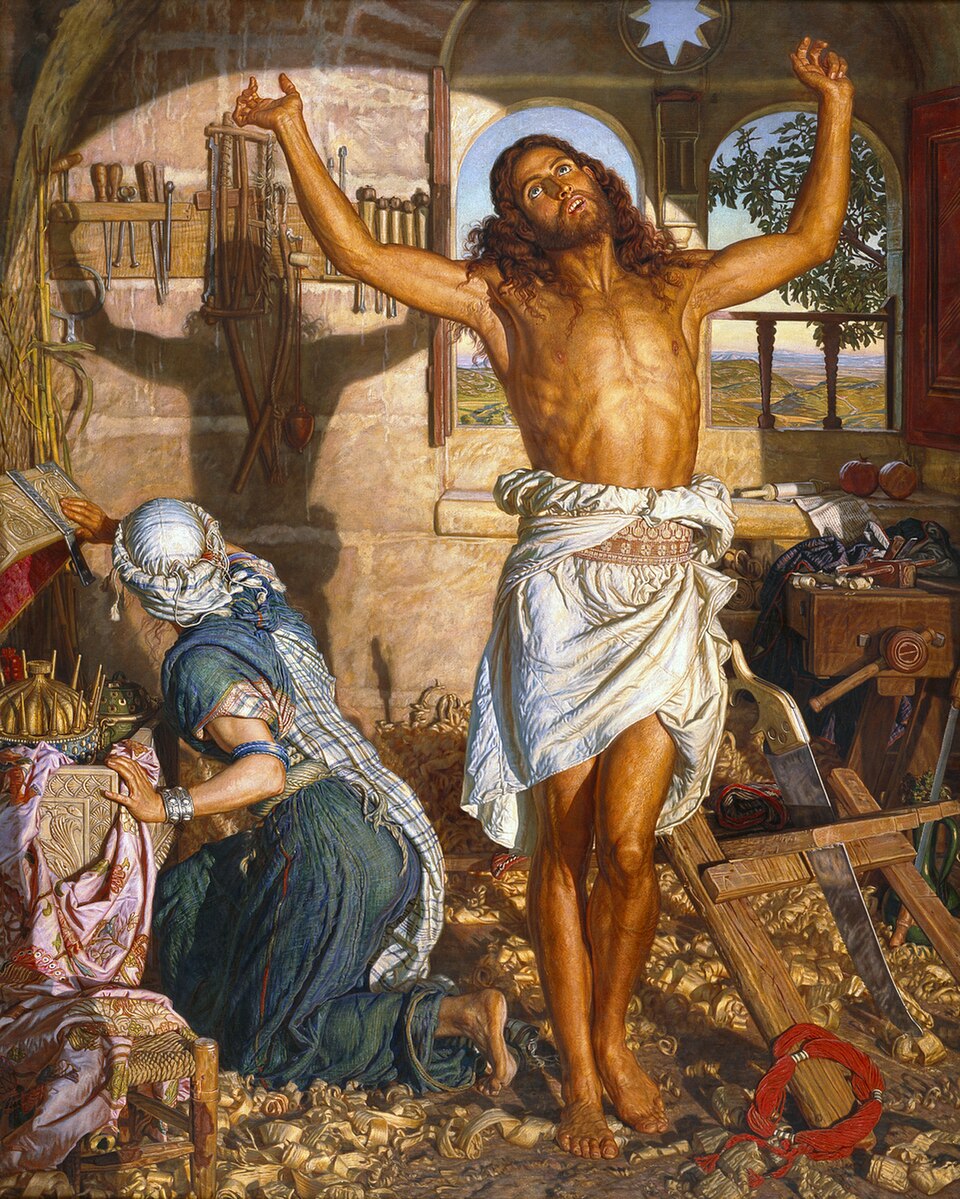
Hebrews 4:15 · Featured Study
The Humanity of Christ
Jesus was hungry, thirsty, tired enough to sleep through a storm, amazed, angry, grieved, and troubled in spirit. None of it diminishes his deity. It is the reason he can help. This page walks the real humanity of Christ from Scripture’s own words, names the ancient error that denied it, and answers it from the earliest apostolic test the church was ever given.
Summary
Jesus was fully God and fully man. This page holds to the second half of that truth without letting go of the first: he hungered, thirsted, grew tired, felt amazement, anger, and grief, and was troubled in his own spirit, all without sin. The ancient claim that he only seemed to have a real body, docetism, is named and answered from the earliest apostolic test given against it.
- Hebrews 4:15 is the page's spine verse: a high priest touched with the feeling of our infirmities, tempted in all points like as we are, yet without sin.
- Real bodily need: hunger after forty days (Matthew 4:2), thirst on the cross (John 19:28), exhaustion enough to sleep through a storm (Mark 4:38).
- Real emotion: amazement at unbelief (Mark 6:6), anger and grief together at hardened hearts (Mark 3:5), and a soul and spirit troubled (John 12:27, 13:21).
- Hebrews 5:8 says he learned obedience through what he suffered, and Luke 2:52 says he grew in wisdom and stature; growth and learning are real facts about him, not appearances.
- 1 John 4:2-3 gives the church's own oldest test: denying that Jesus Christ came in the flesh is named the spirit of antichrist, not a viable Christian reading.
Tempted in All Points
Hebrews 4:15-16: the verse this page turns on
For we do not have a high priest who is unable to sympathize with our weaknesses, but we have one who was tempted in every way that we are, yet was without sin.Touched with the feeling of our infirmities, tempted in all points as we are, yet without sin.
Let us then approach the throne of grace with confidence, so that we may receive mercy and find grace to help us in our time of need.Because he can feel it, we can come boldly. The humanity is the ground of the invitation.
The Greek word behind “touched with the feeling of” is sympatheō, to suffer with, to feel another’s pain as one’s own. Hebrews does not say Christ merely understands our weakness from a distance. It says he feels it alongside us, because he carried a real body and a real human experience through real temptation, and never once sinned. The verse holds both halves at once: full sympathy, and full sinlessness.
“BELOVED, we have a High Priest. All that Israel had under the Law we still retain, only we have the substance of which they had only the shadow. ‘We have an Altar, of which they have no right to eat which serve the tabernacle.’ We have a Sacrifice, which, being once offered, forever avails. We have ‘One greater than the temple,’ and He is to us the Mercy Seat and the High Priest. Take it for granted that all the blessings of the Law remain under the Gospel.”
Charles Spurgeon · "The Tenderness of Jesus," The Metropolitan Tabernacle Pulpit, 1890Reformed Baptist
Hebrews 4:15
“He sympathizes with us even in our innocent infirmities, wants, weaknesses, miseries, dangers. Yet without sin - And, therefore, is indisputably able to preserve us from it in all our temptations.”
John Wesley · Explanatory Notes upon the New Testament, 1755Wesleyan
Hebrews 4:15
Hungry, Thirsty, Tired
the plain bodily needs Scripture records without embarrassment

After fasting forty days and forty nights, He was hungry.Forty days without food, and afterward, plainly, he hungered.
After this, knowing that everything had now been accomplished, and to fulfill the Scripture, Jesus said, “I am thirsty.”On the cross, still fulfilling Scripture, he says the plainest human word: I thirst.
But Jesus was in the stern, sleeping on the cushion. So they woke Him and said, “Teacher, don’t You care that we are perishing?”Asleep on a cushion in the stern, through the start of a storm violent enough to fill the boat.
A body that can go without food for forty days and then hunger, that thirsts under the weight of crucifixion, that grows tired enough to sleep through the first violence of a Galilean squall, is not a body only appearing to need what every human body needs. Scripture records each of these plainly, without any sense that they diminish who Jesus is.
Amazed, Angry, Grieved
the range of his real emotion
And He was amazed at their unbelief. And He went around from village to village, teaching the people.He marveled at their unbelief, the same word used elsewhere for a crowd's astonishment at him.
Jesus looked around at them with anger and sorrow at their hardness of heart. Then He said to the man, “Stretch out your hand.” So he stretched it out, and it was restored.Anger and grief in the same verse, both aimed at the hardening of the heart, before he heals the hand.
The Gospels record Jesus marveling twice: once at great faith in a Gentile centurion (Matthew 8:10; Luke 7:9), and once here, at unbelief in his own hometown. Mark, a few chapters earlier, shows him “looking round about on them with anger, being grieved at the hardening of their heart,” the two emotions given in the same breath, aimed at the same hardness, before he heals the withered hand anyway. Real anger, real grief, and no sin in either.
Troubled in Spirit
John 12:27, 13:21, and the strong crying of Gethsemane
Now My soul is troubled, and what shall I say? ‘Father, save Me from this hour’? No, it is for this purpose that I have come to this hour."Now is my soul troubled," spoken openly, before the cross has even arrived.
After Jesus had said this, He became troubled in spirit and testified, “Truly, truly, I tell you, one of you will betray Me.”Troubled in the spirit at the table, over the betrayal to come, in front of the very man who would do it.
During the days of Jesus’ earthly life, He offered up prayers and petitions with loud cries and tears to the One who could save Him from death, and He was heard because of His reverence.Prayers and supplications, strong crying and tears, in the days of his flesh: Gethsemane, read from the outside.
John records Jesus naming his own trouble twice in his final week, once over his approaching death and once over the betrayal already seated at his table. Hebrews describes the same territory from the garden itself: prayers, supplications, strong crying, and tears, offered to the one who could save him from death. It is real suffering, undergone by someone who could have called it off and did not.
“It was not while bare and not participating in the limits of his emptying that God the Word became our model, but ‘in the days of his flesh.’ Then, quite legitimately, he could employ human limits and pray insistently and shed tears and even appear somehow to need a savior and learn obedience, though a Son. The inspired author is, so to speak, stupefied by the mystery that the Son, existing by nature truly and endowed with the glories of divinity, should so abase himself that he endured the low estate of our impoverished humanity.”
Cyril of Alexandria · On the Unity of Christ, 444Church Father
Hebrews 5:7
“Indeed, his human nature needed the support of Omnipotence; and for this he sent up strong crying and tears: but, throughout his whole life, he showed that it was not the sufferings he was to undergo, but the dishonour that sin had done to so holy a God, that grieved his spotless soul.”
John Wesley · Explanatory Notes upon the New Testament, 1755Wesleyan
Hebrews 5:7
Learning and Growing
Hebrews 5:8-9, Luke 2:52, and Philippians 2:6-8
Although He was a Son, He learned obedience from what He suffered. And having been made perfect, He became the source of eternal salvation to all who obey HimThough a Son, he learned obedience by what he suffered, and so became the source of eternal salvation.
And Jesus grew in wisdom and stature, and in favor with God and man.Increased in wisdom and stature: a real, ongoing growth, not a static appearance of childhood.
Who, existing in the form of God, did not consider equality with God something to be grasped, but emptied Himself, taking the form of a servant, being made in human likeness. And being found in appearance as a man, He humbled Himself and became obedient to death—even death on a cross.Emptied himself, took the form of a servant, was found in fashion as a man.
Philippians 2:7 says Christ “emptied himself,” the Greek verb kenoō, from which the traditional word “kenosis” comes. The verse does not describe the Son setting aside his deity. It describes him taking on a servant’s form and a man’s fashion, adding a full human nature rather than subtracting the divine one. Hebrews 5:8 reads that human nature learning obedience the way any human learns it, through what is actually suffered.
The words underneath
sympatheo: to sympathize
Greek · G4834Strong's entry: to feel "sympathy" with, i.e. (by implication) to commiserate
Hebrews 4:15's own word: sympatheō, to suffer with, to feel another's pain as one's own. The high priest's sympathy is not distant pity but shared feeling.
2 times in the New Testament · sympatheo, in full →
kenoo: to empty
Greek · G2758Strong's entry: to make empty, i.e. (figuratively) to abase, neutralize, falsify
Philippians 2:7's word: kenoō, to empty, to make of no reputation. Christ takes a servant's form; the verse describes an addition, not a subtraction.
5 times in the New Testament · kenoo, in full →
“He was obedient already before His passion, but He stooped to a still more humiliating and trying form of obedience then. The Greek adage is, ‘Pathemata mathemata,’ ‘sufferings, disciplinings.’ Praying and obeying, as in Christ's case, ought to go hand in hand.”
Jamieson, Fausset & Brown · Commentary Critical and Explanatory on the Whole Bible, 1871Reformed
Hebrews 5:8
“Here observe, [1.] The privilege of Christ: He was a Son; the only-begotten of the Father. One would have thought this might have exempted him from suffering, but it did not. Let none then who are the children of God by adoption expect an absolute freedom from suffering.”
Matthew Henry · Commentary on the Whole Bible, 1710Nonconformist
Hebrews 5:8
“Though he were a Son - This is interposed. lest any should be offended at all these instances of human weakness. In the garden, how frequently did he call God his Father! And hence it most evidently appears that his being the Son of God did not arise merely from his resurrection.”
John Wesley · Explanatory Notes upon the New Testament, 1755Wesleyan
Hebrews 5:8
The Sympathizing High Priest
Hebrews 2:17-18: why the humanity matters
For this reason He had to be made like His brothers in every way, so that He might become a merciful and faithful high priest in service to God, in order to make atonement for the sins of the people.Made like his brethren in all things, so he could become a merciful and faithful high priest.
Because He Himself suffered when He was tempted, He is able to help those who are being tempted.Because he suffered, being tempted, he is able to help those who are tempted.
The whole argument of Hebrews on this point runs in one direction: because he was made like us, he can help us. A high priest who never hungered, never wept, never learned obedience the hard way, could represent us before God only from a distance. The letter insists on the opposite: he stands in the gap because he stood where we stand.
Docetism, Answered
1 John 4:2-3: the church's earliest test
By this you will know the Spirit of God: Every spirit that confesses that Jesus Christ has come in the flesh is from God,Every spirit that confesses Jesus Christ come in the flesh is of God.
and every spirit that does not confess Jesus is not from God. This is the spirit of the antichrist, which you have heard is coming and which is already in the world at this time.Every spirit that does not confess it is the spirit of antichrist.
Docetism, from the Greek word for “to seem,” was an early error that Christ only appeared to have a real body and did not truly hunger, suffer, or die. John does not treat this as a minor difference of emphasis. He gives it as the test: to deny that Jesus Christ came in the flesh is named, in his own words, the spirit of antichrist. Everything Scripture records of the real hunger, real thirst, real tears, and real death of Jesus stands against that ancient claim, and this page teaches the church's confession at full strength: Jesus Christ came, and remains, truly in the flesh.
What this does not meanFull humanity and full deity, held together
None of this humanity subtracts from Christ’s deity. The same Gospels that record his hunger and his tears record him forgiving sins, stilling storms with a word, and receiving worship. The doors below carry that side of the doctrine in full: he is fully God as certainly as he is fully man, and this page’s subject is the second half of that truth, not a replacement for the first.
The Voices
with the work named
"The Tenderness of Jesus," The Metropolitan Tabernacle Pulpit (1890) · public domain
Names Christ as the mercy seat and the high priest together, the tenderness of the office grounded in his humanity.
Explanatory Notes upon the New Testament (1755) · public domain
Reads Hebrews 4:15's sympathy as covering "innocent infirmities," and Hebrews 5:7's tears as the human nature needing Omnipotence's support.
On the Unity of Christ (444) · public domain
Insists the Word truly employed "human limits" in the days of his flesh, praying and weeping without ceasing to be the eternal Son.
Commentary Critical and Explanatory on the Whole Bible (1871) · public domain
On Hebrews 5:8, holds together the Son's standing obedience and the deeper obedience learned through suffering.
Commentary on the Whole Bible (1710) · public domain
Notes that sonship did not exempt Christ from suffering, and grounds a lesson for every adopted child of God in it.
Marcus Brown's own commentary leads above all; within a tier, all voices are equal.
Keep Studying
On this page
People and groups2
Places2
Doctrines8
Values1