
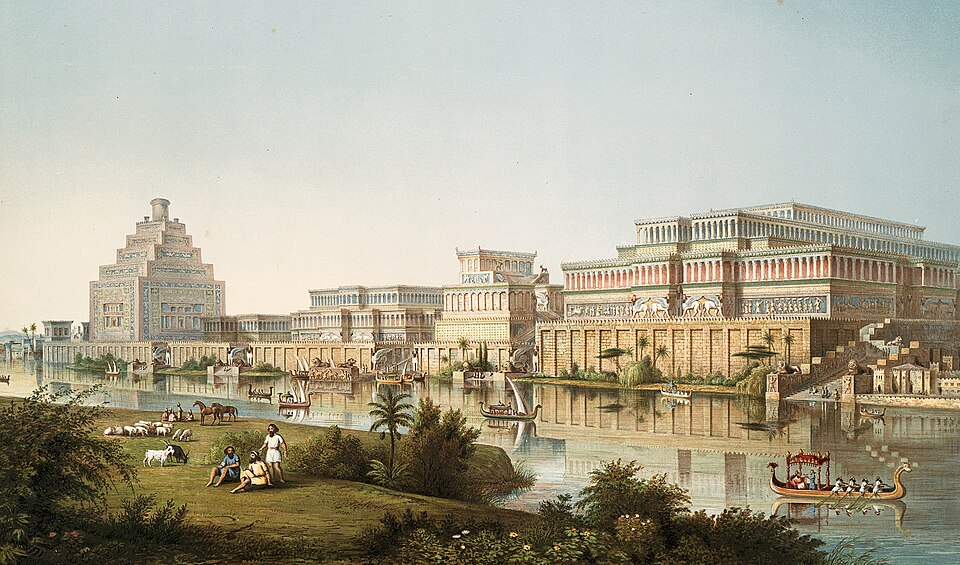
An Ancient Empire · Nineveh, Samaria, and Jerusalem
Assyria
Assyria was the terror of the ancient world, a war machine that emptied nations by deportation and boasted of it in stone. That same empire once repented at a single sermon, and its armies once stopped at the walls of Jerusalem without taking it, exactly as its own king’s inscriptions and Israel’s Scripture both say. This page follows Assyria from Nineveh’s rise through Jonah, the fall of Samaria, the siege of Hezekiah’s Jerusalem, the archaeology that confirms the record, and Nineveh’s own end.
Summary
Assyria rose from Nineveh into the most feared war machine of its age, ruling by deportation. It repented once, at Jonah's preaching, then returned to its old course and destroyed the northern kingdom of Israel in 722 BC. In 701 BC it besieged Jerusalem itself and, by the text and by its own royal inscriptions alike, never took the city. Nahum's oracle against Nineveh was fulfilled in 612 BC, so completely that the site was lost until the 1840s.
- Nineveh's own citizens repented under Jonah's one-line sermon, sparing the city (Jonah 3:4-5, 10)
- Samaria fell in 722 BC; 2 Kings 17 names exactly where Israel was deported, not a hidden or unknown destination
- Sennacherib besieged Jerusalem in 701 BC, and his own Taylor Prism boasts of shutting Hezekiah up but never claims the city fell
- The Lachish reliefs, Hezekiah's Tunnel, and the Siloam Inscription are physical witnesses to the same siege the Bible narrates
- Nahum's oracle against Nineveh was fulfilled in 612 BC; the city was so completely destroyed it was not rediscovered until the 1840s
Rise from Nineveh
the war machine and the deportation policy
Assyria grew from a cluster of cities on the upper Tigris, Nineveh chief among them, into the ancient world’s first true empire of terror. Its kings built a standing army with iron weapons and siege engines that could reduce a walled city in weeks, and they wrote their own campaigns on stone in deliberately frightening detail, flayings, impalings, pyramids of severed heads, so that the report alone would break a city’s will before the army arrived.
The empire’s signature policy was mass deportation. A conquered people was not merely taxed or garrisoned; it was uprooted and resettled somewhere else in the empire, and another conquered people was moved in to replace it. The purpose was practical: a nation with no land under its feet and no neighbors who spoke its language could not easily rebel. That same policy is the hinge of the fall of Samaria, told below, and it is what makes the account in 2 Kings 17 a matter of public record rather than guesswork.
- c. 900-612 BCthe empire's height, Nineveh its capital
- 722 BCthe fall of Samaria, the northern kingdom's end
- 701 BCSennacherib's siege of Jerusalem
- 612 BCNineveh's own fall, to the Medes and Babylonians
Jonah Sent to Nineveh
Jonah 3: the second commission, and the city that believed
“On the first day of his journey, Jonah set out into the city and proclaimed, ‘Forty more days and Nineveh will be overturned!’” Jonah 3:4
God sends a Hebrew prophet not to comfort Israel but to warn the empire that would one day destroy it. Jonah’s message is eight words in the Hebrew, no theology, no invitation, just a countdown. The response is immediate and total.
“And the Ninevites believed God. They proclaimed a fast and dressed in sackcloth, from the greatest of them to the least.” Jonah 3:5
“And Jonah arose and went unto Nineveh ... ready to obey, as before to disobey. Before, when God said those same words, ‘he arose and fled;’ now, ‘he arose and went.’ True conversion shows the same energy in serving God, as the unconverted had before shown in serving self or error.”
Albert Barnes · Notes, Explanatory and Practical, on the Old and New Testaments, 1832-1869Evangelical
Jonah 3:3
“And the people of Nineveh believed God; - strictly, ‘believed in God.’ To ‘believe in God’ expresses more heart-belief, than to ‘believe God’ in itself need convey. ... It combines hope and trust with faith, and love too, since, without love, there cannot be trust.”
Albert Barnes · Notes, Explanatory and Practical, on the Old and New Testaments, 1832-1869Evangelical
Jonah 3:5
“When God saw their actions—that they had turned from their evil ways—He relented from the disaster He had threatened to bring upon them.” Jonah 3:10
“And Gods saw their works - They repented, and brought forth fruits meet for repentance; works which showed that they did most earnestly repent. He therefore changed his purpose, and the city was saved. The purpose was: If the Ninevites do not return from their evil ways, and the violence that is in their hands, within forty days, I will destroy the city. The Ninevites did return, etc., and therefore escaped the threatened judgment. Thus we see that the threatening was conditional.”
Adam Clarke · Commentary on the Bible, 1832Methodist
Jonah 3:10
The repentance did not last. The next section names what Assyria did to Israel a generation or two later, and the section after that names what Nahum says happened when Nineveh finally returned for good to the course Jonah once turned it from.
The Fall of Samaria
2 Kings 17: the northern kingdom deported, 722 BC
“In the ninth year of Hoshea, the king of Assyria captured Samaria and carried away the Israelites to Assyria, where he settled them in Halah, in Gozan by the Habor River, and in the cities of the Medes.” 2 Kings 17:6
The northern kingdom of Israel, ten tribes under its own line of kings since Solomon’s death, falls to the same deportation policy named above. The text does not leave the destination vague. Halah, the Habor river of Gozan, and the cities of the Medes are named places, regions the Assyrian record independently confirms as resettlement zones for deported populations.
“And the king of Assyria brought men from Babylon, and from Cuthah, and from Avva, and from Hamath and Sepharvaim, and placed them in the cities of Samaria instead of the children of Israel; and they possessed Samaria, and dwelt in the cities thereof.” 2 Kings 17:24
The other half of the policy completes the picture. Foreign peoples from Babylon and elsewhere were resettled in Israel’s empty land, and their descendants, mixed with whatever Israelite population remained, become the Samaritans the Gospels meet centuries later.
What 2 Kings 17 does not say: the "lost tribes" questionthe text against the later legend
A popular idea holds that the ten northern tribes vanished into history, hidden somewhere and waiting to be found. The text itself does not teach this. Verse 6 names the destination: known Assyrian provinces, not an unknown place. Verse 23 says plainly that Israel was carried to Assyria and remained there “unto this day,” a settled, documented fact from the writer’s own vantage point, not a mystery. The tribes were deported to real, nameable regions and, over generations, assimilated into the wider populations around them, the common fate of most deported peoples in the ancient Near East. The search for a hidden identity for the “lost tribes” is a later development in tradition, not a claim the biblical text itself makes.
Sennacherib and Hezekiah
701 BC: 2 Kings 18-19, Isaiah 36-37
Two decades after Samaria fell, Sennacherib turned the same war machine on Judah. “Now in the fourteenth year of king Hezekiah did Sennacherib king of Assyria come up against all the fortified cities of Judah, and took them” (2 Kings 18:13). Lachish, Judah’s second city, fell. Jerusalem, the capital, did not, and the record of why fills two of Scripture’s most detailed chapters.
Rabshakeh’s Speech
From the captured city of Lachish, Sennacherib sent his field commander, the Rabshakeh, with an army to stand outside Jerusalem’s wall and talk the city into surrender before a single arrow was fired.
“Thus saith the great king, the king of Assyria, What confidence is this wherein thou trustest?” 2 Kings 18:19
The speech runs through Jerusalem’s every possible defense and dismisses each in turn: Egypt is “a bruised reed” that will pierce the hand of anyone who leans on it (18:21); Hezekiah’s own reforms, tearing down the high places, are twisted into a claim that Hezekiah has offended the LORD (18:22); and the argument ends where every Assyrian speech like it ended, with a roll call of conquered gods who could not save their people.
Rabshakeh's argument from the gods of the nations2 Kings 18:33-35
“Has the god of any nation ever delivered his land from the hand of the king of Assyria? Where are the gods of Hamath and Arpad? Where are the gods of Sepharvaim, Hena, and Ivvah? Have they delivered Samaria from my hand? Who among all the gods of these lands has delivered his land from my hand? How then can the LORD deliver Jerusalem from my hand?” 2 Kings 18:33-35
The argument is not empty bluster. Every city Rabshakeh names really had fallen, and every one of their gods really had failed to save them. The speech’s force is that Jerusalem’s God will fail the same way, and the rest of the story turns entirely on whether that is true.
Spread Before the LORD
“So Hezekiah received the letter from the messengers, read it, and went up to the house of the LORD and spread it out before the LORD.” 2 Kings 19:14
When Sennacherib sends a second, written threat, Hezekiah does not answer it himself. He takes the letter into the temple and physically lays it open before God, an act with no diplomatic purpose at all, only prayer.
“O LORD, God of Israel, enthroned between the cherubim, You alone are God over all the kingdoms of the earth. You made the heavens and the earth.” 2 Kings 19:15
“Spread it before the Lord - The temple was considered to be God's dwelling-place; and that whatever was there was peculiarly under his eye. Hezekiah spread the letter before the Lord, as he wished him to read the blasphemies spoken against himself.”
Adam Clarke · Commentary on the Bible, 1832Methodist
2 Kings 19:14
“Thou art the God, even thou alone - This is the protest of the pure theist against the intense polytheism of Sennacherib's letter, which assumes that gods are only gods of particular nations, and that Hezekiah's God is but one out of an indefinite number, no stronger or more formidable than the rest.”
Albert Barnes · Notes, Explanatory and Practical, on the Old and New Testaments, 1832-1869Evangelical
2 Kings 19:15
The 185,000
“So this is what the LORD says about the king of Assyria: He will not enter this city or shoot an arrow into it… And that very night the angel of the LORD went out and struck down 185,000 men in the camp of the Assyrians. When the people got up the next morning, there were all the dead bodies!” 2 Kings 19:32, 35
“He shall not, etc. - Here follow the fullest proofs that Jerusalem shall not be taken by the Assyrians. 1. He shall not come into this city; 2. He shall not be able to get so near as to shoot an arrow into it; 3. He shall not be able to bring an army before it, 4. Nor shall he be able to raise any redoubt or mound against it; 5. No; not even an Assyrian shield shall be seen in the country; not even a foraging party shall come near the city.”
Adam Clarke · Commentary on the Bible, 1832Methodist
2 Kings 19:32
“Since the evil spirits have no power, they play as on a stage, changing their shapes and frightening children... The true angel sent by the Lord against the Assyrians had no need of crowds or apparitions from without, or loud noises or clappings, but he used his power quietly and destroyed 185,000 at one time.”
Athanasius · Life of St. Anthony, 4th c.Church Father
2 Kings 19:35
“So Sennacherib king of Assyria departed, and went and returned, and dwelt at Nineveh” (2 Kings 19:36). His own death comes twenty years later, at the hands of his own sons, while worshipping the god he had boasted against.
“The death of Sennacherib, which took place many years afterward (680 B.C.), is related here, as, from the divine point of view, the sequel to his Syrian expeditions.”
Albert Barnes · Notes, Explanatory and Practical, on the Old and New Testaments, 1832-1869Evangelical
2 Kings 19:37
The Archaeology Witness
three artifacts, honestly described
The siege of 701 BC is one of the best-attested events in the Old Testament from outside sources. Sennacherib’s own words, Judah’s own engineering, and a Judean city’s own destruction all survive in stone.
The Taylor Prism: a boast, and a silenceBritish Museum, one of several surviving copies of Sennacherib's annals
Sennacherib had his own account of the campaign inscribed on clay prisms, several copies of which survive; the best known, the Taylor Prism, is held by the British Museum. It records Sennacherib’s siege of forty-six of Judah’s fortified cities, enormous tribute taken from Hezekiah, and a king “shut up” inside his own capital “like a bird in a cage,” the phrase widely used in published translations of the text.
What the inscription does not say is the point. Sennacherib’s annals routinely boast when a city is captured, and they do exactly that for Lachish. For Jerusalem, the boast stops at the siege and the tribute. No Assyrian king who took an enemy’s capital ever failed to say so in his own inscriptions, and Sennacherib does not say it here. The silence lines up precisely with 2 Kings 19’s own claim, that the city was never taken.
The Lachish reliefs: the city that did fallBritish Museum, from Sennacherib's palace at Nineveh
Lachish, unlike Jerusalem, was captured, and Sennacherib commemorated it at length. A series of large stone relief panels from his palace at Nineveh depict the siege of Lachish in careful detail: siege ramps, battering rams, archers, captives led into exile, and Sennacherib himself seated on a throne receiving the city’s surrender. The reliefs confirm 2 Kings 18:13-17’s claim that Lachish fell before the army moved on Jerusalem, and by contrast make the absence of any matching “fall of Jerusalem” relief or inscription anywhere in the Assyrian record more striking.
Hezekiah's Tunnel and the Siloam InscriptionJerusalem's City of David; the inscription discovered 1880
Ahead of the siege, Hezekiah had a tunnel cut through solid rock to bring water from the Gihon Spring inside the city walls, so Jerusalem would not have to depend on an exposed water source during a siege (2 Kings 20:20; 2 Chronicles 32:30). The tunnel survives and can still be walked today. In 1880 a Hebrew inscription was found carved near its southern end, describing the moment two teams of tunnelers, digging from opposite ends, heard each other’s picks through the rock and met in the middle. The engineering the Bible credits to Hezekiah’s siege preparation is not a claim resting on the text alone; it is a tunnel a visitor can still walk through.
Nahum's Oracle and Nineveh's Fall
the repentance did not last, and neither did the empire
“The burden of Nineveh. The book of the vision of Nahum the Elkoshite.” Nahum 1:1
Roughly a century after Jonah, Nineveh had returned entirely to the violence it once repented of, and this time no warning precedes the sentence. Nahum names the city’s coming end in the same breath that his contemporaries were still reeling from Sennacherib’s invasion of Judah.
“Nineveh, after having 'repented at the preaching of Jonah,' again fell back into the sins whereof it had repented, and added this, that, being employed by God to chasten Israel, it set itself, not to inflict the measure of God's displeasure, but to uproot the chosen people, in whom was promised the birth of Christ.”
Albert Barnes · Notes, Explanatory and Practical, on the Old and New Testaments, 1832-1869Evangelical
Nahum 1:1
“Though they be - many - Sennacherib invaded Judea with an army of nearly two hundred thousand men. Thus shall they be cut down - The angel of the Lord (a suffocating wind) slew of them in one night one hundred and eighty-five thousand 2Ki 19:35.”
Adam Clarke · Commentary on the Bible, 1832Methodist
Nahum 1:12
“I will make thy grave; for thou art vile - I think this is an address to the Assyrians, and especially to Sennacherib. The text is no obscure intimation of the fact. The house of his gods is to be his grave: and we know that while he was worshipping in the house of his god Nisroch, his two sons, Adrammelech and Sharezer, smote him there that he died, 2Ki 19:37.”
Adam Clarke · Commentary on the Bible, 1832Methodist
Nahum 1:14
Nahum names his own oracle's ending outright: “with an over-running flood he will make a full end of her place” (1:8). Ancient sources describe the Tigris flooding during the final siege and breaching Nineveh’s walls, letting the combined armies of the Medes and the newly risen Babylonians finish what the flood began. Nineveh fell in 612 BC and was never rebuilt. The destruction was so complete that the city’s location itself was lost to memory for over two thousand years, rediscovered by excavation only in the 1840s.
Where It Points
Nahum 1:15, quoted in Romans 10
“Behold upon the mountains the feet of him that bringeth good tidings, that publisheth peace!” Nahum 1:15
Nahum’s announcement of judgment against Nineveh ends, almost without transition, in an announcement of good news for Judah. Paul quotes this same language, alongside Isaiah’s version of it, in Romans 10:15 to describe the gospel itself going out into the world.
“These words are also quoted by the apostle, both from Isaiah and Nahum, and applied to the great redemption wrought out for us by our Lord Jesus, and the publishing of it to the world by the everlasting gospel, Rom. x. Christ's ministers are those messengers of good tidings, that preach peace by Jesus Christ. How beautiful are the feet of those messengers!”
Matthew Henry · Commentary on the Whole Bible, 1710Nonconformist
Nahum 1:15
The same book that records the fall of a pagan empire ends with the language the New Testament borrows for the spread of the gospel to the pagan world. Nineveh once believed a single warning and was spared; Nahum's own generation had turned that mercy into the ground for their own judgment. Both halves of the story sit inside one truth: God is patient with those who repent and just with those who do not.
The Voices
with the work named
Notes, Explanatory and Practical (1832-1869) · public domain
Traces Hezekiah's turn to prayer, the protest against Assyrian polytheism in his prayer, and Nineveh's relapse into the sins Jonah once turned it from.
Commentary on the Bible (1832) · public domain
Lays out the fivefold proof Jerusalem would not fall, and draws the direct line from Nahum's oracle back to the 185,000 and Sennacherib's death.
Commentary on the Whole Bible (1710) · public domain
Reads Nahum's closing verse alongside Paul's use of it in Romans 10, the empire's judgment closing on the gospel's own language.
Life of St. Anthony (4th century) · public domain
Reads the quiet, undramatic manner of the 185,000's destruction as a mark of true divine power against empty spectacle.
Marcus Brown's own commentary leads above all. No roster voice met the relevance gate for this historical portrait; none is used. Archaeology described from the artifacts' general public record (British Museum), named for content and not quoted as verbatim translation.
Keep Studying
On this page
Studies10