
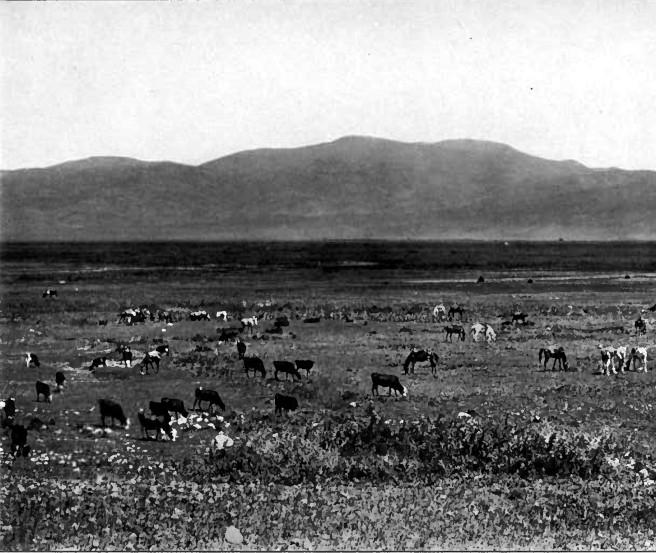
Dwight L. Elmendorf, Mount Hermon, 1912. Public domain.
Deuteronomy 3:8 to 9 · Place · Featured Study
Mount Hermon
Mount Hermon is the high mountain at the southern end of the Anti-Lebanon, and its highest summit rises 2,814 metres.
Far from the house of God, a psalmist remembered Him from Hermon's heights.
At that time we took from the two kings of the Amorites the land across the Jordan, from the Arnon Valley as far as Mount Hermon— which the Sidonians call Sirion but the Amorites call Senir—
- Today
- Jabal a-Shayk
- Region
- North-east of the Sea of Galilee, where the Anti-Lebanon ends
- Site
- 33.400, 35.850
- First named
- Deuteronomy 3:8 “…Arnon Valley as far as Mount Hermon—”
- Last named
- Song of Solomon 4:8 “…of the lions, from the mountains of the…”
Summary
Scripture names Hermon in the books of Moses, in the histories, in three psalms and in the Song of Solomon.
- Psalm 29:6 calls the mountain Sirion and makes it skip like a young wild ox.
- Tyre's builders made the planking of its ships from the cypress of Senir (Ezekiel 27:5).
- The bride of the Song is called down from the summits of Senir and Hermon (Song of Solomon 4:8).
Where Hermon Stands
Moses gives the mountain as the limit of the conquest east of the Jordan.
This study asks where Hermon stands and what Scripture makes of it. It sets the mountain on an atlas plate, follows it through the record and weighs three readings of its several names.
The Berean text names Hermon in 14 verses, and Strong's dictionary glosses it: Chermon, a mount of Palestine.
Albert Barnes, the American commentator, explains on Deuteronomy 3:9 why Moses records the other names; his note stands under Voices on Hermon.
Hermon on Smith's Plate
The plate of Israel's settlement prints Hermon north of the land of Bashan.
Bashan spreads south and east of Hermon to Edrei and Salecah.
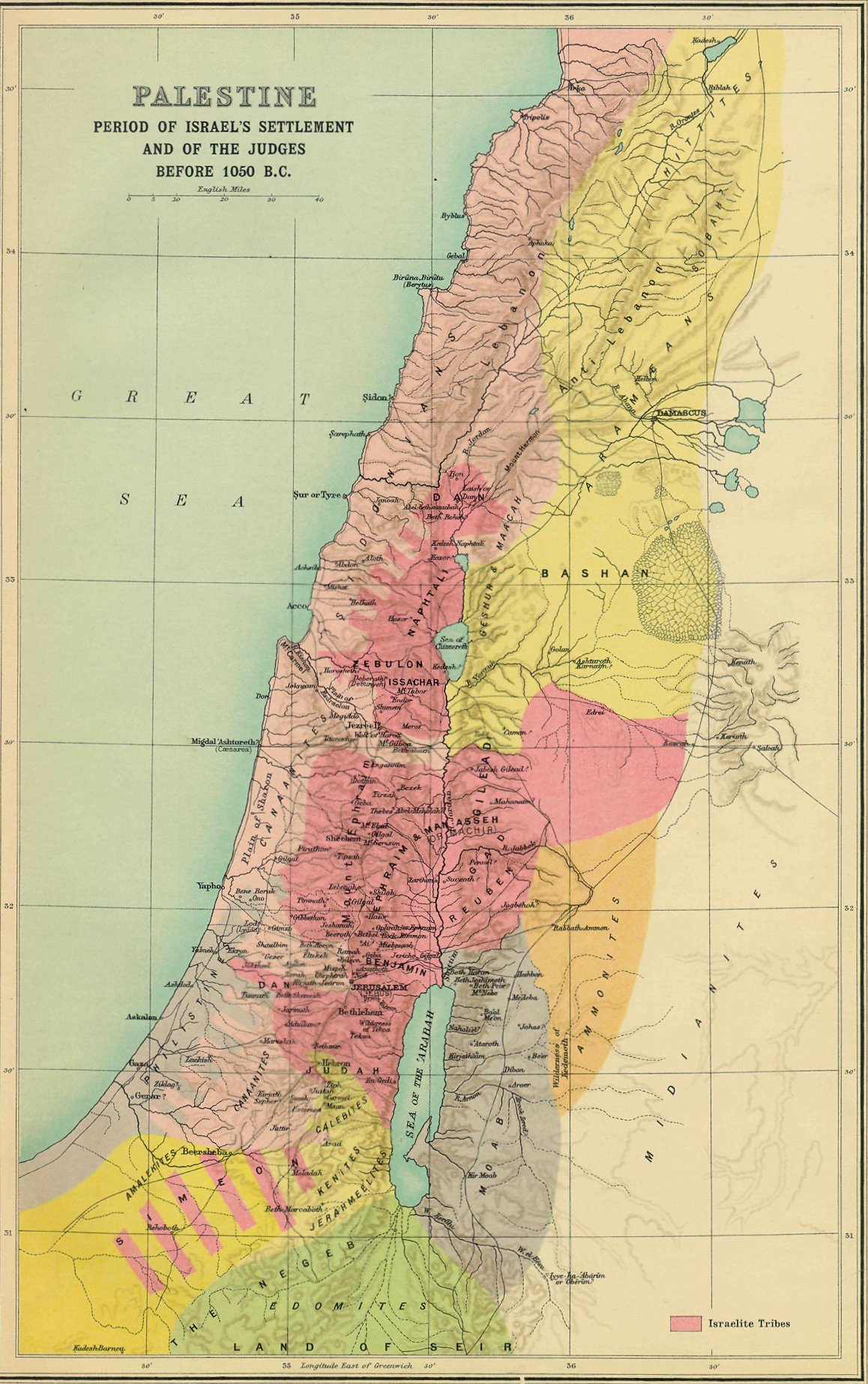
- HermonOg ruled over Hermon, Salecah and all of Bashan. The plate prints the mountain with no query, the northernmost point, and its place is known.Joshua 12:5
- Geshur and MaacahThe land given east of the Jordan took in the territory of the Geshurites and Maacathites and all of the mountain. The plate letters the two with no query along the east side of the upper Jordan.Joshua 13:11
- AshtarothOg lived in Ashtaroth and Edrei. The plate prints Ashtaroth Karnaim with a query, so its place is proposed.Joshua 12:4
- EdreiMoses defeated Og king of Bashan at Edrei. The plate prints the town with no query, and its place is known.Deuteronomy 1:4
- SalecahThe land taken ran over all of Bashan as far as Salecah and Edrei. The plate prints it as Salcah with no query, the south-easternmost point, and its place is known.Deuteronomy 3:10
George Adam Smith, Palestine in the Period of Israel's Settlement and of the Judges, before 1050 B.C., in his Atlas of the Historical Geography of the Holy Land, 1915. Public domain; File:Palestine in the period of Israel's settlement and of the Judges (Smith, 1915).jpg.
Five numbered points, each where George Adam Smith's plate prints the place, with north at the top. The plate colours the land of the Israelite tribes in pink and prints a scale in English miles.
The study of Sihon and Og tells how the land from the Arnon to Hermon was taken.
Hermon in Scripture, in Order
Scripture names the mountain in the conquest lists and in the tribes' lands.
Five of the six moments use Hermon to mark the end of a stretch of land.
- Before the second addressThe narrator sets the land of Sihon and Og from Aroer to Mount Siyon, which is HermonDeuteronomy 4:47 to 48
- Joshua's northern warJabin of Hazor calls the Hivites at the foot of Hermon to the war against IsraelJoshua 11:3
- The end of Joshua's warsJoshua's conquest runs from Mount Halak to Baal-gad at the foot of HermonJoshua 11:17
- The land that remainsAll Lebanon from Baal-gad below Hermon to Lebo-hamath remains to be takenJoshua 13:5
- After JoshuaThe Hivites still live in the mountains from Mount Baal-hermon to Lebo-hamathJudges 3:3
- Manasseh east of the JordanThe half-tribe settles from Bashan to Baal-hermon1 Chronicles 5:23
Six moments from Deuteronomy to 1 Chronicles in the order of the canon, each with its verse.
The Hivites who lived beneath Hermon are taught with the other peoples Joshua left unconquered.
The Highest Ground in the Land
The World Factbook gives its height, and a commentary of 1871 describes its snow.
The World Factbook gives the mountain's highest point as 2,814 metres. Jamieson, Fausset and Brown describe it as a cluster of peaks, the highest in Palestine, almost always under snow.
It is like the dew of Hermon falling on the mountains of Zion. For there the LORD has bestowed the blessing of life forevermore.The psalm takes the dew of Hermon as its picture of brothers living together in harmony.
The study of Psalm 133 sets out the dew of Hermon and its readings whole. Jerome, preaching on that psalm, recalls an apocryphal book that set the descent of the sons of God on Hermon, citing it only for remembrance.
What the Gospels Leave Unsaid
Matthew names the region of Caesarea Philippi and leaves the next mountain unnamed.
Matthew 16:13 brings Jesus near Caesarea Philippi, which Barnes sets at Hermon's foot, and Matthew 17:1 then speaks only of a high mountain.
The study of the Transfiguration weighs the mountains proposed for it.
Tabor and Hermon Shout for Joy
Two psalms name Hermon, one in praise and one in lament.
North and south You created; Tabor and Hermon shout for joy at Your name.The verse sets the mountain among the works of the Creator.
O my God, my soul despairs within me. Therefore I remember You from the land of Jordan and the peaks of Hermon— even from Mount Mizar.The psalm sets Hermon in a lament.
Charles Spurgeon, the London preacher, reads Tabor and Hermon in Psalm 89 as east and west, so every point of the compass praises God. John Wesley, the Methodist preacher, reads the places of Psalm 42:6 as the far parts of the land to which the psalmist might be driven.
The study Why Are You Downcast, O My Soul? teaches Psalm 42 whole.
Voices on Hermon
Albert Barnes wrote on the mountain's names and the worship on its slopes.
Albert Barnes (1798 to 1870)
“Hermon, the southern and culminating point of the range of Lebanon, was also the religious center of primaeval Syria. Its Baal sanctuaries not only existed but gave it a name before the Exodus. Hence, the careful specification of the various names by which the mountain was known. The Sidonian name of it might easily have become known to Moses through the constant traffic which had gone on from the most ancient times between Sidon and Egypt.”
Albert Barnes · Notes, Explanatory and Practical, on the Old and New Testaments (1832-1869) · on Deuteronomy 3:9Evangelical
One Mountain or Its Parts
Readers differ on whether Hermon's names belong to the whole mountain, to its summits or to a place at its foot.
Now the people of the half-tribe of Manasseh were numerous. They settled in the land from Bashan to Baal-hermon (that is, Senir, also known as Mount Hermon).Manasseh's border is given in the mountain's names.
One mountain under several namesJohn Gill, Exposition of the Old Testament
John Gill, the Baptist commentator, takes all of Hermon in Joshua 13:11 as the mountain also called Sirion, Shenir and Sion.
The objection: 1 Chronicles 5:23 lists Baal-hermon, Senir and Hermon as if they were the stages of a border.
Three parts of the mountainAlbert Barnes, Notes on 1 Chronicles 5:23
Barnes reads the three names of 1 Chronicles 5:23 as three parts of the mountain, perhaps its three summits.
The objection: Barnes gives no verse that ties any one name to one summit.
A place at its footAlbert Barnes, Notes on Judges 3:3 and Joshua 11:17
On Judges 3:3 Barnes takes Baal-hermon to be probably Baal-gad under Hermon, since it is not the same as Hermon. On Joshua 11:17 he takes Baal-gad to be probably Paneas, the Caesarea Philippi of later times.
The objection: Judges 3:3 calls it Mount Baal-hermon, which names a mountain.
Help from the Maker of the Mountains
Psalm 121 asks the reader to look past the hills to the LORD who made them.
I lift up my eyes to the hills. From where does my help come? My help comes from the LORD, the Maker of heaven and earth.The answer points past every mountain, Hermon among them.
Sources
Scripture is the Berean Standard Bible.
- James Strong, Exhaustive Concordance of the Bible (1890), Hebrew dictionary, entry 2768.
- Albert Barnes, Notes, Explanatory and Practical, on the Old and New Testaments (1832 to 1869), on Deuteronomy 3:9.
- Jamieson, Fausset and Brown, Commentary Critical and Explanatory on the Whole Bible (1871), on Deuteronomy 3:9.
- Albert Barnes, Notes, Explanatory and Practical, on the Old and New Testaments (1832 to 1869), on Joshua 11:17.
- Albert Barnes, Notes, Explanatory and Practical, on the Old and New Testaments (1832 to 1869), on Judges 3:3.
- Albert Barnes, Notes, Explanatory and Practical, on the Old and New Testaments (1832 to 1869), on 1 Chronicles 5:23.
- John Gill, Exposition of the Old Testament (1748 to 1763), on Joshua 13:11.
- Charles Spurgeon, The Treasury of David, volume 4 (1874), on Psalm 89:12.
- John Wesley, Explanatory Notes upon the Old Testament (1765), on Psalm 42:6.
- Jerome, Homily 45, on Psalm 132 (133 in the Hebrew numbering), before 420.
- OpenBible.info, Bible Geocoding Data, ancient.jsonl, entry Mount Hermon (CC BY 4.0)
Keep Studying
Read it4
People and groups3
Places8
Show the next 2 titles
Symbols1
Doctrines1