
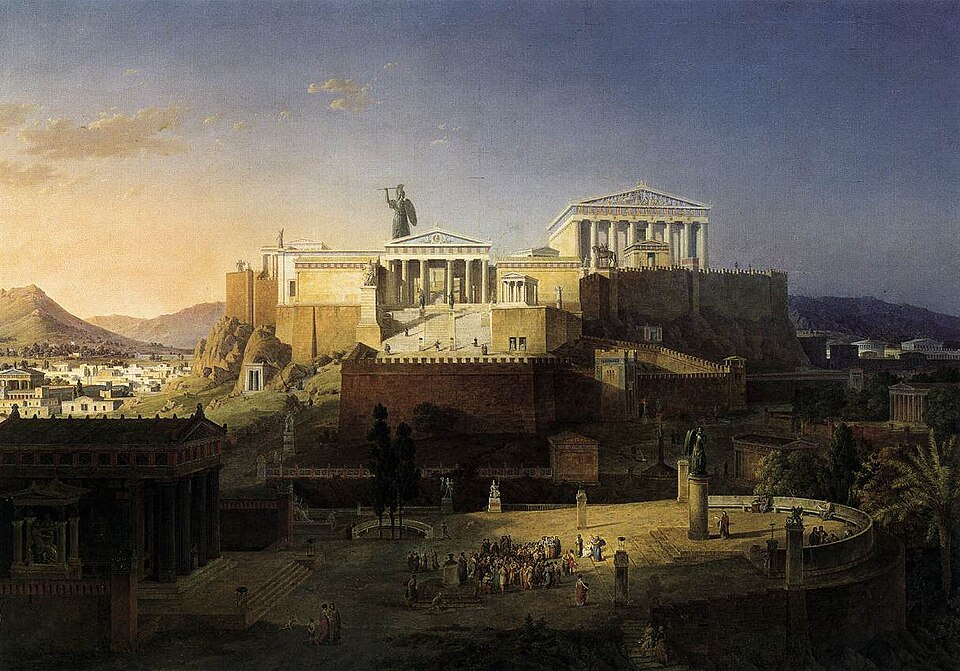
An Ancient Empire · The He-Goat from the West
Greece
Daniel saw the empire coming a hundred and fifty years before it arrived, and Scripture names it outright. “The rough goat is the king of Grecia” is one of the Bible’s own interpretations of its own symbol, not a reading supplied afterward. This page follows Greece from Alexander’s lightning conquest through his empire’s fourfold division, the Greek language the New Testament itself was written in, the pressure Hellenism put on Jewish life, and Antiochus Epiphanes’ assault on the temple, the sharpest test case in Scripture for whether prophecy can name what has not happened yet.
Summary
Daniel 8 pictures Greece as a he-goat that crosses the world without touching the ground and names it outright as the king of Greece, then shows its great horn broken and four horns rising in its place, exactly what happened when Alexander the Great died and his empire split among his four generals. Daniel 11 previews the same history in plainer language, then narrates Antiochus IV Epiphanes' assault on the Jerusalem temple in enough detail that critics have argued the text must have been written after the fact.
- Daniel 8:21 interprets its own symbol: the rough goat is the king of Greece, one of Scripture's few self-named symbols
- The great horn's break and the four horns that follow (8:8, 22) match Alexander's death in 323 BC and the settling of his empire into four kingdoms under Cassander, Lysimachus, Seleucus, and Ptolemy
- Koine Greek, the empire's common tongue, became the language the New Testament was written in and the Septuagint's own Greek Old Testament
- Antiochus IV Epiphanes desecrated the temple and banned Jewish worship (Daniel 8:9-14, 11:21-35); the readings that see a horizon beyond him are named here with their holders
- The prophecy's precision is the reason critical scholarship argues for a later date; the traditional-date response is given honestly alongside it
The He-Goat from the West
Daniel 8:5-8: a conquest too fast to explain any other way
“And as I was considering, behold, a he-goat came from the west over the face of the whole earth, and touched not the ground: and the goat had a notable horn between his eyes.” Daniel 8:5
The vision moves from a ram with two horns, Media and Persia, to a goat crossing the entire visible world without slowing down. The image is speed itself: an army that reaches its target before its target can prepare. That is exactly what Alexander’s campaign against Persia did.
“And I saw him come close unto the ram, and he was moved with choler against him, and smote the ram, and brake his two horns: and there was no power in the ram to stand before him.” Daniel 8:7
“This was Alexander the Great, the son of Philip king of Macedonia. He came from the west, from Greece, which lay west from Persia. He fetched a great compass with his army: he came upon the face of the whole earth; he did in effect conquer the world, and then sat down and wept because there was not another world to be conquered.”
Matthew Henry · Commentary on the Whole Bible, 1710Nonconformist
Daniel 8:5
“‘Touched not . . . ground,’ implies the incredible swiftness of his conquests; he overran the world in less than twelve years. The he-goat answers to the leopard (Da 7:6).”
Jamieson, Fausset & Brown · Commentary Critical and Explanatory on the Whole Bible, 1871Reformed
Daniel 8:5
- 334-323 BCAlexander's campaign, start to death
- 12 yearsthe whole known world conquered, per JFB
- 331 BCGaugamela, the Persian empire's collapse
- 8:21Daniel's own naming of the goat
The Great Horn Broken
Daniel 8:8, 21-22: Alexander's death, and four kingdoms where one stood
“Therefore the he-goat waxed very great: and when he was strong, the great horn was broken; and for it came up four notable ones toward the four winds of heaven.” Daniel 8:8
“And the rough goat is the king of Grecia: and the great horn that is between his eyes is the first king.” Daniel 8:21
Verse 21 is the text interpreting itself: the goat is Greece, the great horn its first king. Alexander died in 323 BC at thirty-two, leaving no heir capable of holding the empire together. Within about fifteen years his family was gone by murder, and the empire split into four successor kingdoms, each named directly in the earliest commentary tradition available.
“Next after the male goat was exalted, ‘his great horn was shattered, and four horns arose under him to the four winds of heaven.’ [Daniel 8:8] For after Alexander ruled all the land of Persia and subjected them, later he died, dividing his kingdom to his four Chiefs as is shown above, that is to Seleucus, to Demetrius, to Ptolemy, and to Philip, from whom one horn was exalted and grew great unto the power of heaven.”
Hippolytus of Rome · Commentary on Daniel, 235Church Father
Daniel 8:8
“The he-goat waxed very strong - He had subdued nearly the whole of the then known world. The great horn was broken - Alexander died in the height of his conquests, when he was but about thirty-three years of age. His natural brother, Philip Aridaeus, and his two sons, Alexander Aegus and Hercules, kept up the show and name of the Macedonian kingdom for a time; but they were all murdered within fifteen years; and thus the great horn, the Macedonian kingdom, was broken, Alexander's family being now cut off.”
Adam Clarke · Commentary on the Bible, 1832Methodist
Daniel 8:8
Of the four, two mattered most for the Bible’s own story: the Ptolemies, who ruled Egypt to Judea’s south, and the Seleucids, who ruled Syria to Judea’s north. Judea sat between them, and the wars the two kingdoms fought over it fill the next section of Daniel’s vision.
Daniel 11's Preview
11:2-4: the same history, told again in plainer terms
“And now will I show thee the truth. Behold, there shall stand up yet three kings in Persia; and the fourth shall be far richer than they all: and when he is waxed strong through his riches, he shall stir up all against the realm of Greece.” Daniel 11:2
“And when he shall stand up, his kingdom shall be broken, and shall be divided toward the four winds of heaven; and not to his posterity, nor according to his dominion which he ruled: for his kingdom shall be plucked up, even for others beside those.” Daniel 11:4
Chapter 11 gives the same sequence without symbols: three more Persian kings after Cyrus, a fourth far richer who provokes Greece to war, a mighty king who rules by his own will, and a kingdom broken and divided to others rather than passed to his own children. Every clause matches the history named in the previous section.
“There shall stand up yet three kings - Gabriel had already spoken of Cyrus, who was now reigning; and after him three others should arise. These were, 1. Cambyses, the son of Cyrus. 2. Smerdis, the Magian, who was an impostor, who pretended to be another son of Cyrus. And, 3. Darius, the son of Hystaspes, who married Mandane, the daughter of Cyrus. Cambyses reigned seven years and five months; Smerdis reigned only seven months; and Darius Hystaspes reigned thirty-six years.”
Adam Clarke · Commentary on the Bible, 1832Methodist
Daniel 11:2
“His kingdom shall be broken - Shall, after his death, be divided among his four chief generals, as we have seen before. See Dan 8:22. And not to his posterity - The family of Alexander had a most tragical end: 1. His wife Statira was murdered soon after his death by his other wife Roxana. 2. His brother Aridaeus who succeeded him, was killed, together with his wife Euridice, by command of Olympias, Alexander's mother, after he had been king about six years and some months. 3. Olympias herself was killed by the soldiers in revenge.”
Adam Clarke · Commentary on the Bible, 1832Methodist
Daniel 11:4
The Tongue of the New Testament
what Greece left behind that outlasted the empire
Alexander’s empire broke apart within a generation, but the common Greek his soldiers, administrators, and merchants carried across three continents did not. Koine Greek, meaning simply “common” Greek, became the working language of the eastern Mediterranean for centuries after the empire that spread it was gone. Two results of that spread outlast every Ptolemy and Seleucid.
First, Jewish scholars in Alexandria translated the Hebrew Scriptures into Greek, the Septuagint, so that Greek-speaking Jews scattered across the empire could still read the Law and the Prophets. Second, when the apostles wrote, they wrote in that same common Greek, not the classical Greek of Athens’ philosophers, so that the gospel could travel on the same roads and in the same tongue as everything else in the Mediterranean world. Every word of the New Testament survives in the language Alexander’s conquest made common.
How koine Greek actually works, its grammar, its verb system, and why it matters for reading the New Testament closely, is its own study. How Greek Works carries that ground; this page names only that the empire's language became the gospel's language.
Hellenism's Pressure
a culture, not only an army, pressing on Jewish life
Greek rule did not only tax and garrison; it offered a whole way of life, gymnasiums, theaters, Greek dress, Greek names, Greek gods, and it made that way of life the price of standing in Greek society. Many Jews adopted it, some by conviction and some by convenience. Others resisted, and the resistance hardened into the parties and pressures the New Testament era inherited.
The pressure came to a head under the Seleucid king Antiochus IV Epiphanes, who found willing partners among Hellenizing Jewish leaders before he turned to outright suppression. What that suppression looked like, and how far it went, is the subject of the next section.
Antiochus and the Abomination
Daniel 8:9-14 and 11:21-35: the near fulfillment, and the readings that see further
“And out of one of them came forth a little horn, which waxed exceeding great, toward the south, and toward the east, and toward the pleasant land.” Daniel 8:9
“Yea, he magnified himself even to the prince of the host, and by him the daily sacrifice was taken away, and the place of his sanctuary was cast down.” Daniel 8:11
The little horn rises from one of the four kingdoms, Syria’s Seleucid line, and turns against Judea. History records exactly one Seleucid king who fits: Antiochus IV Epiphanes, who ruled 175 to 164 BC, entered Jerusalem, stopped the daily sacrifice, and set up an idol altar in the temple itself.
“After he had been a hostage to Rome, and had without the knowledge of the Senate obtained rule by treachery, Antiochus fought with Ptolemy Philometor, that is, ‘against the South’ and against Egypt; and then again ‘against the East,’ and against those who were fomenting revolution in Persia. At the last he fought against the Jews and captured Judea, entering into Jerusalem and setting up in the Temple of God the statue of Jupiter Olympius.”
Jerome · Commentary on Daniel, 420Church Father
Daniel 8:9
“taken away--by Antiochus (1 Maccabees 1:20-50). sanctuary . . . cast down--Though robbed of its treasures, it was not strictly ‘cast down’ by Antiochus. So that a fuller accomplishment is future.”
Jamieson, Fausset & Brown · Commentary Critical and Explanatory on the Whole Bible, 1871Reformed
Daniel 8:11
“And in his estate shall stand up a vile person, to whom they shall not give the honour of the kingdom: but he shall come in peaceably, and obtain the kingdom by flatteries.” Daniel 11:21
“And in his estate shall stand up a vile person,.... Upon his basis or stand, in the same place where Seleucus Philopator stood, succeeded Antiochus Epiphanes his brother, called ‘vile’, being a very immoral man, given to drunkenness, lasciviousness, uncleanness, and unnatural lusts, and a violent persecutor of the church of God.”
John Gill · Exposition of the Old Testament, 1771Particular Baptist
Daniel 11:21
“And arms shall stand on his part, and they shall pollute the sanctuary of strength, and shall take away the daily sacrifice, and they shall place the abomination that maketh desolate” (11:31). Albert Barnes notes that up through this verse there is general agreement among commentators that the reference is Antiochus; from here to the chapter’s end, opinion divides.
“THE uninspired book of the Maccabees is perhaps the best interpreter of this passage in Daniel. The Prophet, we think, refers to the great persecution under Antiochus, when the followers of Judas Maccabees, knowing their God and keeping close to Him amidst general defection, refused to bow before the idols of Syria.”
Charles Spurgeon · The Metropolitan Tabernacle Pulpit, Sermon No. 609, 1865Reformed Baptist
Daniel 11:32
Where readers see a horizon beyond Antiochuspositions with holders, not a house verdict
Antiochus fulfills the text’s own details closely, and no serious reading denies that he is the primary figure Daniel 8 and 11 describe. What is disputed is whether the description exhausts the prophecy. Jamieson, Fausset and Brown call Antiochus “the forerunner of the final Antichrist, standing in the same relation to the first advent of Christ that Antichrist does to His second coming.” Jesus himself reuses Daniel’s exact phrase, “the abomination of desolation,” for an event still future in his own day (Matthew 24:15), which is the strongest textual reason to read the pattern as repeating. This site’s own dispensational tradition holds that near-far reading. The full argument, with every reading and its holders, belongs to its own page.
The Jewish resistance to Antiochus, the Maccabean revolt that retook the temple and restored its worship, has its own page as well. The Maccabean Revolt tells that story in full; Matthew Henry’s own comment on Daniel 11:33, that “to choose suffering rather than sin is a great exploit,” names its center.
The Late-Dating Question
named honestly, with the traditional-date response
Daniel 8 and 11 name events under Antiochus with enough precision that a real argument exists over the book’s date. The argument is old. Jerome records that the third-century critic Porphyry “vainly surmises” parts of the vision refer only to Antiochus and his contemporaries, an early form of the case still made today: a text this specific about events under Antiochus is more easily explained as history written after the fact, during the crisis itself in the 160s BC, than as prophecy given centuries earlier under Belshazzar.
The traditional-date response does not deny the precision; it reads the precision as the point. Daniel was already counted among the Hebrew Scriptures by the time of the Maccabean revolt, and the book itself claims a sixth-century setting under Belshazzar and the Persian kings who followed him, a claim the New Testament repeats without qualification when Jesus names “Daniel the prophet” directly (Matthew 24:15). This site names its own posture plainly: a prophecy this specific is treated as real evidence that Scripture is what it claims to be, not as a difficulty to be explained away. The argument itself, and who holds each side, is stated here rather than settled by this page alone.
Where It Points
a kingdom that outlasts every empire named in this vision
Daniel names four kingdoms across chapters 2, 7, 8, and 11: Babylon, Persia, Greece, and a fourth still to be told. Each one rises, each one breaks, and none of them is the vision’s own point. Greece’s history confirms the pattern in striking detail and then hands the story forward, first to Rome, the fourth kingdom, and then to the kingdom Daniel says “shall never be destroyed” (2:44).
What that fourth kingdom is, and where the whole sequence of empires ends, is its own page. Rome picks the story up from here.
The Voices
with the work named
Commentary on the Whole Bible (1710) · public domain
Names Alexander plainly at the he-goat, and reads the Maccabean martyrs' suffering as a great exploit at 11:33.
Commentary on the Bible (1832) · public domain
Traces the great horn's break to Alexander's death and names the four generals and the three Persian kings before him.
Notes, Explanatory and Practical (1832-1869) · public domain
Marks exactly where commentators agree the text names Antiochus and where opinion divides after 11:31.
Exposition of the Old Testament (1748-1763) · public domain
Describes Antiochus Epiphanes' character at 11:21, naming him "vile" in the text's own word.
Commentary Critical and Explanatory on the Whole Bible (1871) · public domain
Reads Antiochus as Antichrist's forerunner and notes the sanctuary was never fully "cast down" by him, leaving room for a fuller accomplishment.
Commentary on Daniel (5th century) · public domain
Narrates Antiochus' campaigns in detail and records Porphyry's late-dating argument directly, along with his own answer to it.
Commentary on Daniel (4th century) · public domain
Among the earliest surviving commentary to name the ram and goat as Persia and Greece outright.
Commentary on Daniel (3rd century) · public domain
Names all four of Alexander's successor generals directly at the four horns.
Marcus Brown's own commentary leads above all. No roster voice met the relevance gate for this historical portrait; none is used.
Keep Studying
On this page