
Exodus 12 and 1 Corinthians 5 · Doctrine · Featured Study
Passover
Israel keeps the feast on the fourteenth day of the first month, and all four Gospels set the death of Jesus at its season in Jerusalem.
The night a lamb's blood turned judgment aside, and the Lamb it was always drawing toward.
- First taught
- Exodus 12:1 to 14 “…haste; it is the LORD’s Passover. On that…”
- Fullest statement
- 1 Corinthians 5:7 to 8 “…really are. For Christ, our Passover lamb, has…”
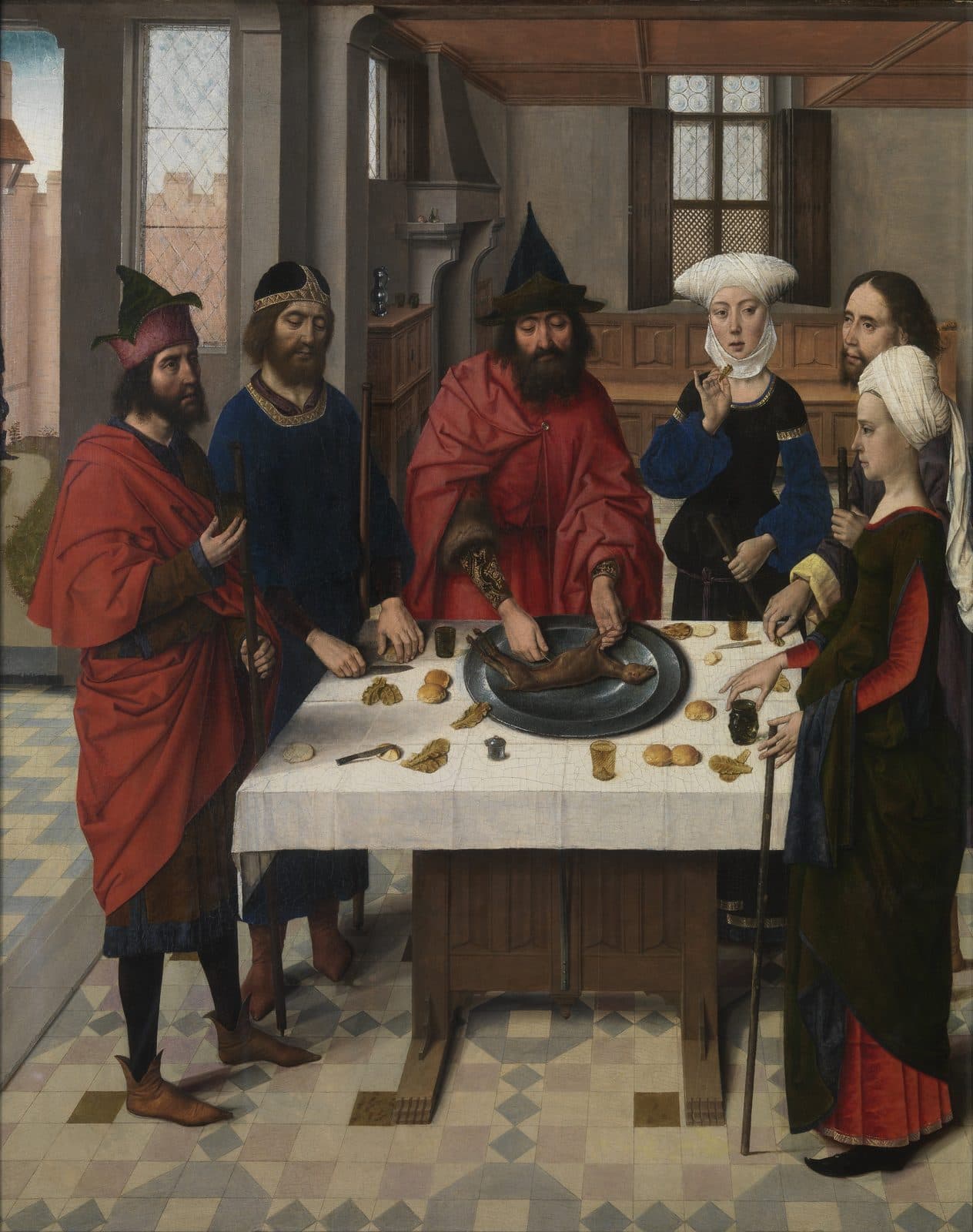
Dieric Bouts, The Feast of the Passover, about 1464-1468. Public domain.
Summary
Passover is the feast Israel keeps for the night in Egypt when the LORD passed over every house marked with a lamb's blood.
- The lamb was chosen, kept, slain and eaten, and every step was specified (Exodus 12:3-11).
- The blood on the door was the difference between houses.
- Paul names Christ the Passover lamb, already sacrificed.
- The feast's calendar carried the cross's date inside it.
The Night of the Passing
Exodus 12:1-14 gives the ordinance and the night it was kept.
Each household killed its lamb at twilight on the fourteenth day of the first month and put the blood on the sides and tops of its doorframes (Exodus 12:6-7). The household ate the meat roasted over the fire that same night, with unleavened bread and bitter herbs, dressed to travel and in haste (Exodus 12:8-11).
At midnight the LORD struck down every firstborn in the land of Egypt (Exodus 12:29). Every house with the blood on its door was passed over, as the LORD had promised.
The blood on the houses where you are staying will distinguish them; when I see the blood, I will pass over you. No plague will fall on you to destroy you when I strike the land of Egypt.The whole rite turns on this: the blood that marks the house, whatever the worth of the house.
Israel walked out of Egypt a nation, and the ordinance was fixed as a memorial and a permanent statute for the generations to come (Exodus 12:14, 17).
“The blood, thus sprinkled, was a means of the preservation of the Israelites from the destroying angel, who had nothing to do where the blood was.”
Matthew Henry · Commentary on the Whole Bible (1710), on Exodus 12:7Puritan
The Lamb the Door Foretold
Exodus 12 sets nine conditions on the lamb, and the New Testament takes up seven of them.
The table sets each requirement of Exodus 12 in its own row, with the New Testament text that reads it of Christ where one stands.
1Kind
- Exodus
- A lamb of the sheep or the goats (12:5)
- Fulfilment
- The Lamb of God who takes away the sin of the world (John 1:29)
2Age
- Exodus
- A year-old male (12:5)
- Fulfilment
- No text names it
- Exodus
- Without blemish, tamim (12:5)
- Fulfilment
- A lamb without blemish or spot (1 Peter 1:19)
4Chosen
- Exodus
- The tenth day of the first month (12:3)
- Fulfilment
- No text names it
- Exodus
- The fourteenth day, between the evenings (12:6)
- Fulfilment
- Jesus is handed over on the day of Preparation (John 19:14-16)
- Exodus
- The sign that turns judgment aside (12:13)
- Fulfilment
- The new covenant in His blood (Luke 22:20)
- Exodus
- Not one broken (12:46)
- Fulfilment
- The soldiers break the legs of the two crucified with Him and leave His unbroken (John 19:33, 36)
- Exodus
- Eaten with unleavened bread (12:8)
- Fulfilment
- The old leaven cleaned out (1 Corinthians 5:6-8)
- Exodus
- Hyssop applies the blood (12:22)
- Fulfilment
- Sour wine lifted on hyssop at the cross (John 19:29)
Its bones, Its bread, The brush
The Lamb the Door Required
Exodus 12:5-46 sets out the lamb and the rite to the detail.
The word for the lamb's condition is tamim (H8549), whole, the word the law uses for animals fit for the altar. The household kept its lamb four days, from the tenth to the fourteenth, long enough to see that it was whole. The statute on its bones is given twice, here and again for the second Passover of Numbers 9:12.
The blood was carried to the doorframe on a bunch of ezov (H231), hyssop, a small wall plant (Exodus 12:22). Alfred Edersheim traces the later Temple observance in The Temple: Its Ministry and Services. He describes how tightly the paschal rite was governed, down to the handling of the blood and the roasting of the lamb whole.
It must be eaten inside one house. You are not to take any of the meat outside the house, and you may not break any of the bones.The statute John cites at the cross.
What the Verb Pasach Means
Exodus 12:13 and 23 and Isaiah 31:5 use the verb behind the feast's name.
The verb pasach (H6452), the root behind pesach (H6453), Passover, means to pass over, and so to spare. It names what the LORD does at the marked door (Exodus 12:13, 23, 27).
In Isaiah 31:5 the same verb stands inside a simile of birds hovering over their young, and some read pasach there as protective hovering. The standard lexica give pass over and spare.
Pass over and spareStrong's lexicon
Strong's gives pasach as to hop, to skip over or spare, and also to limp or to dance. Besides Exodus 12 and Isaiah 31:5 it stands three times, each meaning to limp or to leap (2 Samuel 4:4; 1 Kings 18:21, 26).
Those who read it so hold that four of the seven uses describe a body moving over or past, and that Isaiah's birds are a simile laid over the verb. Strong's gives the noun pesach as an exemption, and counts it 49 times. In the New Testament the feast is pascha (G3957).
Rashi, the eleventh-century French commentator, reads the verb at Exodus 12:23 as and He will spare, and allows also and He will leap over them (Rashi on Exodus 12:23, Rosenbaum and Silbermann translation, 1929-1934). John Wesley reads Isaiah 31:5 the same way, of the destroying angel passing over Jerusalem.
“As birds - Which come from above, and so cannot be kept off; which fly swiftly, and engage resolutely, when their young ones are in danger. Passing over - The destroying angel shall pass over Jerusalem.”
John Wesley · Explanatory Notes upon the Old Testament · on Isaiah 31:5Evangelical
Hover over to protectJamieson, Fausset and Brown
On this reading the LORD stands guard at the door of the blood-marked house, as birds guard their nest, and keeps the destroyer out. Both readings keep the blood as the sign.
Like birds hovering overhead, so the LORD of Hosts will protect Jerusalem. He will shield it and deliver it; He will pass over it and preserve it.”The one use of the verb outside Exodus 12 that speaks of the LORD guarding a city.
“As in the image of ‘the lion,’ the point of comparison is the fearless might of Jehovah; so in that of the birds, it is His solicitous affection (De 32:11; Mt 23:37). flying--Rather, ‘which defend’ their young with their wings; ‘to fly’ is a secondary meaning of the Hebrew word [MAURER].”
Jamieson, Fausset & Brown · Commentary Critical and Explanatory on the Whole Bible · on Isaiah 31:5Reformed
Who is the destroyer?Exodus 12:23 · Hebrews 11:28
Exodus 12:23 says the LORD will pass over the door and will not let the destroyer enter, and Hebrews 11:28 names the destroyer of the firstborn. Some read a distinct destroying agent whom the LORD holds back at the door. Others read the LORD's own act of judgment, since Exodus 12:12 and 29 say that He struck the firstborn. The guarded door fits either reading. The words differ in Hebrew: the destruction of Exodus 12:13 is mashchith (H4889), and the destroyer of 12:23 is the participle of shachath (H7843), to destroy.
When the LORD passes through to strike down the Egyptians, He will see the blood on the top and sides of the doorframe and will pass over that doorway; so He will not allow the destroyer to enter your houses and strike you down.The verse that sets the LORD and the destroyer at the same door.
What Kind of Meal Was It?
Luke 22:15 calls it a Passover, and the Mishnah's order of the meal is later.
The Gospels call the last supper a Passover. The service most people picture, with the plate, the script and the four questions in their familiar wording, is first written down in the Mishnah, tractate Pesachim 10, put in final form around AD 200.
That is well over a century after the upper room, and after the Temple fell in AD 70 and took the lamb out of the meal. Deuteronomy 16:1-3 had already moved the sacrifice from the household to the place the LORD would choose.
The table sets the practices the first-century sources attest beside the parts of the meal first written down from about AD 200 onward.
| When | Practice | Source |
|---|---|---|
| First century | A lamb killed at the Temple on Nisan 14 and roasted whole | Exodus 12:6-9 |
| First century | Unleavened bread and bitter herbs on the table | Exodus 12:8 |
| First century | Reclining rather than sitting: John leans back on Jesus | John 13:23, 25 |
| First century | Cups of wine blessed and passed | Luke 22:17, 20 |
| First century | The telling: a father explains the night to his son | Exodus 13:8 |
| First century | Psalms sung at the close | Mark 14:26 |
| Codified later | The fixed order itself, written as a liturgy (seder means order) | Mishnah, Pesachim 10 |
| Codified later | The Haggadah as a set text, its wording growing for centuries afterward | Later rabbinic tradition |
| Codified later | The seder plate with its assigned symbols | Later rabbinic tradition |
| Codified later | Three matzot in one cover, the middle broken and hidden as afikoman | A medieval custom |
| Codified later | A meal reorganized around the matzah, because after AD 70 there is no Temple and no lamb | After the Temple fell |
Codified later, Codified later, Codified later, Codified later, Codified later
Why the caution matters, and how far it goesPesachim 10
Jonathan Klawans argued the case sharply in Biblical Archaeology Review: the rabbinic seder is a later development and should not be projected onto the Gospels. Baruch Bokser's study of the rite reaches the same historical conclusion: the seder as a liturgy takes shape in the generations after the Temple's destruction, precisely because the lamb was gone.
When the first Passover was kept1 Kings 6:1 · Josephus
First Kings 6:1 counts 480 years from the Exodus to the fourth year of Solomon, which puts the first Passover about 1446 BC. Many historians place the Exodus in the thirteenth century BC instead, and the date is disputed. Josephus gives a count of the lambs slain at one Passover in the Temple of his day (Jewish War 6.9.3).
Where the caution stopsLuke 22:15
Two things are kept apart: what the first century attests, and what was written down later. Both are worth knowing, and only the first can be read back into the upper room.
The caution lands on the later liturgy, and the feast stands. The Synoptics present the meal as a Passover, and first-century practice is described by what the sources show. The typology rests on Exodus 12 and the Gospels themselves.
And He said to them, “I have eagerly desired to eat this Passover with you before My suffering.Jesus names the meal a Passover in His own words.
What the Text Leaves Unsaid
Exodus 12 and the Gospels leave five matters open.
Exodus 12 names no Messiah and no later lamb. The New Testament numbers none of the cups of the supper.
No Gospel ties the entry into Jerusalem to the tenth day of the month, when the lambs were chosen. No Gospel states the hour at which the lambs were slaughtered.
Christ Our Passover
Paul names Christ the Passover lamb in one sentence to the church at Corinth.
Paul's verb is thuo (G2380), the word for killing a sacrifice, and he puts it in the past: the lamb has already been slain, so the feast is already under way. He writes it to a church that had tolerated sin in its midst, and the whole argument of 1 Corinthians 5:6-8 rests on that one identification.
Get rid of the old leaven, that you may be a new unleavened batch, as you really are. For Christ, our Passover lamb, has been sacrificed.The sentence in which Paul names the lamb.
“Purge out therefore the old leaven - Both of sinners and of sin. That ye may be a new lump, as ye are unleavened - That is, that being unleavened ye may be a new lump, holy unto the Lord. For our passover is slain for us - The Jewish passover, about the time of which this epistle was wrote, ver. 11, was only a type of this.”
John Wesley · Explanatory Notes upon the New Testament · on 1 Corinthians 5:7Evangelical
Voices on the Passover
Melito, Chrysostom, Spurgeon and Missler taught the feast, each in a named work.
The church has preached the Passover since the second century, beginning with Melito of Sardis.
J. C. Ryle, in his Expository Thoughts on John (1869), counts Exodus among the three prophecies fulfilled at the cross.
died 180 · Melito of Sardis
On the Passover 1-2, 4-5, 8-10
The quotation1 quotation, 1 paragraph
Melito's sermon On the Passover is the earliest sermon on the feast that survives. It opens on the reading of Exodus 12 and calls the mystery of the Passover new.
“First of all, the Scripture about the Hebrew Exodus has been read and the words of the mystery have been explained as to how the sheep was sacrificed and the people were saved. Therefore, understand this, O beloved: The mystery of the passover is new …”
Melito of Sardis · On the Passover 1-2, 4-5, 8-10 · on John 1:29Patristic
died 407 · John Chrysostom
HOMILIES ON THE GOSPEL OF JOHN 85
The quotation1 quotation, 1 paragraph
Chrysostom reads John 19:36 as the type of the lamb fulfilled in the reality of Christ.
“And that prophecy also is fulfilled, ‘A bone of Him shall not be broken.’ (Ex. xii. 46; Num. ix. 12.) For even if this was said with reference to the lamb of the Jews, still it was for the sake of the reality that the type preceded, and in Him the prophecy was more fully accomplished. On this account the Evangelist brought forward the Prophet. For since by continually producing himself as witness he would have seemed unworthy of credit, he brings Moses to help him, and saith, that neither did this come to pass without a purpose, but was written before of old. And this is the meaning of the words, ‘A bone of Him shall not be broken.’”
John Chrysostom · Homilies on the Gospel of John 85 · on Exodus 12:46Patristic
1834 to 1892 · Charles Spurgeon
The New Park Street Pulpit, Sermon No. 228: “The Blood” (lightly modernized text, CCEL edition)
The quotation1 quotation, 1 paragraph
Charles Spurgeon preached both anchor texts, and both sermons are printed in full in the New Park Street Pulpit. In Christ Our Passover (1855) he takes Paul's line as a plain identification: the feast is something Christ is. He then presses the command that follows, that the whole Christian life is the keeping of the feast. In his sermon on Exodus 12:13, known simply as The Blood, he puts the weight exactly where the verse puts it. The house is safe because the blood is there, and because God has said what He will do when He sees it, whoever the family inside and however steadily they believe.
“GOD’S PEOPLE ARE ALWAYS SAFE. ‘All the saints are in his hand;’ and the hand of God is a place for safety, as well as a place of honour. Nothing can hurt the man who has made his refuge God. ‘Thou hast given commandment to save me,’ said David; and every believing child of God may say the same. Plague, famine, war, tempest,—all these have received commandment of God to save his people.”
Charles Spurgeon · The New Park Street Pulpit, Sermon No. 228: “The Blood” (lightly modernized text, CCEL edition) · on Exodus 12:13
1934 to 2018 · Chuck Missler
Passover (article)
The quotation1 quotation, 1 paragraph
Chuck Missler's Learn the Bible in 24 Hours (2002) reads Passover as the first of the spring feasts of Leviticus 23, fulfilled to the day at Calvary as a prophetic calendar. He reads it as one strand of the larger redemption story told across the book of Exodus.
“Exodus 12 is a key chapter on the Lamb and in Exodus 12:46, the Scripture states that not a bone was to be broken.”
Chuck Missler · Passover (article) · on Exodus 12:46Evangelical
Charles Spurgeon, Chuck Missler
When Was the Supper?
Mark and John date the supper and the cross in two ways.
The Gospels date that table two ways. The Synoptics present the Last Supper as the Passover meal itself, a meal they call the Passover (Mark 14:12, 14, 16), eaten the night Jesus is arrested. John dates the crucifixion to the day of Preparation for the Passover, so that Jesus dies as the lambs are slain. He has the Jewish leaders stay out of Pilate's hall so they could eat the Passover (John 18:28), after Jesus is already condemned.
It was the day of Preparation for the Passover, about the sixth hour. And Pilate said to the Jews, “Here is your King!”The phrase on which the three readings divide.
1. Same day: John is read in the Synoptics' senseD. A. Carson · Andreas Kostenberger
The most common evangelical harmonization argues that John and the Synoptics agree, and that two phrases have been misread. The priests stay out of the governor's hall so they could eat the Passover (John 18:28). There the Passover can mean the chagigah, the festal offering eaten through the days of the feast, and the law itself folds it into Passover language (from the herd or flock, Deuteronomy 16:2-3). The paschal lamb was then eaten the night before.
And the Preparation of the Passover is Greek paraskeue, the ordinary word for Friday, so the phrase reads Friday of Passover week. Mark defines the term that way in so many words: the day of Preparation, that is, the day before the Sabbath (Mark 15:42). D. A. Carson and Andreas Kostenberger both argue the case in their commentaries on John.
2. Different daysJohn exact to the hour
John is read as dating the crucifixion to Nisan 14, while the lambs are being killed, with the official Passover meal still ahead; the supper is then a Passover-shaped meal kept a day early. On this reading the typology is exact to the hour: the Lamb dies as the lambs die.
Its strongest form says John set the death at the hour of the lambs for theology, and the two dates cannot both stand. Readers who hold it take John's date as the history and the Synoptics' Passover as the frame.
3. Different clocksGalilean and Judean reckoning · a solar calendar
A divergence of day-reckoning or of festal calendars lets both accounts stand exactly as written, each true to the calendar it follows. Galilee and Judea, or Pharisees and Sadducees, may have reckoned the 14th of Nisan by different sunrise and sunset conventions, so both accounts describe the same 24-hour window differently.
Or some form of dual-calendar reckoning let Jesus eat the Passover with His disciples before the official slaying of the temple lambs. The reckoning may be a solar calendar of the kind known from Qumran beside the Temple's lunar one, or a private meal held a day early.
Each of the three readings keeps the meal and keeps the sacrifice. They differ over the clock: which evening the supper fell on, and how the day of Preparation is counted.
On every reading Jesus dies at Passover in Jerusalem, in the week the lambs were slain, and John reads His unbroken bones as the statute of the lamb fulfilled.
Books to Read Next
The works this study names, with a free door where the work is in the public domain.
The Temple: Its Ministry and Services
Alfred Edersheim · 1874
Edersheim describes the paschal rite in the Temple, from the handling of the blood to the roasting of the lamb.
Read it free at CCELChrist Our Passover, The New Park Street Pulpit, Sermon 54
C. H. Spurgeon · 1855
Spurgeon preaches Paul's line as the identification of Christ with the feast.
Read it free at CCELThe Blood, The New Park Street Pulpit, Sermon 228
C. H. Spurgeon · 1858
Spurgeon preaches Exodus 12:13 and rests the safety of the house on the blood.
Read it free at CCELThe Eucharistic Words of Jesus
Joachim Jeremias · 1966
Jeremias reads the Lord's Supper as a Passover meal whose order gives the words of institution their sense.
In print: find it wherever books are sold.
The Origins of the Seder
Baruch M. Bokser · 1984
Bokser traces how the seder took shape as a liturgy after the Temple fell.
In print: find it wherever books are sold.
Was Jesus' Last Supper a Seder?, Biblical Archaeology Review 27:5
Jonathan Klawans · 2001
Klawans argues that the rabbinic seder should not be projected onto the Gospels.
In print: find it wherever books are sold.
He That Cometh
David Daube · 1966
Daube's London lecture reads the afikoman as the coming one.
In print: find it wherever books are sold.
Journal for the Study of the New Testament 42
Deborah Bleicher Carmichael · 1991
Carmichael carries Daube's afikoman thesis into New Testament study.
In print: find it wherever books are sold.
Jesus and the Jewish Roots of the Eucharist
Brant Pitre · 2011
Pitre reads the vow of Mark 14:25 as leaving the meal to be finished at the cross.
In print: find it wherever books are sold.
The Gospel According to John, Pillar New Testament Commentary
D. A. Carson · 1991
Carson argues the same-day reading on John 18:28 and 19:14.
In print: find it wherever books are sold.
John, Baker Exegetical Commentary on the New Testament
Andreas Kostenberger · 2004
Kostenberger argues that John and the Synoptics date the supper alike.
In print: find it wherever books are sold.
La date de la Cene
Annie Jaubert · 1957
Jaubert argues that a solar calendar of the kind found at Qumran let two Passover dates stand.
In print: find it wherever books are sold.
The Feasts of Israel
Chuck Missler · not recorded
Missler teaches the three loaves and the broken middle as a picture of Christ.
Keep the Feast
1 Corinthians 5:7-8 draws the command from the feast.
Exodus 12:15 orders every household to remove the leaven from its house for the seven days of the feast. Paul reads that order for the church, whose lamb has already been sacrificed, and names the leaven it removes.
Therefore let us keep the feast, not with the old bread, leavened with malice and wickedness, but with the unleavened bread of sincerity and of truth.What the feast asks of those it sheltered.
The Supper and the Feast
Luke 22 and Mark 14 tell the supper inside the order of a Passover meal.
Five parts of the Passover meal stand behind the Lord's Supper: the four cups, the cup Jesus did not drink, the memorial, the hymn and the hidden bread.
The Mishnah requires four cups, and later tradition names them and ties them to the four promises of Exodus 6:6-7.
The table names the four cups in their order, the promise of Exodus 6:6-7 tradition ties to each, and what each cup does at the table.
| Cup | Name | Promise | At the table |
|---|---|---|---|
| 1 | The cup of Sanctification (Kiddush) | I will bring you out | The cup that opens the night and sets it apart from every other night |
| 2 | The cup of Deliverance (Makkot, the plagues) | I will deliver you from their bondage | Poured as the story is told: what it cost Egypt to let Israel go |
| 3 | The cup of Redemption (Ge'ulah) | I will redeem you with an outstretched arm | Taken after the meal, the cup of blessing and the cup of the Lord's table, where Luke puts the words of institution (Luke 22:20) |
| 4 | The cup of Praise (Hallel) | I will take you as My own people | The cup that ends the night, and the one Jesus says He will not drink until the kingdom (Mark 14:25) |
Four cups, four promisesExodus 6:6-7 · Pesachim 10:1
By the first century the Passover meal moved through cups of wine. The Mishnah makes it a duty of charity: even the poorest man in Israel is to be given no less than four cups (Pesachim 10:1). Jewish tradition ties those four cups to four promises God makes in one breath before the Exodus, the four I wills of Exodus 6:6-7.
Therefore tell the Israelites: ‘I am the LORD, and I will bring you out from under the yoke of the Egyptians and deliver you from their bondage. I will redeem you with an outstretched arm and with mighty acts of judgment. I will take you as My own people, and I will be your God. Then you will know that I am the LORD your God, who brought you out from under the yoke of the Egyptians.The four promises: to bring out, to deliver, to redeem, and to take as His own people.
Where the names of the cups come fromPesachim 10:1
The Mishnah requires four cups without naming them. The names in the table, and their tie to the four promises, come from later rabbinic tradition (Jerusalem Talmud, Pesachim 10:1), an ordering the church has found illuminating.
Why the cup of institution is read as the third cupLuke 22:20 · 1 Corinthians 10:16
Luke times it exactly: the cup after supper (Luke 22:20). In the order of the meal the cup that follows the eating is the third, the one that carried the name the cup of blessing. Paul then uses that name as though his readers already know it (1 Corinthians 10:16).
Is not the cup of blessing that we bless a participation in the blood of Christ? And is not the bread that we break a participation in the body of Christ?Paul says the cup of blessing, with the article: a name the table already had.
Joachim Jeremias made this identification the backbone of his study of the words of institution. He reads the Lord's Supper as a Passover meal whose shape supplies the meaning of what Jesus says over the bread and the cup, and the third cup is his reading of the meal's order.
The cup He did not drinkMark 14:25
Truly I tell you, I will no longer drink of the fruit of the vine until that day when I drink it anew in the kingdom of God.”A meal that ends in a cup is left, deliberately, one cup short.
Luke records the same vow twice over, of the cup and of the Passover itself: Jesus will not eat it again until it is fulfilled in the kingdom of God (Luke 22:16, 18). Whatever else is true of that night, the vow is a real deferral. Jesus binds His next cup to the kingdom and then walks out to Gethsemane, where He asks whether another cup may pass (Mark 14:36).
The reading that finishes the meal at the crossJohn 19:28-30 · Revelation 19:9
Some read the vow as leaving the meal unfinished on purpose, and find it completed at Golgotha, where Jesus says He is thirsty, takes the sour wine and says It is finished (John 19:28-30). The last cup of the Passover is then taken at the cross, and the feast is consummated at the marriage supper of the Lamb (Revelation 19:9). Brant Pitre develops this reading at length, arguing that the Passover framework explains why the meal stops where it stops.
It is a reading of the sequence that Mark and John leave to the reader. Mark 14:25 binds the next cup to the kingdom of God, and Revelation 19:9 names the supper where it is kept.
Do this in remembranceExodus 12:14 · Luke 22:19 · 1 Corinthians 11:26
Passover came with an order to remember: the day is to be a memorial, zikkaron (Exodus 12:14). The remembering had a form. On that day a father tells his son that he keeps it because of what the LORD did for him when he came out of Egypt (Exodus 13:8). The Hebrew for that showing is haggadah, the telling, and the night is kept by saying out loud what God did.
And He took the bread, gave thanks and broke it, and gave it to them, saying, “This is My body, given for you; do this in remembrance of Me.”At the table Jesus takes the memorial word and puts Himself inside it.
The Greek is anamnesis: the memorial word, spoken over Himself on the memorial night. Paul hands the same command on and adds its direction: as often as you eat this bread and drink this cup, you proclaim the Lord's death until He comes (1 Corinthians 11:26). The verb is a herald's word, you proclaim. Like the haggadah before it, the Lord's table is a memorial that is spoken, and it faces both ways at once: back to a death, forward to a coming. Joachim Jeremias reads the command in The Eucharistic Words of Jesus.
The hymn they sangMark 14:26 · Psalm 118
Mark ends the supper in one line: when they had sung a hymn, they went out to the Mount of Olives (Mark 14:26). The hymn of the feast was the Hallel, Psalms 113-118. The Mishnah records it divided around the meal, the opening psalms before and the rest after (Pesachim 10:5-7). If that practice held that night, the last songs Jesus sang before Gethsemane were the closing psalms of the Hallel, and they end with Psalm 118.
The stone the builders rejected has become the cornerstone.A rejected stone.
Blessed is he who comes in the name of the LORD. From the house of the LORD we bless you. The LORD is God; He has made His light to shine upon us. Bind the festal sacrifice with cords to the horns of the altar.A coming one, and a sacrifice bound to the altar: sung on the way to the garden.
Every line of it had already been in the air that week. The crowds had shouted verse 26 at the gate (Mark 11:9). Jesus had quoted verse 22 back at the builders in the Temple courts days before (Mark 12:10-11). Now He sings the psalm through and walks out into the night it describes.
The bread that was hiddenPesachim 10:8
At a modern Passover meal a piece of unleavened bread is broken early, wrapped and hidden, then brought back and eaten last. It is called the afikoman. The oldest mention of the word is a rule. The Mishnah closes its Passover chapter by forbidding something: after the paschal lamb, one does not go on to afikoman (Pesachim 10:8). What the word meant is disputed, and two readings stand.
Reading 1: the after-party (the majority derivation)epikomion
The word is taken as Greek: epikomion, from epi komon, the revelry that followed a banquet, and by extension the dessert course carried to the next house. The ruling then means: the lamb is the last taste of the night; do not get up from the Passover and go carousing. This is the derivation most historians of the rite, Bokser among them, prefer.
Reading 2: the One who has come (Daube's thesis)aphikomenos
David Daube proposed a different Greek word behind it, aphikomenos, the one who has come or the coming one. That would make the hidden and returned bread a messianic sign far older than the medieval custom, and would explain the ruling as a suppression of it. He argued this in a London lecture of 1966; Deborah Bleicher Carmichael carried the argument into New Testament study in the Journal for the Study of the New Testament. It is a minority thesis and is held here as one.
The three loaves and the broken middle: a devotional reading, flaggedIsaiah 53:5 · Zechariah 12:10
Many Christians have been taught a picture, Chuck Missler among those who taught it. Three loaves of unleavened bread lie in one cover, the middle one is broken, and half of it is wrapped, hidden and brought back after the meal. The bread itself is striped and pierced, read with Isaiah 53:5 (by His stripes we are healed) and Zechariah 12:10 (they will look on Me, the One they have pierced).
The three-loaf custom and the hiding are medieval, and the Mishnah knows neither. The piercing is functional: the dough is docked so it cannot rise. The even stripes come from machine-baked matzah, which dates from the nineteenth century, and hand-baked matzah is irregular.
Held as devotion, the picture is still true to the thing it points at: bread without leaven, broken, hidden and brought back. It is kept with its date beside it.
Sources
Scripture is the Berean Standard Bible.
- Strong's Hebrew and Greek dictionaries: h6452 pasach, h6453 pesach, h4889 mashchith, h7843 shachath, h231 ezov, h8549 tamim, g3957 pascha.
- Matthew Henry, Commentary on the Whole Bible (1710), on Exodus 12:7.
- John Wesley, Explanatory Notes upon the New Testament (1755), on 1 Corinthians 5:7.
- Jamieson, Fausset and Brown, Commentary Critical and Explanatory on the Whole Bible (1871), on Isaiah 31:5.
- Melito of Sardis, On the Passover.
- John Chrysostom, Homilies on the Gospel of John 85.
- C. H. Spurgeon, Christ Our Passover, The New Park Street Pulpit, Sermon 54 (1855)
- C. H. Spurgeon, The Blood, The New Park Street Pulpit, Sermon 228 (1858)
- J. C. Ryle, Expository Thoughts on the Gospels: John (1869), on John 19:28-37.
- Chuck Missler, Passover (article, 2018); Learn the Bible in 24 Hours (2002); The Feasts of Israel.
- Alfred Edersheim, The Temple: Its Ministry and Services (1874), chapters 11-12.
- Mishnah, tractate Pesachim, chapter 10.
- Rashi on Exodus 12:23, Pentateuch with Rashi's commentary, trans. M. Rosenbaum and A. M. Silbermann, 1929-1934.
- John Wesley, Explanatory Notes upon the Old Testament (1765), on Isaiah 31:5.
- Josephus, Jewish War 6.9.3.
- Joachim Jeremias, The Eucharistic Words of Jesus (ET 1966)
- Baruch M. Bokser, The Origins of the Seder (1984)
- Jonathan Klawans, Was Jesus' Last Supper a Seder?, Biblical Archaeology Review 27:5 (2001)
- David Daube, He That Cometh (1966)
- Deborah Bleicher Carmichael, Journal for the Study of the New Testament 42 (1991)
- Brant Pitre, Jesus and the Jewish Roots of the Eucharist (2011)
- D. A. Carson, The Gospel According to John (Pillar, 1991), on 18:28 and 19:14.
- Andreas Kostenberger, John (BECNT, 2004), on 18:28 and 19:14.
- Annie Jaubert, La date de la Cene (1957)
Keep Studying
Read it4
Studies12
People and groups8
Show the next 2 titles
Places7
Show the next 1 title
Doctrines22
- The blood
- The seven feasts
- The messianic psalms
- Cut Off from Among His People
- The Fall Feasts
- Firstfruits
Show the next 6 titles
Subjects3
Go further1