
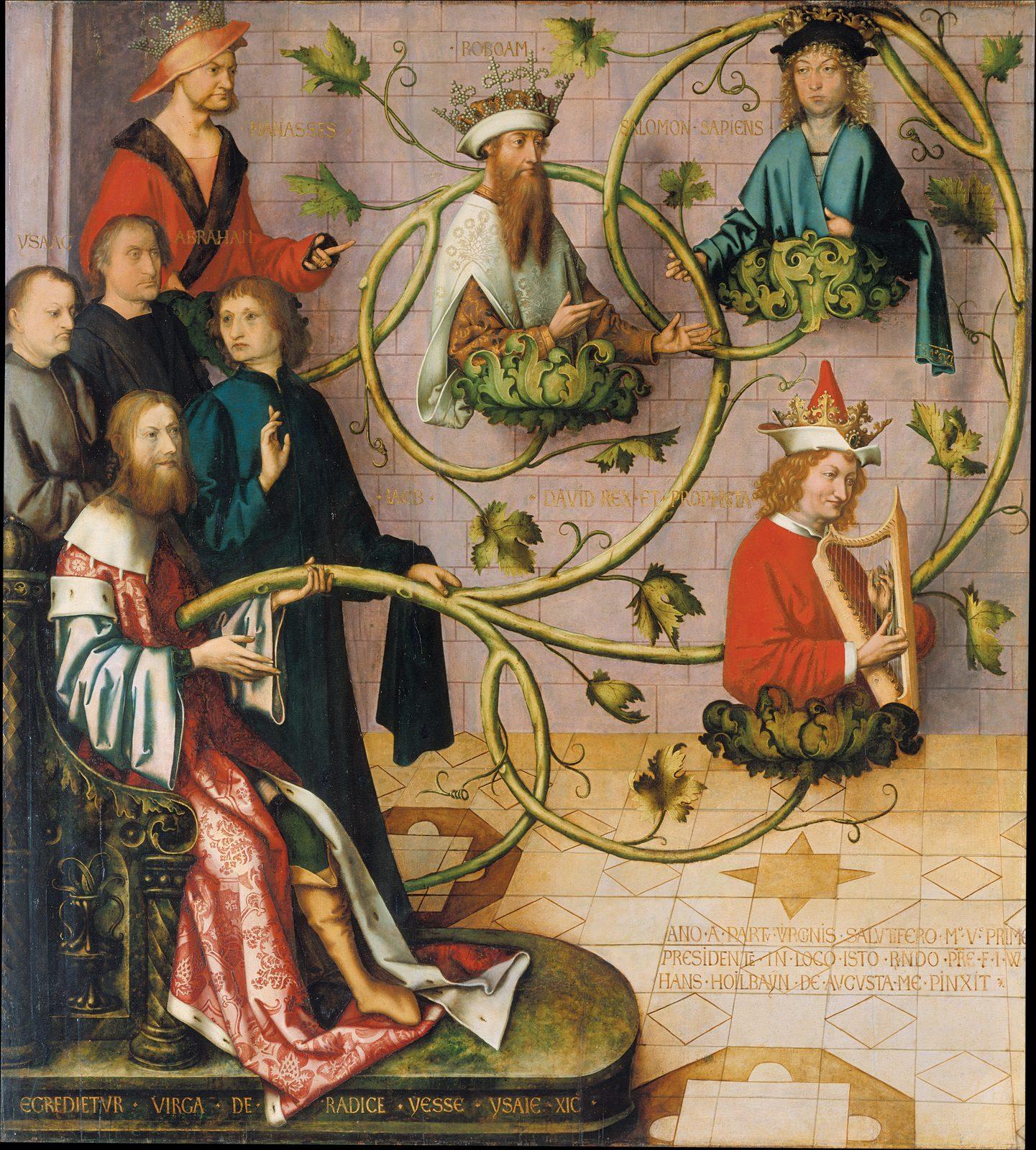
Hans Holbein the Elder, Tree of Jesse, 1501. Public domain.
Deuteronomy 29 · Symbol · Featured Study
The Root
This symbol study follows the root through Scripture with its Hebrew and Greek words and the readings in dispute.
Jude 12 calls certain men at the love feasts fruitless trees in autumn, twice dead after being uprooted.
Make sure there is no man or woman, clan or tribe among you today whose heart turns away from the LORD our God to go and worship the gods of those nations. Make sure there is no root among you that bears such poisonous and bitter fruit,
- The word
- שֶׁרֶשׁ (sheresh), H8328
- First appears
- Deuteronomy 29:18 “…Make sure there is no root among you…”
Summary
A root in Scripture is what a life grows from and what holds it in the ground.
- The Hebrew noun for a root first stands in Deuteronomy, and the Greek noun first in Matthew.
- The Greek verb to uproot stands in Matthew, Luke and Jude.
- The Hebrew verb sharash, to take root or to uproot, stands from Job to Jeremiah.
A Root That Bears Poison
Moses gave the warning in the covenant the LORD made with Israel in the land of Moab.
because when such a person hears the words of this oath, he invokes a blessing on himself, saying, ‘I will have peace, even though I walk in the stubbornness of my own heart.’ This will bring disaster on the watered land as well as the dry.The next verse shows why the root is dangerous: the man blesses himself while he walks in his own way.
See to it that no one falls short of the grace of God, and that no root of bitterness springs up to cause trouble and defile many.Hebrews joins the root to bitterness as Moses joins the root to bitter fruit.
Jesse's Line on Holbein's Panel
Hans Holbein the Elder painted this panel in 1501 for the high altar of the Dominican church in Frankfurt.
The panel reads from Jesse on his throne up through the kings in the coils of the stem.
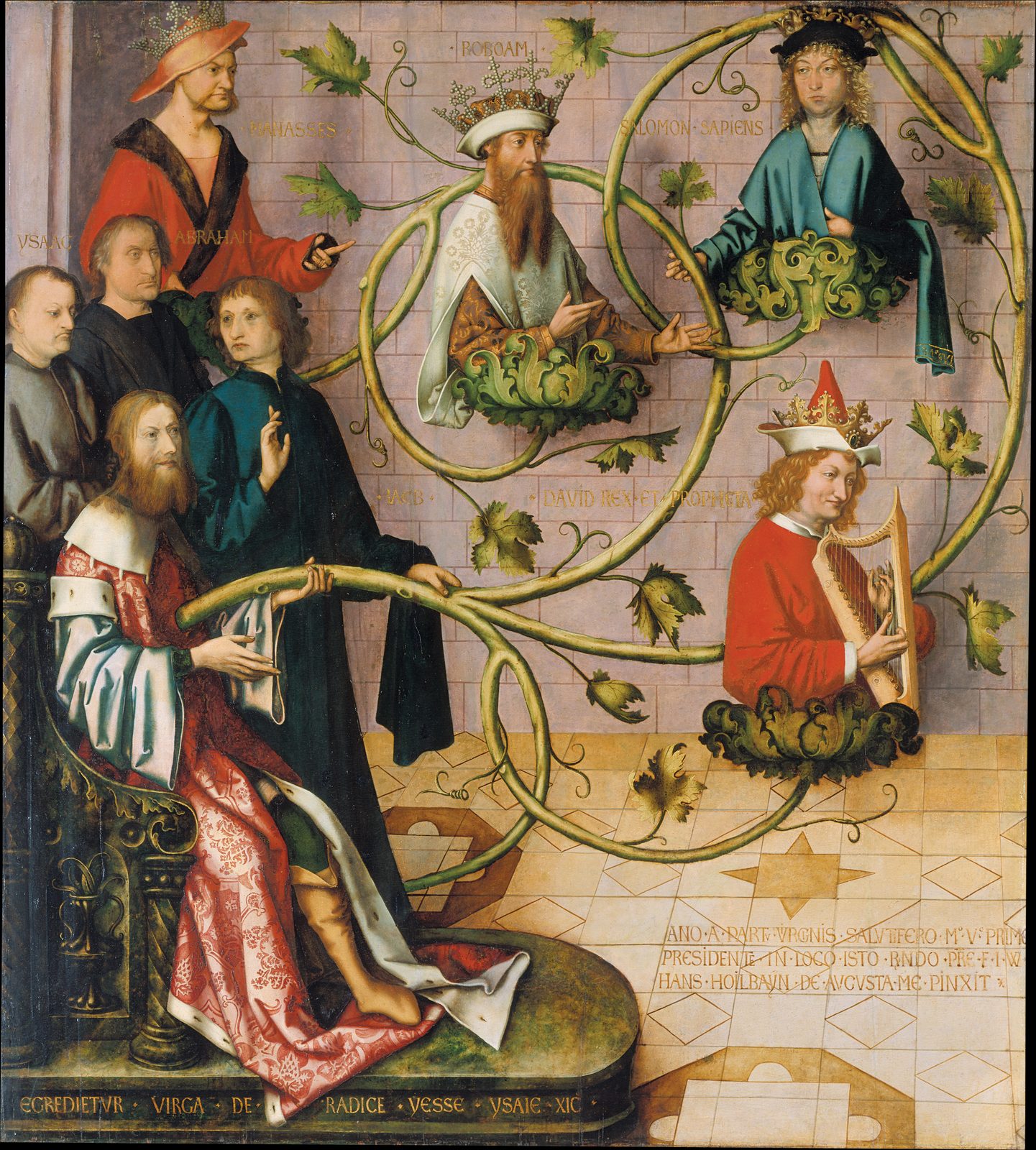
- JesseJesse sits on a throne and holds the stem that grows from him.Ruth 4:22
- The words of IsaiahThe base of the throne carries Isaiah 11:1 in the Latin of the Vulgate: a rod shall come forth from the root of Jesse.Isaiah 11:1
- Abraham, Isaac and JacobThe three patriarchs stand behind the throne, each with his name painted beside him.Matthew 1:2
- DavidDavid plays a harp, and the words beside him read David, king and prophet.Matthew 1:6
- Solomon and RehoboamSolomon in blue and Rehoboam in a white robe appear in the coils above David.Matthew 1:7
- ManassehManasseh, the son of Hezekiah in Matthew's list, stands in red at the upper left.Matthew 1:10
Hans Holbein the Elder, Tree of Jesse, 1501. Public domain.
Each of the six parts answers to a verse of Ruth, Isaiah or Matthew.
The Root Through Scripture
The noun for a root stands in thirteen books of the Old Testament and seven of the New Testament.
Fourteen verses on the root, in the order of the canon.
- Deuteronomy 29A root that bears poisonous and bitter fruit, Deuteronomy 29:18
- 2 Kings 19Take root below and bear fruit above, 2 Kings 19:30
- Job 14If its roots grow old in the ground, Job 14:8
- Psalm 80It took root and filled the land, Psalm 80:9
- Isaiah 11The Root of Jesse will stand as a banner, Isaiah 11:10
- Isaiah 53Like a root out of dry ground, Isaiah 53:2
- Jeremiah 17Sends out its roots toward the stream, Jeremiah 17:8
- Hosea 14Take root like the cedars of Lebanon, Hosea 14:5
- Malachi 4Not a root or branch will be left, Malachi 4:1
- Matthew 3The axe lies ready at the root of the trees, Matthew 3:10
- Matthew 13He has no root, Matthew 13:21
- Romans 11The root supports you, Romans 11:18
- 1 Timothy 6The root of all kinds of evil, 1 Timothy 6:10
- Revelation 22The Root and the Offspring of David, Revelation 22:16
Each stop opens its verse in the reader.
Roots that wither and roots that holdIsaiah 5:24, Hosea 9:16 and Isaiah 27:6
Therefore, as a tongue of fire consumes the straw, and as dry grass shrivels in the flame, so their roots will decay and their blossoms will blow away like dust; for they have rejected the instruction of the LORD of Hosts and despised the word of the Holy One of Israel.Here the rot reaches the root because Israel refused what God had said.
Ephraim is struck down; their root is withered; they cannot bear fruit. Even if they bear children, I will slay the darlings of their wombs.Hosea uses the noun twice, and this is the use where the root fails.
In the days to come, Jacob will take root. Israel will bud and blossom and fill the whole world with fruit.The same picture turns to promise as Isaiah looks ahead.
Sheresh, Sharash, Rhiza, Rhizoo and Ekrizoo
Five words name the root and the work of rooting and uprooting.
sheresh
a root (literally or figuratively)
sharash
to root, i.e. strike into the soil, or (by implication) to pluck from it
rhiza
a root (literally or figuratively)
rhizoo
to root (figuratively, become stable)
ekrizoo
to uproot
The lexicon in full1 table, 1 paragraph
The noun for a root is used far more often than either verb in both Testaments.
| Word | Meaning | Uses |
|---|---|---|
| sheresh, H8328 | a root (literally or figuratively) | 33 |
| sharash, H8327 | to root, i.e. strike into the soil, or (by implication) to pluck from it | 8 |
| rhiza, G4491 | a root (literally or figuratively) | 17 |
| rhizoo, G4492 | to root (figuratively, become stable) | 2 |
| ekrizoo, G1610 | to uproot | 4 |
The King James Version renders sheresh as bottom, deep, heel and root, so a few of its uses name the lowest part of a thing.
The Root of Jesse and the Root of David
Paul quotes Isaiah's title in Romans, and the Revelation gives a second title, the Root of David.
And once more, Isaiah says: “The Root of Jesse will appear, One who will arise to rule over the Gentiles; in Him the Gentiles will put their hope.”This is the one verse of the New Testament that quotes Isaiah's Root of Jesse.
Then one of the elders said to me, “Do not weep! Behold, the Lion of the tribe of Judah, the Root of David, has triumphed to open the scroll and its seven seals.”Here one of the elders speaks the title, and in Revelation 22:16 Jesus speaks it Himself.
Jamieson, Fausset and Brown, in their Commentary, read the Root of Jesse in Romans 15:12 as He that is sprung from Jesse, and they set aside the reading He from whom Jesse sprang.
The stump and the shoot of Isaiah 11:1 are taught on The Branch and the King.
Messianic Prophecy sets the Root of Jesse among the prophecies it follows into the New Testament.
Where Careful Readers Differ
Matthew Henry, John Wesley, Adam Clarke and Albert Barnes wrote between 1707 and 1852.
What the Root and the Offspring of David meansRevelation 22:16; Adam Clarke and Albert Barnes
Adam Clarke, in his commentary on the New Testament, holds that Christ is the root of David as to His divine nature, since all the human race sprang from Him as the Creator.
Albert Barnes, in his Notes on the Book of Revelation, holds that David did not spring from Him as a tree springs from its root. He reads the root as a root-shoot, a sprout from a decayed and fallen tree, so that Jesus sprang from David.
What the root of bitterness isDeuteronomy 29:18 and Hebrews 12:15; Matthew Henry and John Wesley
Matthew Henry, in his Exposition of the Five Books of Moses, reads the root of Deuteronomy 29:18 as a dangerous man who tries to corrupt others and draw them to idolatry.
John Wesley, in his Explanatory Notes upon the New Testament, names the root of bitterness in Hebrews 12:15 as envy, anger and suspicion, and any corruption in doctrine or practice.
Books to Read Next
Charles Spurgeon's sermon is in the public domain, with a free copy to read.
Christ's Rest and Ours, Sermon 2542
Charles Spurgeon · 1897
The sermon on Isaiah 11:10 opens with the Lord Jesus Christ as the root of Jesse and the rallying point of the Gentiles.
Read at Spurgeon GemsRooted in Him
Paul asks the church at Colossae to walk in Christ Jesus as they received Him.
rooted and built up in Him, established in the faith as you were taught, and overflowing with thankfulness.Paul turns the picture of the root into a charge to the church.
Sources
Scripture is the Berean Standard Bible.
- James Strong, Exhaustive Concordance of the Bible, 1890, entries H8328, H8327, G4491, G4492 and G1610, with the verses each entry lists.
- Matthew Henry, An Exposition of the Five Books of Moses, 1707, on Deuteronomy 29:18.
- John Wesley, Explanatory Notes upon the New Testament, 1755, on Hebrews 12:15.
- Adam Clarke, The New Testament of our Lord and Saviour Jesus Christ, with a Commentary and Critical Notes, New York, 1835, on Revelation 22:16.
- Albert Barnes, Notes, Explanatory and Practical, on the Book of Revelation, 1852, on Revelation 22:16.
- Robert Jamieson, A. R. Fausset and David Brown, A Commentary, Critical and Explanatory, on the Old and New Testaments, 1877, on Romans 15:12.
- Charles Spurgeon, Christ's Rest and Ours, Metropolitan Tabernacle Pulpit, Sermon 2542, 1897, on Isaiah 11:10.