
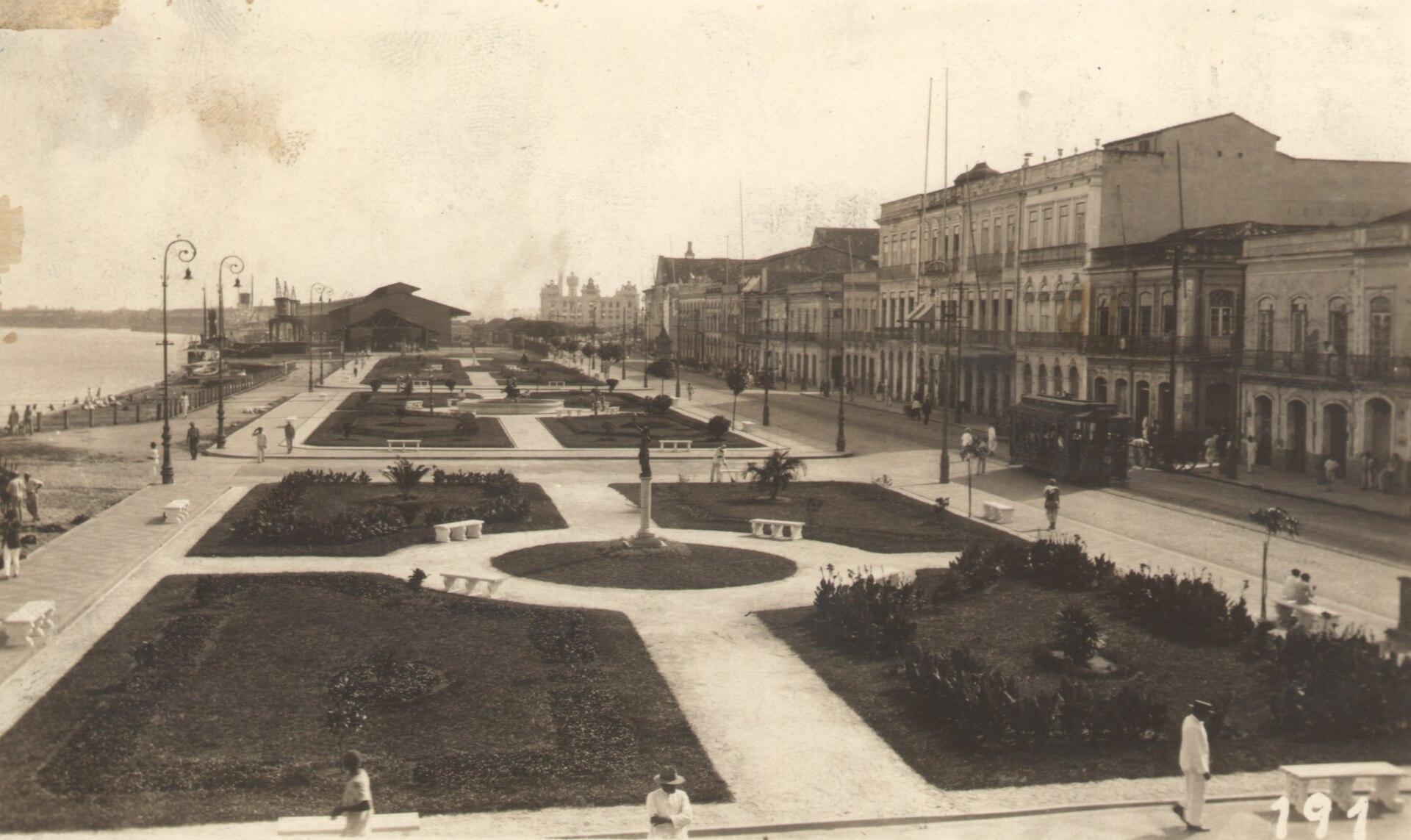
Unknown photographer, the Ver-o-Peso waterfront at Belém, 1910 to 1919. Public domain.
Chicago to São Paulo and Belém · Story · Featured Study
Brazil, 1910 and 1911
Two Pentecostal works began in Brazil within fifteen months of each other, by men who had passed through one mission in Chicago.
- Where
- Chicago, Belém, São Paulo, Santo Antônio da Platina, Natal
- Who
- Gunnar Vingren, Daniel Berg, Louis Francescon, Celina de Albuquerque, Frida Vingren
- When
- March 1910 to June 1911
A word at a prayer meeting told a Swedish pastor to go to Pará, and he and the man who spoke it had to look it up in a library.
This promise belongs to you and your children and to all who are far off—to all whom the Lord our God will call to Himself.”
Summary
Louis Francescon reached São Paulo in March 1910. Gunnar Vingren and Daniel Berg reached Belém that November.
- Francescon's work became the Congregação Cristã.
- The Baptists of Belém put them out seven months later.
- The census of 2010 counted over 25 million Pentecostals.
- A meeting at Natal in 1930 ruled against women leading, against Vingren's own view.
The Texts of the Story
Vingren cites one verse at the meeting that sent him, and he and Conde differ on who read the other at the break.
“Therefore come out from among them and be separate, says the Lord. Touch no unclean thing, and I will receive you.”
Vingren says the pastor opened to this text, and Conde says the brother Plácido read it.
If we are out of our mind, it is for God; if we are of sound mind, it is for you.
Vingren applies this to a brother caught up in spirit at the meeting where the word of Pará came.
Two Lines from One Mission
Francescon left Chicago in 1909, and Vingren and Berg passed through the same mission in the autumn of 1910.
The Italian line reached Brazil eight months before the Swedish.
- 1907ChicagoFrancescon comes to Durham's North Avenue MissionPalma; Wulfhorst
- October 1909Buenos AiresFrancescon, Lombardi and Lucia Menna arrivePalma; Stokes
- March 1910São PauloFrancescon arrives, and Pievani takes him to PlatinaPalma
- Summer 1910South BendThe word of Pará through Adolfo UlldinVingren's diary
- 5 November 1910New YorkVingren and Berg sail on the ClementVingren's diary; Conde
- 19 November 1910BelémThey land at ParáVingren's diary; Conde
- June 1911BelémThe Baptist church divides over the new teachingVingren's diary; Conde
- 18 June 1911BelémThe church that became the Assembleia de Deus beginsConde
The two witnesses agree on the sailing and the landing.
June 1911, 18 June 1911
From Chicago to São Paulo and Belém
Francescon's line ran through Platina and the Brás, and the Swedish line through South Bend and Belém.
Louis Francescon reached Chicago on 3 March 1890 and helped found the First Italian Presbyterian Church there. Paul Palma writes that on 25 August 1907 he was reportedly baptized in the Spirit on a visit to William Durham's North Avenue Mission.
With Giacomo Lombardi and Lucia Menna he reached Buenos Aires in October 1909 and São Paulo the next March. Vincenzo Pievani took him inland to Santo Antônio da Platina, and his own letter says three families and two youths were saved there.
Palma says a priest there reportedly plotted to have him killed, and the editor of his letter dates persecution to the night of 12 to 13 June. At a Presbyterian church in the Italian quarter of São Paulo known as the Brás he preached in Italian, was ordered out, and took a large number with him.
Vingren, a Swedish Baptist pastor in the United States, names Adolfo Ulldin as the man who spoke at South Bend. Pará is the northern state whose capital is Belém. His diary adds that the same word foretold his marriage to a woman named Strandberg, and that detail is told after the event.
Daniel Berg received his call at a later meeting at Ulldin's that summer. Vingren left South Bend on 12 October. At Durham's church in Chicago, he says, he gave his ninety dollars to Durham's paper, and they sailed from New York on the Clement on 5 November.
The Methodist Justus Nelson took them to the Brazilian Baptist Church at Belém, and they lodged in a basement at the pastor's house. Erik Nilsson, a Swede in Baptist service in Amazonia since 1897, told them to leave out the verse on Spirit baptism, by Vingren's report. Vingren wrote of him as of an enemy, and he is a party here.
Celina de Albuquerque, a Baptist Sunday school teacher, was healed of a disease of the lips at prayer in her home, by the diary. She then spoke in tongues for two hours from one in the morning. Conde dates that to 2 June and a paper in the journal Azusa to 10 June.
The break came within days, and the witnesses tell it three ways. The new body met on 18 June at Siqueira Mendes 67 and called itself the Apostolic Faith, and it registered the name Assembleia de Deus only in 1918.
Three Tellings of the Break
Every telling read comes from the side that was put out, and no Baptist account was found.
The witnesses differ on the day, on the number and on who acted.
| The witness | The day | How many | Who acted |
|---|---|---|---|
| Vingren's diary, edited by his son | 13 June | Eighteen who rose | An evangelist who would not let the pastor speak |
| Emilio Conde, the church's historian, 1960 | 12 June | Seventeen members, and minors besides | Raimundo Nobre, at an illegal meeting where the minority put out the majority |
| Araújo and colleagues, journal Azusa | 10 June | Celina and sixteen others | Not named; the paper says other leaders of the church had called the two men fanatics |
What the Census Counts
The census gives the number, and the report that Brazil has the most Pentecostals in the world has thinner ground.
In the census of 2010, about fourteen and a half million Brazilians declared themselves of the two churches of 1910 and 1911.
| What is counted | The count | The counter and the year |
|---|---|---|
| Pentecostals in Brazil | 40,000, of them 13,000 in the Assemblies | Pew, after Wilson, for 1930 |
| Brazilians in churches of Pentecostal origin | 25,370,484 of 190,755,799 | The national census of 2010, by self-declaration |
| Assembleia de Deus | 12,314,410 | The national census of 2010 |
| Congregação Cristã do Brasil | 2,289,634 | The national census of 2010 |
A church news item of December 2009 reports the World Christian Database, on figures for 2006. It gives Brazil twenty-four million Pentecostals against 5.8 million in the United States, and it calls Brazil the most Pentecostal country on earth. The database itself was not available, and no other ground for a world rank is known.
Natal, 1930, and Frida Vingren
The documented failure of the Belém line concerns the women who had preached in it.
Frida Strandberg, a Swedish nurse and editor, married Vingren and preached and wrote for the church's paper. Brazilian workers of the Northeast met at Natal without any Swede on 17 and 18 February 1929 and decided to be autonomous of the Swedish mission.
The convention at Natal met from 5 to 10 September 1930, by the diary, Jan-Åke Alvarsson, Ulrich and Isabela Oliveira; Conde alone puts it in July. It handed the work to national pastors, and Alvarsson calls that the pretext. Claudete Ulrich and her colleagues write that Samuel Nyström organized it and that it ruled that women could not take leadership in the churches.
That ruling went against Gunnar Vingren's own stated view. The church's published diary calls the meeting one of perfect harmony. It prints the declaration that sisters may testify and teach when needed, but a sister is not to be pastor or teacher of a church, save in exceptional cases where no capable brothers are present.
Frida Vingren's name left the paper's masthead in 1931, amid rumours of an affair. Ulrich and Valéria Vilhena call the rumour the trump card Nyström needed to put her out of his way. Alvarsson writes that she fell in love with a young man in 1931 or 1932, and that in all likelihood she never entered into sexual relations with him. Neither reading proves a fault.
Vingren died on 29 June 1933. She was kept from returning to Brazil and died in 1940, and the Swedish paper Evangelii Härold printed no obituary, Alvarsson writes.
Osiel Carvalho counts one federal deputy of the Assemblies between 1911 and 1985 and thirteen elected in 1986. He quotes Freston, who ties that change to a book that turned Scripture to electoral use.
How the Key Verse Was Taught
Three teachers on Peter's promise.
John Chrysostom (died 407)
Homily on Acts 7, on Acts 2:39
John Chrysostom read Peter as speaking first of the gift and then leading his hearers to practice.
“‘The promise,’ i.e. the gift of the Holy Ghost. So far, he speaks of the easy part, and that which has with it a great gift; and then he leads them to practice”
Patristic
Albert Barnes (1798 to 1870)
Notes, Explanatory and Practical, on the Old and New Testaments, on Acts 2:39
Albert Barnes held the promise to be the Spirit's work that Peter had already named from Joel.
“This promise he had adduced in the beginning of his discourse”
Presbyterian
Charles Spurgeon (1834 to 1892)
The Metropolitan Tabernacle Pulpit, Sermon No. 2586: “A Far-reaching Promise” (lightly modernized text, CCEL edition), on Acts 2:39
Charles Spurgeon began from the hearers pricked in the heart, whom the promise answers.
“that in the first stage of the Christian ministry, the thing to be aimed at is that men should be pricked in the heart. Then, in the second stage, the thing to be desired is that they should gladly receive the Word of God.”
Particular Baptist
In Their Own Words
Each quotation stands in the language of the source that prints it. The title gives its sense in English, as a reading of the words, and the note gives the rest.
William H. Durham (1873 to 1912)
Paul J. Palma, "Luigi Francescon (1866-1964)", quoting Durham's paper of 1911, the entry on Francescon
A man of God
“It was never our privilege to meet a more blessed and powerful man of God”
Pentecostal pastor
About this saying1 paragraph
Durham wrote this in 1911, when Francescon had left for Italy to preach in his home region.
Gunnar Vingren (1879 to 1933)
O Diário do Pioneiro (2000), edited by Ivar Vingren, the first months at Belém
A dark corridor with no window
“Não podíamos nos orgulhar muito da nossa nova moradia. Era um corredor bem escuro no porão, o chão de cimento grosso e sem nenhuma janela.”
Swedish Pentecostal
About this saying1 paragraph
Vingren wrote of the home they took at Belém in 1910 that they could take little pride in it, a very dark corridor in the basement with a thick cement floor and no window.
Gunnar Vingren
O Diário do Pioneiro (2000), edited by Ivar Vingren, June 1911
The eighteen who stood were cut off
“Todos os que estão de acordo com a nova seita, levantem-se. Dezoito irmãos se levantaram e foram imediatamente cortados da comunhão da igreja.”
Swedish Pentecostal
About this saying1 paragraph
Vingren reports the evangelist's challenge of June 1911 to all who held with the new sect to stand, and says the eighteen who stood were cut off at once.
Gunnar Vingren
A letter, as quoted by Ulrich, Vilhena and Silva, "Frida Maria Strandberg", Pistis & Praxis (2018), citing Vingren 1982, page 184
The Lord calls men and women
“Não posso deixar minha convicção de que o Senhor chamou e ainda está chamando homens e mulheres para o serviço do Evangelho”
Swedish Pentecostal
About this saying1 paragraph
He could not give up his conviction that the Lord has called and still calls men and women to the gospel's service, and he adds that a woman evangelist led him to Christ. He died in 1933.
Frida Vingren (1891 to 1940)
Mensageiro da Paz, 1 January 1931, as quoted by Ulrich, Vilhena and Silva, "Frida Maria Strandberg", Pistis & Praxis (2018), the section on Natal
The sword still in our hand
“A espada ainda está na nossa mão, e maiores luctas nos aguardam.”
Swedish Pentecostal
About this saying1 paragraph
After Natal, in January 1931, she told readers that the sword is still in our hand, and greater battles wait for us.
Louis Francescon (1866 to 1964)
Letter to Rosina Francescon (1910), edited by Leonardo Marcondes Alves, the Italian text
His life in danger and the time short
“La mia vita è sempre in pericolo, ma sii consolata il tempo è breve, le cose che sono state profetizzate di me al principio si stanno tutte adempiendo.”
Italian Pentecostal
About this saying1 paragraph
Francescon wrote from Platina in 1910 to his wife Rosina that his life was always in danger but she should be comforted. The time was short, he wrote, and all that was prophesied of him at the start was being fulfilled. A family transcription keeps the letter.
Who Broke with Whom, and Who Was First
The church's own histories carry the tellings, and scholars have questioned them.
Eder Santos writes that Nilsson himself wrote a leaflet against them and expelled them. Eduardo Alves says only that they were dismissed.
Vingren and Conde call Celina the first in Brazil to speak in tongues. A note in the paper of Rimilla Araújo and her colleagues reports that Araújo in 2014 and Alencar in 2000 contest it. It records Paulo Malaquias, a Baptist pastor baptized in the Spirit at Ramada in 1908, so she stands first in this church's memory.
Conde says Natal joined the two papers to avert a division. The diary records the joining and the ruling on women together, and Alvarsson, Ulrich and Vilhena say the women's question was the real issue.
Books to Read Next
Frida Strandberg
Jan-Åke Alvarsson · Svenskt kvinnobiografiskt lexikon
Alvarsson tells her life and the convention at Natal in English.
Read Alvarsson free at the Swedish biographical dictionaryHistorical Overview of Pentecostalism in Brazil
Pew Forum · 2006
Pew sets the founding dates and the early counts in one page.
Read the overview free at PewFrancescon's letter of 1910
Louis Francescon, edited by Leonardo Marcondes Alves · 1910
This letter is in effect the birth record of the Congregação Cristã, its editor writes.
Read the letter free at ZenodoWhat the Two Lines Left
Emilio Conde writes that Manoel Rodrigues, one of those put out at Belém, stood and read Peter's promise aloud, and that they then prayed and left.
Sources
Scripture is the Berean Standard Bible.
- The Holy Bible, Berean Standard Bible (read 2026)
- Ivar Vingren, ed., Gunnar Vingren: O Diário do Pioneiro (Rio de Janeiro: CPAD, edition of 2000)
- Emilio Conde, História das Assembléias de Deus no Brasil (1960)
- Paul J. Palma, "Luigi Francescon (1866-1964)", Explorations in Italian Protestantism.
- Louis Francescon, letter to Rosina Francescon, 1910, edited by Leonardo Marcondes Alves, from a family transcription.
- Rimilla Q. Araújo, Bezaliel A. Oliveira and colleagues, in the journal Azusa 16:2 (2025), "Pentecostalismo em movimento"; Eduardo Leandro Alves, "A mensagem pentecostal na alma do brasileiro", Azusa 8:1 (2017); Eder William dos Santos, "As linguagens alteradas da religião", Azusa 17:1 (2024); Osiel Lourenço de Carvalho, "Pentecostalismo na esfera pública", Azusa, article 68.
- Jan-Åke Alvarsson, "Frida Strandberg", Svenskt kvinnobiografiskt lexikon, translated by Alexia Grosjean.
- Claudete Beise Ulrich, Valéria C. Vilhena and Leicyelem von Rondow da Silva, "Frida Maria Strandberg", Pistis & Praxis (2018)
- Isabela Costa de Oliveira, Frida Vingren: a pioneira silenciada, a monograph.
- IBGE, Censo Demográfico 2010, SIDRA table 137.
- Pew Forum, "Historical Overview of Pentecostalism in Brazil" (2006)
- Portal Luterano, "O país mais católico e o mais pentecostal do mundo" (31 December 2009), a report of the World Christian Database.
- Ingo Wulfhorst, "O Pentecostalismo no Brasil", Estudos Teológicos.
- Louie W. Stokes, Historia del Movimiento Pentecostal en la Argentina (about 1968)
Keep Studying
Studies1
People and groups9