
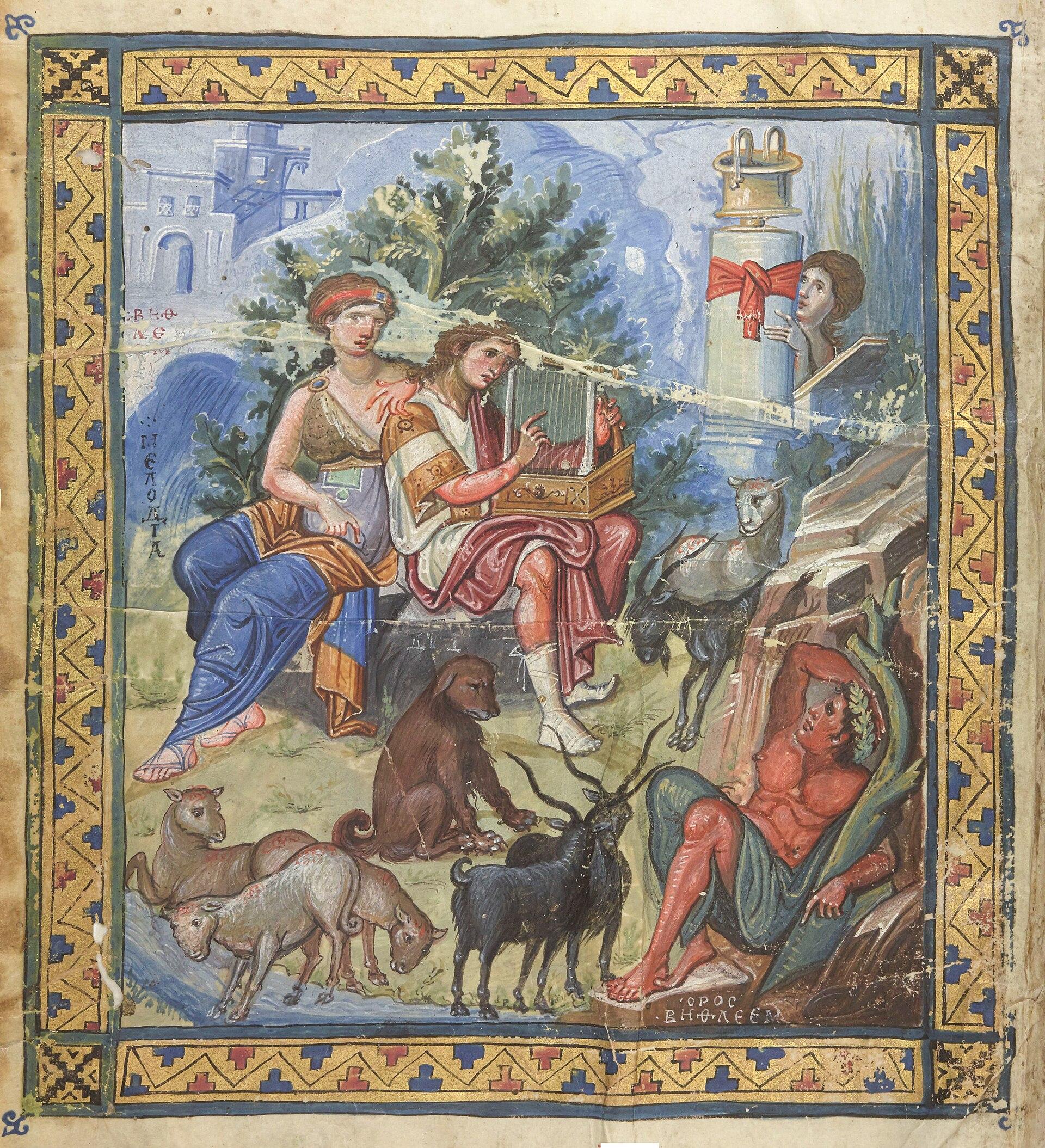
Unknown Byzantine painter, David Composing the Psalms, about 960. Public domain.
Psalms 3 to 143 and Habakkuk 3 · Subject · Featured Study
Selah
Selah stands in 71 verses of 39 psalms and in 3 verses of Habakkuk 3.
No psalm has Selah more often than Psalm 89, where it stands at verses 4, 37, 45 and 48.
The LORD of Hosts is with us; the God of Jacob is our fortress. Selah
- Books
- Psalms, Habakkuk
- Hold in memory
- Psalm 46:11
Summary
Selah is a word set inside the text of the psalms, most often at the end of a verse. The old translators rendered it as an interlude or as for ever. Readers since have taken it as a pause, a lift of the voice or a call to weigh the words.
- Four psalms end on a verse with Selah: Psalms 3, 9, 24 and 46
- Book IV of the Psalter, Psalms 90 to 106, has no Selah
- Selah stands inside the verses and never in a psalm's heading
Where Selah Stands
The word first stands in Psalm 3, three times in a psalm of eight verses.
Many say of me, “God will not deliver him.” SelahThe enemies' taunt is the first verse of the Psalter to carry the word.
To the LORD I cry aloud, and He answers me from His holy mountain. SelahDavid's second Selah comes after his prayer is answered.
Salvation belongs to the LORD; may Your blessing be on Your people. SelahThe psalm closes on the word.
John Wesley comments on the word in his Explanatory Notes upon the Old Testament. He observes that it is used nowhere but in the Psalms and in the song of Habakkuk.
God came from Teman, and the Holy One from Mount Paran. Selah His glory covered the heavens, and His praise filled the earth.In Habakkuk's prayer the word falls in the middle of the verse.
The lines over the psalms that name the singer, the tune and the instruments are taught on the page of the superscriptions.
Psalm 3:8, Habakkuk 3:3
Selah in the Five Books
The table counts the verses with Selah in each book of the Psalter.
Book II holds 30 of the 71 verses that carry Selah.
| Part | Verses with Selah | Psalms | Where it stands |
|---|---|---|---|
| Book I, Psalms 1 to 41 | 17 | 9 | Psalms 3, 4, 7, 9, 20, 21, 24, 32 and 39 |
| Book II, Psalms 42 to 72 | 30 | 17 | Psalms 44, 46 to 50, 52, 54, 55, 57, 59 to 62 and 66 to 68 |
| Book III, Psalms 73 to 89 | 20 | 11 | Psalms 75 to 77, 81 to 85, 87, 88 and 89 |
| Book IV, Psalms 90 to 106 | 0 | 0 | None |
| Book V, Psalms 107 to 150 | 4 | 2 | Psalms 140 and 143 |
| Habakkuk 3 | 3 | 1 prayer | Habakkuk 3:3, Habakkuk 3:9 and Habakkuk 3:13 |
Selah in the Old Translations
The old translations read the word two ways.
The Septuagint, the old Greek translation, renders the word diapsalma. The International Standard Bible Encyclopedia holds that this probably means an instrumental interlude. The Targum, the Aramaic paraphrase of the synagogue, and Aquila render it for ever, and Jerome, following Aquila, renders it always.
Jerome's Commentary on Habakkuk lays the versions side by side at Habakkuk 3:3. Symmachus has eternity, Theodotion has to the end, and the fifth Greek edition keeps the Hebrew sela.
Jerome gave a letter to the word, Letter 28 to Marcella, written at Rome in 384. Its editor in the Nicene and Post-Nicene Fathers says that Jerome inclines to Aquila and Origen. Jerome likens the word to the explicit at the end of a Latin book.
The Word in the Lexicons
Two lexicons give the word two senses.
Strong's lexicon, the dictionary of Hebrew words keyed by number, glosses selah as a suspension of music, a pause. Brown, Driver and Briggs derive it from salal, to lift up or exalt.
Jamieson, Fausset and Brown note that Higgaion, a second musical term, stands beside Selah in this verse alone.
The LORD is known by the justice He brings; the wicked are ensnared by the work of their hands. Higgaion SelahThey read the pause after the LORD's justice on the wicked as a call to wonder and faith.
Voices on Selah
Spurgeon, Clarke and Gregory of Nyssa each read the word as a call to stop and think.
Gregory of Nyssa (died 395)
Gregory of Nyssa defines diapsalma as a pause in the singing to receive a new thought from God. He wrote it in his work on the inscriptions of the psalms.
Adam Clarke (1762 to 1832)
Adam Clarke, in his Commentary on the Bible, reads the Selah of Psalm 46:11 as a mark of a firm and well-tried truth. On Psalm 3:4 he writes that it means mark this, and take encouragement from it.
Charles Spurgeon (1834 to 1892)
Charles Spurgeon comments on the word in The Treasury of David. He takes the Selah of Psalm 46:11 as a call to lift up the heart and rest in thought after praise. On Psalm 46:3 he calls it merely a rest in music, a pause to give the singers breath.
Four Readings of Selah
Each reading has its holders, and each meets an objection from the text.
A pause or interlude in the musicThe Septuagint; Strong's lexicon; the International Standard Bible Encyclopedia; Adam Clarke
The Greek diapsalma and Strong's gloss both take the word as a break in the singing. Clarke, in his Commentary on the Bible, writes on Habakkuk 3:3 that it probably means a pause or alteration in the music.
The objection: the word stands inside the verse at Psalm 55:19, Psalm 57:3, Habakkuk 3:3 and Habakkuk 3:9. There a pause breaks the line in two.
For everThe Targum; Aquila; Jerome; the Babylonian Talmud, Eruvin 54a
A baraita in the Talmud teaches that wherever netzah, selah or va'ed is written, the matter will never cease. It gives Psalm 48:8 as its proof.
As we have heard, so we have seen in the city of the LORD of Hosts, in the city of our God: God will establish her forever. SelahThe verse sets for ever and Selah side by side, the pairing the Talmud reads as one sense.
The objection: the Septuagint renders the word diapsalma, and the versions were already divided when Jerome compared them.
Lift up the voiceBrown, Driver and Briggs; John Wesley
Brown, Driver and Briggs take the word as a call to lift up the voice. Wesley, in his Explanatory Notes, allows that it may direct the singer to lift up his voice, to pause or to lengthen the tune.
The objection: the ISBE warns that it is unwise to dogmatize on the word, and Clarke says we have nothing but conjecture to guide us.
A call to stop and weigh the wordsJohn Wesley; Charles Spurgeon; Jamieson, Fausset and Brown; Gregory of Nyssa
Wesley notes that the word is generally placed at some remarkable passage, to quicken the attention of singer and hearer.
The objection: the reading draws a lesson from the word's place, and no verse of Scripture names that use.
The Word Left Standing
The Berean text keeps the Hebrew word in every verse.
No verse of Scripture explains Selah, so every reading rests on the word's place, its root or its old translations.
The Berean text prints the Hebrew word as it stands, untranslated, in every verse that carries it.
Sources
Scripture is the Berean Standard Bible.
- Strong's Hebrew lexicon, H5542, selah, with its count of uses.
- Brown, Driver and Briggs, A Hebrew and English Lexicon of the Old Testament, on selah.
- The International Standard Bible Encyclopedia (1915), articles Psalms, Book of, section 4 (r), and Music, section II.1.
- The Babylonian Talmud, Eruvin 54a, William Davidson Edition, from Sefaria.
- Jerome, Letter 28, To Marcella, with its editor's summary, Nicene and Post-Nicene Fathers, series 2, vol. 6.
Keep Studying
Words1
People and groups3