
Psalms 3, 7, 18, 34, 51, 52, 54, 56, 57, 59, 60, 63, 142 · Prayer and Praise · Featured Study
David's Life in the Psalms
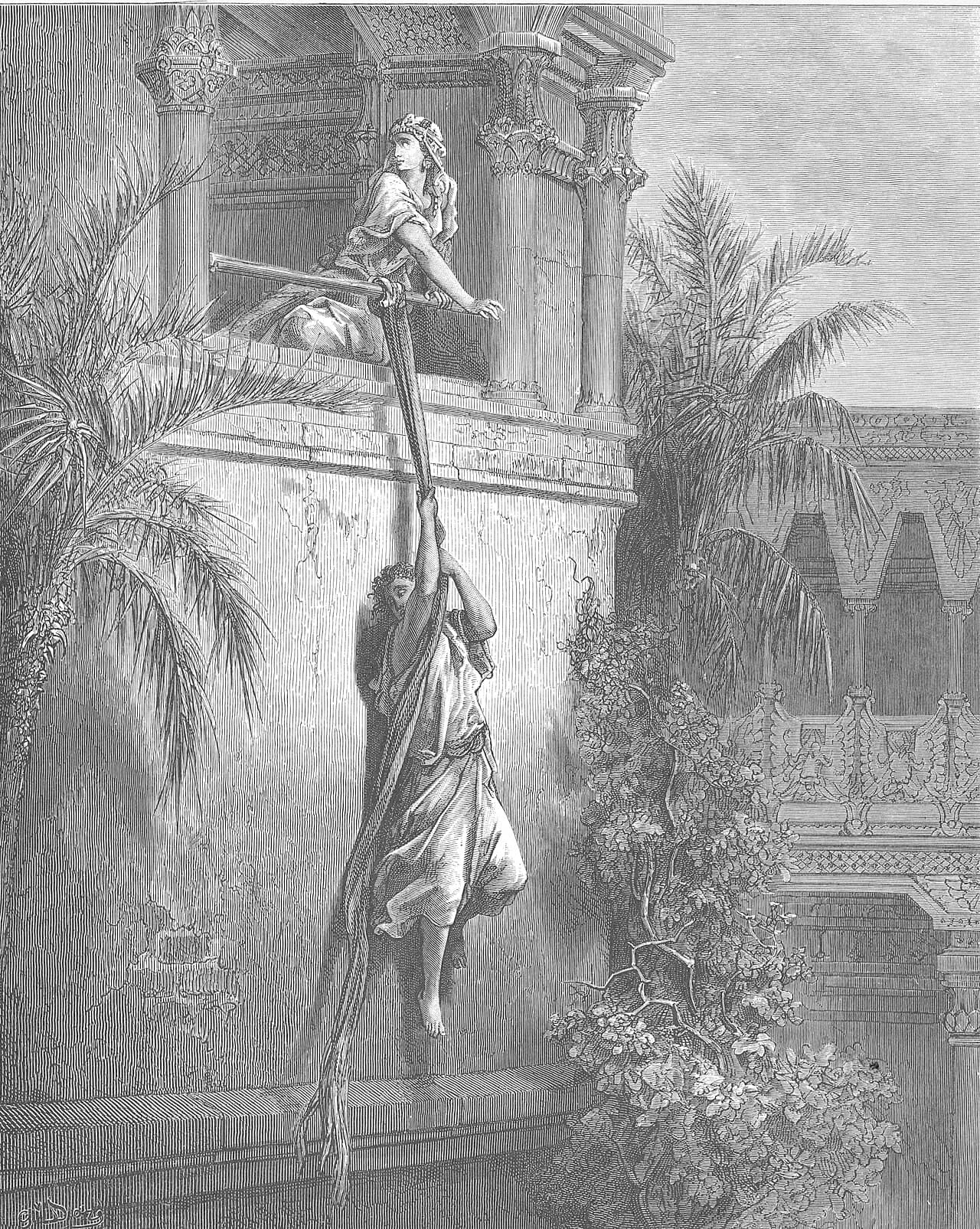
Gustave Doré, David Escapes through a Window, 1866. Public domain.
THE ARTWORKDoré engraved the night Michal let her husband down through a window while Saul's men waited at the door for morning. That night is the event named by the title of Psalm 59, which makes it the earliest of the thirteen and the first stop on the sequence below. The whole plate is here: the window, the rope, the watchers, and the drop.
Summary
Summary
The page does three things. It explains what a historical superscription is, and why this page describes the titles rather than quoting them. It lays the thirteen out on one sequence in the order David lived them, with a door to the psalm and a door to the chapter in Samuel at every stop. It states both positions on when the titles were written, with the scholars and works that hold each.
- Thirteen of the Psalter's titles name an event. Eight belong to the years David spent running from Saul, five to his reign.
- The sequence runs in the order of his life, not the order of the Psalter. Psalm 59 comes first and Psalm 142 comes fourth.
- Four placements carry real doubt and are marked on the sequence: the two cave psalms, Psalm 63, Psalm 18 and Psalm 7.
- Psalms 56 and 34 name the same visit to Gath, and the title of Psalm 34 calls the king Abimelech where the narrative calls him Achish.
- Psalm 60 has a number that differs across the witnesses: twelve thousand Edomites in the title, eighteen thousand in 2 Samuel 8:13, and eighteen thousand credited to Abishai in 1 Chronicles 18:12.
Thirteen Titles That Name a Day
what a historical superscription is, and why this page describes them rather than quoting them
THE THIRTEEN
- Eight from the years of flight: 59, 56, 34, 142, 57, 52, 54, 7
- Five from the reign: 18, 60, 51, 3, 63
- Eleven name a place or a person; two name a war
- One, Psalm 18, has its twin inside the narrative at 2 Samuel 22
Most psalm titles give a name, a tune or an instruction to the choirmaster. Thirteen do something else: they name a day. They say David wrote or sang this when Saul sent men to watch his house, when he fled from Absalom, when Nathan came to him, when the Ziphites went to Saul. Each of those days has a chapter in Samuel that tells the same story from the outside. The thirteen are the one place in the Psalter where a prayer and a narrative can be set side by side.
This page gives each title by what it says rather than by its words. The verse store behind the reader holds the psalms as numbered verses and carries no rows for the titles, and the house rule is that Scripture is served from the store and never retyped. So the sequence below states the event each title names, and the door beside it takes you to the psalm in the reader, where the title stands in full.
Then Saul sent messengers to David’s house to watch him and kill him in the morning. But David’s wife Michal warned him, “If you do not run for your life tonight, tomorrow you will be dead!” So Michal lowered David from the window, and he ran away and escaped.The night behind the title of Psalm 59, and the earliest event any of the thirteen names.
But I will sing of Your strength and proclaim Your loving devotion in the morning. For You are my fortress, my refuge in times of trouble.The same night from inside. The man let down through the window sings about singing in the morning.
The Thirteen in the Order He Lived Them
each stop: the event, the chapter in Samuel, the psalm, and a mark where the placement is uncertain
- PSALM 59The last days at Saul's court
Saul posts men around David's house through the night to kill him in the morning, and Michal lowers him through a window.
- PSALM 56The fugitive years, at Gath
The Philistines take hold of David at Gath, where he had fled for safety and was recognised as the man of the victory song.
- PSALM 34The fugitive years, at Gath
David feigns madness before the Philistine king, scratching at the gate and letting spittle run down his beard, and is driven away.
UNCERTAIN · Psalms 56 and 34 name the same visit to Gath. The title of Psalm 34 names the king Abimelech, which the narrative calls Achish.
- PSALM 142The fugitive years, the cave
David prays in the cave, saying that no one cares for his soul and there is no refuge left to him.
UNCERTAIN · Which cave is open. Adullam at 1 Samuel 22:1 and En-gedi at 1 Samuel 24:1-3 are both candidates, and the choice moves this stop and the next above or below Psalms 52 and 54.
- PSALM 57The fugitive years, the cave
David shelters in the cave from Saul and takes refuge in the shadow of God's wings until the destruction passes by.
UNCERTAIN · The same open question as Psalm 142. The site's own historical layer leaves it open, naming Adullam and En-gedi both.
- PSALM 52The fugitive years, after Nob
Doeg the Edomite tells Saul that David had gone to the priests at Nob, and Saul has eighty-five priests killed.
- PSALM 54The fugitive years, the Ziph wilderness
The men of Ziph go to Saul and tell him where David is hiding among them.
UNCERTAIN · The Ziphites betray him twice. The second time is 1 Samuel 26:1, and the title does not say which occasion it means.
- PSALM 7Undated, within the Saul years
David answers the words of a Benjamite named Cush, asking God to judge him if there is wrong in his hands.
UNCERTAIN · Cush appears in this title and nowhere else in Scripture. The psalm's place in the sequence rests on the tribe alone, since Benjamin was Saul's tribe.
- PSALM 18The reign, looking back
A victory song for deliverance from the hand of every enemy and from the hand of Saul, sung when the wars were behind him.
UNCERTAIN · A retrospect over a span rather than a day. The same song stands in the narrative at 2 Samuel 22, in the appendix of the book rather than at a dated point.
- PSALM 60The reign, the campaign years
The northern war with the Arameans runs while Edom is struck in the Valley of Salt in the south.
UNCERTAIN · The numbers differ across the witnesses. The title as commonly rendered credits Joab with twelve thousand Edomites, 2 Samuel 8:13 gives eighteen thousand, and 1 Chronicles 18:12 credits Abishai with eighteen thousand.
- PSALM 51The reign in Jerusalem, after the sin
Nathan the prophet comes to David after Bathsheba and Uriah, and tells him he is the man.
- PSALM 3The late reign, the Absalom years
David flees Jerusalem before his son's revolt, going up the ascent of the Mount of Olives weeping, his head covered and his feet bare.
- PSALM 63Contested, see the mark
David prays from the dry country, thirsting for God as the land itself thirsts for water.
UNCERTAIN · The title names the wilderness of Judah and gives no reign marker. Verse 11 speaks of the king, which points to the flight from Absalom; the place name alone points to the fugitive years in the Ziph wilderness at 1 Samuel 23:14-15. The site's historical layer holds the Absalom reading.
Five of the thirteen carry a mark. Four are placements the sources leave open, and one, Psalm 60, is a number that differs between the title and the two narratives. The marks are on the page because the order is an argument, not a fact printed anywhere in Scripture.
Eight Psalms From the Years of Running
the court, Gath, the cave, Nob and Ziph, read against 1 Samuel
Eight of the thirteen come from the stretch between the night Michal lowered David out of a window and the day Saul died. In that stretch he was a wanted man with a price on him. The psalms from it are the most physically specific in the Psalter: a window, a gate, a cave, a wilderness, the men of a particular town telling a particular king where he slept.
Now David took these words to heart and was very much afraid of Achish the king of Gath. So he changed his behavior before them and feigned madness in their hands; he scratched on the doors of the gate and let his saliva run down his beard.The visit to Gath that two psalms name, 56 and 34. The narrative calls the king Achish; the title of Psalm 34 calls him Abimelech.
Taste and see that the LORD is good; blessed is the man who takes refuge in Him!The line the church has said at communion tables for centuries, written out of an escape made by pretending to be mad.
So David left Gath and took refuge in the cave of Adullam. When his brothers and the rest of his father’s household heard about it, they went down to him there.The cave of Adullam, one of the two candidates behind the titles of Psalms 142 and 57.
Look to my right and see; no one attends to me. There is no refuge for me; no one cares for my soul.No one cares for his soul. The cave psalm at its lowest point.
So the king ordered Doeg, “You turn and strike down the priests!” And Doeg the Edomite turned and struck down the priests himself. On that day he killed eighty-five men who wore the linen ephod.What Doeg's report ended in. Psalm 52 is David's answer to the man who made it.
Then the Ziphites came up to Saul at Gibeah and said, “Is not David hiding among us in the strongholds at Horesh, on the hill of Hachilah south of Jeshimon?The Ziphites behind Psalm 54. They do the same thing again at 1 Samuel 26:1, which is why the title is not decisive.
Psalm 57 belongs to the same cave as Psalm 142, and the two read very differently. One says there is no refuge; the other says the refuge is the shadow of a wing. Whether the cave was Adullam at the start of the flight or En-gedi near its end changes where both psalms sit in the order, and the sources do not settle it.
Have mercy on me, O God, have mercy, for in You my soul takes refuge. In the shadow of Your wings I will take shelter until the danger has passed.The same cave, the other answer: shelter under wings until the destruction passes by.
Five Psalms From the Throne
the wars, Nathan, Absalom, and the wilderness at the end
The five from the reign carry as much trouble as the eight from the flight. One is a war psalm. One is written after the worst thing he ever did. One is written while his own son hunts him out of his own capital. One looks back over the whole of it as a single deliverance. The king psalms are as exposed as the fugitive psalms.
And David made a name for himself when he returned from striking down eighteen thousand Edomites in the Valley of Salt.The Valley of Salt behind Psalm 60, with eighteen thousand Edomites where the title says twelve thousand.
Moreover, Abishai son of Zeruiah struck down eighteen thousand Edomites in the Valley of Salt.The third figure: eighteen thousand, credited to Abishai. The page names all three rather than choosing one.
Then Nathan said to David, “You are that man! This is what the LORD, the God of Israel, says: ‘I anointed you king over Israel, and I delivered you from the hand of Saul.Four words behind Psalm 51. Nathan has told a story about a lamb and now he closes it.
Create in me a clean heart, O God, and renew a right spirit within me.What the man asks for after he is told he is the man.
But David continued up the Mount of Olives, weeping as he went up. His head was covered, and he was walking barefoot. And all the people with him covered their heads and went up, weeping as they went.The ascent of the Mount of Olives, weeping, head covered and feet bare. Psalm 3 is written from this road.
I lie down and sleep; I wake again, for the LORD sustains me.He lay down and slept, on the night his son's army was forming behind him.
Psalm 18 stands apart from the other twelve because the narrative carries it as well. The same song is printed in the appendix of 2 Samuel, which gives it a witness outside the Psalter and makes it the strongest single piece of evidence that these titles are old.
And David sang this song to the LORD on the day the LORD had delivered him from the hand of all his enemies and from the hand of Saul.The narrative's own heading for the song, saying what the title of Psalm 18 says.
The LORD is my rock, my fortress, and my deliverer. My God is my rock, in whom I take refuge, my shield, and the horn of my salvation, my stronghold.Rock, fortress, shield, horn, stronghold. The vocabulary of a man who spent years in actual strongholds.
The sequence ends in the dry country. Psalm 63 names the wilderness of Judah and gives no marker for the reign, and its eleventh verse speaks of the king. Readers who weigh that verse put it in the flight from Absalom; readers who weigh the place name put it back in the fugitive years. This site holds the Absalom reading and marks the doubt.
O God, You are my God. Earnestly I seek You; my soul thirsts for You. My body yearns for You in a dry and weary land without water.The land is the metaphor and the land is also where he is standing. Both readings of the title keep that double sense.
When Were the Titles Written?
two positions, each with the scholars and works that hold it
EARLY, AND HISTORICALLY VALUABLE
The titles are ancient notes belonging to the transmission of the psalms themselves, and they tell you something true about where a psalm came from. Franz Delitzsch stands for this approach in his Biblical Commentary on the Psalms. Bruce Waltke argues it in its sharpest recent form in Superscripts, Postscripts, or Both, holding the titles to be original, authentic and important.
The case rests on three things. The lamed prefix carries authorship in the places where the text itself supplies the setting, which grammarians call the lamed auctoris. Habakkuk 3 shows a psalm inside a prophetic book already carrying both a heading and a closing musical note, which puts the practice of titling a psalm inside the biblical period. And several of the thirteen settings sit awkwardly against their psalm's contents, where a later editor inventing a setting from the poem had every reason to produce a neat match.
LATER, AND EXEGETICAL
The titles are editorial additions, an early interpreter matching a psalm's language to an episode in Samuel. Hermann Gunkel and the form critics set the titles aside and reconstructed each psalm's setting from its genre. Brevard Childs gave the argument its classic form in Psalm Titles and Midrashic Exegesis, reading the historical titles as early exegesis rather than early record.
The case rests on how much the titles move between the witnesses. The Septuagint carries more titles than the Hebrew text and expands several. The Qumran material, the Great Psalms Scroll above all, shows the same growth, and the Syriac, the Targum and the Peshitta continue it. If titles were still being added long after the Psalter took its shape, the process that produced these thirteen is visible and late. The lamed cuts both ways too, since the same letter opens the heading for the choirmaster, where the sense is plainly liturgical.
The two positions disagree about the origin of the titles, not about the usefulness of reading a psalm beside the story it names. Both sides work through the pairings, because on either account the pairing is what an ancient reader was being invited to make.
Read the Great Books
the works that have carried this teaching: go further than this page
Biblical Commentary on the Psalms
Franz Delitzsch · 1867
The standing representative of the historical approach to the titles, reading them as ancient notes belonging to the transmission of the psalms.
In print: find it wherever books are sold.
Superscripts, Postscripts, or Both
Bruce Waltke · 1991
Journal of Biblical Literature 110 no. 4, pages 583 to 596. The sharpest recent argument that the titles are original, authentic and important.
In print: find it wherever books are sold.
Psalm Titles and Midrashic Exegesis
Brevard Childs · 1971
Journal of Semitic Studies 16 no. 2, pages 137 to 150. The classic statement of the titles as early exegesis rather than early record.
In print: find it wherever books are sold.
The Treasury of David
Charles Spurgeon · 1869-1885
Opens each of the thirteen with a section headed Title, which is where he sets the psalm beside the day in Samuel it names.
In print: find it wherever books are sold.
A Prayer With a Date On It
Most of the Psalter floats free of any one day, which is part of why it has been prayed by so many people in so many situations. These thirteen do the opposite. They fix a prayer to a window, a cave, a valley, a road out of a city. They let you read the same hour twice, once from the outside in Samuel and once from the inside in the psalm. Read in the order he lived them, they show a man who prayed the same way at twenty as at sixty. He kept writing the prayers down whether he was hiding from a king or was the king.
Keep studying
Read it3
On this page
Studies8