

Genesis 8:20 · Doctrine · Featured Study
The Burnt Offering
This doctrine study sets out the rite of Leviticus 1, the voices of the church and the questions readers dispute.
On the way up Moriah, Isaac asked his father where the lamb for the burnt offering was.
- First taught
- Genesis 8:20 “…and clean bird, he offered burnt offerings on…”
- Fullest statement
- Leviticus 1:10 to 13 “…however, one’s offering is a burnt offering from…”
Domenichino, The Sacrifice of Isaac, 1627 to 1628. Public domain.
Summary
The burnt offering is the sacrifice burned whole on the altar, which Israel offered every morning and evening.
- Its Hebrew name, olah, comes from the verb alah, to go up.
- Noah offered burnt offerings when he came out of the ark, and the LORD smelled the pleasing aroma.
- Leviticus 1:4 has the worshiper lay his hand on the animal's head so it can be accepted to make atonement for him.
- Hebrews 10:5 to 10 reads Psalm 40 of Christ, whose body was offered once for all.
The Burnt Offering in Genesis
Noah's offering and the one God asked of Abraham stand in Genesis 8 and Genesis 22.
Then Noah built an altar to the LORD. And taking from every kind of clean animal and clean bird, he offered burnt offerings on the altar. When the LORD smelled the pleasing aroma, He said in His heart, “Never again will I curse the ground because of man, even though every inclination of his heart is evil from his youth. And never again will I destroy all living creatures as I have done.Noah builds the altar as soon as his household and the animals have left the ark, and the LORD answers the offering with a promise.
“Take your son,” God said, “your only son Isaac, whom you love, and go to the land of Moriah. Offer him there as a burnt offering on one of the mountains, which I will show you.”God names the offering Himself, and the one He names is the son of the promise.
Albert Barnes, in his Notes, Explanatory and Practical, on Leviticus 1:3, gives the sense of the Hebrew name as the offering that ascends as a flame. Genesis uses the word in seven verses, once for Noah and six times in the account of Moriah.
“‘The Lord smelled’ not the smell of the flesh or the smoke of wood, but rather he looked out and saw the simplicity of heart with which Noah offered the sacrifice from all and on behalf of all.”
Ephrem the Syrian · Commentary on Genesis 6.13.2 · on Genesis 8:21Patristic
From Genesis 8 to Hebrews 10
Two of the texts stand in Genesis, four in the law of Moses, one in 1 Samuel and one in Hebrews.
Six of the eight texts set down the rite, and two read it of obedience and of Christ.
- What it adds
- The first burnt offerings, of every clean animal, after the flood
- What it adds
- A son asked for, and a ram given in his place
- What it adds
- An altar wherever God causes His name to be remembered
- What it adds
- Two lambs a year old each day, one at dawn and one at twilight
- What it adds
- The animal accepted on the worshiper's behalf to make atonement
- What it adds
- A fire on the altar that must never go out
- What it adds
- Obedience to the LORD's voice set above burnt offerings
- What it adds
- Christ's body offered once for all, by the will of God
Each link sets a text beside what it adds to the burnt offering.
Obedience first, A body prepared
The Rite of Leviticus 1
Leviticus 1:3 to 9 gives the rite for a bull, from the entrance of the tent to the fire.
The worshiper brings and kills the animal, and the priests handle the blood, the fire and the burning.
| Step | Who | What is done | Verse |
|---|---|---|---|
| 1 | The worshiper | brings an unblemished male to the entrance of the Tent of Meeting | Leviticus 1:3 |
| 2 | The worshiper | lays his hand on its head | Leviticus 1:4 |
| 3 | The worshiper | slaughters the young bull before the LORD | Leviticus 1:5 |
| 4 | The priests | sprinkle the blood on all sides of the altar | Leviticus 1:5 |
| 5 | The worshiper | skins it and cuts it into pieces | Leviticus 1:6 |
| 6 | The priests | set the fire on the altar, and wood is arranged on it | Leviticus 1:7 |
| 7 | The priests | lay the pieces, the head and the fat on the burning wood | Leviticus 1:8 |
| 8 | The worshiper | washes the entrails and the legs with water | Leviticus 1:9 |
| 9 | The priest | burns all of it on the altar | Leviticus 1:9 |
7, 8, 9
The flock, the birds and the hideLeviticus 1:10 to 15 and Leviticus 7:8
If, however, one’s offering is a burnt offering from the flock—from the sheep or goats—he is to present an unblemished male. He shall slaughter it on the north side of the altar before the LORD, and Aaron’s sons the priests are to sprinkle its blood against the altar on all sides.A sheep or a goat keeps the order of the bull's rite, with the place of slaughter named.
If, instead, one’s offering to the LORD is a burnt offering of birds, he is to present a turtledove or a young pigeon. Then the priest shall bring it to the altar, twist off its head, and burn it on the altar; its blood should be drained out on the side of the altar.The bird is the third kind of burnt offering Leviticus 1 allows, after the herd and the flock.
Leviticus 7:8 gives the hide to the priest who offered the animal, so the burning took all of it except the skin.
Said Outright, and Heard by Readers
Psalm 51, Mark 12 and Job 1 set the burnt offering beside the heart, and two readings are often heard.
A BROKEN SPIRIT
David wrote the psalm after his sin with Bathsheba, as its heading says, and he names the sacrifice God will not despise.
MORE IMPORTANT THAN ALL BURNT OFFERINGS
A scribe gives this answer, and Jesus tells him he is not far from the kingdom of God.
FOR ALL OF THEM
Job offered for his children in case they had cursed God in their hearts, so the offering answered a fault of the heart.
Burnt offering verses as they are often readLeviticus 6:12 to 13 and Genesis 22:6
Two readings go beyond what Leviticus 6 and Genesis 22 say.
| Verse | The reading | What the text says |
|---|---|---|
| Leviticus 6:12 to 13 | The priests lit the altar fire each morning. | Leviticus 6:12 has the priest add wood each morning to the fire already burning. |
| Genesis 22:6 | Isaac was a small child. | Isaac carried the wood for the burnt offering up the mountain, and the chapter gives his age nowhere. |
The Ram on Moriah
Domenichino's canvas shows the altar, the wood, the fire and the ram of Genesis 22.
Domenichino painted the moment of Genesis 22:11, when the angel of the LORD called out from heaven.
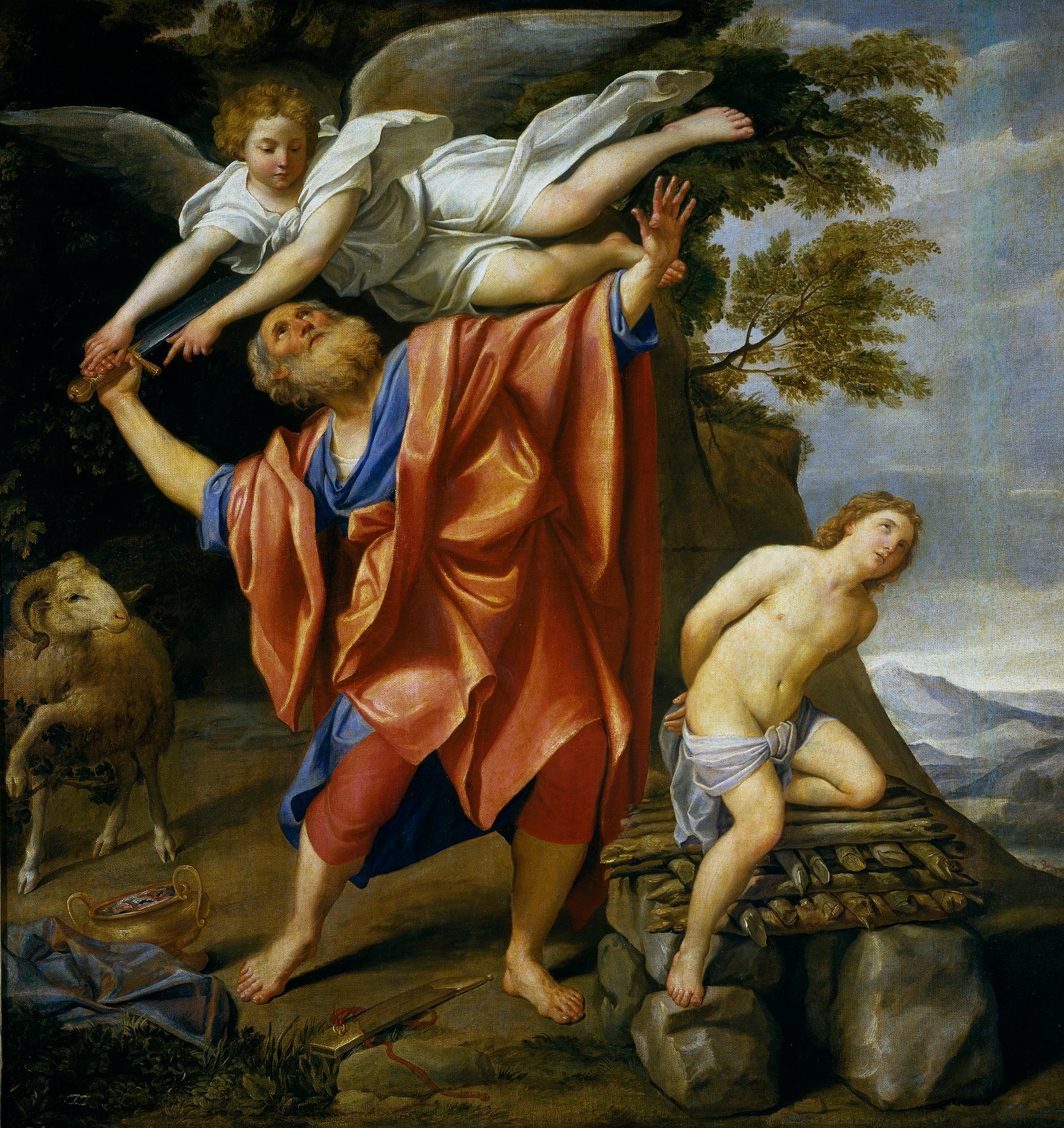
- The angelAn angel in white flies in from the left and holds Abraham's raised arm.Genesis 22:11 to 12
- AbrahamAbraham in a red cloak looks up, the knife still in his hand.Genesis 22:10
- Isaac on the woodIsaac kneels with his hands behind him on the wood laid over the stones.Genesis 22:9
- The ramA ram stands at the left edge of the canvas.Genesis 22:13
- The fireA brass vessel of burning coals stands on the ground at the left.Genesis 22:6
Domenichino, The Sacrifice of Isaac, 1627 to 1628. Public domain.
Each of the five parts answers to a verse.
Questions the Text Leaves Open
Genesis and Leviticus leave three questions open.
Genesis 8 records no command to Noah to build the altar. Genesis 22:13 does not say where the ram came from. Leviticus 1:16 gives no reason for throwing a bird's crop on the ash heap.
The Offering Once for All
Hebrews 10:8 to 10 and Ephesians 5:2 read Christ's death in the words of the altar, and Romans 12:1 asks believers for an offering of their own.
In the passage above He says, “Sacrifices and offerings, burnt offerings and sin offerings You did not desire, nor did You delight in them” (although they are offered according to the law). Then He adds, “Here I am, I have come to do Your will.” He takes away the first to establish the second. And by that will, we have been sanctified through the sacrifice of the body of Jesus Christ once for all.Hebrews quotes Psalm 40, which names burnt offerings, and reads it of Christ's coming to do God's will.
and walk in love, just as Christ loved us and gave Himself up for us as a fragrant sacrificial offering to God.Paul uses the altar's fragrant offering for Christ's giving of Himself, and he makes it the pattern of the believer's love.
“He brought out clearly that God's will is the salvation of humankind. The Lord also said as much, ‘This is the will of my Father, that everyone who believes in me may not be lost but may have eternal life.’”
Theodoret of Cyrus · Interpretation of Hebrews 10 · on Hebrews 10:10Patristic
The believer's offeringRomans 12:1
Therefore I urge you, brothers, on account of God’s mercy, to offer your bodies as living sacrifices, holy and pleasing to God, which is your spiritual service of worship.Paul makes this appeal on account of God's mercy, after eleven chapters of the gospel.
Voices on the Burnt Offering
Four teachers from the fourth century to the nineteenth wrote on the burnt offering.
296 to 373 · Athanasius of Alexandria
1662 to 1714 · Matthew Henry
Matthew Henry, in his Commentary on the Whole Bible, on Genesis 8:21, holds that God had an eye to Christ's sacrifice of Himself more than to Noah's.
1703 to 1791 · John Wesley
John Wesley, in his Explanatory Notes upon the Old Testament, on Genesis 22:13, takes the ram as a pledge of the expiation that the great sacrifice would make.
1834 to 1892 · Charles Spurgeon
Charles Spurgeon preached on the hand laid on the head of the sacrifice. He says the burnt offering, the meat offering, the peace offering and the sin offering show the Lord's atoning work from different standpoints.
John Wesley, Charles Spurgeon
Where Careful Readers Differ
Readers answer two questions about the burnt offering in different ways.
What the burnt offering didJamieson, Fausset and Brown; Adam Clarke; John Wesley
Jamieson, Fausset and Brown, in their Commentary Critical and Explanatory, on Leviticus 1:3, hold that it was designed to turn away God's anger at sin, and that its burning whole showed the offerer giving himself. Adam Clarke, in his Commentary on the Bible, on Leviticus 1:4, holds that the offerer who laid on his hand confessed himself worthy of death. The objection is that the text names no sin before Noah's offering.
John Wesley, in his Explanatory Notes upon the Old Testament, on Leviticus 1:4, holds that burnt offerings were commonly offered in thanksgiving. He allows that they were sometimes offered for sins in general, and he cites Job 1:5. The objection is that Leviticus 1:4 names atonement in the rite itself.
Whether the prophets set the offerings asideJamieson, Fausset and Brown; John Wesley; Theodoret of Cyrus
For I desire mercy, not sacrifice, and the knowledge of God rather than burnt offerings.Hosea says this to Ephraim and Judah, whose loyalty he likens to a morning mist.
Jamieson, Fausset and Brown and John Wesley read the words as a comparison, mercy rather than sacrifice. The objection is that Psalm 40:6 says burnt offerings were not required.
Theodoret of Cyrus, in his Commentary on Hosea, has God say that He had no need of sacrifices and accepted them out of consideration for the people's way of thinking. The objection is that Psalm 51:19 looks for whole burnt offerings in which God will delight.
Books to Read Next
Both works are in the public domain, and each has a free copy to read.
Putting the Hand upon the Head of the Sacrifice, Sermon 1771
Charles Spurgeon · 1884
The sermon stands in The Metropolitan Tabernacle Pulpit for 1884.
Read at Spurgeon GemsCommentary on the Whole Bible
Matthew Henry · 1708 to 1710
The first volume is a verse by verse commentary on Genesis to Deuteronomy, Leviticus 1 among it.
Read at CCELThe Lamb God Provided
Isaac's question on the road to Moriah is answered when John the Baptist sees Jesus coming toward him.
The next day John saw Jesus coming toward him and said, “Look, the Lamb of God, who takes away the sin of the world!John says this at Bethany beyond the Jordan, where he was baptizing, as John 1:28 says.
Sources
Scripture is the Berean Standard Bible.
- The Berean Standard Bible, every verse carrying the words burnt offering.
- James Strong, Exhaustive Concordance of the Bible, 1890, entries H5930, H5927, H3632 and G3646.
- Albert Barnes, Notes, Explanatory and Practical, on Leviticus 1:3.
- Ephrem the Syrian, Commentary on Genesis 6.13.2, on Genesis 8:21.
- Theodoret of Cyrus, Interpretation of Hebrews 10, on Hebrews 10:10.
- Theodoret of Cyrus, Commentary on Hosea 6:6 to 7.
- Athanasius of Alexandria, Festal Letter 6, on Genesis 22:13.
- Matthew Henry, Commentary on the Whole Bible, 1710, on Genesis 8:21.
- John Wesley, Explanatory Notes upon the Old Testament, 1765, on Genesis 22:13; on Leviticus 1:4; on Hosea 6:6.
- Charles Spurgeon, Putting the Hand upon the Head of the Sacrifice, Metropolitan Tabernacle Pulpit, Sermon 1771, 1884, on Leviticus 1:4.
- Jamieson, Fausset and Brown, Commentary Critical and Explanatory on the Whole Bible, 1871, on Leviticus 1:3; on Hosea 6:6.
- Adam Clarke, Commentary on the Bible, 1832, on Leviticus 1:4.
Keep Studying
Studies1
Places2
Symbols1