
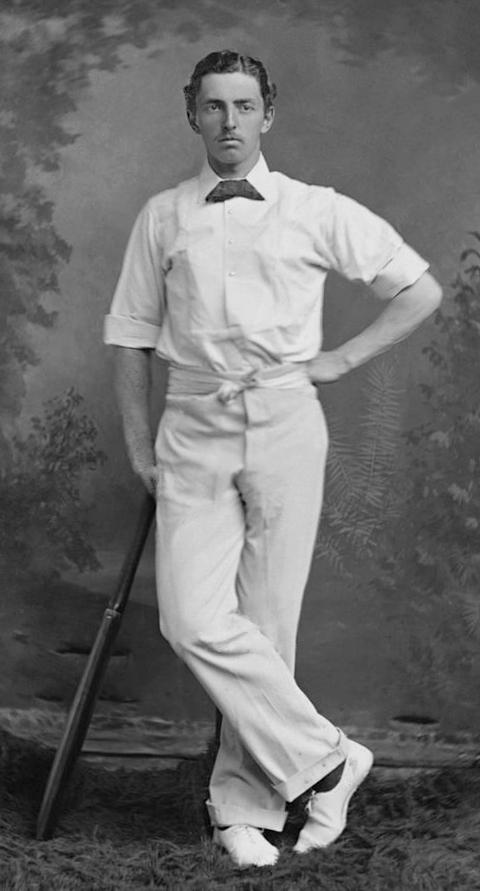
Charles Studd, about 1882. Public domain.
England, China, India and the Congo, 1860 to 1931 · Person · Featured Study
C. T. Studd
This England cricketer gave away his inherited fortune and preached abroad for more than forty years.
Lillywhite's Annual put him first among the batsmen of 1882, and three years later he sailed for China.
Ask Me, and I will make the nations Your inheritance, the ends of the earth Your possession.
Ask Me, and I will make the nations Your inheritance, the ends of the earth Your possession.
- Born
- 2 December 1860, a day the Cambridge register supplies in brackets (probable)
- Died
- 16 July 1931
- Family
- father: Edward Studd; mother: Dorothy Sophia Thomas; wife: Priscilla Livingstone Stewart; daughter: Grace; daughter: Dorothy; daughter: Edith; daughter: Pauline
- Places
- Spratton, Eton, Cambridge, Tientsin, Ootacamund, Niangara, Ibambi
Summary
Charles Thomas Studd was born in 1860 and went to Eton and Cambridge. He played cricket for Cambridge and for England. In 1885 he went to China with the China Inland Mission.
- By his wedding in 1888 he had given his whole inheritance to Christian work.
- He served six years as a minister in South India.
- He founded the Heart of Africa Mission and led it until his death in 1931.
The Texts He Leaned On
The verse that sent him to China stands under Psalm 2, and the promise he claimed for his gifts under Mark 10.
The question of this life is why a champion cricketer with a fortune gave both up for missions. His own testimony in The Fundamentals, the Cambridge register and Norman Grubb's life of 1933 are the witnesses.
will fail to receive a hundredfold in the present age—houses and brothers and sisters and mothers and children and fields, along with persecutions—and in the age to come, eternal life.He counted the hundredfold promised here as his return on the fortune he gave away.
The Life in Order
The early years stand on his own testimony and the Cambridge register, and the later ones on Grubb and Bonk.
Africa held the last eighteen years of his life.
- 1860He was born at Spratton, NorthamptonshireThe Cambridge register
- About 1878He was converted at home in talk with a visiting preacherStudd, The Fundamentals; Broomhall, 1887
- 1880 to 1883He won his cricket blue and captained CambridgeThe Cambridge register
- 29 August 1882He played for England in the Oval Test that gave rise to the AshesGrubb
- 5 February 1885He left London for China with the Cambridge bandBroomhall, 1887
- 1886He inherited a fortune, which he gave to Christian workThe Cambridge register
- 1888He married Priscilla Livingstone Stewart in ChinaThe Cambridge register; Grubb
- 1894Poor health forced him home from ChinaBonk
- 1900 to 1906He was minister of the church at OotacamundGrubb; Bonk
- 15 December 1910He set out for the SudanGrubb; Bonk
- 16 October 1913He reached Niangara in the Belgian Congo with Alfred BuxtonGrubb
- 1929Priscilla Studd died in EnglandBonk
- 16 July 1931He died at IbambiThe Cambridge register; Grubb
Each step of the life stands with its witness.
1888, 1894, 1900 to 1906, 15 December 1910, 16 October 1913, 1929, 16 July 1931
From Lord's to the Heart of Africa
A rich man's son who stood first among English batsmen spent his money and his last years on missions.
The Cambridge register names his father as Edward Studd of Hyde Park Gardens. His father was converted under Moody's preaching and opened his country house to meetings. There, Studd said, a visiting preacher pressed John 3:16 on him as he went out to play cricket, and he knelt and thanked God for the gift of eternal life.
After the Oval Test of 1882 he toured Australia under Ivo Bligh.
He said that six years of drifting followed his conversion, until The Christian's Secret of a Happy Life taught him that a man Christ had died for did not belong to himself. He sailed for China with six other young men of the Cambridge band.
In 1888 he married Priscilla Livingstone Stewart, an Irish missionary, at Tientsin before the Consul, and they had four daughters. Poor health sent him home in 1894. Bonk writes that he spoke for the Student Volunteer Movement in Britain and America.
Grubb writes that a notice in Liverpool in 1908, "Cannibals want missionaries!", turned his mind to Africa. He sailed for the Sudan at the end of 1910, though his wife did not approve, and the new mission took shape on his return. With Alfred Buxton he pushed on into the Belgian Congo in 1913.
His wife stayed in England through his years in Africa, except for one visit in 1928, and died in 1929. He led the work from Ibambi until gallstones, as his colleagues judged them, struck him in July 1931. His colleague Mr. Harrison wrote that he died on the night of Thursday 16 July, able to say only "Hallelujah" with each breath.
In Their Own Words
Three lines from the testimony he gave to The Fundamentals, on the call to China, surrender and his fortune.
C.T. Studd (1860 to 1931)
"The Personal Testimony of Charles T. Studd", The Fundamentals, volume 3, chapter VII, chapter VII, page 125
Ask of me
“That night I could not get to sleep, but it seemed as though I heard someone say this verse over and over, ‘Ask of me and I will give thee the heathen for thine inheritance and the uttermost parts of the earth for thy possession.’”
Evangelical
About this saying1 paragraph
In The Fundamentals, about 1910, he told of the night his elder brother doubted his call and they prayed together.
C.T. Studd
"The Personal Testimony of Charles T. Studd", The Fundamentals, volume 3, chapter VII, chapter VII, page 124
Common, ordinary honesty
“When I came to see that Jesus Christ had died for me, it didn't seem hard to give up all to Him. It seemed just common, ordinary honesty.”
Evangelical
About this saying1 paragraph
He said this of reading The Christian's Secret of a Happy Life, before he sailed for China in 1885.
C.T. Studd
"The Personal Testimony of Charles T. Studd", The Fundamentals, volume 3, chapter VII, chapter VII, page 126
Ten thousand per cent
“God has promised to give a hundredfold for everything we give to him. An hundredfold is a wonderful percentage; it is ten thousand per cent.”
Evangelical
About this saying1 paragraph
He said this after telling how he signed away his inheritance in China, before his wedding of 1888.
The People Around Him
The witnesses name his father, his brother, his wife, his daughters and the men who shared his work.
Two of his daughters married men who carried on his work.
| Person | Tie to Studd | The witness |
|---|---|---|
| Edward Studd | His father | Studd, The Fundamentals |
| An elder brother | A Christian who thought his call to China a mistake and then prayed with him | Studd, The Fundamentals |
| Priscilla Livingstone Stewart | His wife from 1888, daughter of William Stewart of Lisburn | The Cambridge register |
| Grace, Dorothy, Edith and Pauline | His four daughters | Grubb |
| Stanley P. Smith | A Cambridge rower in the same party | Broomhall, 1887; Ober, 1927 |
| Alfred Buxton | His co-pioneer at Niangara in 1913, who married Edith | Grubb; Bonk |
| Norman Grubb | The son-in-law who married Pauline, wrote his life and led the mission after him | Grubb; Bonk |
| D. L. Moody | The evangelist who reached his father and received his gift of 5,000 pounds | The Fundamentals; Grubb |
Norman Grubb, D. L. Moody
The Places of His Life
His life runs from an English country house to China, South India and the forests of the Congo.
He spent ten years in China, six in India and eighteen in Africa.
| Place | What the witnesses say | The witness |
|---|---|---|
| Spratton, Northamptonshire | He was born there. | The Cambridge register |
| Eton and Cambridge | He was schooled at Eton and took his degree from Trinity. | The Cambridge register |
| The Oval, London | He played there for England against Australia. | Grubb |
| Tientsin, China | He was married there before the Consul. | Grubb |
| Ootacamund, India | The English church he served as minister. | Grubb; Bonk |
| Niangara, Belgian Congo | His first station in the Congo. | Grubb |
| Ibambi, Belgian Congo | He led the mission from there and died there in 1931. | The Cambridge register; Grubb |
The Fortune He Gave Away
A vow and a letter from home led him to sign away his inheritance.
Studd told The Fundamentals that while reading of the rich young ruler at a station in China he remembered his vows, and the next post brought word of his inheritance. The British consul refused to sign his power of attorney and gave him two weeks to think it over, then signed it.
Grubb lists gifts of 5,000 pounds each to Moody, George Müller, George Holland of Whitechapel and Commissioner Booth-Tucker for the Salvation Army in India. He writes that Moody used his gift to start the Bible institute in Chicago, and that Studd gave his bride the last 3,400 pounds before the wedding.
How the Key Verse Was Taught
Origen, Augustine, Charles Spurgeon and Jamieson, Fausset and Brown read the Father's promise of the nations.
Origen of Alexandria (died 253)
COMMENTARY ON THE GOSPEL OF JOHN 13:5
Origen read the verse as the Father urging the Son to ask.
“It may perhaps be a dogma of some kind that no one receives a divine gift who does not request it. The Father, indeed, through the psalm, urges the Savior to ask that it may be given to him, as the Son teaches us when he says, ‘The Lord said to me, You are my son; ask from me, and I will give you the Gentiles as your inheritance and the ends of the earth as your possession.’ And the Savior says, ‘Ask and it will be given to you … for everyone who asks receives.’”
on Psalm 2:8Patristic
Augustine of Hippo (died 430)
Exposition on Psalm 2
Augustine read the promise of the nations of the manhood Christ took on Himself.
“‘Ask of Me, and I shall give Thee the nations for Thine inheritance’ [Psalm 2:8]. This has at once a temporal sense with reference to the Manhood which He took on Himself, who offered up Himself as a Sacrifice in the stead of all sacrifices, who also maketh intercession for us; so that the words, ‘ask of Me,’ may be referred to all this temporal dispensation, which has been instituted for mankind, namely, that the ‘nations’ should be joined to the Name of Christ, and so be redeemed from death, and possessed by God. ‘I shall give Thee the nations for Thine inheritance,’ which so possess them for their salvation, and to bear unto Thee spiritual fruit. ‘And the uttermost parts of the earth for Thy possession.’ The same repeated, ‘The uttermost parts of the earth,’ is put for ‘the nations;’ but more clearly, that we might understand all the nations. And ‘Thy possession’ stands for ‘Thine inheritance.’”
on Psalm 2:8Patristic
Charles Spurgeon (1834 to 1892)
The Treasury of David, Vol. 1
Spurgeon read it as a king's promise to a favoured one, granted to Christ.
“‘Ask of me.’ It was a custom among great kings, to give to favoured ones whatever they might ask. (See Esther 5:6; Matthew 14:7.) So Jesus hath but to ask and have. Here he declares that his very enemies are his inheritance. To their face he declares this decree, and ‘Lo! here, ‘ cries the Anointed One, as he holds aloft in that once pierced hand the sceptre of his power, ‘He hath given me this, not only the right to be a king, but the power to conquer.’ Yes!”
on Psalm 2:8 to 9Particular Baptist
Jamieson, Fausset & Brown (1802 to 1910)
Commentary Critical and Explanatory on the Whole Bible
Jamieson, Fausset and Brown read it as the kingdom reaching the whole earth.
“The hopes of the rebels are thus overthrown, and not only so; the kingdom they opposed is destined to be coextensive with the earth.”
on Psalm 2:8Reformed
The rest5 more paragraphs
heathen--or, "nations"
(Ps 2:1).
and the uttermost parts of the earth--
(Ps 22:27);
denotes universality.
What the Witnesses Leave Open
Readers still ask who first wrote the lines printed under his name, and how well he led his mission.
Who wrote the famous sayingsNorman Grubb; the Missionary Helpers' Union; Moody Monthly
Grubb in 1933 sets "If Jesus Christ be God and died for me" at a farewell, when a young man asked whether at fifty-two he meant to leave home, wife and children. He prints the lines on a Rescue Shop within a yard of hell in his account of the return to Africa in 1916.
The motto was printed unsigned in a paper of the Missionary Helpers' Union, which the Internet Archive dates to 1920, and in Moody Monthly in January 1921. Grubb's book is the earliest print of the Rescue Shop lines yet found, and no print of the motto over Studd's own name before 1930 has been found.
How well he led the missionJonathan Bonk, Norman Grubb and J. Murray
Jonathan Bonk, writing in 1998, calls him an inspiring example who proved an obstinate and unreasonable leader, in bitter conflict with family, fellow missionaries and Africans until his death. J. Murray writes that he dismissed Alfred Buxton, his son-in-law, as disloyal.
Grubb, also his son-in-law, writes that he had to dismiss two workers, that others resigned and that some of the home committee disagreed with him. He writes of an undercurrent of opposition to Studd's leadership and of days of fierce conflict.
Books to Read Next
The Fundamentals, volume 3
C. T. Studd and others · about 1910
Its seventh chapter is his own testimony, from his father's conversion to his inheritance.
Read The Fundamentals free at the Internet ArchiveThe Evangelisation of the World: A Missionary Band
B. Broomhall · 1887
It prints the Cambridge band's farewell addresses, Studd's among them, and their letters from China.
Read Broomhall free at the Internet ArchiveWhat Studd Left
Studd left the Heart of Africa Mission, which Grubb counts the first advance of the Worldwide Evangelization Crusade, and a fortune spent on other men's work. Bonk writes that after his death the mission began to flourish under Grubb.
Sources
Scripture is the Berean Standard Bible.
- The Holy Bible, Berean Standard Bible (read 2026)
- C. T. Studd, "The Personal Testimony of Charles T. Studd", in The Fundamentals: A Testimony to the Truth, volume 3 (Chicago: Testimony Publishing Company, about 1910), chapter VII.
- J. A. Venn, Alumni Cantabrigienses, part II, entry Studd, Charles Thomas, admitted at Trinity 1879.
- B. Broomhall, The Evangelisation of the World: A Missionary Band (London: Morgan and Scott, 1887)
- Norman P. Grubb, C. T. Studd: Cricketer and Pioneer (first published in England, November 1933; the copy read a later American impression)
- Jonathan J. Bonk, "Studd, C(harles) T(homas)", in Gerald H. Anderson, ed., Biographical Dictionary of Christian Missions (New York: Macmillan Reference USA, 1998), page 649.
- J. Murray, "Buxton, Alfred Barclay", in the Biographical Dictionary of Christian Missions (1998)
- C. K. Ober, Luther D. Wishard: Projector of World Movements (1927), quoting Tissington Tatlow.
- The Missionary Helpers' Union (about 1920); Moody Monthly, January 1921.
- Origen, Commentary on the Gospel of John, on Psalm 2:8.
- Augustine of Hippo, Exposition on Psalm 2.
- Charles Spurgeon, The Treasury of David, volume 1 (1869), on Psalm 2:8.
- Jamieson, Fausset and Brown, Commentary Critical and Explanatory on the Whole Bible (1871), on Psalm 2:8.