
Genesis 49 · Passage · Featured Study
The Blessing of Jacob: Genesis 49 Tribe by Tribe
In the Berean text the phrase the tribes of Israel first appears in Genesis 49, in the sayings Jacob spoke over his sons.
Jacob gives his two longest sayings to Judah and to Joseph, and each runs to five verses.
- The passage
- Genesis 49:1 to 28
- Book
- Genesis
- When
- after seventeen years in Egypt
- Hold in memory
- Genesis 49:18, Genesis 49:28
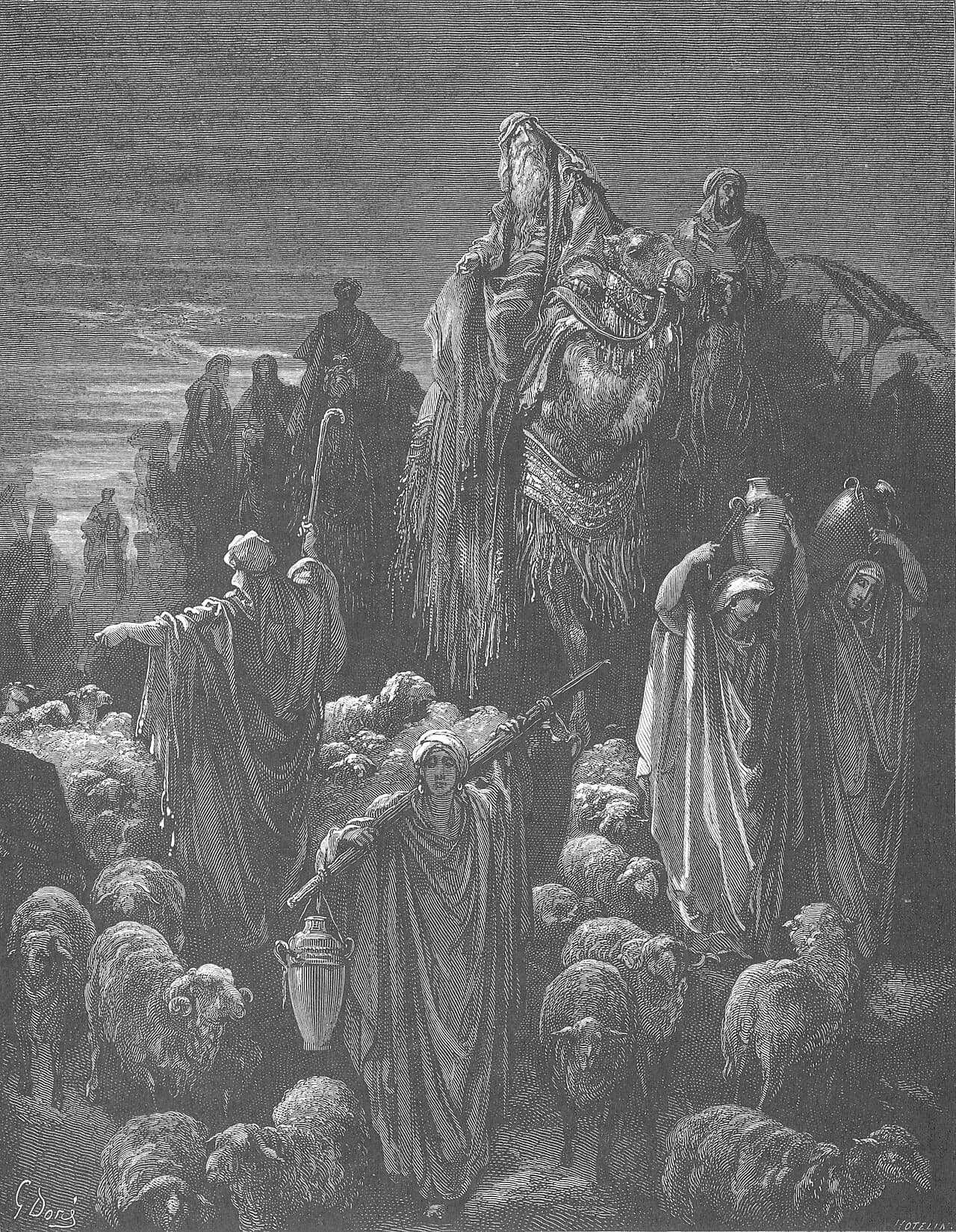
Gustave Doré, Jacob Goes to Egypt, 1866, from Doré's English Bible. Public domain.
THE ARTWORKDoré drew the aged Jacob riding a camel at the head of his household, with shepherds, flocks and women carrying water jars, on the road to Egypt that Genesis 46:5 to 7 tells. The sons who went down with him are the twelve he blesses from his bed in Genesis 49.
Summary
Jacob called his twelve sons to his bed in Egypt and spoke to each in turn, from Reuben the firstborn to Benjamin the youngest.
- Jacob names the sins of Reuben, Simeon and Levi, which Genesis 35:22 and Genesis 34:25 to 30 record.
- Several sayings play on a son's name, as when Judah's brothers praise him and Dan provides justice.
- Joseph receives blessings of the heavens above and of the depths below.
- Readers divide over whether the chapter is prophecy of the tribes or a father's blessing of his sons.
Jacob Calls His Sons
Jacob spoke these words at the end of his seventeen years in Egypt.
He had already made Joseph swear to bury him in Canaan, and he had blessed Joseph's two sons.
Then Jacob called for his sons and said, “Gather around so that I can tell you what will happen to you in the days to come: Come together and listen, O sons of Jacob; listen to your father Israel.Jacob speaks under the name Israel, which God gave him in Genesis 35:10.
Ambrose of Milan, in The Patriarchs, observes that the father who had set the younger grandson before the elder began here with the firstborn and kept the order of age.
The Twelve Sons in Jacob's Order
Leah's six sons come before the four sons of Bilhah and Zilpah, and Rachel's two sons stand last.
| Son | Mother | Verses | The image | The later record |
|---|---|---|---|---|
| Reuben | Leah | Genesis 49:3 to 4 | Uncontrolled as the waters | His birthright given to the sons of Joseph, 1 Chronicles 5:1 |
| Simeon | Leah | Genesis 49:5 to 7 | Swords that are weapons of violence | An inheritance within the territory of Judah, Joshua 19:9 |
| Levi | Leah | Genesis 49:5 to 7 | Anger cursed and a tribe scattered in Israel | No inheritance of land, the LORD as its inheritance, Joshua 13:33 |
| Judah | Leah | Genesis 49:8 to 12 | A young lion | A ruler came from him, 1 Chronicles 5:2 |
| Zebulun | Leah | Genesis 49:13 | A harbor for ships | The third lot, from Sarid west toward Jokneam, Joshua 19:10 to 11 |
| Issachar | Leah | Genesis 49:14 to 15 | A strong donkey | Men who understood the times, 1 Chronicles 12:32 |
| Dan | Bilhah | Genesis 49:16 to 17 | A snake by the road | Laish taken in the north and renamed Dan, Judges 18:27 to 29 |
| Gad | Zilpah | Genesis 49:19 | Attacked by raiders | Mighty men of valor trained for battle, 1 Chronicles 12:8 |
| Asher | Zilpah | Genesis 49:20 | Rich food and royal delicacies | Stayed at the coast in his harbors, Judges 5:17 |
| Naphtali | Bilhah | Genesis 49:21 | A doe set free | A people who risked their lives on the heights, Judges 5:18 |
| Joseph | Rachel | Genesis 49:22 to 26 | A fruitful vine | Two tribes, Manasseh and Ephraim, Joshua 14:4 |
| Benjamin | Rachel | Genesis 49:27 | A ravenous wolf | Seven hundred left-handers who could sling a stone at a hair, Judges 20:16 |
- Son
- Reuben
- Mother
- Leah
- Verses
- Genesis 49:3 to 4
- The image
- Uncontrolled as the waters
- The later record
- His birthright given to the sons of Joseph, 1 Chronicles 5:1
- Son
- Simeon
- Mother
- Leah
- Verses
- Genesis 49:5 to 7
- The image
- Swords that are weapons of violence
- The later record
- An inheritance within the territory of Judah, Joshua 19:9
- Son
- Levi
- Mother
- Leah
- Verses
- Genesis 49:5 to 7
- The image
- Anger cursed and a tribe scattered in Israel
- The later record
- No inheritance of land, the LORD as its inheritance, Joshua 13:33
- Son
- Judah
- Mother
- Leah
- Verses
- Genesis 49:8 to 12
- The image
- A young lion
- The later record
- A ruler came from him, 1 Chronicles 5:2
- Son
- Zebulun
- Mother
- Leah
- Verses
- Genesis 49:13
- The image
- A harbor for ships
- The later record
- The third lot, from Sarid west toward Jokneam, Joshua 19:10 to 11
- Son
- Issachar
- Mother
- Leah
- Verses
- Genesis 49:14 to 15
- The image
- A strong donkey
- The later record
- Men who understood the times, 1 Chronicles 12:32
- Son
- Dan
- Mother
- Bilhah
- Verses
- Genesis 49:16 to 17
- The image
- A snake by the road
- The later record
- Laish taken in the north and renamed Dan, Judges 18:27 to 29
- Son
- Gad
- Mother
- Zilpah
- Verses
- Genesis 49:19
- The image
- Attacked by raiders
- The later record
- Mighty men of valor trained for battle, 1 Chronicles 12:8
- Son
- Asher
- Mother
- Zilpah
- Verses
- Genesis 49:20
- The image
- Rich food and royal delicacies
- The later record
- Stayed at the coast in his harbors, Judges 5:17
- Son
- Naphtali
- Mother
- Bilhah
- Verses
- Genesis 49:21
- The image
- A doe set free
- The later record
- A people who risked their lives on the heights, Judges 5:18
- Son
- Joseph
- Mother
- Rachel
- Verses
- Genesis 49:22 to 26
- The image
- A fruitful vine
- The later record
- Two tribes, Manasseh and Ephraim, Joshua 14:4
- Son
- Benjamin
- Mother
- Rachel
- Verses
- Genesis 49:27
- The image
- A ravenous wolf
- The later record
- Seven hundred left-handers who could sling a stone at a hair, Judges 20:16
The Sayings, Son by Son
Five sons receive a single verse each, and Simeon and Levi share one saying of three verses.
1. Genesis 49:3 to 4, Reuben2 passages, 1 quotation
Reuben, you are my firstborn, my might, and the beginning of my strength, excelling in honor, excelling in power. Uncontrolled as the waters, you will no longer excel, because you went up to your father’s bed, onto my couch, and defiled it.Jacob grants Reuben the honor of the firstborn and then takes away his first place.
While Israel was living in that region, Reuben went in and slept with his father’s concubine Bilhah, and Israel heard about it. Jacob had twelve sons:Genesis records the deed here, and Jacob answers it on his deathbed.
Adam Clarke notes that the Hebrew word pachaz, behind uncontrolled in verse 4, is used elsewhere in Scripture of dissolute and licentious conduct.
Matthew Henry carries the dignity Reuben lost over to Christ and his church.
“How welcome he was to his parents his name bespeaks, Reuben, See a son. To him belonged the excellency of dignity above his brethren, and some power over them. Christ Jesus is the firstborn among many brethren, and to him, of right, belong the most excellent power and dignity: his church also, through him, is a church of firstborn.”
Matthew Henry · Commentary on the Whole Bible · on Genesis 49:3Puritan
2. Genesis 49:5 to 7, Simeon and Levi3 passages, 1 quotation
Simeon and Levi are brothers; their swords are weapons of violence. May I never enter their council; may I never join their assembly. For they kill men in their anger, and hamstring oxen on a whim. Cursed be their anger, for it is strong, and their wrath, for it is cruel! I will disperse them in Jacob and scatter them in Israel.These three verses carry the chapter's one curse.
Three days later, while they were still in pain, two of Jacob’s sons (Dinah’s brothers Simeon and Levi) took their swords, went into the unsuspecting city, and slaughtered every male. They killed Hamor and his son Shechem with their swords, took Dinah out of Shechem’s house, and went away.The slaughter at Shechem is the violence that verse 5 names.
Then Jacob said to Simeon and Levi, “You have brought trouble upon me by making me a stench to the Canaanites and Perizzites, the people of this land. We are few in number; if they unite against me and attack me, I and my household will be destroyed.” But they replied, “Should he have treated our sister like a prostitute?”Jacob's first rebuke spoke of the danger to his household, and the brothers answered with their sister's honor.
Jacob's twelve sayings go to his sons, and his daughter Dinah is last named among the family that went down to Egypt (Genesis 46:15).
Ambrose of Milan weighs the brothers' defense against Jacob's curse.
“For the brothers supplied the reasons for their own misfortune when they claimed to their father that they, although young in years, were vindicators and avengers of a wrong done to the sense of respect and of a violation of chastity. Surely the holy Jacob could not have condemned the fact that they did not permit their sister to be unavenged, in the position of a harlot, who had lost her virginity and did not have the consolation of a vindication.”
Ambrose of Milan · On the Blessings of the Patriarchs · on Genesis 49:5Patristic
3. Genesis 49:8 to 12, Judah1 passage
Leah named her fourth son Judah when she said that this time she would praise the LORD (Genesis 29:35), and Jacob's words to him open with his brothers' praise.
Judah, your brothers shall praise you. Your hand shall be on the necks of your enemies; your father’s sons shall bow down to you. Judah is a young lion—my son, you return from the prey. Like a lion he crouches and lies down; like a lioness, who dares to rouse him? The scepter will not depart from Judah, nor the staff from between his feet, until Shiloh comes and the allegiance of the nations is his. He ties his donkey to the vine, his colt to the choicest branch. He washes his garments in wine, his robes in the blood of grapes. His eyes are darker than wine, and his teeth are whiter than milk.Judah, the fourth son, receives the first saying that promises his brothers will bow to him.
4. Genesis 49:13 to 21, Zebulun to Naphtali4 passages
Zebulun shall dwell by the seashore and become a harbor for ships; his border shall extend to Sidon. Issachar is a strong donkey, lying down between the sheepfolds. He saw that his resting place was good and that his land was pleasant, so he bent his shoulder to the burden and submitted to labor as a servant.Zebulun is set by the sea and Issachar under a burden, each pictured by his land or his labor.
Adam Clarke pictures the strong donkey of verse 14 as a pack animal, which lies down with its load on its back when it is weary or overloaded.
Dan shall provide justice for his people as one of the tribes of Israel. He will be a snake by the road, a viper in the path that bites the horse’s heels so that its rider tumbles backward.Dan's saying begins with justice and ends with a snake that brings down a rider.
Rachel named Bilhah's first son Dan when she said that God had vindicated her (Genesis 30:6). Adam Clarke notes that the name signifies judgment, which verse 16 plays on, and that the word for viper in verse 17 is found nowhere else in the Bible.
I await Your salvation, O LORD.The verse is Jacob's own confession of faith, spoken among words about his sons' futures.
Matthew Henry, in his Commentary on the Whole Bible (1706), takes the salvation Jacob waited for to be Christ, the promised seed.
Gad will be attacked by raiders, but he will attack their heels. Asher’s food will be rich; he shall provide royal delicacies. Naphtali is a doe set free that bears beautiful fawns.These three sayings close the words to the sons of Bilhah and Zilpah, and each holds a single image.
John Wesley notes that the saying alludes to Gad's name, which he takes to signify a troop. Jerome, in his Hebrew Questions on Genesis, writes that the Hebrew word for the raider was chosen to allude to the name Gad.
Leah named Asher when she called herself happy (Genesis 30:13), and Rachel named Naphtali for her struggles with her sister (Genesis 30:8).
5. Genesis 49:22 to 26, Joseph2 passages
Joseph is a fruitful vine—a fruitful vine by a spring, whose branches scale the wall. The archers attacked him with bitterness; they aimed at him in hostility. Yet he steadied his bow, and his strong arms were tempered by the hands of the Mighty One of Jacob, in the name of the Shepherd, the Rock of Israel,Jacob pictures Joseph as a fruitful vine and then as an archer who stood firm under attack.
In the Berean text Jacob's first word for Joseph, fruitful, is the word Joseph used when he named his second son Ephraim in Genesis 41:52.
Adam Clarke takes the archers of verse 23 to be Joseph's brothers, whose hatred Genesis 37:4 records. John Wesley reads the bow that stayed steady as Joseph's faith, which did not fail.
by the God of your father who helps you, and by the Almighty who blesses you, with blessings of the heavens above, with blessings of the depths below, with blessings of the breasts and womb. The blessings of your father have surpassed the blessings of the ancient mountains and the bounty of the everlasting hills. May they rest on the head of Joseph, on the brow of the prince of his brothers.The fullest run of blessing in the chapter goes to Joseph, the son Jacob had once mourned as dead.
Jacob's words in verses 22 to 26 address Joseph himself, whose sons Ephraim and Manasseh he had already taken as his own in Genesis 48:5.
6. Genesis 49:27 to 28, Benjamin and the twelve2 passages, 1 quotation
Benjamin is a ravenous wolf; in the morning he devours the prey, in the evening he divides the plunder.”Jacob's last saying gives the youngest son the image of a wolf that takes prey and divides plunder.
Paul names himself a man of the tribe of Benjamin in Romans 11:1 and Philippians 3:5, and Ambrose of Milan builds on that descent.
“The devil has many wolves, whom he directs towards the sheep of Christ; and therefore Joseph, being intelligent, snatched the wolf Paul, the enemy who came to plunder the sheep, in order to save his own sheep, making him a teacher from a persecutor. Concerning whom Jacob says, as it is written: Benjamin is a ravenous wolf; in the morning he shall devour prey, and in the evening he shall divide the spoil among the princes. The wolf was present when he scattered and devoured the sheep of the Church. But the one who was a wolf became a shepherd.”
Ambrose of Milan · On the Blessings of the Patriarchs · on Genesis 49:27Patristic
These are the tribes of Israel, twelve in all, and this was what their father said to them. He blessed them, and he blessed each one with a suitable blessing.Verse 28 closes the sayings in the narrator's voice, heard last in verse 1.
What Followed in the Land
Joshua and Judges record where Levi, Simeon, Zebulun and Dan settled.
Joshua records the scattering of verse 7 for both brothers when the land was divided.
To the tribe of Levi, however, Moses had given no inheritance. The LORD, the God of Israel, is their inheritance, just as He had promised them.Levi's portion is the LORD Himself in place of a territory.
So by the command of the LORD, the Israelites gave the Levites these cities and their pasturelands out of their own inheritance:The Levites' cities came out of the other tribes' land, so the tribe lived among them all.
The inheritance of the Simeonites was taken from the territory of Judah, because the share for Judah’s descendants was too large for them. So the Simeonites received an inheritance within Judah’s portion.Joshua lists Simeon's lot, the second drawn, by its towns.
Adam Clarke, in his Commentary on the Bible, sets Zebulun's lot from the Mediterranean on the west to the lake of Gennesaret on the east.
The third lot came up for the clans of the tribe of Zebulun: The border of their inheritance stretched as far as Sarid. It went up westward to Maralah, reached Dabbesheth, and met the brook east of Jokneam.The sea and Sidon that verse 13 gives Zebulun stand in Joshua 19:28 to 29, in the border of Asher.
Dan's lot lay in the west, with the territory across from Joppa (Joshua 19:46), and Joshua 19:47 records that the tribe lost it.
The Amorites forced the Danites into the hill country and did not allow them to come down into the plain.The tribe's trouble began in its first lot, before the move north.
After they had taken Micah’s idols and his priest, they went to Laish, to a tranquil and unsuspecting people, and they struck them with their swords and burned down the city. There was no one to deliver them, because the city was far from Sidon and had no alliance with anyone; it was in a valley near Beth-rehob. And the Danites rebuilt the city and lived there. They named it Dan, after their forefather Dan, who was born to Israel—though the city was formerly named Laish.The tribe's new home in the north is the city that bears Dan's name from then on.
Jacob's Words and the Blessing of Moses
Moses' blessing of the tribes in Deuteronomy 33 takes up several of Jacob's sayings.
This is the blessing that Moses the man of God pronounced upon the Israelites before his death.Moses' blessing stands at the end of his life, as Jacob's stands at the end of his.
Levi in Deuteronomy 33 and Exodus 322 passages
Concerning Levi he said: “Give Your Thummim to Levi and Your Urim to Your godly one, whom You tested at Massah and contested at the waters of Meribah. He said of his father and mother, ‘I do not consider them.’ He disregarded his brothers and did not know his own sons, for he kept Your word and maintained Your covenant. He will teach Your ordinances to Jacob and Your law to Israel; he will set incense before You and whole burnt offerings on Your altar.Levi, whose anger Jacob cursed in Genesis 49:7, is blessed here for keeping the LORD's covenant.
So Moses stood at the entrance to the camp and said, “Whoever is for the LORD, come to me.” And all the Levites gathered around him. He told them, “This is what the LORD, the God of Israel, says: ‘Each of you men is to fasten his sword to his side, go back and forth through the camp from gate to gate, and slay his brother, his friend, and his neighbor.’” The Levites did as Moses commanded, and that day about three thousand of the people fell dead. Afterward, Moses said, “Today you have been ordained for service to the LORD, since each man went against his son and his brother; so the LORD has bestowed a blessing on you this day.”This is the day that turned the tribe's sword to the LORD's side, between Jacob's curse and Moses' blessing.
Reuben and Joseph in Deuteronomy 332 passages
Let Reuben live and not die, nor his men be few.”Moses prays that Reuben will live, for the tribe whose first place Jacob took away.
Concerning Joseph he said: “May his land be blessed by the LORD with the precious dew from heaven above and the deep waters that lie beneath, with the bountiful harvest from the sun and the abundant yield of the seasons, with the best of the ancient mountains and the bounty of the everlasting hills, with the choice gifts of the land and everything in it, and with the favor of Him who dwelt in the burning bush. May these rest on the head of Joseph and crown the brow of the prince of his brothers.Moses' words for Joseph repeat the close of Jacob's blessing on him almost word for word.
Voices on Joseph's Blessing
Matthew Henry and Charles Spurgeon comment on Jacob's blessing of Joseph.
Matthew Henry applies the verse's two kinds of blessing to the reader.
“Spiritual blessings are blessings of heaven above, which we ought to desire and seek for in the first place, and to which we must give the preference; while temporal blessings, those of this earth, must lie under in our account and esteem. Blessings of the womb and the breasts are given when children are safely born and comfortably nursed.”
Matthew Henry · Commentary on the Whole Bible · on Genesis 49:25Puritan
Charles Spurgeon turns to the father's love behind the blessing.
“You must have noticed, when reading Jacob's prophecies concerning his sons, that the good old man, when he came to talk about Joseph, suddenly seemed to be freer of speech than while he was addressing any of the others. The dying flame of life within him appeared to burn up more brightly at the sight of the son of his old age, the darling of his heart.”
Charles Spurgeon · The Metropolitan Tabernacle Pulpit, Sermon No. 2531: “A Boundless Benediction” (lightly modernized text, CCEL edition) · on Genesis 49:25
Prophecy or Blessing
The question turns on the frame of the chapter, verse 1 at its opening and verse 28 at its close.
The words foretell the tribes in the landRadak, Jerome
Radak, David Kimhi, in his commentary on Genesis, calls verse 2 the introduction to Jacob's prophetic utterances. He sets it beside the opening of Moses' song in Deuteronomy 32:1 and of Deborah's song in Judges 5:3.
Jerome, in his Hebrew Questions on Genesis, renders verse 7 afresh from the Hebrew and takes its last line as spoken of the tribes still to come.
The objection: the words to Reuben, Simeon and Levi answer deeds already done.
The words bless and judge each sonJohn Wesley, Adam Clarke
John Wesley, in his Explanatory Notes upon the Old Testament (1765), reads the words to Reuben as a charge for a sin committed forty years before, which Jacob now remembers against him. Adam Clarke, in his Commentary on the Bible, reads verse 6 as Jacob clearing himself of any part in the slaughter at Shechem.
On this reading verse 28 governs the chapter, since it calls every saying a suitable blessing.
The objection: verse 1 announces the sayings as words about the days to come.
The words are history and prophecy at onceMatthew Henry
Matthew Henry holds both readings together in his comment on Joseph's saying.
“His two sons were as branches of a vine, or other spreading plant, running over the wall. Note, God can make those fruitful, great comforts to themselves and others, who have been looked upon as dry and withered. More is recorded in the history concerning Joseph than concerning any other of Jacob's sons; and therefore what Jacob says of him is historical as well as prophetical.”
Matthew Henry · Commentary on the Whole Bible · on Genesis 49:22Puritan
The objection: the reading leaves open which sayings foretell and which judge.
Gathered to His People
Genesis 49:29 to 33 closes the chapter with Jacob's death, and Revelation 7 and Revelation 21 carry his hope and the names of the tribes to the end of Scripture.
Then Jacob instructed them, “I am about to be gathered to my people. Bury me with my fathers in the cave in the field of Ephron the Hittite. The cave is in the field of Machpelah near Mamre, in the land of Canaan. This is the field Abraham purchased from Ephron the Hittite as a burial site. There Abraham and his wife Sarah are buried, there Isaac and his wife Rebekah are buried, and there I buried Leah. The field and the cave that is in it were purchased from the Hittites.”Jacob's last charge sends his body back to the field Abraham bought in Canaan.
Matthew Henry traces the charge to Jacob's trust in God's promise of the land.
“His heart was very much upon it, not so much from a natural affection to his native soil as from a principle of faith in the promise of God, that Canaan should be the inheritance of his seed in due time.”
Matthew Henry · Commentary on the Whole Bible · on Genesis 49:31Puritan
When Jacob had finished instructing his sons, he pulled his feet into the bed and breathed his last, and he was gathered to his people.Jacob's death closes the life that began with his birth in Genesis 25:26.
The city had a great and high wall with twelve gates inscribed with the names of the twelve tribes of Israel, and twelve angels at the gates. There were three gates on the east, three on the north, three on the south, and three on the west. The wall of the city had twelve foundations bearing the names of the twelve apostles of the Lamb.John's vision sets the sons Jacob spoke over beside the apostles Christ chose.
After this I looked and saw a multitude too large to count, from every nation and tribe and people and tongue, standing before the throne and before the Lamb. They were wearing white robes and holding palm branches in their hands. And they cried out in a loud voice: “Salvation to our God, who sits on the throne, and to the Lamb!”The salvation Jacob waited for in Genesis 49:18 is sung here to God and to the Lamb.
Genesis 49 asks its reader to hold to God's promise until death, as Jacob did, and to look for its keeping in Christ, the Lamb of Revelation.
Keep studying
Read it1
Studies6
Peoples and groups1