
Psalm 55 · Passage · Injustice
Betrayed by a Friend
Psalm 55:12 to 14 and Psalm 41:9 are prayers of a man wronged by a close friend he had trusted.
The psalmist could have hidden from an enemy, but the man who turned on him had walked beside him into the house of God.
But it is you, a man like myself, my companion and close friend.
- The passage
- Psalm 55:12 to 14, Psalm 41:9
- Book
- Psalms
- Hold in memory
- Psalm 55:16 to 17, Psalm 41:9
Summary
Psalm 55 is a prayer for someone hurt by a person close to him. It lets him tell God everything, his fear, his wish to escape and his anger at the plotters. Then it turns him to prayer at every hour of the day. Psalm 41:9 names the same wound, and the Gospels show Jesus bearing it at His own table.
- The betrayer of Psalm 55 was the psalmist's equal and familiar friend.
- His speech was soft while he planned war.
- Psalm 41:9 names a trusted friend who ate the psalmist's bread and turned on him.
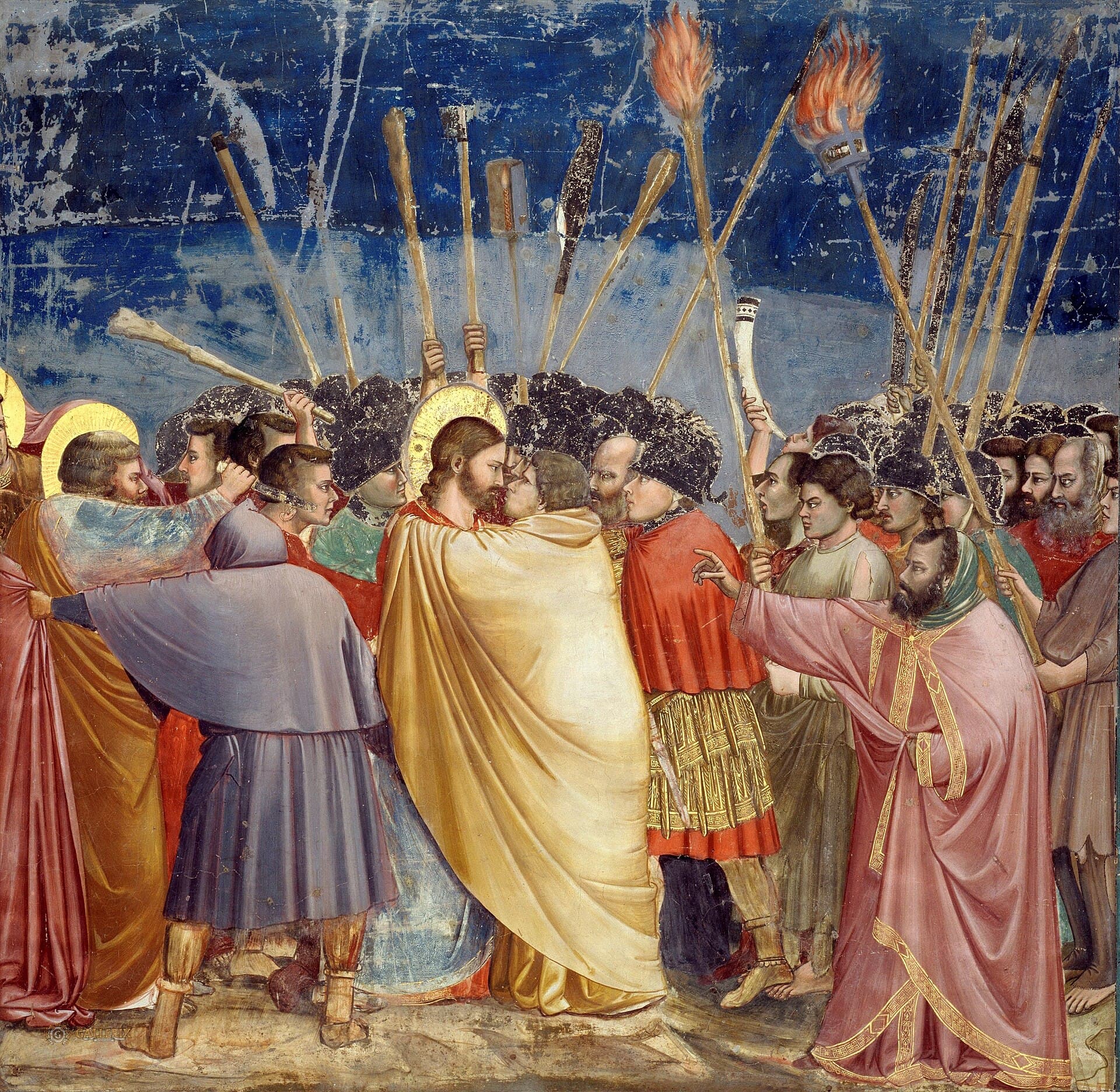
- Jesus applied Psalm 41:9 to Judas, who handed Him over with a kiss.
It Was You, My Friend
Psalm 55 moves from terror and the wish to flee to the friend who broke faith.
Betrayed by a Friend reads Psalm 55:12 to 14 and Psalm 41:9. It belongs to the trial of injustice, where the hardest wrong comes from someone close.
The question it answers is what Scripture gives the one who has been betrayed. It gives the psalm's movement and the Hebrew words for the friend. It sets four betrayals of Scripture side by side and gives Jesus's own use of Psalm 41:9. It sets out three readings of who the friend of Psalm 55 was.
I said, “Oh, that I had wings like a dove! I would fly away and find rest. How far away I would flee! In the wilderness I would remain. Selah I would hurry to my shelter, far from this raging tempest.”The betrayed man's first wish is to escape, and the psalm records the wish without rebuke.
For it is not an enemy who insults me; that I could endure. It is not a foe who rises against me; from him I could hide.The verse sets the friend apart from every enemy the psalm has named before it.
The Hebrew of Psalm 55:13 calls the man 'enosh ke'erki, a man of my own valuation, which is to say an equal. He is 'alluph, a familiar friend, and meyudda', one well known to him.
We shared sweet fellowship together; we walked with the crowd into the house of God.The verse stands here because it names the bond that was broken.
The sweet fellowship is sod, glossed as a company of persons in close deliberation.
Four Betrayals Side by Side
Two psalms, the court of David and the Twelve each give one betrayer.
Each betrayer had shared the life of the man he betrayed.
| The friend | What he shared | What he did |
|---|---|---|
| The companion of Psalm 55 | Counsel and worship | Broke faith with his friends |
| The friend of Psalm 41 | Trust and a shared table | Turned against the man who fed him |
| Ahithophel the Gilonite | The king's ear as his adviser | Went over to the rebel prince |
| Judas, one of the Twelve | A place at the Last Supper | Handed his teacher to the arresting crowd |
Smooth Words and the Turn to Prayer
Psalm 55:15 to 21 holds the curse, the cry to God and the friend's smooth words.
The psalm asks God to let death seize the plotters (Psalm 55:15). Matthew Henry wrote of such prayers in his Commentary on the Whole Bible (1710). He held them to be read “as prophecies, but not to copy into our prayers against any particular enemies of our own.”
But I call to God, and the LORD saves me. Morning, noon, and night, I cry out in distress, and He hears my voice.The verses stand here as the turn of the psalm from the friend to God.
My companion attacks his friends; he violates his covenant. His speech is smooth as butter, but war is in his heart. His words are softer than oil, yet they are swords unsheathed.The verses come back to the friend after the prayer, as a wound comes back to mind.
Ahithophel, David's Counsellor
David's own counsellor went over to Absalom.
While Absalom was offering the sacrifices, he sent for Ahithophel the Gilonite, David’s counselor, to come from his hometown of Giloh. So the conspiracy gained strength, and Absalom’s following kept increasing.Absalom sends for David's counsellor at the moment his conspiracy gathers strength.
In 2 Samuel 15:31 David heard that Ahithophel was among the conspirators. He prayed, “O LORD, please turn the counsel of Ahithophel into foolishness!” In those days his advice “was like the consultation of the word of God” (2 Samuel 16:23).
When Ahithophel saw that his advice had not been followed, he saddled his donkey and set out for his house in his hometown. He put his affairs in order and hanged himself. So he died and was buried in his father’s tomb.The verse stands here because it ends the story of the counsellor who turned.
The Friend Who Ate My Bread
The bread shared in the psalm becomes a morsel at the Last Supper.
Even my close friend whom I trusted, the one who shared my bread, has lifted up his heel against me.The verse stands beside Psalm 55 because it names the same wound in another psalm.
The Hebrew calls him 'ish shelomi, the man of my peace. The last word of the verse is 'aqev, a heel.
I am not speaking about all of you; I know whom I have chosen. But this is to fulfill the Scripture: ‘The one who shares My bread has lifted up his heel against Me.’The verse stands here as the place where the psalm and the Gospel meet.
A few verses later Jesus “dipped the morsel and gave it to Judas son of Simon Iscariot” (John 13:26). The bread of the psalm became the sign that marked the betrayer.
Now the betrayer had arranged a signal with them: “The One I kiss is the man; arrest Him.” Going directly to Jesus, he said, “Greetings, Rabbi!” and kissed Him.The sign Judas chose for the arrest was the greeting of a friend.
Luke records that Jesus named the sign as Judas came near (Luke 22:48).
Who Was the Friend of Psalm 55?
Three readings, from Ambrose of Milan to Charles Spurgeon, each met by an objection from the text.
Ahithophel in Absalom's revoltCharles Spurgeon
Charles Spurgeon, in The Treasury of David (1872), heard Ahithophel in Psalm 55:13, and Judas with him.
The objection is that the psalm names no one and no occasion in its verses.
Saul or Doeg the EdomiteThomas Aquinas
Thomas Aquinas wrote an Exposition on the Psalms of David. Of Psalm 55:12 to 14 he said, “And perhaps it refers to Saul, or to Doeg the Edomite.”
The objection is that the psalm calls the man the psalmist's equal and close friend. Saul was David's king, and Doeg was one of Saul's servants and his chief shepherd (1 Samuel 21:7).
Judas at the tableAmbrose of Milan
Ambrose of Milan, in On the Duties of the Clergy, read the friend of Psalm 55:13 to 14 as Judas. He wrote that Judas “had mingled the poison of malice at the table of friendship.”
The objection is that John 13:18 quotes Psalm 41:9 of Judas, and the Gospels quote no line of Psalm 55 of him.
The Wound Brought to God
The psalms give the betrayed words for the wrong done to them.
The betrayed may name the friend's wrong before God in full and go on praying. The one who was betrayed at His own table is the Lord they pray to.
Sources
Scripture is the Berean Standard Bible.
- STEP Bible, Translators Amalgamated Hebrew Old Testament (Tyndale House, Cambridge), CC BY 4.0.
- STEP Bible brief lexicons of Extended Strongs for Hebrew (Tyndale House, Cambridge), CC BY 4.0, with the Strong's glosses.
- Matthew Henry, Commentary on the Whole Bible (1710), on Psalm 55:14.
- Charles Spurgeon, The Treasury of David, vol. 3 (1872), on Psalm 55:13.
- Ambrose of Milan, On the Duties of the Clergy, book 3, section 136.
- Thomas Aquinas, Exposition on the Psalms of David, on Psalm 55:12 to 14.
Keep Studying
Read it1
In this trial6
People and groups7