
AD 1517 to 1518 · Story · Featured Study
The Ninety-five Theses
Luther's propositions on repentance and pardons began a quarrel that reached the archbishop of Mainz and the pope within weeks.
Ten years after the theses, Luther dated a letter to Amsdorf “In tenth year of the overthrow of the Indulgence, to whose memory we are drinking a toast.”
- When
- 31 October 1517 to 1518
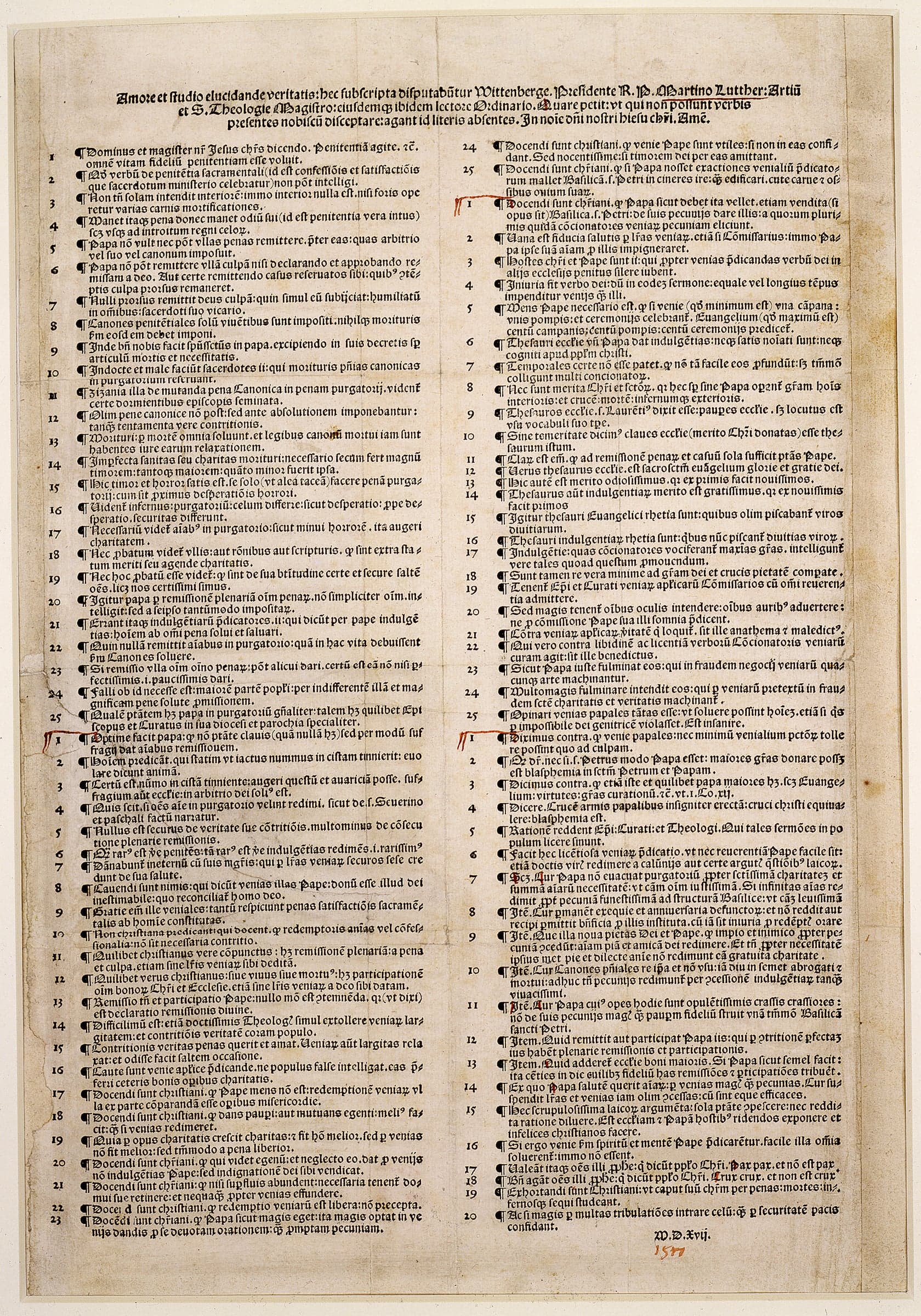
Martin Luther, the Ninety-five Theses printed at Nuremberg, 1517. Public domain.
From that time on Jesus began to preach, “Repent, for the kingdom of heaven is near.”
Summary
On 31 October 1517 Martin Luther sent the archbishop of Mainz ninety-five short theses against the selling of pardons. Copies were in print at Nuremberg and Basel before the year was out.
- The pardons were preached in the archbishop's name to build St Peter's at Rome.
- The theses called for a debate and asked for answers by letter.
- Later in life Luther said he had been a mad papist when he wrote them.
The Verse of the First Thesis
Thesis 1 reads Matthew 4, and the letter and the last theses read Paul, Ezekiel and Acts.
Luther opened the theses with Christ's first preaching, “Repent,” which the Latin Bible gave as poenitentiam agite. In the first thesis he read it as a call on the whole life of believers. In the second he denied that it could mean the sacrament of penance done before a priest.
In the letter and theses 92 to 95
Therefore, my beloved, just as you have always obeyed, not only in my presence, but now even more in my absence, continue to work out your salvation with fear and trembling.
The letter to Albrecht quotes it against the preachers who made the people sure of salvation.
Because they have led My people astray, saying, ‘Peace,’ when there is no peace, and whitewashing any flimsy wall that is built,
Thesis 92 sends away the prophets who say “Peace, peace,” and the Holman edition sets this verse beside it.
strengthening the souls of the disciples and encouraging them to continue in the faith. “We must endure many hardships to enter the kingdom of God,” they said.
Thesis 95 has Christians trust to enter heaven through many tribulations.
Acts 14:22BSB
The Letter and the Witnesses to a Posting
Luther's letter, his later account, a secretary's note, a friend's preface and two modern historians.
The letter of 31 October 1517 is the fixed point, and the witnesses to a posting are Rörer's note and Melanchthon's preface of 1546.
| Witness | Written | What it says of a door |
|---|---|---|
| Luther's letter to Albrecht of Mainz, with the theses enclosed | 31 October 1517 | It names no door |
| Georg Rörer's note in a New Testament printed in 1540 | Not dated | The theses were posted on the doors of the churches in Wittenberg |
| Luther's account in Wider Hans Worst | 1541 | He wrote to the bishops first, and it names no door |
| Melanchthon's preface to Luther's Latin works, volume 2 | 1546 | Luther publicly posted them at the church next to the castle |
| Erwin Iserloh | 1961 | The posting is a legend |
| Volker Leppin and Timothy Wengert | 2015 | The two authors differ and call the question unresolvable |
Preachers long told the story as a nailing, Spurgeon among them in 1883. Melanchthon's preface appeared after Luther's death, and Melanchthon came to Wittenberg only in 1518.
From Tetzel's Preaching to the Printers
Within two months the propositions had left the university and reached Mainz, Nuremberg and Basel.
Johann Tetzel was not allowed to preach the indulgence in the lands of the Elector of Saxony. He came instead to Jüterbog and Zerbst, within easy reach of Wittenberg.
Albrecht's Summary Instruction for the preachers said that those who gave for the souls of the dead need not be contrite in heart or confessed by mouth.
Frederick Myconius heard Tetzel for two years at St Annaberg and later became a pastor at Gotha. He recalled Tetzel teaching that “so soon as the coin rang in the chest, the soul for whom the money was paid, would go straightway to heaven.”
Schaff notes that Mathesius and Johann Hess, two contemporary witnesses, ascribe the same saying to Tetzel himself. Tetzel's own words for it are not known.
Ludwig Pastor, the Catholic historian of the popes, holds that on indulgences for the living Tetzel always taught pure doctrine. He calls the charges against Tetzel's morals inventions.
Luther sent the theses with his letter to Albrecht, asking him to see how doubtful the opinion of indulgences was.
In Wider Hans Worst of 1541 Luther wrote that the theses “went throughout the whole of Germany inside two weeks.”
Smith says that before Luther knew it they were printed at Nuremberg in Latin and German.
Albrecht sent the theses to the University of Mainz on 1 December, and then on to the pope.
Tetzel answered with counter-theses that Conrad Wimpina drew up for him. His second series begins from the supreme power of the pope in the Church.
What the Theses Say About Pardons
Wace and Buchheim's English of 1883 gives the theses on the money, on certainty, on the poor and on St Peter's.
Thesis 27 says, “They preach man, who say that the soul flies out of purgatory as soon as the money thrown into the chest rattles.”
Thesis 32 warns that those who think letters of pardon make them sure of salvation “will be eternally damned along with their teachers.”
Thesis 36 says that every Christian who feels true compunction “has of right plenary remission of pain and guilt, even without letters of pardon.”
Thesis 43 teaches that he who gives to a poor man, or lends to a needy one, “does better than if he bought pardons.”
Thesis 50 says the pope, if he knew the preachers' exactions, would rather see St Peter's burnt to ashes “than that it should be built up with the skin, flesh, and bones of his sheep.”
What the Theses Still Held
What Luther still held to in 1517, by Schaff's reading.
Schaff writes that the theses protest against the abuse of indulgences and against no doctrine of the Roman Church. They condemn those who speak against indulgences, in thesis 71, and they imply belief in purgatory.
He adds that they nowhere mention Tetzel and are silent about faith and justification.
In the preface to his collected works in 1545, Luther let them stand as a sign of how weak he had been when he began.
In Their Own Words
Martin Luther (1483 to 1546)
The Ninety-five Theses (1517), thesis 62, in Henry Wace and C. A. Buchheim, First Principles of the Reformation (London, 1883)
The true treasure of the Church
“The true treasure of the Church is the Holy Gospel of the glory and grace of God.”
Other
About this saying1 paragraph
Thesis 62, of 1517, answers the preachers of pardons with the gospel.
Martin Luther
Letter to John Staupitz accompanying the Resolutions (Day of the Holy Trinity, 1518), in Works of Martin Luther, vol. 1 (Philadelphia, 1915), the letter sent with the Resolutions
A word grown sweet
“but now there is no word which has for me a sweeter or more pleasing sound than ‘penitence.’”
Other
About this saying1 paragraph
On the Day of the Holy Trinity 1518 Luther sent his Resolutions on the theses to John Staupitz, vicar of the Augustinian order. He wrote of how the word penitence had changed for him.
Martin Luther
Letter to Pope Leo X accompanying the Resolutions (1518), in Works of Martin Luther, vol. 1 (Philadelphia, 1915), the letter sent with the Resolutions
The fire they complain of
“Lo, this is the fire with which they complain that all the world is now ablaze!”
Other
About this saying1 paragraph
In 1518 he wrote to the pope of the outcry his propositions had raised.
Martin Luther
Letter to Christoph Scheurl (5 March 1518), in Preserved Smith, The Life and Letters of Martin Luther (Boston, 1911), chapter on the theses, page 44
Doubts of his own
“my purpose was not to publish them, but first to consult a few of my neighbors about them, that thus I might either destroy them if condemned or edit them with the approbation of others.”
Other
About this saying1 paragraph
Luther wrote to Christoph Scheurl at Nuremberg on 5 March 1518, after Scheurl had sent him the printed theses in Latin and German.
Martin Luther, Martin Luther
What the Theses Were For
Two readings of their purpose, one Luther's own and one a Catholic historian's.
A disputation for one university1 paragraph
Luther told Leo X that the disputation “was made public at our University and for our University only.” The theses' own heading asks those absent to dispute by letter.
The first sign of a break1 paragraph
Ludwig Pastor held in 1908 that the theses were “nothing but the first incidental expression” of Luther's deep-lying antagonism to the Catholic doctrine of good works.
What the Theses Began
Propositions written for Wittenberg reached Mainz, Rome and the printers within months, and the road from them ran to the Diet of Worms in 1521.
Sources
Scripture is the Berean Standard Bible.
- The Holy Bible, Berean Standard Bible (read 2026)
- Henry Wace and C. A. Buchheim, First Principles of the Reformation, or the Ninety-five Theses and the Three Primary Works of Dr. Martin Luther (London, 1883), the theses and the letter to Albrecht.
- Works of Martin Luther, vol. 1 (Philadelphia: A. J. Holman, 1915), the theses, the letter to Albrecht, and the letters to Staupitz and to Leo X of 1518.
- B. J. Kidd, Documents Illustrative of the Continental Reformation (Oxford, 1911), numbers 6 to 11.
- Philip Schaff, History of the Christian Church, vol. 7 (New York, 1888), on the theses and the indulgence.
- Preserved Smith, The Life and Letters of Martin Luther (Boston, 1911), the chapter on the theses.
- Preserved Smith, Luther's Correspondence and Other Contemporary Letters, vol. 1 (Philadelphia, 1913), number 44 and its note.
- Volker Leppin and Timothy J. Wengert, "Sources for and against the Posting of the Ninety-Five Theses", Lutheran Quarterly 29 (2015), pages 373 to 398, cited.
- Erwin Iserloh on the posting as legend (1961), as luther.de reports him, and his Luther zwischen Reform und Reformation (Münster, 1966), cited.
- Ludwig Pastor, The History of the Popes, vol. 7, edited by Ralph Francis Kerr (London, 1908), on Tetzel and the theses.
- Margaret A. Currie, The Letters of Martin Luther (London, 1908), the letter to Nicholas Amsdorf of All Saints' Day 1527.
- Charles H. Spurgeon, The Luther Sermon at Exeter Hall, sermon 1750 (11 November 1883), Metropolitan Tabernacle Pulpit, vol. 29.
Keep Studying
Read it1
People and groups5
Symbols1
Values1
Church history1