
Numbers 6:22 to 27 · Passage · Featured Study
The Priestly Blessing
The LORD's name stands in each of the three lines of this blessing.
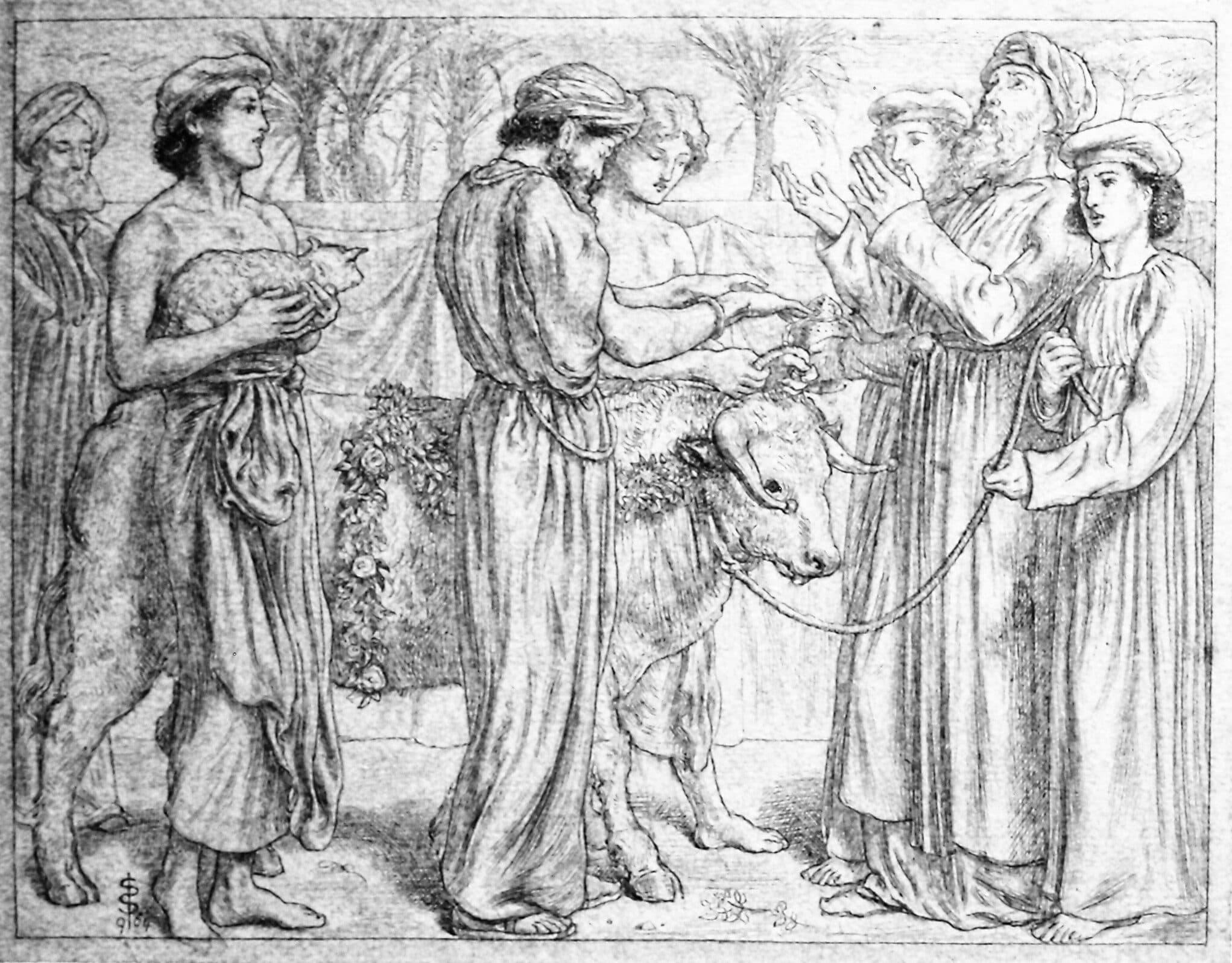
Simeon Solomon, The First Offering of Aaron, 1864, pen and black ink on paper, The Higgins, Bedford. Public domain by date (made in 1864); photograph by Simon Speed, CC0, via Wikimedia Commons, File:FirtsOfferingAaron.JPG.
THE ARTWORKSolomon drew Leviticus 9, the first offerings of the ordained priests, with a bull led forward while an old man lifts both hands toward heaven.
Aaron's first blessing of Israel in Leviticus 9 has no recorded words, and Numbers 6 gives the priests the words to speak.
Summary
The passage follows the law of the Nazirite in Numbers 6:1 to 21 and closes the chapter.
- Adam Clarke, in his Commentary on the Bible (1810 to 1826), counts three forms of blessing in these verses, any or all of which the priests might use.
- Psalm 67 opens with the words of the blessing turned into the people's prayer.
- Readers divide over whether the three times the LORD is named point to the Father, the Son and the Holy Spirit.
The Blessing and Its Setting, Verse by Verse
Aaron lifted up his hands toward the people and blessed them. And having made the sin offering, the burnt offering, and the peace offering, he stepped down. Moses and Aaron then entered the Tent of Meeting. When they came out, they blessed the people, and the glory of the LORD appeared to all the people.Albert Barnes calls this joint blessing of Moses and Aaron the solemn close of the consecration.
Then the LORD said to Moses, “Tell Aaron and his sons: This is how you are to bless the Israelites. Say to them:The command names Aaron and his sons, so the blessing belongs to the office of the priests.
‘May the LORD bless you and keep you; may the LORD cause His face to shine upon you and be gracious to you; may the LORD lift up His countenance toward you and give you peace.’These three lines are the whole of the words the priests were given, and verse 27 states what speaking them did.
So they shall put My name on the Israelites, and I will bless them.”The priests speak the words, and the LORD promises that He Himself will give the blessing they speak.
G. B. Gray, in his commentary on Numbers (1903), notes that the Hebrew addresses the whole people as a single you.
Three Lines, Each Longer Than the Last
Counted by letters, the lines run fifteen, twenty and twenty-five.
| Line | First clause | Second clause | Hebrew words |
|---|---|---|---|
| Numbers 6:24 | May the LORD bless you | and keep you | 3 |
| Numbers 6:25 | may the LORD cause His face to shine upon you | and be gracious to you | 5 |
| Numbers 6:26 | may the LORD lift up His countenance toward you | and give you peace | 7 |
C. F. Keil describes a triple blessing of two members each, in which the second member applies the first to the people and each step speaks with more weight than the one before.
Gray describes three unequal lines, each a longer half followed by a shorter one.
How the Blessing Was Given
The Mishnah and Rashi record how the priests spoke the blessing in the temple and outside it.
Three blessings or oneMishnah Sotah 7:6; Mishnah Tamid 7:2
The Mishnah is the first written code of Jewish oral law, edited by Rabbi Judah ha-Nasi about AD 200. Its tractate Sotah 7:6 says that outside the temple the priest spoke the three verses as three blessings, and the people answered amen after each. In the temple the priests spoke them as one blessing, and the people answered by blessing the LORD, the God of Israel, from eternity to eternity.
Mishnah Tamid 7:2 places the blessing in the temple after the daily offering, with the priests standing on the steps before the entrance hall.
The name and the lifted handsMishnah Sotah 7:6
Only in the temple was the name of God spoken as it is written, and elsewhere a substitute stood in its place. Outside they raised their hands to the height of their shoulders, and in the temple they raised them above their heads. The high priest raised his no higher than the plate on his forehead, which bore the name.
Rabbi Yehuda held that the high priest also raised his hands above the plate, and he cited Leviticus 9:22.
Rashi on the hearing and the nameRashi
Rashi is the French commentator Rabbi Shlomo Yitzchaki (1040 to 1105). In his commentary on Numbers he reads the command of verse 23 to mean that all the people must hear the blessing. He adds that the priests must speak it with a whole heart and without haste.
On verse 27 he reads the name the priests put on Israel as the LORD's own name, spoken with no substitute. He gives two readings of the promise that He will bless them: the LORD blesses Israel and agrees with the priests, or He blesses the priests.
The Priesthood That Gave the Blessing
Leviticus 8 and 9 ordain Aaron and his sons, and later books name blessing in the LORD's name as part of their charge.
On the eighth day Moses summoned Aaron and his sons and the elders of Israel.The seven days of ordination in Leviticus 8:33 end before this eighth day, so this is the first day the new priests served.
Gray observes that the blessing would have fitted the method of the priestly law better in Leviticus 9, and he thinks it may once have stood there.
Albert Barnes places the blessing at the height of the priest's office and records the tradition of when it was spoken.
“The priestly blessing (compare Ecclus. 36:17) is appointed as a solemn form to be used by the priests exclusively, and in this function their office as it were culminates (compare Lev 9:22 note). God Himself provides a formula, through which from time to time, as His people by obedience place themselves in true and right relationship to Him, the authorised mediators may pronounce and communicate His special blessing to them. It was a Jewish tradition that this blessing was given at the close of the daily sacrifice. The structure of the blessing is remarkable.”
Albert Barnes · Notes, Explanatory and Practical, on the Old and New Testaments (1832-1869) · on Numbers 6:22Evangelical
At that time the LORD set apart the tribe of Levi to carry the ark of the covenant of the LORD, to stand before the LORD to serve Him, and to pronounce blessings in His name, as they do to this day.Gray notes that this verse gives the task of blessing to the whole tribe of Levi.
And the priests, the sons of Levi, shall come forward, for the LORD your God has chosen them to serve Him and pronounce blessings in His name and to give a ruling in every dispute and case of assault.In the law of the unsolved killing the priests come forward, and Moses names their duty of blessing beside their duty of judging.
The sons of Amram: Aaron and Moses. Aaron and his descendants were set apart forever to consecrate the most holy things, to burn incense before the LORD, to minister before Him, and to pronounce blessings in His name forever.The Chronicler records the duty within David's ordering of the Levites in 1 Chronicles 23.
What Each Line Asks
C. F. Keil, Rashi, John Wesley and Matthew Henry read the three lines, and Charles Spurgeon and Jerome read their echo in Psalm 67:1.
Keil reads the first line as the blessing in its most general form, with keeping from the evil of the world as the LORD's work. Rashi, in his commentary on Numbers, reads it as the increase of a man's goods and their guarding from robbers.
For Keil the face in the second line is the person of God as turned toward man, and its light sends mercy into a heart in need of salvation. Rashi reads the shining face as a friendly countenance and the grace as good favour.
In the third line, Keil explains, to lift up the face to someone is to look at him, and said of God it denotes His providential work, whose end is peace. Rashi reads the line as the LORD setting His anger aside. John Wesley, in his Explanatory Notes upon the Old Testament (1765), reads the peace as peace with God, with one's own conscience and with all men.
Matthew Henry, in his Commentary on the Whole Bible (1710), calls the favour of God the fountain of all good in this blessing. He sets man's blessing of God, which is speaking well of Him, beside God's blessing of man, which is doing well for him.
May God be gracious to us and bless us, and cause His face to shine upon us, SelahGray holds that the blessing shaped this psalm directly.
Charles Spurgeon, in The Treasury of David (1872), hears this verse as a fit refrain to the high priest's benediction in Numbers 6. Jerome, in his sixth homily on the Psalms, hears it as the voice of the apostles speaking to the people gathered from the nations.
Whether the Three Lines Are Trinitarian
Henry and Keil read the threefold name by the New Testament, and Gray finds in it the weight of the one name.
The three persons in the three linesMatthew Henry; C. F. Keil; Calovius and Luther, as Keil reports them
Matthew Henry, in his Commentary on the Whole Bible (1710), notes that the name is repeated three times. He holds that the New Testament explains it in 2 Corinthians 13:14, by the grace of Christ, the love of the Father and the fellowship of the Holy Spirit.
Keil reports that most of the fathers and earlier theologians saw the Trinity in the three blessings, and he names Calovius. He gives Luther's exposition, which refers the first line to the life and goods of the body, as Luther expounds the first article of the Creed. Luther refers the second line to the soul and the forgiveness of sins.
Keil finds truth in this reading and calls its grounds faulty. He holds that the blessing unfolds the grace of God in the threefold way it comes through the Father, the Son and the Spirit.
The objection: the verses name the LORD three times and name no persons, and Keil himself sets the threefold repetition beside Jeremiah 7:4, where it gives the greatest weight to one thought.
One name spoken three times for weightG. B. Gray
Gray, in his commentary on Numbers 6:27, reads the solemn threefold speaking of the name as the act that secures the presence and favour of the LORD. He finds in the verse a lingering sense of the power of the name when it is duly spoken.
The objection: the fathers whom Keil reports rest their reading first on the triple repetition of the name, and Gray's reading accounts for that repetition by solemnity alone.
Christ's Blessing at Bethany
When Jesus had led them out as far as Bethany, He lifted up His hands and blessed them. While He was blessing them, He left them and was carried up into heaven.Matthew Henry, on Leviticus 9:22 in his Commentary on the Whole Bible, reads Aaron as a type of Christ, who in His disciples blessed His whole church at His ascension.
The priests' blessing in Numbers 6 asks the reader to receive the LORD's blessing as His gift and to live as one of the people who bear His name.
Keep studying
Studies2
Symbols2
Places2
Doctrines6
Peoples and groups1