
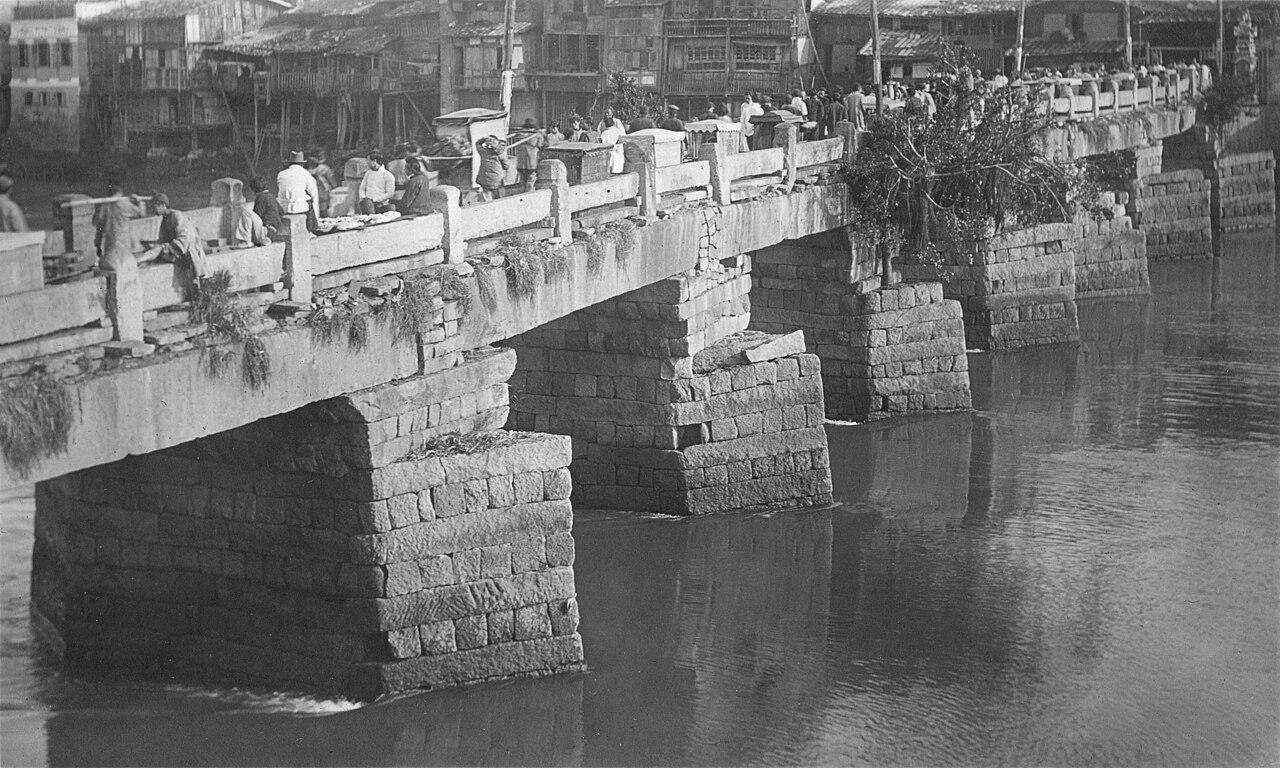
Ralph G. Gold, Bridge over river, Fuzhou, 1911 to 1913. Public domain.
Foochow to Anhui, 1903 to 1972 · Person · Featured Study
Watchman Nee
A Chinese teacher and church planter, he led the Little Flock and died a prisoner in 1972.
- The name means
- Tuosheng, the sound of the night watchman's bamboo gong
- Born
- 4 November 1903 at Swatow
- Died
- 1 June 1972 in Anhui province (probable)
- Family
- mother: not named in the sources read; wife: Charity Chang (Zhang Pinhui); brother: Ni Huaizu, called George
- Places
- Swatow, Foochow, Shanghai, Manchuria, Anhui
A teacher who wrote that Christ lives in the believer spent his last twenty years in prison.
I have been crucified with Christ, and I no longer live, but Christ lives in me. The life I live in the body, I live by faith in the Son of God, who loved me and gave Himself up for me.
Summary
Watchman Nee was born at Swatow in 1903 and grew up in Foochow. He came to faith in 1920 through the evangelist Dora Yu. From Shanghai he built a network of local churches, one to a city, called the Little Flock. He was arrested in 1952 and held for the rest of his life.
- His talks of 1938 on Romans 5 to 8 became The Normal Christian Life.
- Doyle's dictionary entry records grave faults in business and in conduct, and Li Yading's entry calls the group the state condemned a so-called clique.
- The sources differ on the day and the place of his death.
Christ Lives in Me
His best known book takes its subtitle from Galatians 2:20.
The Normal Christian Life carries the words of Galatians 2:20 under its title. In it he calls that verse Paul's own definition of the Christian life, and he makes the knowing of Romans 6:6 its first step.
The question of this life is how a teacher of Christ living in the believer led a movement of hundreds of churches. It is also how the record of his own conduct stands beside that teaching.
We know that our old self was crucified with Him so that the body of sin might be rendered powerless, that we should no longer be slaves to sin.The verse he cites for the knowing that opens that life.
The Life in Order
The dates come from the dictionary's entries and Kinnear's life of 1974.
He was a prisoner for his last twenty years, five years past his sentence.
- 4 November 1903He was born at SwatowDoyle; Li
- April 1920He and his mother came to faith through Dora YuDoyle
- 1921Margaret Barber baptized him and his motherDoyle
- 1923Revival, his first magazine, appearedDoyle
- 1926He moved to Shanghai and began The Spiritual ManDoyle
- 1932He formed the group of co-workers that led the movementDoyle
- 1934He married Charity ChangDoyle
- 1938He gave the talks on Romans 5 to 8 in EuropeDoyle
- 1942He lost his place at the head of the movementDoyle
- 1948He was restored with Witness Lee's helpDoyle
- April 1952He was arrested in ManchuriaDoyle
- 21 June 1956He was sentenced to fifteen yearsLi
- 1967His sentence ended and he was not releasedDoyle; Li
- October 1971Charity died in ShanghaiKinnear
- 1 June 1972He died in Anhui, by Kinnear's dateKinnear; Li
Each step of the life stands with its witness.
1934, 1938, 1942, 1948, April 1952, 21 June 1956, 1967, October 1971 and 1 more
From Foochow to the Labor Farm
A student convert became the leader of a Chinese movement, and then a prisoner of the state.
Ni Tuosheng, known in English as Watchman Nee, was born in Swatow, in southern China, on November 4, 1903, and raised in Foochow. His father was the son of a Christian preacher. His mother had promised God, before he was born, that if she were given a son she would give him back.
He was converted in April 1920, with his mother, under the preaching of Dora Yu, a Chinese evangelist. Margaret Barber, an English missionary living near Foochow, became the strongest influence on his thought. He read the Brethren writers and the holiness teachers of her library, Jessie Penn-Lewis above all.
He began publishing in 1923, with the magazine Revival. The Spiritual Man, written while he was seriously ill with tuberculosis, ran to three volumes. Later books, among them The Normal Christian Life and Sit, Walk, Stand, were taken down from his spoken messages.
From Shanghai he taught that there is one church in each city, free of the Western denominations, and the churches that grew from his work became known as the Little Flock. By the late 1940s there were hundreds of assemblies across China. Nee also trained workers and sent them out to plant.
Then the door closed. After the Communist victory, the state brought the churches under the Christian Manifesto and the Three-Self Patriotic Movement. Doyle writes that Nee supported the movement when it was formed in 1951.
He was arrested in Manchuria in April 1952. In 1956, after a public trial in Shanghai, he was given fifteen years. He never came out. When the sentence expired in 1967 he was kept in custody. He was held at a labor farm in Anhui province.
His wife, Charity Chang, died in 1971 after years of harassment. Nee died on June 1, 1972, by Kinnear's date. A farm official showed his relatives a note found under his pillow. It said, in substance: Christ is the Son of God who died for the redemption of sinners and was resurrected after three days. This is the greatest truth in the universe. I die because of my belief in Christ.
He died after twenty years in custody.
The Charges against Him
Doyle and Kinnear give different accounts of his fall from leadership and of his trial.
In 1942 the co-workers removed him from leadership. G. Wright Doyle gives three reasons: his full-time work in his brother's pharmaceutical company, shady business dealings, and sexual immorality.
Kinnear, his editor and biographer, tells the company's founding as a way to support the work. He names it the China Biological and Chemical Laboratories.
The state arrested him on charges of tax evasion and corrupt business practices, and it convicted him on political grounds. Doyle writes that the evidence shown his followers, a signed confession among it, proved his sexual misconduct.
In Their Own Words
Three short sayings, from two books and a letter from the labor farm.
Watchman Nee (1903 to 1972)
Sit, Walk, Stand, edited by Angus I. Kinnear (Bombay, 1957; CLC edition, 2012), the part on Stand
We fight from victory
“Thus, today we do not fight for victory; we fight from victory. We do not fight in order to win, but because in Christ we have already won.”
Other
About this saying1 paragraph
This stands in Sit, Walk, Stand, his talks on Ephesians, which Angus Kinnear edited in 1957.
Watchman Nee
The Normal Christian Life (Christian Literature Crusade), the chapter on reckoning, the second step, on Romans 6:11
Out from death
“It is not reckoning toward death but from death.”
Other
About this saying1 paragraph
In The Normal Christian Life, from his talks of 1938, he set the reckoning of Romans 6:11 on a death already past.
Watchman Nee
a letter to his sister from the Baimaoling labor farm, as G. Wright Doyle gives it in the Biographical Dictionary of Chinese Christianity, Doyle, "Nee, Watchman"
The mountains are beautiful
“Here the mountains are beautiful and the water clear.”
Other
About this saying1 paragraph
He wrote this to his sister from the labor farm after his sentence expired, as Doyle gives it.
The People Around Him
The women who led him to faith, his wife, his brother and his co-workers.
Two women evangelists shaped his first years of faith.
| Person | Tie to Nee | The witness |
|---|---|---|
| Dora Yu | The Methodist evangelist brought him and his mother to faith. | Doyle |
| Margaret Barber | The English missionary baptized him and lent him her books. | Doyle |
| Leland Wang | A fellow student, he parted from Nee over the Western churches. | Doyle |
| Charity Chang | His wife was arrested and tortured in the Cultural Revolution. | Doyle |
| Ni Huaizu | He founded the firm, as Li records. | Li |
| Ruth Lee | She was one of the first co-workers of 1932. | Doyle |
| Witness Lee | He helped restore Nee in 1948 and led the movement abroad. | Doyle |
| Angus Kinnear | He edited the talks into books and wrote the life of 1974. | Doyle |
Witness Lee, Angus Kinnear
The Places of His Life
He grew up in Fujian, worked from Shanghai and died inland in Anhui.
Shanghai was the center of his work from 1926 until his arrest.
| Place | What the witnesses say | The witness |
|---|---|---|
| Swatow | He was born there, where his father worked for the customs. | Doyle; Li; Kinnear |
| Foochow | He was raised and schooled there. | Doyle |
| Shanghai | He moved there in 1926 and was tried there in 1956. | Doyle |
| Keswick | He attended its convention in 1938. | Doyle |
| Hong Kong | His friends urged him to stay there in 1950, and he went back. | Doyle |
| Manchuria | Doyle places his arrest there. | Doyle |
| Baimaoling | He wrote from there that the mountains were beautiful. | Doyle |
One Church to a City
He taught that each city has one church, led by its own elders.
Nee rejected every denomination and taught the principle of locality. Each assembly was to be self-governing under elders that the workers appointed.
After the war, Doyle writes, his books on the church moved the weight from the local assembly to the authority of the workers, with Nee foremost among them. By 1949 there were over 700 local churches.
How the Key Verse Was Taught
John Wesley, Jamieson, Fausset and Brown, and Charles Spurgeon read the words under his title.
John Wesley (1703 to 1791)
Explanatory Notes upon the New Testament
John Wesley read the verse as Paul's account of how he was freed from sin.
“The Apostle goes on to describe how he is freed from sin; how far he is from continuing therein. I am crucified with Christ - Made conformable to his death; ‘the body of sin is destroyed.’ Rom. vi, 6.”
on Galatians 2:20Evangelical
Charles Spurgeon (1834 to 1892)
The Metropolitan Tabernacle Pulpit, Sermon No. 2370: “"Christ First, Me Last—Nothing Between But Love"” (lightly modernized text, CCEL edition)
Charles Spurgeon read it from the side of grace.
“Paul looks at the matter of salvation from the point of view suggested by Grace. If any man might have said, ‘The Son of God, whom I have loved, and to whom I have given myself,’ it would have been the Apostle. On another occasion, speaking of the Lord, he said, ‘Whose I am, and whom I serve.’ But here he thinks not of himself, or of what he had been led to do for the Lord, but only of what the Lord had done for him!”
on Galatians 2:20Particular Baptist
Jamieson, Fausset & Brown (1802 to 1910)
Commentary Critical and Explanatory on the Whole Bible
Jamieson, Fausset and Brown weighed the Greek of living by faith.
“I live by the faith, &c.--Greek, ‘IN faith (namely), that of (that is, which rests on) the Son of God.’ ‘In faith,’ answers by contrast to ‘in the flesh.’ Faith, not the flesh, is the real element in which I live.”
on Galatians 2:20Reformed
What the Witnesses Leave Open
Readers differ on his death, his trial, his birth year and the movement Witness Lee led.
The day and the place of his deathAngus Kinnear; G. Wright Doyle; Li Yading; Living Stream Ministry
Kinnear gives 1 June 1972 in Anhui. Doyle writes that about a week after a letter of 22 May he was put on a tractor for the prison hospital and died on the way.
Li Yading writes that news came out on 1 June that he had died at the Baimaoling farm. Living Stream Ministry, his movement's own publisher, gives 30 May.
What the trial of 1956 provedAngus Kinnear; G. Wright Doyle; Li Yading
Kinnear reports the state's charges as espionage, counter-revolutionary activity and licentious living. Doyle holds the misconduct proven by photographs, a signed confession and a co-worker's admission. Li calls the condemned group a so-called clique.
The year of his birthLi Yading
Most sources give 4 November 1903. Li notes that his gravestone gives the year 1901.
Witness Lee's local churchesthe open letter of 2007; the Christian Research Institute
An open letter of 2007 asked the local churches to withdraw three of Lee's teachings and to stop suing other Christians. In 2009 the Christian Research Institute reversed its earlier judgment and called them neither cultic nor aberrant.
Books to Read Next
The Normal Christian Life
Watchman Nee · 1957
It sets down those talks in English.
In print: find it wherever books are sold.
Against the Tide: The Story of Watchman Nee
Angus Kinnear · 1974
The life his editor wrote, warm toward him and the source of his death date.
In print: find it wherever books are sold.
What Nee Left
He left a body of teaching on the Christian life, churches both inside and outside the Three-Self movement, and a record that his own followers have had to weigh.
Sources
Scripture is the Berean Standard Bible.
- The Holy Bible, Berean Standard Bible (read 2026)
- G. Wright Doyle, "Nee, Watchman", Biographical Dictionary of Chinese Christianity.
- Li Yading, "Ni Tuosheng", Biographical Dictionary of Chinese Christianity, the Chinese entry.
- Angus Kinnear, Against the Tide: The Story of Watchman Nee (Christian Literature Crusade, 1974)
- Watchman Nee, The Normal Christian Life (Christian Literature Crusade)
- Watchman Nee, Sit, Walk, Stand, edited by Angus I. Kinnear (Bombay, 1957; CLC edition, 2012)
- Elliot Miller, "We Were Wrong", Christian Research Journal 32:6 (2009)
- John Wesley, Explanatory Notes upon the New Testament (1755), on Galatians 2:20.
- Jamieson, Fausset and Brown, Commentary Critical and Explanatory on the Whole Bible (1871), on Galatians 2:20.
- Charles Spurgeon, The Metropolitan Tabernacle Pulpit, Sermon No. 2370.
Keep Studying
People and groups8
Church history1