
AD 1604 to 1611 · Story · Featured Study
The King James Bible of 1611
Scholars in six companies revised the English Bible, and Robert Barker printed their work in 1611.
The translators wrote that they never meant to make a new translation, but to make a good one better.
- When
- 22 July 1604 to 1611
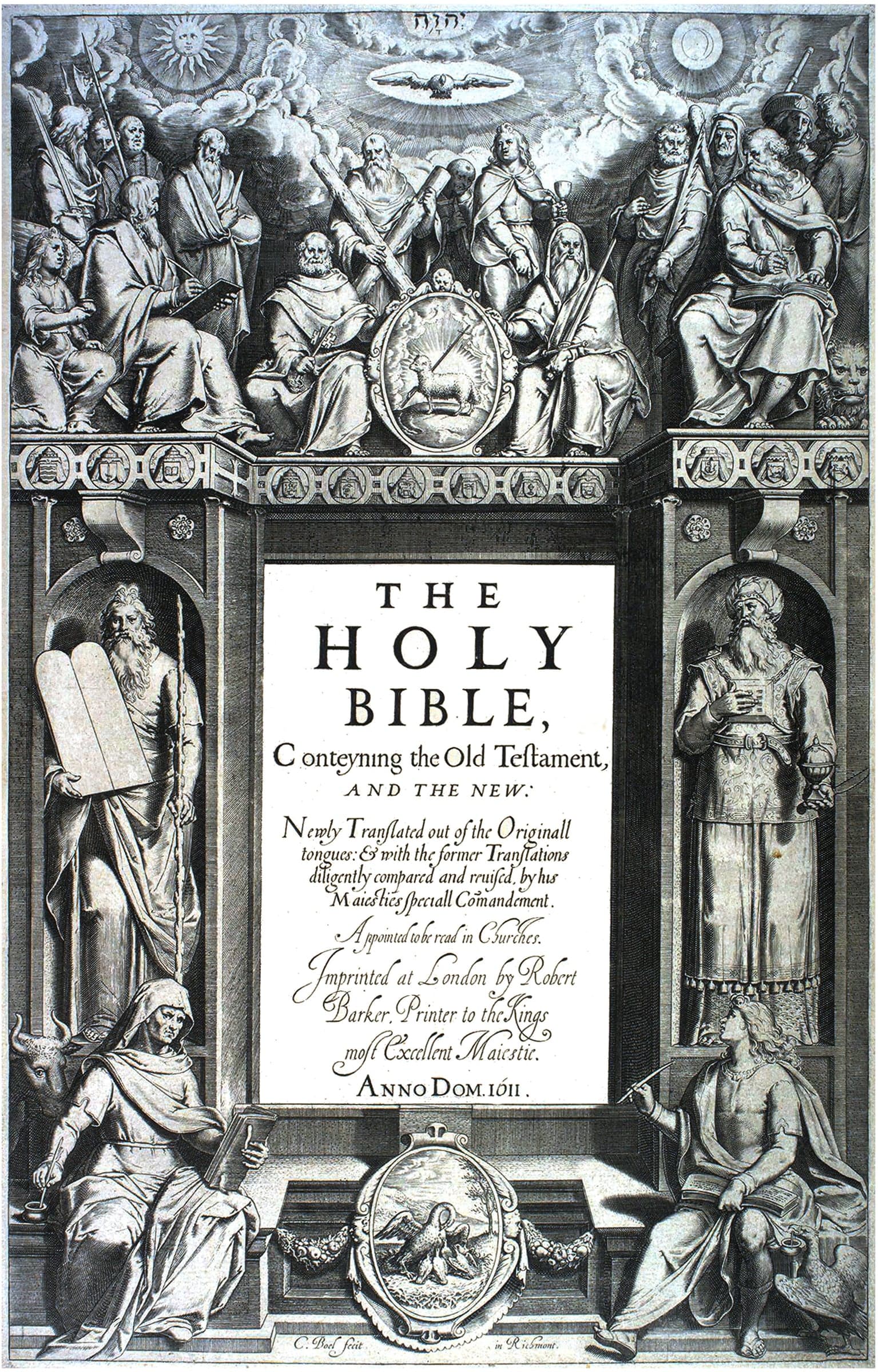
Cornelis Boel, the engraved title page of the Bible of 1611, public domain
As we have heard, so we have seen in the city of the LORD of Hosts, in the city of our God: God will establish her forever. Selah
Summary
The King James Bible is a revision of the Bishops' Bible. The Puritans asked for it at Hampton Court, and it was made under fifteen rules.
- Bancroft asked the bishops, and every dean and chapter, to give toward the work.
- Barlow says the king found some of the Geneva notes “very partiall, vntrue, seditious.”
- The preface's margin also cites Acts 8:28 to 29 and Luke 24:25 among its first texts.
- Pollard guessed that the early editions ran to as many as 5,000 copies each.
The Verses in the Translators' Margin
The translators cited each of these four texts in their preface.
The preface prints its references in the margin, and its first group stands beside the case for the Scriptures in the people's tongue.
You pore over the Scriptures because you presume that by them you possess eternal life. These are the very words that testify about Me,The preface cites it first, for the duty to search the Scriptures.
Now the Bereans were more noble-minded than the Thessalonians, for they received the message with great eagerness and examined the Scriptures every day to see if these teachings were true.The preface cites it next to John 5 as an example for its readers.
From infancy you have known the Holy Scriptures, which are able to make you wise for salvation through faith in Christ Jesus.The preface cites it among its first texts.
“Sir,” the woman replied, “You have nothing to draw with and the well is deep. Where then will You get this living water?The preface uses the deep well of this verse as its picture of a Bible left untranslated.
2 Timothy 3:15, John 4:11
The Six Companies and Their Books
Burnet's list, as Pollard prints it, gives each company its seat and its books.
Two companies sat at each of three places, and one of the six took the Apocrypha.
| Company | Where it sat | The books it revised |
|---|---|---|
| First | Westminster | The five books of Moses, and Joshua to 2 Kings |
| Second | Cambridge | 1 Chronicles and the rest of the history, with Job, Psalms, Proverbs, the Song and Ecclesiastes |
| Third | Oxford | The greater and the twelve lesser Prophets, with Lamentations |
| Fourth | Cambridge | The Apocrypha, Manasseh's prayer included |
| Fifth | Oxford | The four Gospels, Acts and the Revelation |
| Sixth | Westminster | The Epistles of Paul and the other epistles |
The Story From Hampton Court to Blayney's Oxford Text
Seven years passed between the request at Hampton Court and Barker's printing.
At Hampton Court in January 1604 the Puritans' spokesman, John Reynolds, asked the king for a new translation of the Bible.
William Barlow's report of the conference says the king thought the Geneva Bible “the worst of all” and ruled that no marginal notes be added. Pollard warns that Barlow's report is “highly prejudiced.”
To the law and to the testimony! If they do not speak according to this word, they have no light of dawn.The preface cites it in its margin beside John 5:39, for the law and the testimony as the test.
On 22 July the king wrote that he had appointed learned men “to the number of four and fifty.” Bancroft sent the letter on from Fulham nine days later.
Fifteen rules governed the work. The first kept the Bishops' Bible, “as little altered as the Truth of the original will permit.” The sixth allowed a note in the margin only to explain a Hebrew or Greek word.
The fourteenth named Tyndale's, Matthew's, Coverdale's, Whitchurch's and the Geneva, to be used where they agreed better with the text.
Jesus answered, “You are mistaken because you do not know the Scriptures or the power of God.The preface cites the rebuke of those who did not know the Scriptures.
Lancelot Andrewes was one of the translators, and Reynolds died in 1607 before the work was done.
John Bois of Cambridge was given a part of the Apocrypha. His life says the revisers met at Stationers' Hall and “in three quarters of a year, finished their task.”
Bilson and Miles Smith gave the translation its final touches, as the report to the Synod of Dort says.
Therefore, the LORD, the God of Israel, declares: ‘I did indeed say that your house and the house of your father would walk before Me forever. But now the LORD declares: Far be it from Me! For I will honor those who honor Me, but those who despise Me will be disdained.The preface cites it near its opening, on God honouring those who honour him.
Robert Barker published the book. Its engraved title calls it “Newly Translated out of the Originall tongues” and “Appointed to be read in Churches.”
The book was never entered on the Stationers' Registers, and the month it appeared is not known.
And the entire vision will be to you like the words sealed in a scroll. If it is handed to someone to read, he will say, “I cannot, because it is sealed.”The preface likens Scripture in an unknown tongue to this sealed scroll.
Miles Smith wrote the preface for his fellows, as Pollard and Westcott both say.
The preface says the translators did not tie themselves “to an identitie of words,” and asks, “is the kingdome of God become words or syllables?”
If, then, I do not know the meaning of someone’s language, I am a foreigner to the speaker, and he is a foreigner to me.The preface cites the chapter on a language the hearer does not know.
Hugh Broughton was sent the new Bible to judge, and in A Censure of the late translation for our Churches he wrote that he “had rather be rent in pieces with wilde horses, then any such translation by my consent should bee vrged vpon poore Churches.”
Geneva Bibles went on being printed in England until 1616, and abroad after that.
Benjamin Blayney's revision came out at Oxford in 1769. Scrivener says the King's Printer and the two universities went on reproducing what was in substance Blayney's work. They did so until a complaint drew public attention to it in 1831.
“For My people have committed two evils: They have forsaken Me, the fountain of living water, and they have dug their own cisterns—broken cisterns that cannot hold water.The preface cites it in its last charge to the reader, which warns against preferring broken pits to the fountains others have dug.
1 Samuel 2:30, Isaiah 29:11, 1 Corinthians 14:11, Jeremiah 2:13
The People of the Story
The record gives an office or a standing for seven people of the story.
Six of the seven worked on the translation or the book, and one attacked it.
| Person | Office or standing | The record |
|---|---|---|
| John Reynolds | President of Corpus Christi College, Oxford, from 1598 | Pollard's notes on Burnet's list |
| Lancelot Andrewes | Dean of Westminster, made Bishop of Chichester in 1605 | Pollard's notes on Burnet's list |
| Bilson | Bishop of Winchester; he belonged to no company | Pollard's introduction |
| Miles Smith | Made Bishop of Gloucester in 1612 | Pollard's notes on Burnet's list; Westcott |
| Robert Barker | “Printer to the Kings most Excellent Maiestie,” as the title calls him | The title page, in Pollard |
| Cornelis Boel | An Antwerp artist | Pollard's introduction |
| Hugh Broughton | A Hebrew scholar kept out of the work | Westcott's note |
Who Tells the Story
Most of the witnesses stand in A. W. Pollard's Records of the English Bible, printed at Oxford in 1911.
The translators speak for themselves in their preface, and the king's letter and the fifteen rules survive as documents.
Later writers supply the rest. Burnet's list of the companies was printed in 1715, and Walker's life of Bois was printed by Peck in 1779.
What the Record Leaves Unsaid
Pollard, who gathered the documents of the translation, sets out the gaps in them.
Pollard found no authority for the words “Appointed to be read in Churches,” nor for the name Authorized Version. He found no order that every parish buy a copy.
How the Key Verse Was Taught
Three writers of three centuries on Psalm 48:8.
Ambrose of Milan (died 397)
Commentaries on the Twelve Davidic Psalms, On Psalm 48
The first reading lifts the city of the psalm from Jerusalem to heaven.
“Outside the city, we have heard. Inside the city, we have seen. God is the eternal light of this city. The light of day shines there without the sun we know in this world, and of the moon there is no need. The foundation of this city belongs not to time but to eternity.”
on Psalm 48:8Patristic
Matthew Henry (1662 to 1714)
Commentary on the Whole Bible
The second takes the promise of the verse's last line as made to the Christian church.
“Let our hope of the stability and perpetuity of the church be hereby encouraged. ‘From what we have seen, compared with what we have heard, in the city of our God, we may conclude that God will establish it for ever.’ This was not fulfilled in Jerusalem (that city was long since destroyed, and all its glory laid in the dust), but has its accomplishment in the gospel church.”
on Psalm 48:8Puritan
Charles Spurgeon (1834 to 1892)
The Metropolitan Tabernacle Pulpit, Sermon No. 2014: “"As We Have Heard, So Have We Seen"” (lightly modernized text, CCEL edition)
The third preached the verse as a believer's discovery that the church holds more than any account of it.
“But when you come into the ‘City of the Lord of Hosts, in the city of our God,’ the reports about it are true and the truth exceeds the report. For, like the Queen of Sheba, we cry, ‘The half was not told me.’ When we speak of the privileges of the Church of God on earth it is impossible to exaggerate. ‘Behold, what manner of love the Father has bestowed upon us, that we should be called the sons of God.’ Behold, what blessings, what riches, what royalties the Lord Jesus bestows upon His chosen!”
on Psalm 48:8Particular Baptist
In Their Own Words
The three sayings come from the translators' preface, in its own spelling.
Miles Smith
The Translators to the Reader (1611), the preface to the Bible of that year, reprinted in A. W. Pollard, Records of the English Bible (Oxford, 1911), page 349
The window and the light
“Translation it is that openeth the window, to let in the light”
Church of England
About this saying1 paragraph
Early in the seventeenth century the translators gave their reason for putting the Scriptures into the common tongue.
Miles Smith
The Translators to the Reader (1611), the preface to the Bible of that year, reprinted in A. W. Pollard, Records of the English Bible (Oxford, 1911), page 362
The meanest translation
“wee affirme and auow, that the very meanest translation of the Bible in English, set foorth by men of our profession (for wee haue seene none of theirs of the whole Bible as yet) containeth the word of God, nay, is the word of God.”
Church of England
About this saying1 paragraph
The seventeenth-century translators answer what their margin calls the imputations of their adversaries.
Miles Smith
The Translators to the Reader (1611), the preface to the Bible of that year, reprinted in A. W. Pollard, Records of the English Bible (Oxford, 1911), page 376
Understood by everyone
“But we desire that the Scripture may speake like it selfe, as in the language of Canaan, that it may bee vnderstood euen of the very vulgar.”
Church of England
About this saying1 paragraph
The translators of the seventeenth century set their plain words against the hard terms they found in the late translation of those they call the Papists.
Where Historians Disagree
Three questions about the translation, with the writers who answer them.
Who began it, the Puritans or the king?2 paragraphs
Barlow's report gives the first motion to Reynolds, and the preface says the work began “vpon the importunate petitions of the Puritanes.”
The preface also says that the king, set thinking by their plea, “presently after gaue order for this Translation,” and his letter and rules governed the work.
Was it ever authorized?3 paragraphs
Pollard held that “Appointed” on the title means little more than “assigned,” and that it is “far from safe to postulate” an order of 1611.
Lord Selborne answered in 1881 that an Order in Council may have been made and then destroyed in the fire at Whitehall on 12 January 1618.
Westcott wrote in 1868 that the version won “a vital authority which could never have been secured by any edict of sovereign rulers.”
How much of it is Tyndale's?1 paragraph
Westcott wrote that nine tenths of the First Epistle of John and five sixths of Ephesians in the version of 1611 are kept from Tyndale.
Books to Read Next
Three free books that print or weigh the record.
Records of the English Bible
A. W. Pollard · 1911
It prints the king's letter, the rules, the list of the companies and the whole preface.
Read it free onlineThe Authorized Edition of the English Bible (1611)
F. H. A. Scrivener · 1884
It traces the text from the first printing to Blayney's Oxford edition.
Read it free onlineA General View of the History of the English Bible
B. F. Westcott · 1868
It sets the King James version beside the English Bibles before it.
Read it free onlineWhat the Translators Left
The companies left the churches a translation without a sealed standard copy, and its printers and revisers carried its text forward from edition to edition.
Sources
Scripture is the Berean Standard Bible.
- The Holy Bible, Berean Standard Bible (read 2026)
- A. W. Pollard, Records of the English Bible: The Documents Relating to the Translation and Publication of the Bible in English, 1525 to 1611 (Oxford: Oxford University Press, 1911), the introduction, pages 45 to 76, with Barlow's Summe and Substance of the Conference (1604), the king's letter of 22 July 1604, the rules, Burnet's list and the report to the Synod of Dort, and the preface of 1611 at pages 340 to 377.
- B. F. Westcott, A General View of the History of the English Bible (London: Macmillan, 1868), pages 154, 160 and 211.
- F. H. A. Scrivener, The Authorized Edition of the English Bible (1611), Its Subsequent Reprints and Modern Representatives (Cambridge: Cambridge University Press, 1884), pages 28 to 35.
- Hugh Broughton, A Censure of the late translation for our Churches (undated), the first page of the text.
- Ambrose of Milan, Commentaries on the Twelve Davidic Psalms, On Psalm 48 (fourth century; Ambrose died in 397)
- Matthew Henry, Commentary on the Whole Bible (1710), on Psalm 48:8.
- Charles Spurgeon, sermon number 2014, As We Have Heard, So Have We Seen (1888), in The Metropolitan Tabernacle Pulpit, the CCEL edition.
Keep Studying
Studies4
People and groups9
Symbols1
Church history2
Doctrines1
Subjects1