
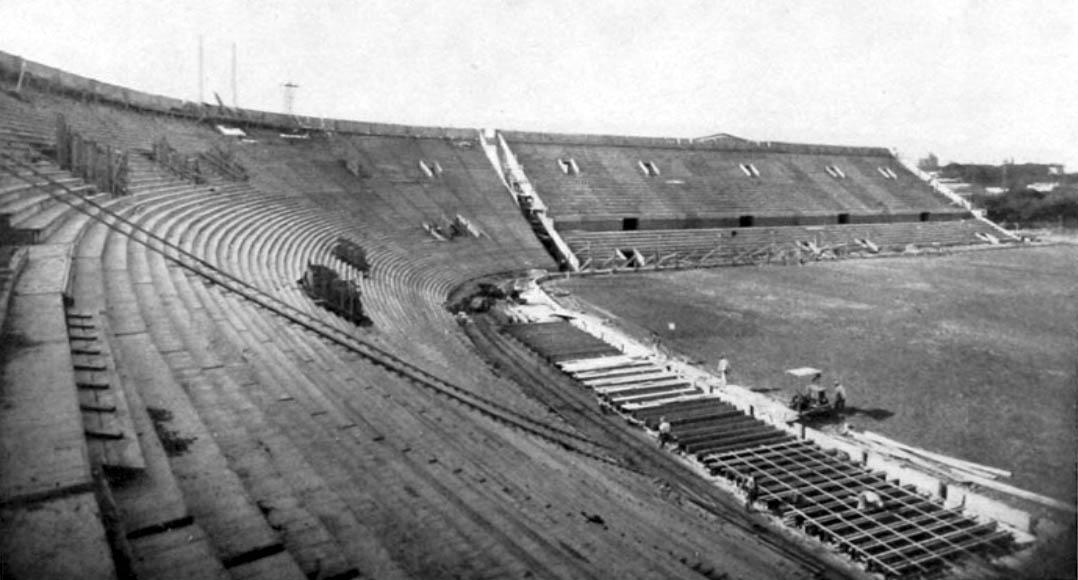
Unknown photographer, the Huracán stadium under construction, 1945. Public domain.
The stadiums of Buenos Aires · Story · Featured Study
Argentina, 1954
The organizers, the press and later scholars each give a different account of these weeks.
- Where
- Buenos Aires, Atlanta stadium, Huracán stadium
- Who
- Tommy Hicks, Juan Domingo Perón, Louie W. Stokes, R. Edward Miller
- When
- April to June
For weeks a football stadium in Catholic Buenos Aires filled for an American healing preacher, and no one can say how many came.
Jesus Christ is the same yesterday and today and forever.
Summary
Tommy Hicks, an American evangelist, preached in Buenos Aires from 14 April to June 1954, first at the Atlanta stadium and then at Huracán. President Perón gave him a permit when Protestants were usually refused one.
- Stokes put the top night at 150,000, and the editor of The Voice of Healing at over 400,000.
- The story that Hicks healed Perón first appears, among the earliest found, in a book of 1964.
- Hicks's return the next year was shut down.
- Scholars differ on whether the meetings grew the churches.
The Texts of the Campaign
The campaign's poster, headed “¡La Biblia en Acción!”, closed with the verse at the head of the page in Spanish, and Hicks named these two verses as grounds for praying for the sick.
Heal the sick, raise the dead, cleanse the lepers, drive out demons. Freely you have received; freely give.
Hicks quoted this command of Jesus to the disciples as a ground for healing.
Matthew 10:8BSB
And the prayer offered in faith will restore the one who is sick. The Lord will raise him up. If he has sinned, he will be forgiven.
Hicks named this promise as another ground.
James 5:15BSB
The Tellings of the Audience with Perón
Hicks's first tellings carry a permit, a prayer and a photograph, and the story of a healing comes later.
The tellings change over the years, and the story of a healing appears ten years on.
| When | The witness | What it says |
|---|---|---|
| July 1954 | Hicks, The Voice of Healing | Permission for mass meetings, radio and press, and a photograph taken together |
| August 1954 | The Voice of Healing's headnote to its interview with Hicks | He prayed with Perón, and a guard healed may have opened the way |
| November 1954 | Hicks to G. H. Montgomery | An official he calls Mr. X and does not name embraced him sobbing and set two conditions |
| 1956 | Hicks, Millions Found Christ, as Seth Zielicke reads it | No mention of any healing |
| 1964 | R. Edward Miller, Thy God Reigneth | A provincial governor told in his hearing that Perón's skin disease was healed at once |
| 1989 | José Norberto Saracco, as Zielicke reports him | Hicks in an interview denied praying for Perón |
| 2006 | Hilario Wynarczyk | A Peronist official who mediated the interview may have sought healing through Hicks |
| 2012 | Zielicke, citing Rocky Grams, In Awe In Argentina (2006) | Hicks prayed for Perón, who claimed to be healed |
2006, 2012
Hicks's book of 1956 and Saracco are known here through Zielicke, and the denial Saracco reports conflicts with Hicks's own words at the time. Miller's is the earliest telling of the story found in print, and an earlier one may exist.
From the Permit to Huracán
The campaign ran eight weeks by Stokes's count, and most of what is known of it comes from the organizers.
The censuses of 1947 and 1960 put evangelicals at two or three percent of the country, and Daniel Míguez writes that they were usually refused permits for public acts. Rocky Grams's In Awe In Argentina gives a census of 174 adherents in the Assemblies of God in the early 1950s.
Pentecostals had been there since before the First World War. Louie Stokes dates Louis Francescon's arrival in Buenos Aires to 9 October 1909, on the Italian line out of Chicago.
In 1953 Perón courted the Evangelical Confederation, and its leaders refused him. At the end of that year, Stokes writes, a commission formed for a stadium campaign under T. L. Osborn, who could not come, and Hicks visited and it was agreed for April.
Hicks came on the invitation of the Union of the Assemblies of God, Míguez writes, and reached Argentina on 9 March. He met Perón a week later, on 16 March by Zielicke or 17 March by Hilario Wynarczyk, who gives the interview forty-five minutes.
The campaign opened at the Atlanta stadium on 14 April, and Stokes gave about 8,000 for the first crowd, Hicks about 6,000, Wynarczyk about 1,000, and an assistant of Hicks, interviewed by Zielicke, 500. Stokes reported almost 100,000 on 13 May and over 100,000 on the next night, “according to estimates.” The meetings moved to Huracán on Saturday 22 May and closed on 12 or 13 June.
Stokes counts fifty-two days without rain days and holidays, and Wynarczyk counts fifty-eight, in an event planned for fifteen. Paul Sorensen interpreted, Zielicke writes, and Stokes reported some thirty-five co-operating churches at the time.
The Los Angeles Times asked why no doctors confirmed the healings, and no medical check is known. Argentine medical associations called the meetings curandería, folk healing. The Catholic daily El Pueblo attacked the campaign.
Other Pentecostals held the stadiums to be sinful ground, Baptists disliked the style, and leading pastors objected that healing put the forgiveness of sins second. Stokes himself admits the campaign was not supported by all the churches.
Who Gave Which Number
The witnesses give estimates, and no count of the crowd is known.
The whole campaign runs from two million to six million by these witnesses.
| What is counted | The figure | Who gave it, and how |
|---|---|---|
| The top night | 150,000 | Stokes, at the time |
| The top night | At least 180,000 | The club president's estimate, as Miller reports it |
| The top night | 200,000 | The Los Angeles Times and the Buenos Aires Herald, through later writers |
| The top night | Over 400,000 | The Voice of Healing's editor, from reports and photographs |
| The whole campaign | Over two million | Stokes |
| The whole campaign | Three to four million in thirty days | Hicks to Gordon Lindsay |
| The whole campaign | Six million | The Federal Police, by Saracco's report, with no paper shown |
| Decision cards | 300,000 | The organizers: a count of cards printed and handed out |
The whole campaign, Decision cards
What It Left
The campaign's own people say the churches filled, and the scholars read the numbers more slowly.
Perón turned on part of the Catholic clergy on 10 November 1954, and a law of 20 May 1955 opened the way to reform the constitution's article on religion. Perón fell that September, and the new government dissolved the evangelical union he had sponsored.
Hicks returned early in 1955. The Foursquare minutes of 3 February say he was being held in a hotel, and Zielicke writes that he was released on 4 February and forbidden further meetings. Stokes has him opening a temple in Buenos Aires with a campaign from 6 to 13 March. Míguez calls the return a resounding failure. Hicks died on 6 January 1973.
Stokes counts fifty-three congregations in the Union in 1957 and one hundred and fifty about 1964. Wynarczyk writes that Hicks and the healings did not contribute directly to the growth of the churches, since the churches lacked the structure and the crowds came for miracles.
A table by Wynarczyk and his colleagues counts six Pentecostal temples in the capital in 1950, sixteen in 1970, thirty-six in 1980 and one hundred and twenty in 1992. The count grows slowly at first and fastest after 1980.
Míguez calls the campaign a passing success whose legacy lay in how Pentecostal leaders came to see themselves. He traces from it the local mass ministries of the 1970s and early 1980s. Wynarczyk and his colleagues trace the “fourth Protestantism” of the 1980s to the same movement.
How the Key Verse Was Taught
Three teachers on the Christ who does not change.
John Chrysostom (died 407)
Homily on Hebrews 33, on Hebrews 13:8
John Chrysostom applied the verse to the wonders of Christ, which he told his hearers not to place in the past.
“Do not think that then indeed He wrought wonders, but now works no wonders. He is the same.”
Patristic
Adam Clarke (1762 to 1832)
Commentary on the Bible, on Hebrews 13:8
Adam Clarke read it of the one way to God in every age.
“In all past times there was no way to the holiest but through the blood of Jesus, either actually shed, or significantly typified.”
Methodist
Charles Spurgeon (1834 to 1892)
The New Park Street Pulpit, Sermon No. 170: “The Immutability of Christ” (lightly modernized text, CCEL edition), on Hebrews 13:8
Charles Spurgeon read it as the one fixed thing in a changing life.
“that there is one person who is the same.”
Particular Baptist
In Their Own Words
These words come from the evangelist, the organizer and the missionary, in the magazines and the book of their own movement.
Tommy Hicks (died 1973)
The Voice of Healing (1954), August, the interview with Gordon Lindsay
The kindest of men
“Very frankly, I can say that he was one of the finest, and kindest of men that I have ever met in all my life.”
Healing evangelist
About this saying1 paragraph
A preacher in the same magazine, in October 1954, likened Perón to Hitler.
Tommy Hicks
"I Saw Three Million People Bow Before God", as told to G. H. Montgomery, Oral Roberts magazine (1954), November, the account of Mr. X
Two conditions
“Only two stipulations: He is not to discuss politics or to speak against any religious group”
Healing evangelist
About this saying1 paragraph
These are the official's words as Hicks reported them in November 1954, of a man he calls Mr. X.
Louie W. Stokes
The Voice of Healing (1954), July, his report from Huracán
The count of the saved
“Only the recording angels and God know how many were saved”
Assemblies of God missionary in Argentina
About this saying1 paragraph
Stokes wrote this of a night at the Atlanta stadium in May 1954.
R. Edward Miller
Thy God Reigneth (1964), the chapter on the president
A governor's story
“Before the eyes of all present, the skin of President Peron became as clean as a baby's; he was instantly made whole.”
Missionary
About this saying1 paragraph
Miller printed this in 1964 on the word of a provincial governor he does not name.
Why Perón Allowed It, and Why the Crowds Came
The witnesses give God's favour, and the scholars give politics and need.
Hicks gave God's favour and a guard who was healed. Miller printed a story that Perón was healed. Míguez holds that Perón allowed it as a further challenge to Catholic power in his conflict with the Church. Wynarczyk studies Perón's own agency among the churches, with the union he sponsored that year as his evidence.
Zielicke also calls the permit likely a political move, and he finds Hicks's timing closer to chance than plan. The open war with the Church came seven months after the campaign opened. La Nación reports that the Church was angered by the permits for football grounds.
José Norberto Saracco held in 1992 that the masses needed a Hicks because Perón's charisma was in crisis that April. Wynarczyk answers that this explains only a part. Míguez points to freedom after restriction and to the people's old resort to healers. Hicks and Stokes said God did it.
Hicks's own account of how he came shifts. He told Lindsay that God spoke to him in prayer and sent him to South America, and Stokes has a commission already at work. He puts Chile before the permit in August and after it in November.
Books to Read Next
Historia del Movimiento Pentecostal en la Argentina
Louie W. Stokes · about 1968
Stokes wrote as an Assemblies of God missionary in the work, and he names the churches and the numbers.
Read Stokes free at Oral Roberts UniversityThy God Reigneth
R. Edward Miller · 1964
Miller tells the revival at City Bell in 1951 and prints the governor's story.
Read Miller free at Oral Roberts UniversityEl río fluye en tierra seca
Hilario Wynarczyk · 2006
Wynarczyk's study reads the campaign against the state and the churches of its time.
Read Wynarczyk free in the Wayback copyThe Poster's Promise
The poster promised a Christ who does not change, and writers were still disagreeing in 2012 over what happened under it.
Sources
Scripture is the Berean Standard Bible.
- The Holy Bible, Berean Standard Bible (read 2026)
- The Voice of Healing, July, August and October 1954.
- Tommy Hicks as told to G. H. Montgomery, "I Saw Three Million People Bow Before God", Oral Roberts magazine, November 1954.
- Louie W. Stokes, Historia del Movimiento Pentecostal en la Argentina (about 1968; Oral Roberts University dates it 1967)
- R. Edward Miller, Thy God Reigneth (1964)
- Hilario Wynarczyk, "El río fluye en tierra seca" (2006)
- Seth N. Zielicke, "The Role of American Evangelist Tommy Hicks in the Development of Argentine Pentecostalism", in Michael Wilkinson, ed., Global Pentecostal Movements (Brill, 2012), pages 135 to 154.
- Daniel Míguez, "El protestantismo popular en la Argentina", Anuario IEHS.
- Hilario Wynarczyk, Pablo Semán and Mercedes de Majo, Panorama actual del campo evangélico en Argentina (1995)
- La Nación, "El conflicto entre Perón y la Iglesia", updated 24 July 2020.
- Rocky Grams, In Awe In Argentina (2006), through Zielicke; not opened.
- Tommy Hicks, Millions Found Christ (1956), through Zielicke; not opened.
- José Norberto Saracco, Argentine Pentecostalism: Its History and Theology (1989), through Zielicke and Wynarczyk; not opened.
- Healing and Revival Press, a biography of Tommy Hicks.