
1 Chronicles to 2 Chronicles · Subject · Featured Study
What the Chronicler Leaves Out, and Why
How 1 and 2 Chronicles retell Samuel and Kings for the exiles who came home, with the stories they drop, the stories they add, and four readings of the choice.
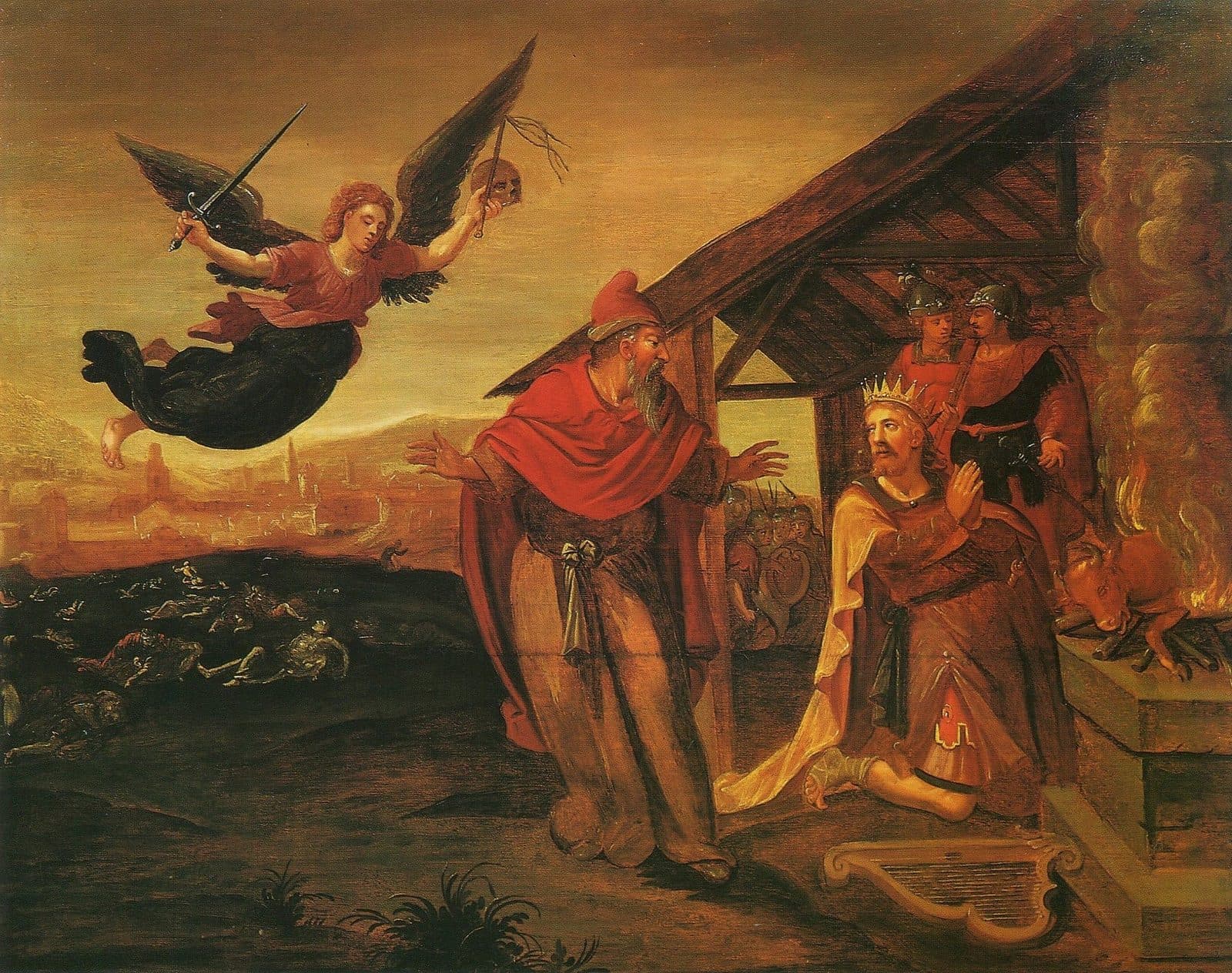
Circle of Lambert Jacobsz, David and Araunah Making Offerings at the Altar, 17th century. Public domain, via Wikimedia Commons.
THE ARTWORKThe painter set the angel of the plague in the sky at the left, a sword in one hand, above a field strewn with the dead outside the city. At the right David kneels in a crown and a gold cloak before an altar where a bull burns. The old man in red who turns toward him is the owner of the threshing floor, whom Chronicles calls Ornan.
Chronicles opens with Adam's name and closes with a call to go up to Jerusalem.
Summary
Chronicles begins its history of the kings at Saul's death.
- It drops David's sin with Bathsheba, Absalom's revolt, and Solomon's turn to other gods.
- After the kingdom splits it follows Judah alone.
- It records faults of David, Asa, Uzziah and Hezekiah, and the faults of Asa and Uzziah appear in Chronicles alone.
- It adds Manasseh's prayer in captivity and the LORD's answer, which Kings never mentions.
The Retelling Beside Samuel and Kings
Four places where Chronicles changes the older account.
In the spring, at the time when kings march out to war, David sent out Joab and his servants with the whole army of Israel. They destroyed the Ammonites and besieged Rabbah, but David remained in Jerusalem.Samuel has David stay in Jerusalem, and the story of Bathsheba begins in the next verse.
In the spring, at the time when kings march out to war, Joab led out the army and ravaged the land of the Ammonites. He came to Rabbah and besieged it, but David remained in Jerusalem. And Joab attacked Rabbah and demolished it. Then David took the crown from the head of their king. It was found to weigh a talent of gold and was set with precious stones, and it was placed on David’s head. And David took a great amount of plunder from the city.Chronicles keeps the same opening and moves straight to the crown of Rabbah.
I will be his Father, and he will be My son. When he does wrong, I will discipline him with the rod of men and with the blows of the sons of men.In Samuel the promise carries a warning for the son.
I will be his Father, and he will be My son. And I will never remove My loving devotion from him as I removed it from your predecessor.Chronicles gives the promise to the son without the rod.
Again the anger of the LORD burned against Israel, and He stirred up David against them, saying, “Go and take a census of Israel and Judah.”Samuel names the LORD's anger as the cause, where Chronicles will name another.
Then Satan rose up against Israel and incited David to take a census of Israel.Here Chronicles gives the other cause, an adversary who rose up against Israel.
Nevertheless, the LORD did not turn away from the fury of His burning anger, which was kindled against Judah because of all that Manasseh had done to provoke Him to anger.Even after Josiah's reform, Kings names Manasseh's deeds as the cause of the LORD's anger against Judah.
And in his distress, Manasseh sought the favor of the LORD his God and earnestly humbled himself before the God of his fathers. And when he prayed to Him, the LORD received his plea and heard his petition; so He brought him back to Jerusalem and to his kingdom. Then Manasseh knew that the LORD is God.The LORD answers the prayer of the worst king of Judah, so Chronicles holds repentance open to any king.
What Chronicles Leaves Out and What It Adds
David, Solomon, the divided kingdom and Manasseh.
| Reign or period | In Samuel or Kings only | In Chronicles only |
|---|---|---|
| David | The war with Saul's house, Bathsheba and Uriah, Amnon and Tamar, Absalom's revolt, Sheba's revolt | The men who came to him at Ziklag, the Levites and singers, the plans for the temple |
| Solomon | Adonijah's bid for the throne, the wives who turned his heart to other gods | Fire from heaven on the sacrifices when the temple is dedicated |
| The divided kingdom | The stories of the northern kings, and of Elijah and Elisha | Priests and Levites leave the north for Judah, and Abijah calls to Jeroboam from Mount Zemaraim |
| Manasseh | The prophets' word that the LORD would wipe out Jerusalem as one wipes a bowl | The outer wall of the City of David rebuilt, and the foreign gods removed from the temple |
- Reign or period
- David
- In Samuel or Kings only
- The war with Saul's house, Bathsheba and Uriah, Amnon and Tamar, Absalom's revolt, Sheba's revolt
- In Chronicles only
- The men who came to him at Ziklag, the Levites and singers, the plans for the temple
- Reign or period
- Solomon
- In Samuel or Kings only
- Adonijah's bid for the throne, the wives who turned his heart to other gods
- In Chronicles only
- Fire from heaven on the sacrifices when the temple is dedicated
- Reign or period
- The divided kingdom
- In Samuel or Kings only
- The stories of the northern kings, and of Elijah and Elisha
- In Chronicles only
- Priests and Levites leave the north for Judah, and Abijah calls to Jeroboam from Mount Zemaraim
- Reign or period
- Manasseh
- In Samuel or Kings only
- The prophets' word that the LORD would wipe out Jerusalem as one wipes a bowl
- In Chronicles only
- The outer wall of the City of David rebuilt, and the foreign gods removed from the temple
What Chronicles Records Against David and the Kings
Three accounts about David, and faults of three later kings.
Chronicles keeps the census and the plague that followed it.
The story ends at Ornan's threshing floor, the place David chose for the house of the LORD.
Chronicles also records why David could not build the temple.
The census, the bar on building, and Michal's contempt1 Chronicles 21, 22 and 15, with 2 Samuel 6
And David said to God, “Was it not I who gave the order to count the people? I am the one who has sinned and acted wickedly. But these sheep, what have they done? O LORD my God, please let Your hand fall upon me and my father’s house, but do not let this plague remain upon Your people.”David's own words make the census his sin and not the people's.
but this word of the LORD came to me: ‘You have shed much blood and waged great wars. You are not to build a house for My Name because you have shed so much blood on the ground before Me.David reports to Solomon that the LORD named the blood he had shed as the reason.
As the ark of the LORD was entering the City of David, Saul’s daughter Michal looked down from a window and saw King David leaping and dancing before the LORD, and she despised him in her heart.Samuel tells Michal's look from the window and then her rebuke, which Chronicles leaves out.
As the ark of the covenant of the LORD was entering the City of David, Saul’s daughter Michal looked down from a window and saw King David dancing and celebrating, and she despised him in her heart.Chronicles keeps the look from the window in nearly the same words.
Jerome on David's bloodAgainst Jovinianus 1.24
Jerome read the blood of 1 Chronicles 22:8 as the murder of Uriah.
“David slew Uriah the Hittite and committed adultery with Bathsheba. And because he was a man of blood — the reference is not, as some think, to his wars, but to the murder — he was not permitted to build a temple of the Lord.”
Jerome · Against Jovinianus, Book 1, section 24 · on 1 Chronicles 22:8Patristic
Why the census story stays1 Chronicles 21:26
Albert Barnes sets the two accounts of the census side by side.
“He answered him from heaven by fire - This fact is not mentioned by the author of Samuel, since his object is to give an account of the sin of David, its punishment, and the circumstances by which that punishment was brought to a close, not to connect those circumstances with anything further in the history. With the writer of Chronicles the case is different. He would probably have omitted the whole narrative, as he did the sin of David in the matter of Uriah, but for its connection with the fixing of the temple site 1 Chr. 22. It was no doubt mainly the fact that God answered him by fire from heaven on this altar, which determined David, and Solomon after him, to build the temple on the spot so consecrated.”
Albert Barnes · Notes, Explanatory and Practical, on the Old and New Testaments (1832-1869) · on 1 Chronicles 21:26Evangelical
Asa, Uzziah and Hezekiah2 Chronicles 16, 26 and 32, with 1 Kings 15
In the thirty-ninth year of his reign, Asa became diseased in his feet, and his malady became increasingly severe. Yet even in his illness he did not seek the LORD, but only the physicians.Chronicles adds a fault to a king it praised for his reform.
Now the rest of the acts of Asa, along with all his might, all his accomplishments, and the cities he built, are they not written in the Book of the Chronicles of the Kings of Judah? In his old age, however, he became diseased in his feet.The account in Kings ends with the disease alone.
But when Uzziah grew powerful, his arrogance led to his own destruction. He was unfaithful to the LORD his God, for he entered the temple of the LORD to burn incense on the altar of incense.Kings says only that the LORD afflicted this king with leprosy, and Chronicles gives the reason.
But because his heart was proud, Hezekiah did not repay the favor shown to him. Therefore wrath came upon him and upon Judah and Jerusalem.Chronicles holds even Hezekiah, its great reformer, to account for his pride.
Written for Those Who Came Home
When the book was written, and for whom.
C. F. Keil reads the line of David in 1 Chronicles 3 as reaching the grandchildren of Zerubbabel, who led the return. He concluded that the book could not have been written before the time of Ezra, and the exact year is unknown.
The Talmud names Ezra as the one who wrote the genealogy of Chronicles down to his own day, and the book itself names no writer.
The Greek translators called the book Paraleipomena, the things passed over. Jerome called it the book of things omitted, and said it throws light on narratives passed over in the books of Kings.
For David's reign Chronicles sends its readers to the records of Samuel the seer, Nathan the prophet and Gad the seer.
In the order of the Writings that the Talmud gives, Ezra and Chronicles stand last.
Where Chronicles stops and Ezra goes on2 Chronicles 36:22 to 23 and Ezra 1:1 to 3
In the first year of Cyrus king of Persia, to fulfill the word of the LORD spoken through Jeremiah, the LORD stirred the spirit of Cyrus king of Persia to send a proclamation throughout his kingdom and to put it in writing as follows: “This is what Cyrus king of Persia says: ‘The LORD, the God of heaven, who has given me all the kingdoms of the earth, has appointed me to build a house for Him at Jerusalem in Judah. Whoever among you belongs to His people, may the LORD his God be with him, and may he go up.’”A book that ends with this decree was written after the exiles were free to go home.
In the first year of Cyrus king of Persia, to fulfill the word of the LORD spoken through Jeremiah, the LORD stirred the spirit of Cyrus king of Persia to send a proclamation throughout his kingdom and to put it in writing as follows: “This is what Cyrus king of Persia says: ‘The LORD, the God of heaven, who has given me all the kingdoms of the earth, has appointed me to build a house for Him at Jerusalem in Judah. Whoever among you belongs to His people, may his God be with him, and may he go to Jerusalem in Judah and build the house of the LORD, the God of Israel; He is the God who is in Jerusalem.Ezra repeats these words and finishes the sentence Chronicles leaves open.
The source for Manasseh's reign2 Chronicles 33:18 to 19
John Wesley answers which archive Chronicles draws on here.
“Of Israel - Of Judah, often called Israel, he speaks not of the book of Kings, for these things are not mentioned there, but of their publick records, whence the most important things were taken by the prophets, and put into those canonical books.”
John Wesley · Explanatory Notes upon the Old Testament · on 2 Chronicles 33:18Evangelical
As for the rest of the acts of Manasseh, along with his prayer to his God and the words of the seers who spoke to him in the name of the LORD, the God of Israel, they are indeed written in the Chronicles of the Kings of Israel. His prayer and how God received his plea, as well as all his sin and unfaithfulness, and the sites where he built high places and set up Asherah poles and idols before he humbled himself, they are indeed written in the Records of the Seers.Chronicles points to two other books for this reign.
The Words Chronicles Turns On
Four Hebrew words, each with a verse where Chronicles uses it.
SÂṬÂN (HEBREW, H7854)
A noun that means an opponent. In the census story of Chronicles it has no article, where Job 1:6 and Zechariah 3:1 write the satan.
DÂRASH (HEBREW, H1875)
A verb that means to seek. Chronicles says that as long as Uzziah sought the LORD, God gave him success.
MAʻAL (HEBREW, H4604)
A noun that means unfaithfulness, the word Chronicles uses for the sin that sent Judah into exile.
KÂNAʻ (HEBREW, H3665)
A verb that means to humble oneself, the first condition the LORD sets for hearing His people.
What the Text Leaves Unsaid
Two silences in Chronicles.
Chronicles gives no reason for any story it leaves out, and it makes no charge against the older books.
Chronicles records that Manasseh prayed and gives none of the prayer's words.
What the Choices Teach
The measure Chronicles applies to its kings.
Keil traced how each king after Saul who sought the LORD prospered and how every turning from Him brought loss.
Keil held that the north had left the covenant when it left the house of David, so its kings appear only where they meet Judah.
So Saul died for his unfaithfulness to the LORD, because he did not keep the word of the LORD and even consulted a medium for guidance, and he failed to inquire of the LORD. So the LORD put him to death and turned the kingdom over to David son of Jesse.This verdict on Saul names the fault by which Chronicles judges every later king.
As for you, Solomon my son, know the God of your father and serve Him wholeheartedly and with a willing mind, for the LORD searches every heart and understands the intent of every thought. If you seek Him, He will be found by you; but if you forsake Him, He will reject you forever.David's charge to Solomon states the same test as a promise and a warning.
Voices on the Chronicler's Choices
Three voices from the fourth, eighteenth and nineteenth centuries.
John Chrysostom drew on the repentance only Chronicles records to call a fallen friend back.
“Manasses, having exceeded all in fury and tyranny, and having subverted the legal form of worship, and shut up the temple, and caused the deceit of idolatry to flourish, and having become more ungodly than all who were before him, when he afterwards repented, was ranked amongst the friends of God. Now if, looking to the magnitude of his own iniquities, he had despaired of restoration and repentance, he would have missed all which he afterwards obtained: but as it was, looking to the boundlessness of God's tender mercy instead of the enormity of his transgressions, and having broken in sunder the bonds of the devil, he rose up and contended with him, and finished the good course.”
John Chrysostom · An Exhortation to Theodore After His Fall, Letter 1 · on 2 Chronicles 33:12 to 13Patristic
Matthew Henry reads the split of the kingdom as both a judgment and a mercy.
“When Solomon's iniquity is remembered, and for it his son loses ten tribes, David's piety is not forgotten, nor the promise made to him; but for the sake of that his grandson had two tribes preserved to him. The failings of the saints shall not frustrate any promise made to Christ their Head. They shall be chastised, but the covenant not broken, Ps. lxxxix.”
Matthew Henry · Commentary on the Whole Bible · on 2 Chronicles 10:15Puritan
Albert Barnes names the worship of the temple as the matter Chronicles adds to the reign of Hezekiah.
“The treatment of Hezekiah’s reign by the author of Chronicles is in marked contrast with that followed in the Book of Kings. The writer of Kings describes mainly civil affairs; the author of Chronicles gives a full account of Hezekiah’s religious reformation. 2 Chr. 29–31 contain matter, therefore, which is almost wholly new.”
Albert Barnes · Notes, Explanatory and Practical, on the Old and New Testaments (1832-1869) · on 2 Chronicles 29:1Evangelical
Why Did the Chronicler Leave These Stories Out?
Four answers given by Jewish, Protestant and critical readers.
For the honour of David's houseRashi; Adam Clarke; Albert Barnes · Jewish and Protestant commentary
The medieval Jewish commentary printed under Rashi's name says the rod of 2 Samuel 7:14 and the battle where David grew faint are left out for David's honour. Albert Barnes says the rod is dropped because the writer will not record the sins of Solomon.
“After the year was expired, at the time that kings go out to battle - About the spring of the year; see the note on 2Sa 11:1. After this verse the parallel place in Samuel relates the whole story of David and Bath-sheba, and the murder of Uriah, which the compiler of these books passes over as he designedly does almost every thing prejudicial to the character of David. All he states is, but David tarried at Jerusalem; and, while he thus tarried, and Joab conducted the war against the Ammonites, the awful transactions above referred to took place.”
Adam Clarke · Commentary on the Bible · on 1 Chronicles 20:1Evangelical
Against this reading stand the three accounts that shame David, which Chronicles keeps.
A lesson for the people who returnedC. F. Keil · Conservative Protestant commentary
C. F. Keil, in his commentary on Chronicles of 1872, holds that the writer set the past before his own people as a mirror of their conduct toward God, drawn from records they could consult. Julius Wellhausen objects that the omissions still fall where the king would be shamed.
Silence over a sin forgivenMatthew Henry · Puritan commentary
Matthew Henry reads the silence at the close of Solomon's reign.
“His sin is not again recorded, because it was repented of, and pardoned, and became as if it had never been. Scripture-silence sometimes speaks. I am willing to believe that its silence here concerning the sin of Solomon is an intimation that none of the sins he committed were mentioned against him, Ezek. xxxiii.”
Matthew Henry · Commentary on the Whole Bible · on 2 Chronicles 9:29 to 31Puritan
Charles Spurgeon's sermon on Manasseh points the other way, since Chronicles tells that king's sins in full though he repented.
An idealised David for a later ageJulius Wellhausen · Critical scholarship
Julius Wellhausen, in his Prolegomena to the History of Israel, held that Chronicles turned David the warrior into the patron of the temple's singers. He judged that only the older account has value as history.
Jamieson, Fausset and Brown object that Chronicles assumes its readers know the older books, since its second anointing of Solomon in 1 Chronicles 29:22 looks back to Adonijah's plot in 1 Kings 1.
Chronicles also says the split of the kingdom fulfilled the word of Ahijah to Jeroboam, a word that only 1 Kings tells.
Books on Chronicles and Its Sources
Two works that set out the conservative reading and the critical reading in full.
Biblical Commentary on the Old Testament: The Books of the Chronicles
C. F. Keil · 1872
Keil's introduction lists what Chronicles leaves out and adds, reign by reign.
Read it free at the Internet ArchiveProlegomena to the History of Israel
Julius Wellhausen · 1885
In his sixth chapter Wellhausen sets each passage of Chronicles beside Samuel and Kings.
Read it free at Project GutenbergThe Throne Held for David's Son
Chronicles calls the throne of David the throne of the LORD, and Solomon sits on it as king in place of his father.
The people who came home lived under Persian governors, with no son of David on that throne.
The angel told Mary that the Lord God would give her Son the throne of His father David, and that His kingdom would never end.
Chronicles asks the reader to seek the LORD as the faithful kings did, and to humble himself as Manasseh did before the God who heard him.
Keep studying
Read it3
Studies7
People9