
Psalm 22 and Matthew 27 · Passage · Loneliness
My God, Why Have You Forsaken Me?
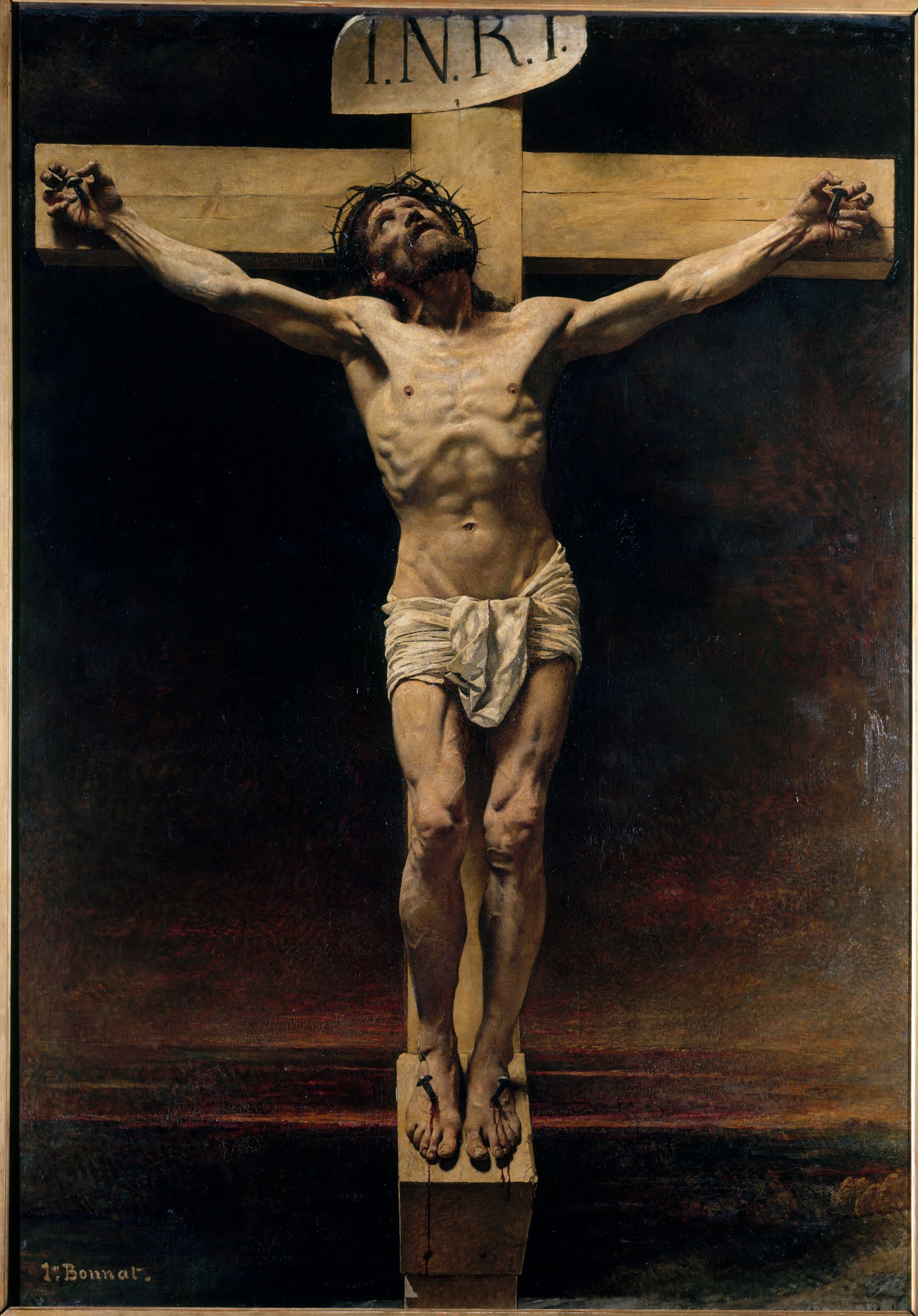
Psalm 22 opens with the words Jesus cried from the cross at the ninth hour, as Matthew 27:46 records them.
Some who stood by the cross heard the cry and said, “He is calling Elijah” (Matthew 27:47).
My God, my God, why have You forsaken me? Why are You so far from saving me, so far from my words of groaning?
- The passage
- Psalm 22:1 to 11, Psalm 22:21 to 24, Matthew 27:35 to 50
- Books
- Psalms, Matthew
- Hold in memory
- Psalm 22:1, Hebrews 13:5
Summary
Psalm 22 is David's cry to a God who seems far off. Through the silence the psalm holds on to God, remembering the fathers who trusted, recalling God's care from birth and asking Him to come near. It ends in praise, because God has heard the afflicted. At the cross the One who had no one to help bore the sin of His people.
- The priests mocked Jesus with the taunt the mockers of Psalm 22:8 spoke, and the soldiers divided His garments as Psalm 22:18 describes.
- In Hebrews 13:5 God promises His people, with the verb of the cry, that He will never forsake them.
- Teachers differ on whether the forsaking was a forsaking under God's wrath, a forsaking of His human nature with the union unbroken, or a cry spoken in our person.
The Cry and the Silence
Psalm 22 opens with a question and a complaint of prayer unanswered by day and by night.
My God, Why Have You Forsaken Me? studies Psalm 22:1 to 11 and its place in the account of the crucifixion. It belongs to the trial of loneliness, the pain of being alone or of having no one who cares, and it treats the deepest form of that pain, the sense of being left by God.
The question it answers is what the cry meant on David's lips and on Christ's, and what it gives a reader who feels left by God. It reads the first eleven verses of the psalm and its turn to praise, and it matches the psalm's lines with the Gospel accounts of the Passion. It sets out three ways teachers have understood the forsaking.
David's complaint goes on: “I cry out by day, O my God, but You do not answer, and by night, but I have no rest” (Psalm 22:2).
In Hebrew the cry is 'eli 'eli lamah 'azavtani. The verb is 'azav, which Strong's gives as “to leave: forsake”, the common word for leaving someone behind.
Psalm 22 and the Cross
Each line of Psalm 22 in the table stands beside a Gospel text that answers it.
The words of Psalm 22 return in the account of the cross, from the cry to the dividing of the garments.
| Moment | Psalm 22 | The Gospels |
|---|---|---|
| The cry | “My God, my God, why have You forsaken me?” (Psalm 22:1) | “Eli, Eli, lema sabachthani?” (Matthew 27:46) |
| The shaking of heads | “All who see me mock me; they sneer and shake their heads” (Psalm 22:7) | “And those who passed by heaped abuse on Him, shaking their heads” (Matthew 27:39) |
| The mockers' words | “He trusts in the LORD, let the LORD deliver him” (Psalm 22:8) | “He trusts in God. Let God deliver Him now if He wants Him.” (Matthew 27:43) |
| The thirst | “my tongue sticks to the roof of my mouth” (Psalm 22:15) | “I am thirsty.” (John 19:28) |
| The hands and feet | “they have pierced my hands and feet” (Psalm 22:16) | “Unless I see the nail marks in His hands” (John 20:25) |
| The garments | “They divide my garments among them and cast lots for my clothing.” (Psalm 22:18) | “they divided up His garments by casting lots” (Matthew 27:35) |
John says the soldiers cast lots for His tunic “to fulfill the Scripture” (John 19:24), and the line he quotes is Psalm 22:18.
Read the study of the Fulfillment Formula, Matthew's ten quotations
Psalm 22 is one of several psalms the Gospels apply to Christ, and the others are set out in their own study.
Holding On Through the Silence
Between Psalm 22:1 and Psalm 22:11 the psalmist reasons with God from His holiness, from the past and from his own birth.
The psalmist answers his own complaint: “Yet You are holy, enthroned on the praises of Israel” (Psalm 22:3). The fathers “trusted and You delivered them” (Psalm 22:4).
Then he turns to himself: “But I am a worm and not a man, scorned by men and despised by the people” (Psalm 22:6).
From birth I was cast upon You; from my mother’s womb You have been my God.The psalmist reaches back to his birth for a reason to trust, since God has been his God from the womb.
His plea is “Be not far from me, for trouble is near and there is no one to help” (Psalm 22:11).
From Psalm 22:22 the psalm praises God in the assembly, “For He has not despised or detested the torment of the afflicted” (Psalm 22:24).
The Ninth Hour
Matthew and Mark record the darkness, the cry in its spoken form and the words of the bystanders.
“From the sixth hour until the ninth hour darkness came over all the land” (Matthew 27:45). Mark gives the opening words of the cry in a second form, “Eloi, Eloi” (Mark 15:34).
Some of the bystanders said, “Let us see if Elijah comes to save Him” (Matthew 27:49).
The night before, in Gethsemane, Jesus “found them sleeping” when He came back from prayer (Matthew 26:40).
Forsaken in His People's Place
Paul names the sin laid on Christ and the curse He bore for others.
God made Him who knew no sin to be sin on our behalf, so that in Him we might become the righteousness of God.It shows how the sinless Son could be forsaken, since God made Him to be sin on our behalf.
Christ redeemed us from the curse of the law by becoming a curse for us. For it is written: “Cursed is everyone who is hung on a tree.”It shows that He bore the curse for His people, so His forsaking stood in their place.
Jesus took a psalm of David on His lips at His darkest hour, and a separate study follows David as a type of Christ. Another gathers the questions Jesus asked in the Gospels, and this cry is the one He asked of God from the cross.
A believer who feels forsaken by God may bring that complaint to God, as Jesus did. He should also seek a pastor, and a doctor where the mind or the body is unwell, beside prayer and never in its place.
Spurgeon on the Plea of Psalm 22:11
A nineteenth-century preacher read the plea as a prayer of Christ.
1834 to 1892 · Charles Spurgeon
Charles Spurgeon taught that Christ bore the friendlessness that crushes the heart. On Psalm 22:11 in The Treasury of David (1869) he wrote, “His great woe was that God had forsaken him.” He also wrote that “man was not made to be alone”. A man alone, he said, “is like a dismembered limb when he has to endure heart-loneliness.”
What the Forsaking Was
Three readings of the cry, each with its holders and the objection to it.
The Definition of Faith of the Council of Chalcedon (451) says that Jesus Christ “must be confessed to be in two natures, unconfusedly, immutably, indivisibly, inseparably”, and “not separated or divided into two persons”.
A real forsaking under the Father's wrath against sinMatthew Henry; John Wesley; Eusebius of Caesarea
Matthew Henry wrote in his Commentary on the Whole Bible (1710) that “the Father laid him under the present impressions of his wrath and displeasure against sin”. John Wesley, in his Explanatory Notes upon the New Testament (1755), wrote that the cry “expresses his trust in God” and a sense of “the wrath due to the sins which he was bearing”. Eusebius of Caesarea, in the Proof of the Gospel, said the Father forsook Him “to ransom the whole human race”.
The objection: Jesus still says “My God”, and He had told His disciples, “Yet I am not alone, because the Father is with Me” (John 16:32).
Forsaken in His human nature, the union unbrokenAdam Clarke; Ambrose of Milan
Adam Clarke, in his Commentary on the Bible (1832), wrote that to say the divinity departed from Christ “would deprive his sacrifice of its infinite merit”. Ambrose of Milan, in the Exposition of the Christian Faith, wrote, “As being man, therefore, he speaks, bearing with him my terrors”.
The objection: the cry names a forsaking by God Himself, and Isaiah says, “the LORD has laid upon Him the iniquity of us all” (Isaiah 53:6).
Spoken in our person and in the prophet's wordsGregory of Nazianzus; John Chrysostom
Gregory of Nazianzus, in his fourth Theological Oration, wrote that “he was in his own person representing us”, and that “we were the forsaken and the despised”. John Chrysostom, in his Homily 88 on Matthew, said Jesus cried in the prophet's words so that “they might see that He honors His Father”.
The objection: Matthew sets the cry in the darkness of the ninth hour as Jesus' own loud cry.
The Promise to the Forsaken
The promise God made to Joshua (Joshua 1:5) is given to the church in Hebrews 13:5.
Keep your lives free from the love of money and be content with what you have, for God has said: “Never will I leave you, never will I forsake you.”Those who hold this promise are the people whose sin Christ bore when He cried that He was forsaken.
The believer who prays Psalm 22 now prays it after the cross and knows how the psalm ended for Christ.
Sources
Scripture is the Berean Standard Bible.
- STEP Bible, the tagged Hebrew Bible and the Translators Amalgamated Greek New Testament (Tyndale House, Cambridge), CC BY 4.0.
- STEP Bible brief lexicons of Extended Strongs for Hebrew and Greek (Tyndale House, Cambridge), CC BY 4.0, with the Strong's glosses.
- Charles Spurgeon, The Treasury of David, Vol. 1 (1869), on Psalm 22:11.
- Matthew Henry, Commentary on the Whole Bible (1710), on Psalm 22:1 to 2.
- John Wesley, Explanatory Notes upon the New Testament (1755), on Matthew 27:46.
- Eusebius of Caesarea, Proof of the Gospel, 10.8, on Psalm 22:1.
- Adam Clarke, Commentary on the Bible (1832), on Matthew 27:46.
- Ambrose of Milan, Exposition of the Christian Faith, 2.7.56.
- Gregory of Nazianzus, Fourth Theological Oration (Oration 30), section 5.
- The Council of Chalcedon (451), the Definition of Faith, translated by Henry Percival (Nicene and Post-Nicene Fathers, second series, volume 14, Buffalo: Christian Literature Publishing, 1900)
- John Chrysostom, Homilies on the Gospel of Matthew, Homily 88, on Matthew 27:46.
Keep Studying
Studies2
In this trial7
People and groups11
Symbols1