

1 Samuel 3 · 1 Kings 19:12 · John 10:27 · Acts 13:2 · Hebrews 1:1–2 · Founder-Foundational Study
Hearing God
A boy asleep in a temple who does not yet know the LORD. A prophet at his lowest point, expecting thunder and getting a still small voice instead. A shepherd who says, plainly, that his sheep hear him. A fasting, worshiping church that simply reports what the Spirit said. And one verse (Hebrews 1:1–2) that frames all four: God has spoken in many times and many ways, and has now spoken finally in the Son. This is one of MannaFest's seven founder-foundational topics. What follows is the scripture spine, the anchor stream's own framework named, and the guardrails that stream insists on.
Frederic Leighton, Elijah in the Wilderness (1878) — Public domain, via Wikimedia Commons
Summary
This page traces five scenes of God speaking, from Samuel to a fasting church in Acts, names the modern framework for hearing him, and sets out the guardrails for testing what is heard.
- The scripture spine runs from young Samuel through Elijah's still small voice, John 10's ordinary sheep, and a Spirit-word to a worshiping church.
- Four architects of the modern hearing-God stream are named to their own books: Willard, Virkler, Winship, and Hennessey.
- A five-part testing apparatus, scripture, character, fruit, counsel, and time, is laid out for weighing what is heard.
- This is one of the site's seven founder-foundational topics, so no MannaFest verdict is planted here; it stays open for Marcus's own word.
The Spine
one claim, traced through five very different scenes
- I1 Samuel 3:4, 9–10the child who did not yet know the LORD
“Then the LORD called to Samuel… Speak, LORD, for Your servant is listening.”
The narrator is blunt about it: “Samuel did not yet know the LORD, because the word of the LORD had not yet been revealed to him” (3:7). Nothing about the boy qualifies him, he mistakes the voice for Eli three times running. What qualifies him is an old, half-blind priest willing to say, on the third try, this might be God, and to hand him the sentence to answer with. Hearing God, on the page's own account, does not start with expertise. It starts with someone teaching a child what to say back.
“Had he been envious of this honour done to Samuel, he would have done what he could to deprive him of it… but he was of a better spirit than to act so; he gave him the best advice he could, for the forwarding of his advancement.”
Matthew Henry, Commentary on the Whole Bible (1710), on 1 Samuel 3:9 — public domain, on Eli's response
- II1 Kings 19:11–13the prophet who expected thunder
“After the earthquake there was a fire, but the LORD was not in the fire. And after the fire came a still, small voice.”
Elijah has just called down actual fire on Carmel. At Horeb the display escalates, wind that rends mountains, an earthquake, a fire, and each time the text insists the LORD was not in it. The word after all three is qol demamah daqqah, a phrase that is itself a small paradox: a “sound” (qol) of “thin” (daq) “silence” (demamah). The prophet who just won the most spectacular contest in the Old Testament has to be told, gently, that the power display was not where the conversation was going to happen.
“Faith comes by hearing the word of God; miracles do but make way for it… Then God spoke to his people with terror; but in the gospel of Christ… he would speak by a still small voice, the dread of which should not make us afraid.”
Matthew Henry, Commentary on the Whole Bible (1710), on 1 Kings 19:12 — public domain
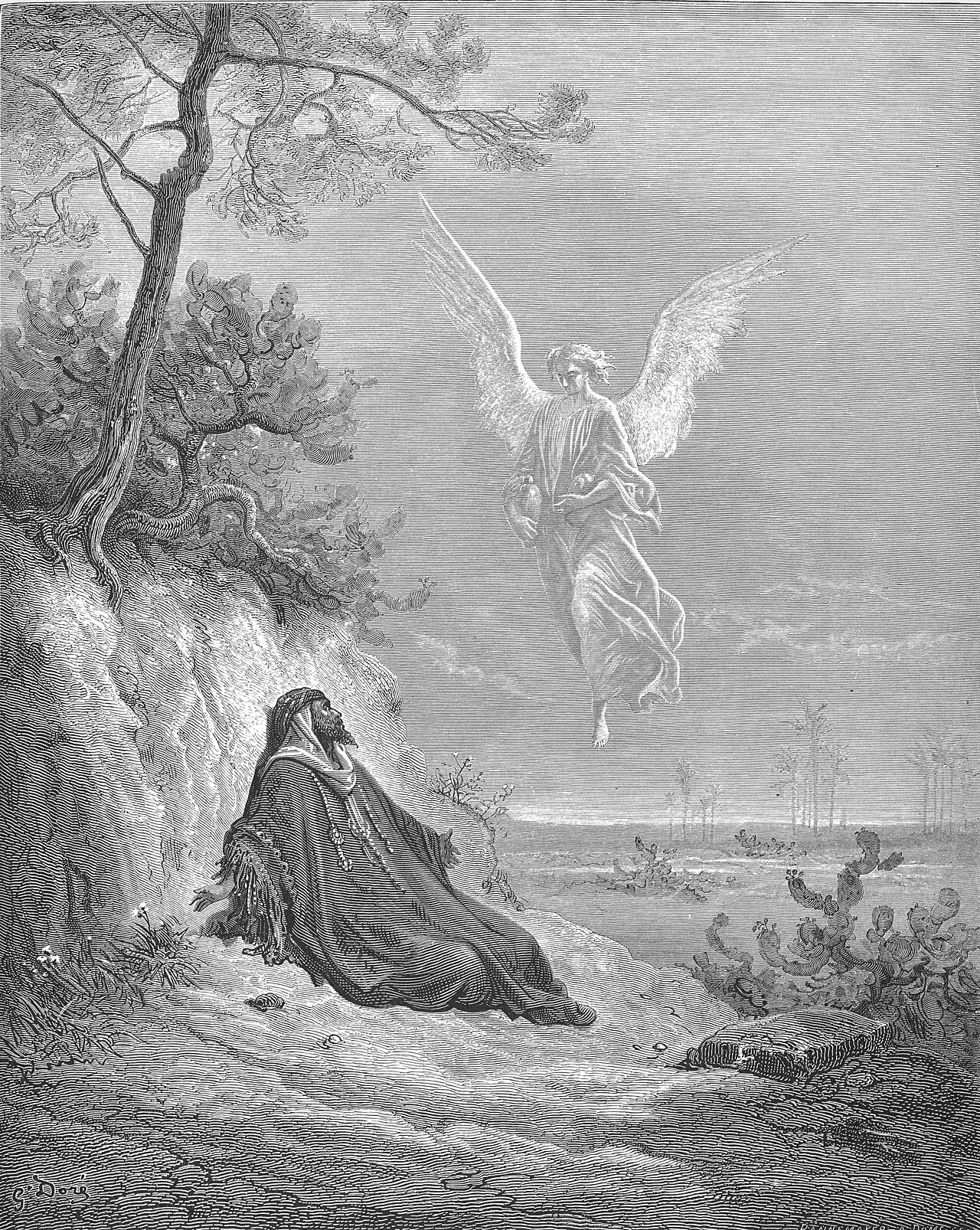
Elijah, fed before the forty-day walk to Horeb where he would hear the still small voice. Gustave Doré, Doré’s English Bible (1866), public domain · 1 Kings 19:5–8 - IIIJohn 10:27the shepherd's voice, not a technique
“My sheep listen to My voice; I know them, and they follow Me.”
Present tense, and unremarkable on purpose. Jesus does not say this of apostles, prophets, or the specially gifted, he says it of sheep, the least distinguished member of any flock. In his own accounting, hearing his voice is not the advanced course; it is the ordinary evidence of belonging to him at all, and it is paired with being known before it is paired with following.
Jesus names the same voice Elijah and Samuel heard, now as an ordinary, daily fact of belonging to him, not a peak experience reserved for a prophet at Horeb.
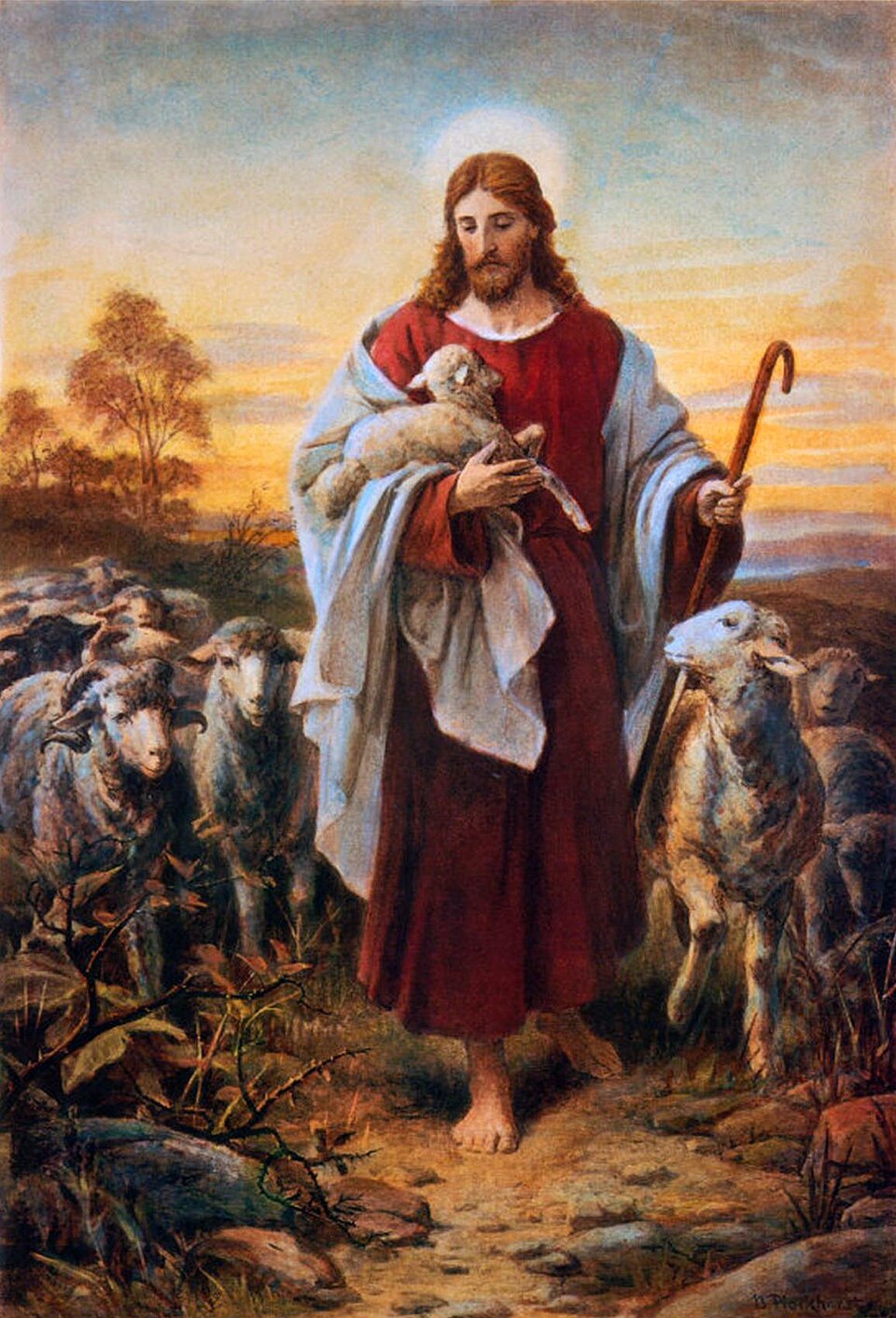
The Good Shepherd — Bernhard Plockhorst (1825–1907). Public domain, via Wikimedia Commons. - IVActs 13:2heard in the gathered, fasting church, not only alone
“And as they ministered to the Lord, and fasted, the Holy Spirit said, Separate me Barnabas and Saul for the work whereunto I have called them.”
The only sentence in this spine where Luke simply reports, in his own narrative voice, what the Spirit said, no vision described, no method explained. What is described is the posture that preceded it: a gathered church, ministering to the Lord, fasting. The most consequential missionary decision in the book arrives inside corporate worship, not a private mystical experience, and Luke feels no need to defend it.
- VHebrews 1:1–2the frame the whole topic sits inside
“God, having of old time spoken unto the fathers in the prophets by divers portions and in divers manners, hath at the end of these days spoken unto us in his Son…”
This is the verse everything above answers to. God's speech was always various in mode (dreams, visions, a boy's audible call, a still small voice, a Spirit-word to a fasting church) and has now arrived at its final, definitive form in the Son. The Son who has spoken finally is the same Shepherd who says his sheep hear his voice, so the canon that founds doctrine is complete while the Shepherd's own address to those he already knows goes on.
The Anchor Stream
named in the locked taxonomy, attributed, not adopted, on this page
MannaFest's own taxonomy names four architects of the modern continuationist framework for hearing God, in two complementary registers: one academic-philosophical, one charismatic-practical. What follows is their own framing, cited to their own named work, not a MannaFest teaching.
Dallas Willard
Hearing God (1984; rev. 1999, 2012)
Willard's phrase gives the whole stream its name: the still small voice (or the interior, inner voice) is, in his account, the preferred and most valuable form of God's individualized communication. A USC philosopher by trade, he grounds the claim in the classical Christian-formation tradition rather than a charismatic-gifts framework.
Mark Virkler
4 Keys to Hearing God's Voice (1986 as Communion with God; expanded)
Virkler's four keys, stillness, inward vision, spontaneity (flowing thought rather than analysis), and two-way journaling, train the same claim as a practice, from Habakkuk 2:1's watchman posture: “I will stand upon my watch… and will look forth to see what he will speak with me.”
Jamie Winship
Living Fearless (2022)
Winship, thirty years in Muslim-world conflict zones before writing this down, pairs hearing God with identity: fear traces to a false view of God, self, or others, and the remedy is bringing that fear to God as a direct question and then living from what he says back, not merely affirming it.
A fourth voice, held transparently
The taxonomy names a fourth architect of this popular-practical register: David Hennessey (“Praying Medic”), whose Hearing God’s Voice Made Simplesits downstream of Virkler’s framework. MannaFest's registry holds his ministry-teaching catalog separately from his contested post-2018 political-cultural commentary, and this page follows that same separation rather than featuring him further.
Testing What Is Heard
the guardrail cuts both ways
1 Thessalonians 5:19–21 gives the single sentence this whole subject has to answer to, because it refuses to let a reader off the hook in either direction: “Quench not the Spirit; despise not prophesyings; but prove all things; hold fast that which is good.” The command is double-sided on purpose: do not shut it down, and do not swallow it whole. 1 John 4:1 gives the same double edge from the other direction: “believe not every spirit, but prove the spirits, whether they are of God; because many false prophets are gone out into the world.”
The anchor stream's own literature (Virkler's four-part test, Winship's scripture-first filter, Jane Hamon's Discernment: The Essential Gift) does not treat testing as optional or as an afterthought. It is presented as load-bearing from the start:
Scripture-conformity
Anything heard that contradicts Scripture is not from God, full stop, Virkler's, Winship's and Hamon's frameworks all name this first and treat it as non-negotiable.
Character-conformity
Anything heard that violates God's revealed character, his holiness, his mercy, his justice, is not from him, whatever else recommends it.
Fruit-conformity
What is genuinely heard from God produces love, joy, peace, patience, the Spirit's own fruit, not fear, condemnation, confusion, or division.
Confirming counsel
Important matters are brought to spiritually mature people in community before they are acted on; a private impression that cannot survive being said out loud to someone else is not yet ready to be obeyed.
Time and fruit tested
Jane Hamon's Discernment: The Essential Gift presses this as a fifth layer, genuine prophetic words hold up as events unfold; the apparatus does not certify a word the moment it is spoken.
The Guardrails in Practice
the two places a heard word goes wrong, and what Scripture tells the church to do about each
An impression is not yet a word
Dressing a spontaneous thought, feeling or impression in the authority of “God said” is a category error, and it has a long record of producing bad guidance, spiritual pride and doctrinal drift. The Shepherd's sheep hear his voice, and they carry the same fallen minds and hurried hearts as everyone else. Nothing about hearing God removes the duty to know which is which.
What Scripture says to do: prove all things (1 Thess 5:21). The apparatus above is that proving, scripture-conformity, character-conformity, fruit-conformity, confirming counsel, time. A word that is from God comes through that testing intact.
The track record
Specific prophetic words within the modern apostolic-prophetic movement, including from voices adjacent to this very stream, have not come to pass. A pattern of failed particulars is a real problem, and a church is right to weigh it carefully.
1 Thessalonians 5:20–21 answers this in the same breath it is raised in, “despise not prophesyings” and “prove all things” sit in one sentence. Scripture's remedy for bad fruit is testing, and Deuteronomy 18:22 gives the plainest test there is: the word that does not come to pass was not spoken by the LORD.
where it goes wrong what Scripture says to do
A Note on This Page
why there is no flag planted here
Hearing God is one of MannaFest's seven founder-foundational topics, the ones Marcus Brown has reserved for his own direct authoring rather than an AI-synthesized position. What appears above is real: a verified scripture spine, the anchor stream's own framework cited to its own named books, the testing apparatus that stream itself insists on, and the guardrails that keep a heard word honest. What does not appear is his own extended word on method: how he teaches a believer to listen, weigh and act. That is reserved, and this page waits for it.
Other Voices in the Roster
each cited to a specific work
The Pursuit of God (1948), ch. 6, “The Speaking Voice”
Tozer's chapter title is his whole argument compressed: God is speaking. Not God spoke, but God is speaking, present tense, ongoing, and anchored throughout in Scripture and orthodox doctrine rather than an unmoored mysticism.
The Pleasure of His Company (2014)
Better known as the intercession-movement's ★★★ anchor voice, Sheets frames hearing God here as friendship before it is instruction, the same posture Psalm 25:14 calls the LORD's secret with them that fear him.
Drawing Near (2008)
Bevere ties intimacy with God to the same fear-of-the-Lord posture that anchors his own ★★★ topic, holy reverence is not a barrier to hearing God's voice; on his account it is the precondition for hearing it rightly rather than presumptuously.
Dreams and Visions (1997) · Discernment: The Essential Gift
Hamon extends the same testing apparatus to dreams specifically, Joseph and Daniel as the biblical pattern, symbolic vocabulary anchored in Scripture, and a careful, named distinction between God-given, soul-generated, and demonic dreams.
The Words the Spine Turns On
two Hebrew roots, two Greek, the sound, the call, the voice, the test
Notable art
— click a piece to enlargeKeep studying
Read it2
On this page
Studies4
Places1
Words1