
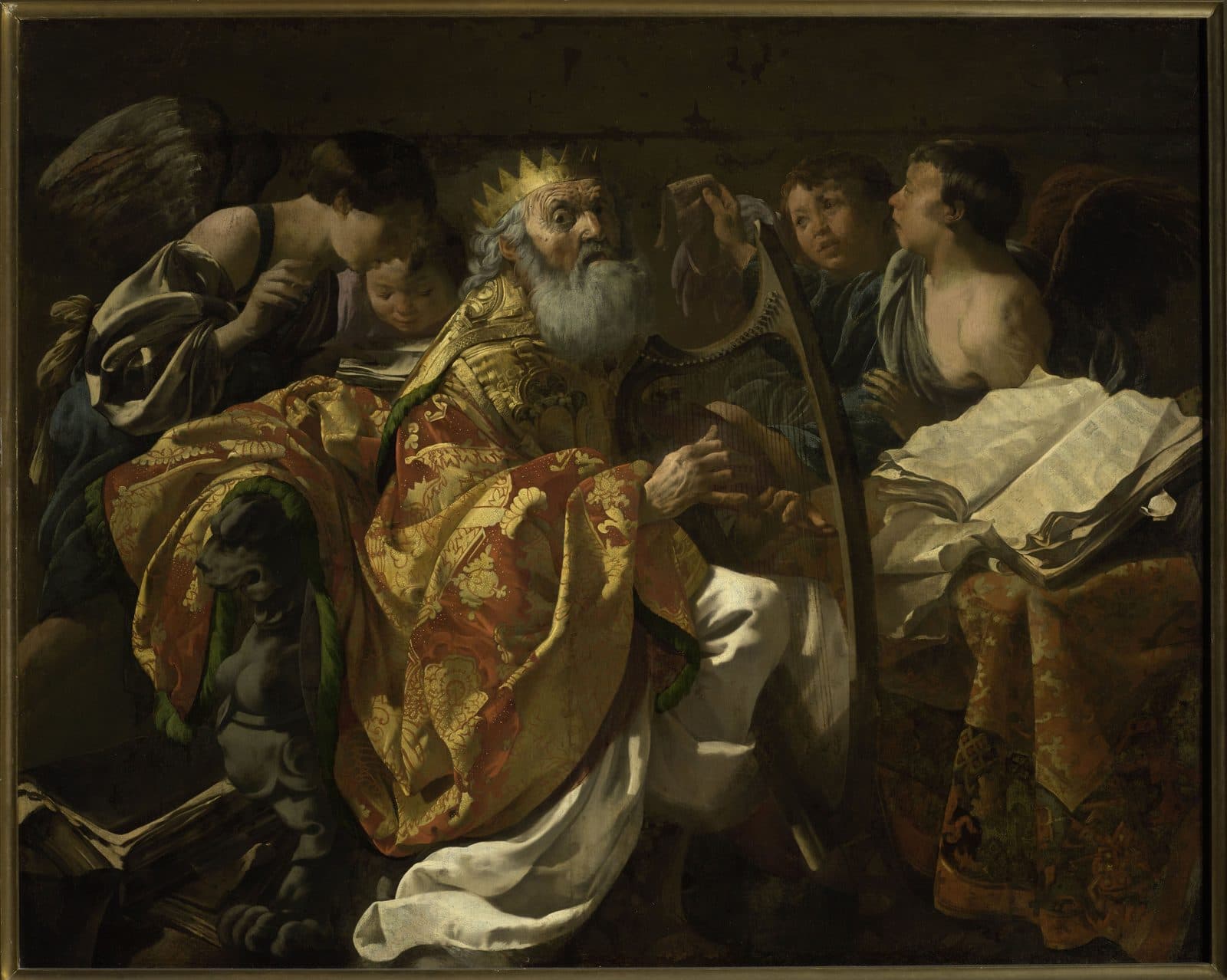
Hendrick ter Brugghen, King David Playing the Harp, Surrounded by Angels, 1628. Public domain.
Psalms 2, 16, 22, 45, 69 and 110 · Doctrine · Featured Study
The Messianic Psalms
Six psalms the New Testament quotes of Jesus, from the begotten Son of Psalm 2 through the forsaken sufferer of Psalm 22 to the priest-king of Psalm 110.
Three speakers quote these psalms aloud in the New Testament: Jesus from the cross, Peter at Pentecost, and Paul at Pisidian Antioch, who names the second psalm by number.
My God, my God, why have You forsaken me? Why are You so far from saving me, so far from my words of groaning?
- First taught
- Psalm 2:7 “I will proclaim the decree spoken to Me…”
- Fullest statement
- Psalm 110:1 to 4 “The LORD said to my Lord: “Sit at…”
Three speakers quote these psalms aloud in the New Testament: Jesus from the cross, Peter at Pentecost, and Paul at Pisidian Antioch, who names the second psalm by number.
Summary
Six psalms form one chain, read of Jesus in the New Testament, from a Son named king to a priest seated at God's right hand.
- The New Testament cites Psalm 110:1 more than any other Old Testament verse.
- Psalm 22 gives the cross its cry and its details.
- A psalm points to Christ in one of three ways: words spoken to the Son, David's life as the pattern, or the king every king fell short of.
- Luke 24:44 is Christ's own warrant for reading the Psalms this way.
Christ's own reading of the Psalms
A psalm line and the verse that quotes it.
My God, my God, why have You forsaken me? Why are You so far from saving me, so far from my words of groaning?David's cry of abandonment, in a lament that ends in praise.
About the ninth hour Jesus cried out in a loud voice, “Eli, Eli, lema sabachthani?” which means, “My God, My God, why have You forsaken Me?”Jesus speaks it from the cross, alone; Mark 15:34 gives the same cry.
About the ninth hour Jesus cried out in a loud voice, “Eli, Eli, lema sabachthani?” which means, “My God, My God, why have You forsaken Me?”Jesus speaks it from the cross, alone; Mark 15:34 gives the same cry.
On the road to Emmaus and again in the upper room, the risen Christ speaks to his disciples of the Scriptures. Everything written about him in the Law of Moses, the Prophets and the Psalms must be fulfilled (Luke 24:44). The Psalter is named alongside the Law and the Prophets as a body of Scripture that witnesses to Christ. These six psalms are its densest examples.
Dietrich Bonhoeffer's Psalms: The Prayer Book of the Bible (1940) builds on that saying: the Psalms are Christ's own prayer, prayed by the church only in him. It was his last book before the Nazi writing ban, written against a state church that had hollowed out the cost of following Jesus.
The chain of six psalms
Six links, each with the New Testament verse that reads it of Jesus.
The Son is named king, kept from decay, forsaken and answered, addressed as God, consumed by zeal and seated as priest-king.
1Psalm 2. The LORD names his anointed king his Son.
- Quoted of Jesus at
- Acts 13:33
2Psalm 16. The Holy One is kept from decay.
- Quoted of Jesus at
- Acts 13:35
3Psalm 22. The forsaken sufferer cries out and is answered.
- Quoted of Jesus at
- Matthew 27:46
4Psalm 45. The king is addressed as God on an everlasting throne.
- Quoted of Jesus at
- Hebrews 1:8
5Psalm 69. Zeal for God's house consumes the one hated without cause.
- Quoted of Jesus at
- John 2:17
6Psalm 110. David's Lord sits at God's right hand, a priest forever.
- Quoted of Jesus at
- Matthew 22:44
Each link opens the New Testament verse that quotes it.
He has fulfilled for us, their children, by raising up Jesus. As it is written in the second Psalm: ‘You are My Son; today I have become Your Father.’Paul, at Pisidian Antioch, names the second psalm.
So also, He says in another Psalm: ‘You will not let Your Holy One see decay.’Paul: David saw decay, so the Holy One is Jesus.
So they said to one another, “Let us not tear it. Instead, let us cast lots to see who will get it.” This was to fulfill the Scripture: “They divided My garments among them, and cast lots for My clothing.” So that is what the soldiers did.John on the soldiers casting lots.
But about the Son He says: “Your throne, O God, endures forever and ever, and justice is the scepter of Your kingdom. You have loved righteousness and hated wickedness; therefore God, Your God, has anointed You above Your companions with the oil of joy.”Hebrews hears the throne song spoken to the Son.
His disciples remembered that it is written: “Zeal for Your house will consume Me.”The disciples remember it at the temple.
‘The Lord said to my Lord, “Sit at My right hand until I put Your enemies under Your feet.”’Jesus asks how David's son is David's Lord.
John 19:24, Hebrews 1:8 to 9, John 2:17, Matthew 22:44
The case, from the cross to the throne
Psalm 22 sounds at the crucifixion, and the call to sit at God's right hand at the ascension.
Jesus quotes Psalm 22 from the cross. The casting of lots for his garments answers verse 18 (Matthew 27:35; John 19:23-24). The pierced hands and feet of verse 16 rest on a contested reading of the Hebrew, set out below. The crimson worm of verse 6 links the psalm to The Scarlet Thread. The closing ten verses (22:22-31) turn from the cry to a declaration of victory, which the New Testament reads as Christ rising from the cross to the Father's presence (Hebrews 2:12).
Psalm 110 is quoted or alluded to about 25 times in the New Testament, more than any other Old Testament passage. Jesus uses its first verse to silence the Pharisees (Matthew 22:41-46), Peter cites it at Pentecost (Acts 2:34-36), and Paul leans on it for the risen Christ at God's right hand (Romans 8:34; Ephesians 1:20-22). Hebrews builds its case for a priest of Melchizedek's order on verse 4 (Hebrews 5 to 7). The seating began at the ascension, and the enemies made a footstool await the second coming.
How each psalm points to Christ
Three ways, and when each psalm is fulfilled.
WORDS SPOKEN TO THE SON
The New Testament applies the psalm's words to Christ as the one addressed, in Psalms 2 and 45, Psalm 102:25-27 and the throne at God's right hand in Hebrews 1:13.
DAVID'S OWN LIFE IS THE PATTERN
What David suffered, Christ suffers more deeply, the pattern scholars call typology, in Psalms 22, 41 and 69. The psalmist speaks of himself and is answered in someone greater.
THE KING EVERY KING FELL SHORT OF
The songs written for Israel's kings, read forward after the throne failed, among them Psalms 72, 89 and 132. Every son of David fell short of the words sung at his crowning.
Each psalm also has a time of fulfilment. Psalms 16, 22 and 69 were fulfilled in the first coming. Psalms 2 and 45 and the seating at God's right hand are progressively fulfilled, begun in the first coming and completed in the second. A third class, awaiting the second coming, holds none of the six.
The Davidic covenant (2 Samuel 7) is the warrant behind the royal and suffering psalms. God's promise to David's house made them songs designed to overflow their first singer.
How the commentators read the chain
Four voices from the second century to the nineteenth, earliest first.
1703 to 1791 · John Wesley
Justin Martyr's Dialogue with Trypho (about 160, chapters 97 to 106) reads Psalm 22 at length as the passion of Christ, from the pierced hands to the parted garments.
John Wesley's Explanatory Notes of 1765 read the parted garments of Psalm 22:18 as fulfilled in Christ.
“They part - This also cannot be applied to David, but was literally fulfilled in Christ, Matt. xxvii, 35 John xix, 24.”
John Wesley · Explanatory Notes upon the Old Testament · on Psalm 22:18Evangelical
1834 to 1892 · Charles Spurgeon
Charles Spurgeon's The Treasury of David (1869-1885), the standard nineteenth-century evangelical exposition of the Psalter, hears the first line of Psalm 22 as the cry of Golgotha.
“‘My God, my God, why hast thou forsaken me?’ This was the startling cry of Golgotha: Eloi, Eloi, lama sabacthani. The Jews mocked, but the angels adored when Jesus cried this exceeding bitter cry. Nailed to the tree we behold our great Redeemer in extremities, and what see we? Having ears to hear let us hear, and having eyes to see let us see! Let us gaze with holy wonder, and mark the flashes of light amid the awful darkness of that midday-midnight.”
Charles Spurgeon · The Treasury of David, Vol. 1 · on Psalm 22:1
1834 to 1892 · Charles Spurgeon
Spurgeon calls the priest's oath of Psalm 110:4 the heart of the psalm.
“We have now reached the heart of the psalm, which is also the very centre and soul of our faith. Our Lord Jesus is a Priest King by the ancient oath of Jehovah: ‘he glorified not himself to be made an high priest, ‘but was ordained there unto from of old, and was called of God an high priest after the order of Melchizedek.”
Charles Spurgeon · The Treasury of David, Vol. 5 · on Psalm 110:4
1802 to 1910 · Jamieson, Fausset & Brown
Jamieson, Fausset and Brown (1871) read the opening words of the psalm Jesus put to the Pharisees as the formula of a prophet's oracle.
“The Lord said--literally, ‘A saying of the Lord,’ (compare Ps 36:1), a formula, used in prophetic or other solemn or express declarations. my Lord--That the Jews understood this term to denote the Messiah their traditions show, and Christ's mode of arguing on such an assumption (Mt 22:44) also proves.”
Jamieson, Fausset & Brown · Commentary Critical and Explanatory on the Whole Bible · on Psalm 110:1Reformed
Charles Spurgeon, Jamieson, Fausset & Brown
Where readers differ
Four readings, each with its holders, work, tradition, tier and objection.
Christians agree that the New Testament reads these psalms of Jesus. They differ over how the psalms speak of him, and Jewish readers hear them of David, of Israel's king and of the nation.
Direct prophecy: the psalmist speaks of a figure beyond himselfWalter Kaiser, The Messiah in the Old Testament (1995); Michael Rydelnik, The Messianic Hope (2010). Evangelical
On this reading David speaks in the Spirit of a king to come, most clearly in Psalms 16 and 110. Peter argues it at Pentecost: David died and was buried, so both speak of the Christ (Acts 2:29-34).
The objection: the headings and the settings of these psalms are David's own, and a prediction read into every line loses the man who prayed them.
Typology: David's life is a pattern Christ fillsPatrick Fairbairn, The Typology of Scripture (1845-1847); G. K. Beale and D. A. Carson, Commentary on the New Testament Use of the Old Testament (2007). Reformed and evangelical
On this reading a real king or sufferer is a God-given pattern, and Christ fills it more fully. It is the majority reading for Psalms 22, 69 and 118.
The objection: a pattern read back from the cross can be found in almost any lament unless the New Testament itself names it.
The fuller sense: the Spirit meant more than the writer graspedRaymond E. Brown, The Sensus Plenior of Sacred Scripture (1955). Catholic
On this reading the Spirit gave a line a fuller sense than its writer knew, as the New Testament hears of the Son the words to the king in Psalm 45:6.
The objection: a meaning cut loose from its human author has no check on it.
The psalms speak of David and of IsraelRashi, Commentary on Psalms; the Aramaic Psalms (Targum). Jewish
Jewish commentators read the royal psalms of David and his house, and the laments of the righteous sufferer or of Israel. The Aramaic Psalms name the King Messiah at Psalm 45 and Psalm 72.
The objection from the apostles: David died and saw decay, so the Holy One of Psalm 16:10 must be another (Acts 2:29-31; 13:36-37).
Written of me
Jesus said to them, “These are the words I spoke to you while I was still with you: Everything must be fulfilled that is written about Me in the Law of Moses, the Prophets, and the Psalms.” Then He opened their minds to understand the Scriptures.The risen Jesus names the Psalms among the Scriptures written of him, and then opens his disciples' minds to understand them.
Jesus read these psalms of himself, and the apostles quoted them by chapter and speaker. The text asks the reader to read the Psalms as the disciples learned to read them, with Christ as the one they are written of.
Follow a thread
Six threads, the ledger of nine psalms, the formulas and all 72 quotations.
Each thread opens its own page on one psalm.
| Thread | Verse | What it holds |
|---|---|---|
| The Begotten Son | Psalm 2:7 | The Son named at the baptism and the resurrection; the inheritance awaits the end. |
| The Holy One Not Left to Sheol | Psalm 16:10 | The resurrection, fulfilled at Easter (Acts 2 and 13). |
| The Crucifixion Preview | Psalm 22:1 | The crucifixion scene; Christ quotes verse 1 from the cross. |
| The Royal Wedding | Psalm 45:6 | The bridegroom pattern begun; the marriage supper awaits Revelation 19. |
| Zeal, Vinegar, and Gall | Psalm 69:9 | Rejection, zeal for the temple, and the vinegar and gall at the cross (John 19:29). |
| The Priest-King at God's Right Hand | Psalm 110:1-4 | The king seated now, with every enemy still to be subdued. |
Nine psalms with the kind of song each is and who quotes it.
| Psalm | Kind of song | Spoken by |
|---|---|---|
| Psalm 2:7 | A king's song | Paul, at Pisidian Antioch |
| Psalm 8:6 | A hymn of praise | Paul, on the reign of the risen Christ |
| Psalm 16:10 | A song of confidence | Peter, at Pentecost |
| Psalm 22:1 | A lament | Jesus, from the cross, in Aramaic |
| Psalm 40:6 | A lament that turns to thanks | The writer to the Hebrews, of Christ coming into the world |
| Psalm 45:6 | A royal wedding song | The writer to the Hebrews, of the Son addressed as God |
| Psalm 69:9 | A lament | The disciples, remembering |
| Psalm 110:1 | A coronation song and a priest's oath | Jesus, then Peter and the writer to the Hebrews |
| Psalm 118:22 | A thanksgiving song sung at Passover | Jesus, then Peter |
Psalm 69:9, Psalm 110:1, Psalm 118:22
The New Testament cites Scripture by formula.
| Formula | Times in the New Testament |
|---|---|
| It is written (gegraptai) | 67 |
| The scripture (hē graphē) | 49 |
| The fulfilment formula, that the scripture might be fulfilled | 23 |
Psalm 16:10: David, or the Christ?Two readings, the apostles' and the critics'
Critics answer that the plain sense of the psalm is David's own confidence of preservation, and that the messianic reading is an apostolic argument built from the fact of David's death.
For You will not abandon my soul to Sheol, nor will You let Your Holy One see decay.Psalm 22 close up: the psalm Jesus quotes from the crossFive Hebrew words and two readings of verse 16
Three lines of Psalm 22 are quoted. Jesus speaks verse 1 from the cross (Matthew 27:46), and John quotes verse 18 of the soldiers casting lots (John 19:24). The writer to the Hebrews quotes verse 22 at the psalm's turn to praise (Hebrews 2:12).
Each Hebrew word below carries in brackets the number of times it is found in the Old Testament. ʿAzab, to forsake (215), is the cry of 22:1 that Jesus makes his own. Mark 15:34 gives it in Aramaic as shevaq. Karah, to dig or bore through (14), stands behind they pierced my hands and my feet at 22:16, and ʾarî, lion (80), behind the other reading of the same line. Beged, garment (217), and goral, lot (78), are the words of 22:18 quoted in John 19:24. Word meanings are from Strong's lexicon and counts from the tagged Hebrew text.
One line in this psalm can be read two ways. The old Hebrew copies differ at Psalm 22:16. Some give they pierced my hands and my feet, others like a lion at my hands and my feet, and both rest on the same few letters.
The reading kaʾaru, from karah, gives they pierced, and the Greek Septuagint ōryxan (they dug) and the Naḥal Ḥever Psalms scroll (5/6 Ḥev) support it. The Masoretic Text reads kaʾarî, like a lion, and the pierced verb is a reconstruction of the same consonants. Both readings sit in the apparatus. The scroll can be seen in the Leon Levy Dead Sea Scrolls Digital Library of the Israel Antiquities Authority.
Read as a whole, Psalm 22 runs from abandonment to rescue, and the line Jesus quotes carries the arc behind it: verse 16, verse 18 (John 19:24) and verse 22 (Hebrews 2:12). By its form the psalm is a lament whose speaker is a suffering righteous man, and form critics read the New Testament use as a pattern answered. Stanley Porter adds a caution: quoting a psalm's first line is no automatic claim on the whole psalm. These readings come from Gunkel and Begrich, Introduction to Psalms (1933), and Hays, Echoes of Scripture in the Gospels (2016).
For dogs surround me; a band of evil men encircles me; they have pierced my hands and feet.Psalm 40:6: a body, or ears?Two wordings, the Greek and the Hebrew
Hebrews 10:5 quotes the line as a body you prepared for me and reads it of the incarnation. The Hebrew reads my ears you have opened, and Hebrews follows the older Greek translation. Swete, Introduction to the Old Testament in Greek (1900), sets out the difference.
Sacrifice and offering You did not desire, but my ears You have opened. Burnt offerings and sin offerings You did not require. Then I said, “Here I am, I have come— it is written about me in the scroll: I delight to do Your will, O my God; Your law is within my heart.”Therefore, when Christ came into the world, He said: “Sacrifice and offering You did not desire, but a body You prepared for Me. In burnt offerings and sin offerings You took no delight. Then I said, ‘Here I am, it is written about Me in the scroll: I have come to do Your will, O God.’”Psalm 110 close up: the priest-king at God's right handSix Hebrew words and the question Jesus sets
Verse 1 is quoted by Jesus (Matthew 22:44), then by Peter (Acts 2:34) and Hebrews (1:13); verse 4 by the writer to the Hebrews (Hebrews 5:6).
Each Hebrew word below carries in brackets the number of times it is found in the Old Testament. YHWH, the LORD (6,520), is the speaker of the oracle in 110:1. ʾAdon or ʾadoni, lord or my lord (333), is the second Lord of the same verse. Nĕʾum, oracle (376), is the prophetic frame of the opening. Yamin, right hand (140), is the enthronement image quoted across the New Testament, at Acts 2:34, Hebrews 1:13 and Matthew 26:64. Kohen, priest (750), and Malki-tsedeq, Melchizedek (4), are the priest-king of 110:4, a priestly order outside Aaron's and for ever (Hebrews 5 to 7). Word meanings are from Strong's lexicon and counts from the tagged Hebrew text.
Jesus asks how the Messiah can be David's son if David, in the Spirit, calls him my Lord (Matthew 22:45). The question turns on the two Hebrew words behind the one English Lord: YHWH, the LORD who speaks, says to ʾadoni, David's lord. It is a teaching question set by Jesus himself, and it stands with the claim.
Alfred Edersheim's Life and Times of Jesus the Messiah, Appendix IX (1883), records that the ancient synagogue applied Psalm 110 throughout to the Messiah (Midrash on Psalm 18:36). David M. Hay's Glory at the Right Hand (1973) traces the psalm through early Christianity.
The LORD has sworn and will not change His mind: “You are a priest forever in the order of Melchizedek.”The synagogue's own reading: the ancient Aramaic PsalmsTwo quotations, Psalms 45 and 72
The ancient Aramaic paraphrase of the Psalms, read aloud in the synagogue, names the King Messiah in two places. It shows how the psalms were heard, in its own words.
“Thy beauty, O King Messiah.”
The Aramaic Psalms (Targum), on Psalm 45 · quoted in Edersheim, Life and Times of Jesus the Messiah, Appendix IX (1883)
“the King Messiah… Son of David the King.”
The Aramaic Psalms (Targum), on Psalm 72 · quoted in Edersheim, Life and Times of Jesus the Messiah, Appendix IX (1883)
How the New Testament reads the whole PsalterFive quotations outside the messianic psalms
The New Testament quotes the Psalms constantly, and much of it is Paul reaching for a line about sin, suffering or ascent. These sit beside the messianic ledger as a different use of the same book.
Paul quotes Psalm 44:22 at Romans 8:36, Psalm 51:4 at Romans 3:4 and Psalm 68:18 at Ephesians 4:8. He quotes Psalm 116:10 at 2 Corinthians 4:13, and Psalm 140:3 at Romans 3:13 in his chain of texts on sin.
The receipts: every psalm the New Testament quotes72 quotations
Every quotation in the site's index that touches the Psalms, 72 of them, psalm by psalm. The indexes behind it are Westcott and Hort (1881), Swete (1900) and Roger Nicole (1958).
Psalm 10:7 is quoted at Romans 3:14, in Paul's chain of texts on sin.
Psalm 102:25 is quoted at Hebrews 1:10.
Psalm 104:4 is quoted at Hebrews 1:7.
Psalm 2:1 is quoted at Acts 4:25, in the believers' prayer, which names David as God's servant.
Psalm 2:7 is quoted at Hebrews 5:5, of Christ's appointment as high priest.
Psalm 2:7 is quoted at Hebrews 1:5: the Son above the angels, with 2 Samuel 7:14.
Psalm 2:7 is quoted at Acts 13:33.
Psalm 4:4 is quoted at Ephesians 4:26.
Psalm 5:9 is quoted at Romans 3:13, in Paul's chain of texts on sin.
Psalm 8:2 is quoted at Matthew 21:16.
Psalm 8:4 is quoted at Hebrews 2:6.
Psalm 8:6 is quoted at 1 Corinthians 15:27, of the reign of the risen Christ.
Psalm 14:1 is quoted at Romans 3:10, opening Paul's chain of texts on universal sin.
Psalm 16:10 is quoted at Acts 13:35.
Psalm 16:8 is quoted at Acts 2:25, as a proof of the resurrection.
Psalm 18:49 is quoted at Romans 15:9, in a chain of texts on the praise of the Gentiles.
Psalm 19:4 is quoted at Romans 10:18, of the witness of creation.
Psalm 22:1 is quoted at Matthew 27:46: the cry of dereliction, which calls up the whole of Psalm 22.
Psalm 22:1 is quoted at Mark 15:34: the cry of dereliction.
Psalm 22:18 is quoted at John 19:24: soldiers cast lots.
Psalm 22:22 is quoted at Hebrews 2:12: Christ not ashamed to call us brethren.
Psalm 24:1 is quoted at 1 Corinthians 10:26, on meat offered to idols.
Psalm 31:5 is quoted at Luke 23:46: the last word from the cross.
Psalm 32:1 is quoted at Romans 4:7: David on imputed righteousness.
Psalm 34:12 is quoted at 1 Peter 3:10.
Psalm 36:1 is quoted at Romans 3:18, closing Paul's chain of texts on sin.
Psalm 40:6 is quoted at Hebrews 10:5.
Psalm 41:9 is quoted at John 13:18: Judas.
Psalm 44:22 is quoted at Romans 8:36.
Psalm 45:6 is quoted at Hebrews 1:8: the Son addressed as God.
Psalm 51:4 is quoted at Romans 3:4: God true, every man a liar.
Psalm 68:18 is quoted at Ephesians 4:8.
Psalm 69:22 is quoted at Romans 11:9.
Psalm 69:25 is quoted at Acts 1:20: on Judas.
Psalm 69:4 is quoted at John 15:25: with Psalm 35:19.
Psalm 69:9 is quoted at John 2:17, at the temple cleansing, as the disciples remember.
Psalm 69:9 is quoted at Romans 15:3: Christ pleased not himself.
Psalm 78:2 is quoted at Matthew 13:35, with the fulfilment formula.
Psalm 78:24 is quoted at John 6:31, in the discourse on the bread of life.
Psalm 82:6 is quoted at John 10:34.
Psalm 89:20 is quoted at Acts 13:22: Paul at Antioch, with 1 Samuel 13:14.
Psalm 91:11 is quoted at Luke 4:10: the tempter cites it.
Psalm 91:11 is quoted at Matthew 4:6: the tempter cites it.
Psalm 94:11 is quoted at 1 Corinthians 3:20.
Psalm 95:11 is quoted at Hebrews 4:3, of the Sabbath rest that remains.
Psalm 95:7 is quoted at Hebrews 3:7.
Psalm 109:8 is quoted at Acts 1:20: replacing Judas.
Psalm 110:1 is quoted at Matthew 22:44, in the question of David's son.
Psalm 110:1 is quoted at Matthew 26:64: before the Sanhedrin with Daniel 7:13.
Psalm 110:1 is quoted at Luke 20:42, in the question of David's son.
Psalm 110:1 is quoted at Hebrews 1:13.
Psalm 110:1 is quoted at Acts 2:34, as a proof of the ascension.
Psalm 110:1 is quoted at Mark 12:36.
Psalm 110:1 is quoted at Mark 14:62: before the high priest, with Daniel 7:13.
Psalm 110:4 is quoted at Hebrews 7:17, of the eternal priesthood.
Psalm 110:4 is quoted at Hebrews 5:6.
Psalm 112:9 is quoted at 2 Corinthians 9:9.
Psalm 116:10 is quoted at 2 Corinthians 4:13.
Psalm 117:1 is quoted at Romans 15:11.
Psalm 118:22 is quoted at Mark 12:10.
Psalm 118:22 is quoted at 1 Peter 2:7.
Psalm 118:22 is quoted at Matthew 21:42.
Psalm 118:22 is quoted at Luke 20:17.
Psalm 118:22 is quoted at Acts 4:11: before the Sanhedrin.
Psalm 118:25 is quoted at John 12:13, at the entry into Jerusalem.
Psalm 118:26 is quoted at Matthew 23:39: lament over Jerusalem.
Psalm 118:26 is quoted at Luke 19:38.
Psalm 118:26 is quoted at Matthew 21:9.
Psalm 118:26 is quoted at Mark 11:9, at the entry into Jerusalem.
Psalm 118:6 is quoted at Hebrews 13:6.
Psalm 132:11 is quoted at Acts 2:30, of God's oath to David.
Psalm 140:3 is quoted at Romans 3:13, in Paul's chain of texts on sin.
Sources
Scripture is the Berean Standard Bible.
- The New Testament's quotations of the Psalms, as listed by Westcott and Hort (1881), Swete (1900) and Nicole (1958)
- Alfred Edersheim, The Life and Times of Jesus the Messiah, Appendix IX, 1883.
- Justin Martyr, Dialogue with Trypho, chapters 97-106, Ante-Nicene Fathers vol. 1.
- Hermann Gunkel and Joachim Begrich, Introduction to Psalms, 1933; English translation 1998.
- Richard B. Hays, Echoes of Scripture in the Gospels, 2016.
- Walter C. Kaiser Jr., The Messiah in the Old Testament, 1995.
- Patrick Fairbairn, The Typology of Scripture, 1845-1847.
- Raymond E. Brown, The Sensus Plenior of Sacred Scripture, 1955.
- Rashi, Commentary on Psalms.
- Michael Rydelnik, The Messianic Hope, 2010.
- G. K. Beale and D. A. Carson, eds., Commentary on the New Testament Use of the Old Testament, 2007.
- Dietrich Bonhoeffer, Psalms: The Prayer Book of the Bible, 1940.
- H. B. Swete, An Introduction to the Old Testament in Greek, 1900.
- David M. Hay, Glory at the Right Hand: Psalm 110 in Early Christianity, 1973.
- The Aramaic Psalms (Targum), in English translation, as quoted in Edersheim, Appendix IX.
- The Nahal Hever Psalms scroll (5/6 Hev), Psalm 22:16.
- Tagged Hebrew and Greek biblical text data (CC BY 4.0), the source of the site's word tools and quotation counts.
Keep Studying
Studies17
Doctrines13
Subjects3
Go further1