
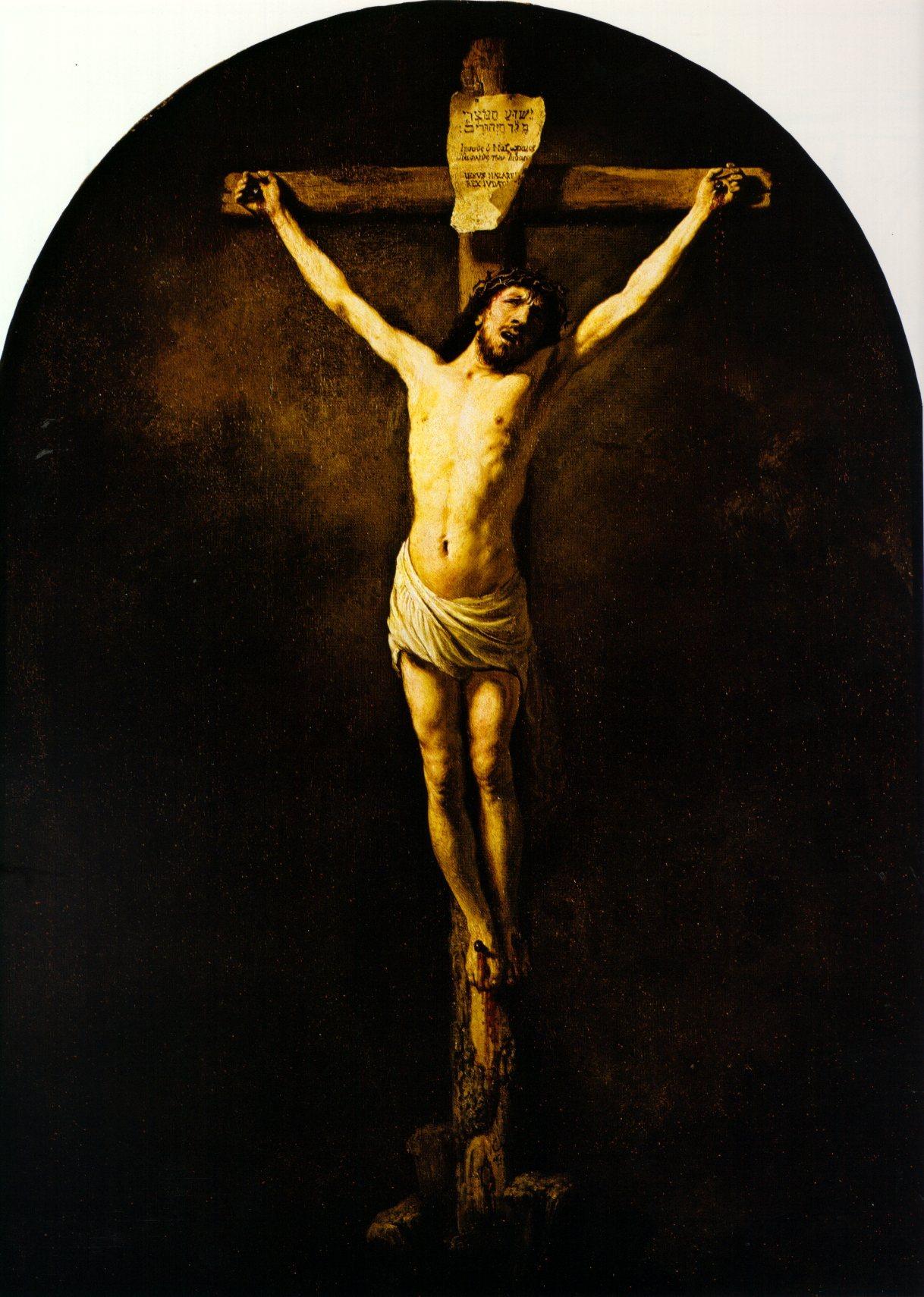
Rembrandt, Christ on the Cross, 1631. Public domain.
Psalm 22 · Passage · Featured Study
The Pierced Hands and Feet
The pointed Hebrew reads like a lion at the end of the line, and the ancient translations read a verb.
The scribes' own notes record the verb behind they have pierced.
For dogs surround me; a band of evil men encircles me; they have pierced my hands and feet.
For dogs surround me; a band of evil men encircles me; they have pierced my hands and feet.
- The passage
- Psalm 22:12 to 13, Psalm 22:16 to 18, Psalm 22:20 to 21, Isaiah 38:13, John 20:25, Luke 24:39 to 40
- Books
- Psalms, Isaiah, John, Luke
- Hold in memory
- Psalm 22:16, Luke 24:39
Summary
The last Hebrew word of the verse is pointed in the copies as a noun with like. Every old version Perowne lists turns it into a verb, and the Berean text gives they have pierced. Two commentators of the nineteenth century, J. J. Stewart Perowne and Franz Delitzsch, list the witnesses and weigh them.
- Two Hebrew manuscripts named by Perowne carry a verb.
- Aquila, Symmachus and Jerome read other verbs, and the Targum joins the lion to a verb.
- Perowne would give up the Masoretic interpretation, and Delitzsch gives the verb an equal right with it.
The Verse Among the Beasts
From Psalm 22:12 to 21 the psalm surrounds the sufferer with bulls, lions, dogs and wild oxen.
Many bulls surround me; strong bulls of Bashan encircle me. They open their jaws against me like lions that roar and maul.The psalm names the strong beasts first.
Deliver my soul from the sword, my precious life from the power of wild dogs. Save me from the mouth of the lion; at the horns of the wild oxen You have answered me!The prayer for rescue names the dogs and the lion again.
A lion stands in Psalm 22:13 and again in Psalm 22:21, with the disputed line between them.
The Witnesses to the Line
Perowne and Delitzsch list the Hebrew copies, the notes of the scribes and the old versions.
The Hebrew copies give a noun, and the versions give a verb.
| Witness | What it reads | Who lists it |
|---|---|---|
| The Hebrew manuscripts, almost without exception | Like a lion | Perowne |
| Kennicott 39 | A verb, where a later hand seems to have altered the last letter | Perowne |
| De Rossi 337 | Both readings joined in one word | Perowne |
| The Masora finalis of Jacob ben Chayim | The verb as the written form and like a lion as the form read aloud, found in good manuscripts | Perowne and Delitzsch |
| The Masora Magna on Numbers 24:9 | The verb as a written form | Perowne and Delitzsch |
| Three late manuscripts, two of them in the margin | A third spelling of the word | Perowne |
| The Targum | Biting like a lion, both senses at once | Perowne and Delitzsch |
| The Septuagint, the Syriac and the Vulgate | They pierced or bored through, in the Vulgate foderunt | Perowne and Delitzsch |
| The Arabic | They pierced or bored through | Perowne |
| Aquila in his first edition | They put to shame | Perowne and Delitzsch |
| Aquila in his second edition, and Symmachus | They bound | Perowne and Delitzsch |
| Jerome | Vinxerunt in some copies and fixerunt in others | Perowne and Delitzsch |
The Targum, The Septuagint, the Syriac and the Vulgate, The Arabic, Aquila in his first edition, Aquila in his second edition, and Symmachus, Jerome
Perowne writes that the case rests first on the manuscripts and second on the ancient versions. He calls the passage one of the most discussed in the Old Testament.
The Hebrew Copies and the Masora
Two notes of the scribes bear on how the word is read.
Delitzsch writes that Jacob ben Chayim's note of the verb may be disputed, because Jacob ben Chayim became a Christian. He still judges it premature to call the note an interpolation.
Both editors cite one more note of the Masora. It says that the same word stands in two places, here and in Isaiah 38:13, with two different meanings.
I composed myself until the morning. Like a lion He breaks all my bones; from day until night You make an end of me.Here the same Hebrew word gives like a lion.
Strong's dictionary, under the word for lion (H738), lists pierce among the King James renderings, taken from the margin.
The Ancient Translations
The old versions differ on what the verb means.
Delitzsch judges that the reading they bound is unlikely, because Hebrew has other words for binding. He finds nothing of weight against the reading of the Septuagint, the old Greek translation. The verb can mean to dig through, and so to pierce.
Perowne writes that the Targum, an Aramaic paraphrase, joins both meanings. Delitzsch takes it as a sign that the old readers wavered between the noun and the verb.
Hands and Feet in the Gospels
Two Gospels record the wounds the verb reading names.
Delitzsch reads the verb reading as fulfilled in the nailing of the hands of the Crucified One. He adds the feet, at least as bound fast. He sets the verse beside Isaiah 53:5, where the Servant is pierced for our sins, and beside Zechariah 12:10.
So the other disciples told him, “We have seen the Lord!” But he replied, “Unless I see the nail marks in His hands, and put my finger where the nails have been, and put my hand into His side, I will never believe.”John's account gives the nails in the hands, the first half of that fulfilment.
Look at My hands and My feet. It is I Myself. Touch Me and see—for a spirit does not have flesh and bones, as you see I have.” And when He had said this, He showed them His hands and feet.Luke's account gives the feet, the second half of that fulfilment.
Voices on the Verse
Eusebius of Caesarea and Charles Spurgeon read the dogs of the verse.
Eusebius of Caesarea (died 339)
PROOF OF THE GOSPEL 10:8.505-6
Eusebius names who the dogs were.
“The dogs that surrounded him and the council of the wicked were the rulers of the Jews, the scribes and high priests and the Pharisees, who spurred on the whole multitude to demand his blood against themselves and against their own children. Isaiah clearly calls them dogs when he says, ‘You are all foolish dogs, unable to bark.’”
on Psalm 22:16Patristic
Charles Spurgeon (1834 to 1892)
The Treasury of David, Vol. 1
Spurgeon hears the verse as a plea for help.
“We are to understand every item of this sad description as being urged by the Lord Jesus as a plea for divine help; and this will give us a high idea of his perseverance in prayer. ‘For dogs have compassed me.’ Here he marks the more ignoble crowd, who, while less strong than their brutal leaders, were not less ferocious, for there they were howling and barking like unclean and hungry dogs. Hunters frequently surround their game with a circle, and gradually encompass them with an ever-narrowing ring of dogs and men. Such a picture is before us.”
on Psalm 22:16Particular Baptist
How to Read the Line
Three readings weigh the Hebrew copies against the ancient versions.
Give up the Masoretic interpretationJ. J. Stewart Perowne
Perowne keeps the consonants of the Hebrew and sets aside the vowels the Masoretes gave them. Read as a participle, the word gives the verb the versions read. He concludes that the Masoretic interpretation ought to be given up, because like a lion does not suit the context and leaves the sentence incomplete.
Against this reading, Delitzsch judges that the word, kept in its letters and read as a participle, would be doubly Aramaic in form and a capricious expression most liable to be misread. He holds that, read as a verb, the word ought to end in a different letter.
An equal right for bothFranz Delitzsch
Delitzsch finds the tradition unreliable at this point. He judges that the verb reading might at least have an equal right to be recognised beside the received reading.
Against this reading, Hupfeld and Hitzig, in Delitzsch's report, demand recognition for the received reading alone.
Like a lion aloneHupfeld and Hitzig, as Delitzsch reports them
Delitzsch reports that Hupfeld suspects the Masora's note of the verb to be a Christian interpolation. Perowne reports that Joseph and David Kimchi likewise took a third spelling, found in three late copies, to be the work of Christians.
Against this reading, Delitzsch answers that the note stands in the alphabetical register of the Masora, and that Elias Levita wrote of it with astonishment without doubting it.
Books to Read Next
Both works are in the public domain, and each has a free copy to read.
The Book of Psalms: A New Translation, with Introductions and Notes, Explanatory and Critical
J. J. Stewart Perowne · 1876
Perowne takes up the verse on pages 219 to 221.
Read at the Internet ArchiveBiblical Commentary on the Psalms, volume 1
Franz Delitzsch, translated by Francis Bolton · 1880
Delitzsch sets out the readings and the notes of the Masora on pages 317 to 319.
Read at the Internet ArchiveThe Line Read Both Ways
Read with the noun or with the verb, the line ends with the hands and the feet of the one the dogs surround.
I can count all my bones; they stare and gloat over me.The next verse stays with the sufferer's body.
Sources
Scripture is the Berean Standard Bible.
- J. J. Stewart Perowne, The Book of Psalms, from the third London edition, Warren F. Draper, 1876, vol. 1, pp. 219 to 221.
- Franz Delitzsch, Biblical Commentary on the Psalms, translated by Francis Bolton, T. and T. Clark, 1880, vol. 1, pp. 317 to 319.
- Strong's dictionary, H738.
- Eusebius of Caesarea, Proof of the Gospel, book 10.
- Charles Spurgeon, The Treasury of David, on Psalm 22:16.
Keep Studying
Studies8
People and groups1
Go further2
Doctrines1
Subjects1