
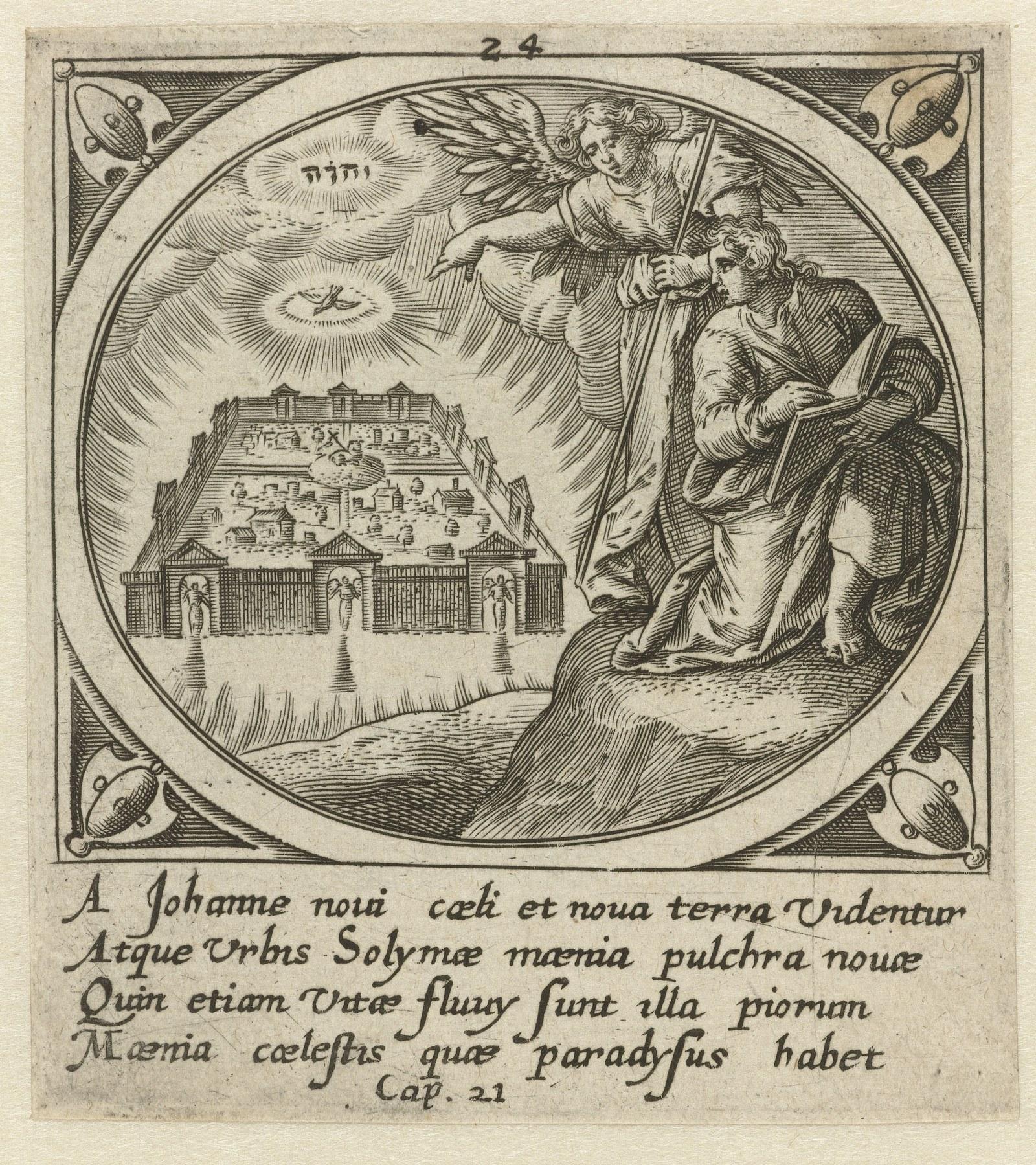
Attributed to Adriaen Collaert, An Angel Shows John the New Jerusalem, 1585. Public domain.
Joel 3:18 · Symbol · Featured Study
The River from the House of the LORD
Ezekiel saw a river run east from the temple and make the water of the Sea fresh.
Near the end of his book, after locusts, drought and war, Joel promises water.
And in that day the mountains will drip with sweet wine, and the hills will flow with milk. All the streams of Judah will run with water, and a spring will flow from the house of the LORD to water the Valley of Acacias.
- The word
- נַחַל (nachal), H5158
- First appears
- Genesis 2:10 “Now a river flowed out…”
Summary
In Joel 3:18 a spring flows from the LORD's house to a dry valley. Zechariah and the book of Revelation also tell of water that flows from where God dwells.
- Ezekiel 47:10 puts fishermen on the shore of the healed Sea, from En-gedi to En-eglaim.
- Jesus spoke of streams of living water at the Feast of Tabernacles.
- Revelation 22 puts the tree of life on both banks of the river.
The Spring in Joel 3
Joel 3:18 gives four gifts of the day the LORD dwells in Zion, and the spring is the fourth.
Then you will know that I am the LORD your God, who dwells in Zion, My holy mountain. Jerusalem will be holy, never again to be overrun by foreigners.The verse names the house the spring comes from, the LORD's dwelling on Zion.
Amos 9:13 has the same picture of the mountains dripping with sweet wine.
The River Measured
Ezekiel's vision of the river comes at the end of his long vision of the temple.
Each thousand cubits from the threshold, the water stood deeper, until no one could cross it.
1,000 cubits
- The thresholdwater flowing east from under the temple, south of the altarEzekiel 47:1
- Ankle-deepthe first thousand cubitsEzekiel 47:3
- Knee-deepthe second thousand cubitsEzekiel 47:4
- Waist-deepthe third thousand cubitsEzekiel 47:4
- A river for swimmingthe fourth thousand cubits, a river that could not be crossedEzekiel 47:5
Ezekiel gives the four lengths in cubits and the depths in words, and the drawing sets each depth by his words, from the ankles to water deep enough for swimming.
Drawn to the lengths of Ezekiel 47:1 to 5.
The guide's question in Ezekiel 47:6 asks the prophet to mark what he has seen. On the bank he then saw a great number of trees on both sides of the river (Ezekiel 47:7).
The River Across the Canon
Seven passages from Genesis to Revelation name a river or a spring and the place it belongs to.
The river runs from Eden to the city of Revelation 22, and each step names its place.
- Where the water is
- Out of Eden, to water the garden.
- Where the water is
- Its streams delight the city of God.
- Where the water is
- From the house of the LORD.
- Where the water is
- From under the threshold of the temple.
- Where the water is
- From Jerusalem, to the eastern sea and the western sea.
- Where the water is
- From within the one who believes in Jesus.
- Where the water is
- From the throne of God and of the Lamb.
In the order of the books.
Where the Water Goes
Commentators name the valley and the seas the water reaches.
And he said to me, “This water flows out to the eastern region and goes down into the Arabah. When it empties into the Sea, the water there becomes fresh. Wherever the river flows, there will be swarms of living creatures and a great number of fish, because it flows there and makes the waters fresh; so wherever the river flows, everything will flourish.The verses name where the river ends and what it does there.
John Wesley and Albert Barnes take the Sea of Ezekiel 47:8 for the Dead Sea. Jamieson, Fausset and Brown give the Arabah as the valley of the Jordan and the plain south of the Dead Sea.
But the swamps and marshes will not become fresh; they will be left for salt.The verse sets a limit on the healing.
And on that day living water will flow out from Jerusalem, half of it toward the Eastern Sea and the other half toward the Western Sea, in summer and winter alike.Zechariah's water goes out two ways, where Ezekiel's goes east only.
Jamieson, Fausset and Brown and Adam Clarke read the Eastern Sea of Zechariah as the Dead Sea and the Western Sea as the Mediterranean.
The Valley of Acacias
Shittim is the place name the Berean renders the Valley of Acacias.
While Israel was staying in Shittim, the men began to indulge in sexual immorality with the daughters of Moab,Shittim first appears here, as the camp where Israel sinned with the women of Moab.
Early the next morning Joshua got up and left Shittim with all the Israelites. They went as far as the Jordan, where they camped before crossing over.From that camp Israel set out for the river and lodged on its bank before going over.
Jamieson, Fausset and Brown place Joel's Shittim on the border of Moab beyond the Jordan.
The Words for the Water
Three Hebrew words name the water of these passages.
ma'yan
23 uses in the canon
A spring or fountain; the source of Joel 3:18.
nachal
141 uses in the canon
A stream valley or torrent; Ezekiel's river and Joel's valley of Shittim.
nahar
119 uses in the canon
A stream or river; the river out of Eden and the river of Psalm 46.
Streams of Living Water
The saying of Jesus rests on the Scripture He cites in John 7:38.
On the last and greatest day of the feast, Jesus stood up and called out in a loud voice, “If anyone is thirsty, let him come to Me and drink. Whoever believes in Me, as the Scripture has said: ‘Streams of living water will flow from within him.’” He was speaking about the Spirit, whom those who believed in Him were later to receive. For the Spirit had not yet been given, because Jesus had not yet been glorified.John's own comment in verse 39 explains the saying.
Albert Barnes, on Zechariah 14:8, quotes the rabbi David Kimchi, who read Zechariah's water as the spring of Joel and the stream of Ezekiel.
The Voices
Three teachers of the eighteenth and nineteenth centuries read the water as God's grace.
Matthew Henry (1662 to 1714)
Matthew Henry set the two visions in order.
“And there is plainly a reference to this in St. John's vision of a pure river of water of life, Rev. xxii. That seems to represent the glory and joy which are grace perfected. This seems to represent the grace and joy which are glory begun.”
Matthew Henry · Commentary on the Whole Bible · on Ezekiel 47:12Puritan
John Wesley (1703 to 1791)
John Wesley tied the spring to Christ and to the church.
“This no doubt is a shadow of the purifying blood of Christ, and his sanctifying spirit and word. And in that it is said to come from the house of the Lord, it intimates that this saving grace shall be first preached from Jerusalem, and by the church, which is the house of God, shall be published to others.”
John Wesley · Explanatory Notes upon the Old Testament · on Joel 3:18Evangelical
Charles Spurgeon (1834 to 1892)
Charles Spurgeon described the river's steady course.
“There is a river. Divine grace like a smoothly flowing, fertilising, full, and never failing river, yields refreshment and consolation to believers. This is the river of the water of life, of which the church above as well as the church below partakes evermore. It is no boisterous ocean, but a placid stream, it is not stayed in its course by earthquakes or crumbling mountains, it follows its serene course without disturbance. Happy are they who know from their own experience that there is such a river of God.”
Charles Spurgeon · The Treasury of David, Vol. 2 · on Psalm 46:4Particular Baptist
How the River Has Been Read
Four readings of the water stand among the fathers and the commentators.
The gospel going out from JerusalemMatthew Henry; Adam Clarke
Henry, on Zechariah 14:8, read the living water as the gospel with the graces of the Spirit. Clarke, on the same verse, traced it from Jerusalem to Syria, Greece, Italy and Britain.
The grace of baptismJerome
Jerome, in his Commentary on Ezekiel, read the waters of Ezekiel 47:8 as the grace of baptism or the teaching of the gospel.
A day of grace still to comeAlbert Barnes; John Gill
Barnes placed Joel 3:18 after the fall of antichrist, in a time when the grace of God spreads more widely. Gill set it in a day when the Jews are converted and the presence of God is enjoyed among His people.
A blessing on the dry groundJamieson, Fausset and Brown
Jamieson, Fausset and Brown read the spring as blessings temporal and spiritual that reach the arid desert. They note that acacias grow only in arid regions.
Books to Read Next
Two older commentaries read Joel 3 and Ezekiel 47 verse by verse.
Explanatory Notes upon the Old Testament
John Wesley · 1765
Wesley gives each phrase of Joel 3 a short note.
Read it free at BibleHubCommentary on the Whole Bible
Matthew Henry · 1710
Henry reads Ezekiel 47 stage by stage, from the threshold to the trees.
Read it free at BibleHubCome and Drink
The last chapter of the Bible ends with a call to come and drink.
The Spirit and the bride say, “Come!” Let the one who hears say, “Come!” And let the one who is thirsty come, and the one who desires the water of life drink freely.Joel's spring waters one valley, and this water is for anyone who desires it.
Sources
Scripture is the Berean Standard Bible.
- The Hebrew text of Joel 3:18, Ezekiel 47:5 and 9, Genesis 2:10 and Psalm 46:4, word by word, with Strong's numbers.
- Strong's dictionary entries for ma'yan, nachal and nahar, with their counts of uses.
- John Wesley, Explanatory Notes upon the Old Testament (1765), on Joel 3:18 and Ezekiel 47:8.
- Matthew Henry, Commentary on the Whole Bible (1710), on Joel 3:18, Ezekiel 47:12 and Zechariah 14:8.
- Adam Clarke, Commentary on the Bible (1832), on Zechariah 14:8.
- Albert Barnes, Notes, Explanatory and Practical (1832 to 1869), on Joel 3:18, Ezekiel 47:8 to 9 and Zechariah 14:8.
- John Gill, Exposition of the Old Testament (1748 to 1763), on Joel 3:18.
- Jamieson, Fausset and Brown, Commentary Critical and Explanatory on the Whole Bible (1871), on Joel 3:18, Ezekiel 47:8 and Zechariah 14:8.
- Jerome, Commentary on Ezekiel, on Ezekiel 47:8.
- Charles Spurgeon, The Treasury of David, volume 2 (1870), on Psalm 46:4.
- Attributed to Adriaen Collaert, An Angel Shows John the New Jerusalem, engraving, 1585, Rijksmuseum RP-P-2007-407; public domain.
Keep Studying
Read it4
Symbols2
Doctrines1