
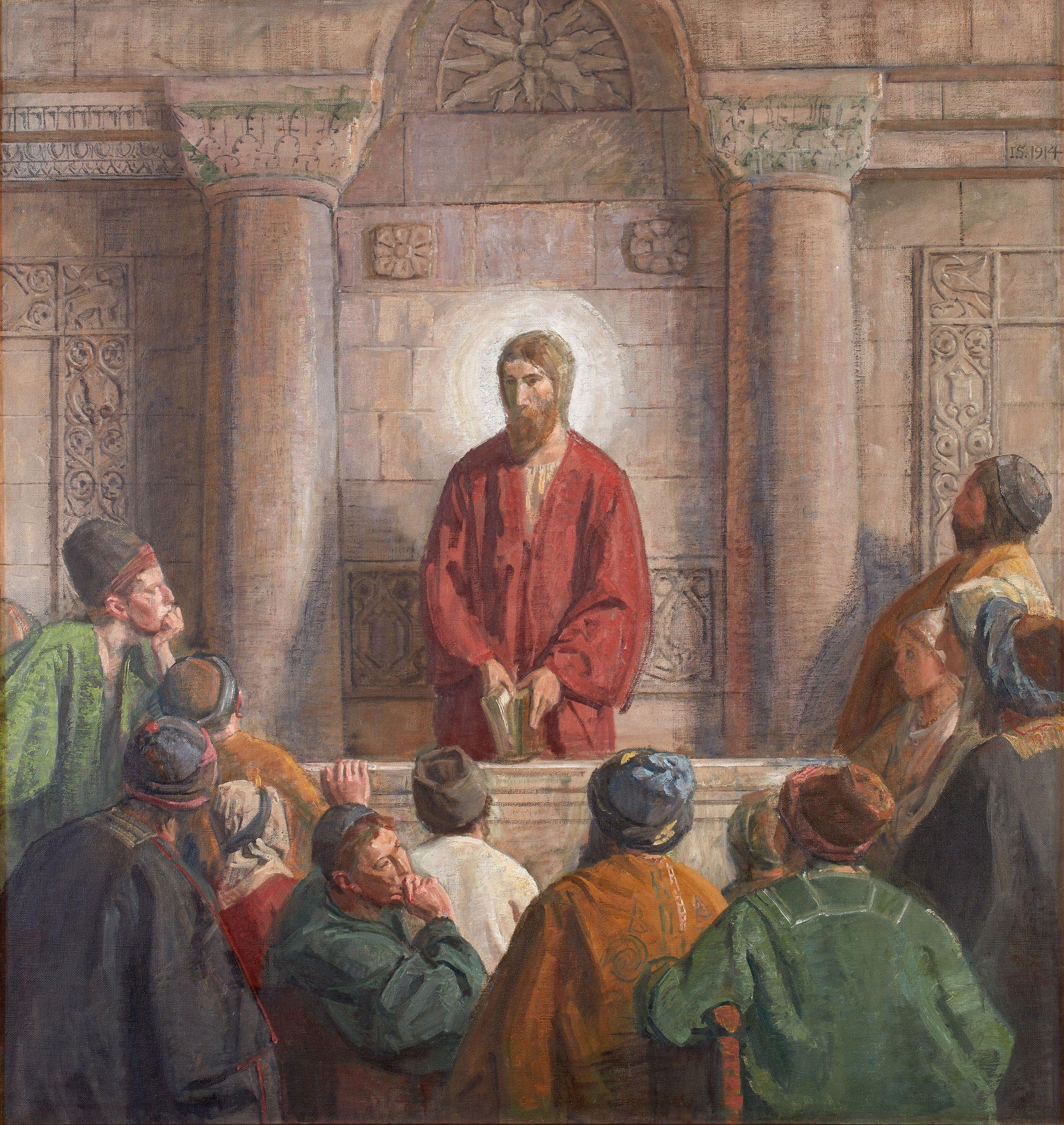
Joakim Skovgaard, Jesus in the Synagogue, 1914. Public domain.
Luke 4 · Passage · Featured Study
The Sermon at Nazareth
Jesus reads from Isaiah in the synagogue of His hometown and says the Scripture is fulfilled that day.
The town that raised Jesus heard Him read the prophets, and then it tried to kill Him.
and He began by saying, “Today this Scripture is fulfilled in your hearing.”
- The passage
- Luke 4:16 to 30, Isaiah 61:1 to 2
- Books
- Luke, Isaiah
Summary
On a Sabbath in Nazareth Jesus read from Isaiah 61 and claimed the words for that day. When He named a widow of Sidon and a Syrian leper, the town turned on Him and led Him to a cliff.
- The acts before and after the reading answer each other in reverse order, and the reading stands at the centre.
- Luke sets the reading beside a lesson from Elijah and Elisha.
- J. C. Ryle reads Mark 6 as a later visit, and the Cambridge Bible reads Luke 4 as the same visit told out of order.
The Reading in the Synagogue
Luke places the visit after Jesus returned to Galilee in the power of the Spirit.
“The Spirit of the Lord is on Me, because He has anointed Me to preach good news to the poor. He has sent Me to proclaim liberty to the captives and recovery of sight to the blind, to release the oppressed, to proclaim the year of the Lord’s favor.”Jesus read these lines and stopped there.
Nazareth was the town where Jesus had been brought up, and Luke says He went to its synagogue on the Sabbath as His custom was. Luke sets this reading at the start of the work in Galilee, though the hearers already know what He did in Capernaum. The Haftarah page sets out how the Prophets were read after the Law on the Sabbath.
The Reading at the Centre
Luke tells three acts before the reading and three after it, in reverse order.
The acts around the reading mirror each other, with the reading at the centre.
| Rung | The words in the Berean text | It answers |
|---|---|---|
| A | when He stood up to read | A′, He sat down |
| B | the scroll of the prophet Isaiah was handed to Him | B′, the scroll is given back |
| C | Unrolling it, He found the place | C′, the scroll is rolled up |
| D, the centre | The reading from Isaiah | The centre of the ladder |
| C′ | Then He rolled up the scroll | C, the scroll is unrolled |
| B′ | returned it to the attendant | B, the scroll is handed over |
| A′ | and sat down | A, He stood up |
He stood and sat, the scroll was handed and returned, and it was unrolled and rolled up. Between the pairs stands the reading, and the next word Jesus speaks is today.
From Wonder to Rage
The synagogue's praise turned to anger when Jesus named two Gentiles shown mercy in the prophets' days.
All spoke well of Him and marveled at the gracious words that came from His lips. “Isn’t this the son of Joseph?” they asked.Praise and doubt come in the same verse.
Jesus said to them, “Surely you will quote this proverb to Me: ‘Physician, heal yourself! Do here in Your hometown what we have heard that You did in Capernaum.’” Then He added, “Truly I tell you, no prophet is accepted in his hometown.Jesus answers the demand He knows they will make.
But I tell you truthfully that there were many widows in Israel in the time of Elijah, when the sky was shut for three and a half years and great famine swept over all the land. Yet Elijah was not sent to any of them, but to the widow of Zarephath in Sidon. And there were many lepers in Israel in the time of Elisha the prophet. Yet not one of them was cleansed—only Naaman the Syrian.”Both people He names are Gentiles, chosen over the many in Israel.
On hearing this, all the people in the synagogue were enraged. They got up, drove Him out of the town, and led Him to the brow of the hill on which the town was built, in order to throw Him over the cliff. But Jesus passed through the crowd and went on His way.The anger rises to an attempt on His life.
Luke 4:25 to 27, Luke 4:28 to 30
The Reading Beside Isaiah
Luke's wording of the reading differs from the Berean Isaiah at four points.
The Spirit of the Lord GOD is on Me, because the LORD has anointed Me to preach good news to the poor. He has sent Me to bind up the brokenhearted, to proclaim liberty to the captives and freedom to the prisoners, to proclaim the year of the LORD’s favor and the day of our God’s vengeance, to comfort all who mourn,This is the passage Luke says Jesus found in the scroll.
Isn’t this the fast that I have chosen: to break the chains of wickedness, to untie the cords of the yoke, to set the oppressed free and tear off every yoke?One line of Luke's reading matches this verse in place of Isaiah 61.
Luke names the Lord where Isaiah names the Lord GOD and the LORD, and Luke has no line for the brokenhearted. Luke has recovery of sight to the blind where Isaiah has freedom to the prisoners, and Luke adds a line close to Isaiah 58:6.
Luke's reading stops in the middle of Isaiah 61:2. Readers divide over whether that year is a jubilee, and the Jubilee page gives the readings with their holders.
What Luke Leaves Unsaid
Two gaps stand in Luke's account of the visit.
Luke does not say how Jesus escaped the crowd at the cliff.
Luke names no one in the synagogue but Jesus.
Voices on the Sermon
Ambrose of Milan and Charles Spurgeon wrote on the reader and the reading.
Charles Spurgeon (1834 to 1892)
Ambrose of Milan, as the Catena Aurea gathers him, saw humility in the Lord taking the office of a reader. He held that Jesus received the book to show Himself the same who spoke in the Prophets.
Charles Spurgeon, preaching on Isaiah 61:2 in 1877, rested the meaning of the prophecy on the Lord's own words at Nazareth.
“We know that this Scripture speaks concerning the Lord Jesus Christ. We don't say this as if we relied upon our own opinion. We know it, for sure, from the Lord's own lips, for, reading this passage in the synagogue at Nazareth, He said, ‘This day is this Scripture fulfilled in your ears.’ It is Jesus of Nazareth whom the Lord has anointed to preach deliverance to the captives and recovering of sight to the blind!”
Charles Spurgeon · The Metropolitan Tabernacle Pulpit, Sermon No. 1369: “Proclamation of Acceptance and Vengeance” (lightly modernized text, CCEL edition) · on Isaiah 61:2Particular Baptist
Spurgeon pictured the town waiting to hear what the carpenter's son had to say, in his Sermon No. 753 of 1867.
One Visit or Two?
Commentators divide over whether Mark 6 and Matthew 13 tell the visit of Luke 4.
Jesus went on from there and came to His hometown, accompanied by His disciples. When the Sabbath came, He began to teach in the synagogue, and many who heard Him were astonished. “Where did this man get these ideas?” they asked. “What is this wisdom He has been given? And how can He perform such miracles? Isn’t this the carpenter, the son of Mary and the brother of James, Joses, Judas, and Simon? Aren’t His sisters here with us as well?” And they took offense at Him.Mark's account opens on a Sabbath in the same town.
So He could not perform any miracles there, except to lay His hands on a few of the sick and heal them.Mark records what Jesus could and could not do there.
A first visit in Luke, a later one in MarkJ. C. Ryle
J. C. Ryle, in his Expository Thoughts on the Gospels on Luke (1858), calls Luke's account the first visit our Lord paid to Nazareth after entering on His public ministry, recorded only by Luke.
The objection: both accounts set the visit on a Sabbath in the synagogue and give the same saying about a prophet in his hometown.
The one visit, placed early by LukeThe Cambridge Bible; the Expositor's Greek Testament; Jamieson, Fausset and Brown
The Cambridge Bible on this passage reads it as the visit related in unchronological order, and the Expositor's Greek Testament says Luke uses an editorial discretion in the placing. Jamieson, Fausset and Brown list Mark 6:1 to 6 as the same account as Luke 4:16 to 30.
The objection: Luke alone has the reading, the widow and Naaman, and the cliff, and Mark alone has the few who were healed.
To the Other Towns
From Nazareth Luke takes Jesus down to Capernaum, and later in the chapter He names why He was sent.
But Jesus told them, “I must preach the good news of the kingdom of God to the other towns as well, because that is why I was sent.”Jesus names the purpose the reading at Nazareth announced.
Sources
Scripture is the Berean Standard Bible.
- Ambrose of Milan, in Thomas Aquinas, Catena Aurea, on Luke 4:16 to 17.
- Charles Spurgeon, Metropolitan Tabernacle Pulpit, Sermon No. 1369, Proclamation of Acceptance and Vengeance, 1877, CCEL edition.
- Charles Spurgeon, Metropolitan Tabernacle Pulpit, Sermon No. 753, Nazareth, or Jesus Rejected by His Friends, 1867, CCEL edition.
- J. C. Ryle, Expository Thoughts on the Gospels: Luke, 1858.
- The Cambridge Bible for Schools and Colleges and the Expositor's Greek Testament on Luke 4:16; Jamieson, Fausset and Brown on Luke 4:16.
Keep Studying
Symbols1
Subjects1