
Nine of His Questions · Featured Study
The Questions Jesus Asked
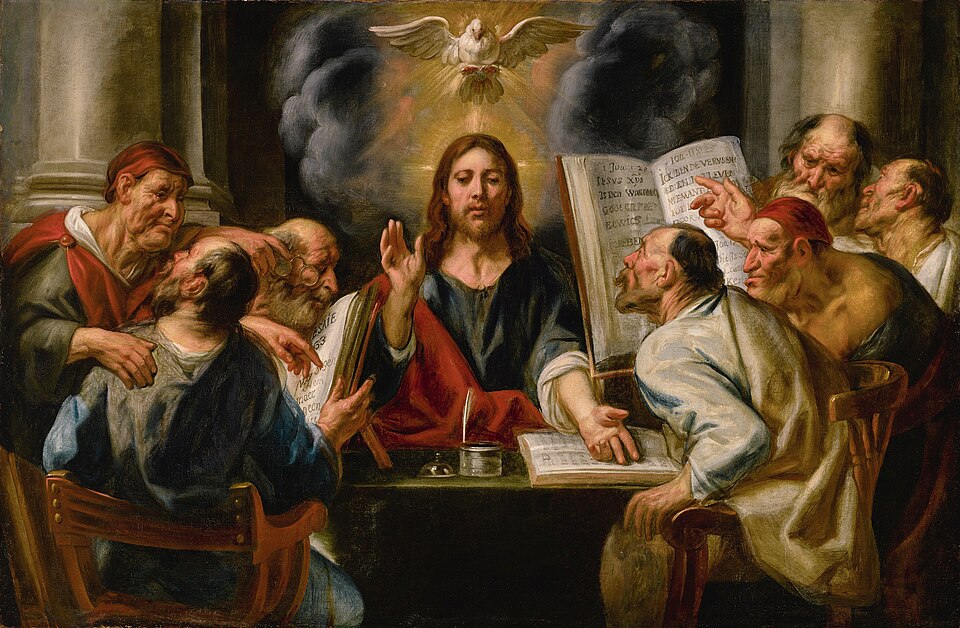
Jesus rarely just answered. Even his answers often came wrapped in another question. A question does what a statement cannot: it makes the hearer find the answer inside themselves. Nine of his questions, grouped by what each one does: the ones that expose the heart, the ones that call, the one that turns an attack back on the questioner, the ones that grieve, and the one left unanswered from the cross.
Summary
Jesus taught as much by asking as by telling. This page groups nine of his questions by what each one does: exposing a hidden motive, calling someone by name into a decision, turning a trap back on the one who set it, grieving over a failure of faith, and, from the cross, going unanswered.
- Some questions expose the heart: "why callest thou me good?" and "whose is this image and superscription?" both turn a flattering or trapping question back on the asker.
- Some questions call: "whom say ye that I am?", "wilt thou be made whole?", and the threefold "lovest thou me?" each put a decision directly to one person.
- One question answers an attack with a better question: when his authority is challenged, he asks about John's baptism and lets his questioners answer themselves.
- Some questions grieve: "where is your faith?" and "have I been so long time with you?" both carry visible disappointment alongside patience.
- One question is left unanswered in the text itself: "my God, my God, why hast thou forsaken me?", Psalm 22 quoted from the cross.
Why He Asked
a teacher who rarely just answered
Question after question runs through all four Gospels, put to disciples, to crowds, to the men trying to trap him, and once to heaven itself. A question does something a statement cannot. It will not let the hearer stay a spectator. It puts the work of finding the answer inside the person being asked, and it often reveals, in the answer given, exactly what needed revealing. This page walks nine of them, grouped by what each one accomplishes.
Questions That Expose the Heart
a flattering title and a trick question, both turned back
“Why callest thou me good?”
As Jesus started on His way, a man ran up and knelt before Him. “Good Teacher,” he asked, “what must I do to inherit eternal life?” “Why do you call Me good?” Jesus replied. “No one is good except God alone.A rich young ruler opens with a compliment. Jesus questions the compliment before answering the question.
The man calls him “Good Teacher” on his way to asking about eternal life. Jesus does not refuse the title; he makes the man weigh what he just said. Goodness in the absolute sense belongs to God alone, and the question invites the man to notice who he is actually speaking to before the conversation goes any further.
“Whose is this image and superscription?”
So tell us what You think: Is it lawful to pay taxes to Caesar or not?”The trap: is it lawful to pay tribute to Caesar, a question built to lose Jesus either the crowd or the Romans.
“Whose image is this,” He asked, “and whose inscription?” “Caesar’s,” they answered. So Jesus told them, “Give to Caesar what is Caesar’s, and to God what is God’s.”Render unto Caesar the things that are Caesar's, and unto God the things that are God's.
The Pharisees and Herodians build a question with no safe answer. Jesus asks for a coin, then asks whose face is on it. The answer they give supplies the terms of his own reply, and the trap closes on the men who set it.
Questions That Call
a decision put directly to one person
“Whom say ye that I am?”
When Jesus came to the region of Caesarea Philippi, He questioned His disciples: “Who do people say the Son of Man is?”First he asks what the crowds are saying, a survey before the real question.
“But what about you?” Jesus asked. “Who do you say I am?” Simon Peter answered, “You are the Christ, the Son of the living God.” Jesus replied, “Blessed are you, Simon son of Jonah! For this was not revealed to you by flesh and blood, but by My Father in heaven.Then he asks the disciples directly, and Peter answers for the ages.
“THIS is one of the earliest places in the New Testament in which we find any mention of the Church. Jesus says, in verse eighteen, ‘I will build My Church.’ It is very significant that our Lord should connect with the Church the right idea of Himself. In our text we have the test question which must be put to everyone who is to be admitted into the assembly of the Lord—‘Whom do you say that I am?’ The first question to be put to one who would join the Church is, ‘What do you think of Jesus?’”
Charles Spurgeon · "Jesus Known by Personal Revelation," The Metropolitan Tabernacle Pulpit, 1888Reformed Baptist
Matthew 16:15
“Thou art the Christ, the Son of the living God - Every word here is emphatic - a most concise, and yet comprehensive, confession of faith. The Christ, or Messiah, points out his divinity, and shows his office; the Son - designates his person: on this account it is that both are joined together so frequently in the new covenant.”
Adam Clarke · Commentary on the Bible, 1832Methodist
Matthew 16:16
“Peter did not say ‘you are a Christ’ or ‘a son of God’ but ‘the Christ, the Son of God.’ For there are many christs by grace, who have attained the rank of adoption [as sons], but [there is] only one who is by nature the Son of God. Thus, using the definite article, he said, the Christ, the Son of God. And in calling him Son of the living God, Peter indicates that Christ himself is life and that death has no authority over him.”
Cyril of Alexandria · Fragment 190, 444Church Father
Matthew 16:16
“Wilt thou be made whole?”
One man there had been an invalid for thirty-eight years. When Jesus saw him lying there and realized that he had spent a long time in this condition, He asked him, “Do you want to get well?”A man lying by the pool of Bethesda for thirty-eight years. The question sounds obvious. It is not.
Thirty-eight years is long enough for hope itself to become the harder habit to break. Jesus asks the man to say what he actually wants, out loud, before healing him. The question calls for an answer the man has to own.
“Lovest thou me?”
When they had finished eating, Jesus asked Simon Peter, “Simon son of John, do you love Me more than these?” “Yes, Lord,” he answered, “You know I love You.” Jesus replied, “Feed My lambs.” Jesus asked a second time, “Simon son of John, do you love Me?” “Yes, Lord,” he answered, “You know I love You.” Jesus told him, “Shepherd My sheep.” Jesus asked a third time, “Simon son of John, do you love Me?” Peter was deeply hurt that Jesus had asked him a third time, “Do you love Me?” “Lord, You know all things,” he replied. “You know I love You.” Jesus said to him, “Feed My sheep.Asked three times, over a charcoal fire, to the man who denied him three times over a charcoal fire.
“READ the whole chapter and observe the change of scene. First, they are on the lake fishing, casting their nets at Christ's command, and dragging to land a multitude of great fishes. They have all come on shore and when they have breakfasted, their faces are not turned to the sea, but to the pastures on the hillside. These are clothed with flocks and the Master says no more about fishermen and fish, but speaks of shepherds and sheep. Herein lies a parable—the servants of the Lord Jesus are first, fishermen, and then shepherds.”
Charles Spurgeon · "Feed My Lambs," The Metropolitan Tabernacle Pulpit, 1882Reformed Baptist
John 21:15
“He saith to him . . . the second time . . . lovest thou me, &c.--In this repetition of the question, though the wound was meant to be reopened, the words ‘more than these’ are not repeated; for Christ is a tender as well as skilful Physician, and Peter's silence on that point was confession enough of his sin and folly.”
Jamieson, Fausset & Brown · Commentary Critical and Explanatory on the Whole Bible, 1871Reformed
John 21:16
“It was fitting that he should; it was meant that he should. But this accomplished, the painful dialogue concludes with a delightful ‘Feed My sheep’; as if He should say, ‘Now, Simon, the last speck of the cloud which overhung thee since that night of nights is dispelled: Henceforth thou art to Me and to My work as if no such scene had ever happened.’”
Jamieson, Fausset & Brown · Commentary Critical and Explanatory on the Whole Bible, 1871Reformed
John 21:17
A Better Question
Matthew 21:23-27: an attack answered with a question the attackers cannot afford to answer
When Jesus returned to the temple courts and began to teach, the chief priests and elders of the people came up to Him. “By what authority are You doing these things?” they asked. “And who gave You this authority?”By what authority doest thou these things? A direct challenge to his standing.
“I will also ask you one question,” Jesus replied, “and if you answer Me, I will tell you by what authority I am doing these things. What was the source of John’s baptism? Was it from heaven or from men?” They deliberated among themselves and said, “If we say, ‘From heaven,’ He will ask, ‘Why then did you not believe him?’Jesus answers with one question of his own, about John's baptism, and traps them in their own caution.
The chief priests and elders demand to know who authorized him. Jesus offers a trade: answer one question about John the Baptist, and he will answer theirs. Either answer they could give would cost them, either with the crowd or with their own consistency, so they refuse to answer at all. He is not evading the question. He is showing them that they already know why they will not answer their own.
Questions That Grieve
disappointment and patience in the same breath
“Where is your faith?”
The disciples went and woke Him, saying, “Master, Master, we are perishing!” Then Jesus got up and rebuked the wind and the raging waters, and they subsided, and all was calm. “Where is your faith?” He asked. Frightened and amazed, they asked one another, “Who is this? He commands even the winds and the water, and they obey Him!”Asked right after he calms the storm the disciples woke him from, still afraid.
The storm is already still by the time he asks. The question is not about the wind. It is about what the disciples were carrying in the boat with them the whole time and had not yet learned to use.
“Have I been so long time with you, and dost thou not know me?”
Philip said to Him, “Lord, show us the Father, and that will be enough for us.” Jesus replied, “Philip, I have been with you all this time, and still you do not know Me? Anyone who has seen Me has seen the Father. How can you say, ‘Show us the Father’?Philip asks to see the Father. Jesus asks how, after this long together, that is still the question.
This is the night before the cross, and one of his own closest friends still asks to be shown something already standing in front of him. The question carries real grief, and it answers itself in the same breath: “he that hath seen me hath seen the Father.”
The Unanswerable Question
Matthew 27:46: Psalm 22, quoted from the cross
About the ninth hour Jesus cried out in a loud voice, “Eli, Eli, lema sabachthani?” which means, “My God, My God, why have You forsaken Me?”My God, my God, why hast thou forsaken me? The only question in this list Scripture never answers in the text.
My God, my God, why have You forsaken me? Why are You so far from saving me, so far from my words of groaning?The exact words he quotes, written a thousand years earlier.
Every other question on this page gets a response inside its own scene. This one does not. Jesus quotes the opening line of Psalm 22 word for word, in the language he spoke, and the Gospel records no reply from heaven. What the rest of that psalm says, and how the church has read it since the earliest sermons preached about the cross, is argued in full at the door below.
Why this page does not answer the question itselfThe full argument belongs to the psalm
Psalm 22 moves from this exact cry of abandonment to a confidence, by its final verses, that stretches to the ends of the earth. Whether Jesus meant the whole psalm by quoting its first line, and what that would mean for reading the cross, is the subject of its own page rather than a paragraph here.
The Voices
with the work named
"Jesus Known by Personal Revelation," The Metropolitan Tabernacle Pulpit (1888), and "Feed My Lambs" (1882) · public domain
Reads "whom say ye that I am" as the test question put to everyone entering the church, and hears the shift from fishermen to shepherds in John 21 as the scene's own parable.
Commentary on the Bible (1832) · public domain
Weighs Peter's confession word by word, calling it "a most concise, and yet comprehensive, confession of faith."
Fragment 190 (5th century) · public domain
Rests on the definite article: not "a son of God" but "the Son of God," and one over whom death holds no authority.
Commentary Critical and Explanatory on the Whole Bible (1871) · public domain
Reads the second and third askings of "lovest thou me" as a physician's careful reopening of an old wound, closing the threefold denial.
Marcus Brown's own commentary leads above all; within a tier, all voices are equal. Only Matthew 16 and John 21 carried a quote pool for this page; the other seven questions are carried by Scripture and the page's own exposition rather than an invented citation.
Keep Studying
On this page
Studies5
People and groups2
Places2
Doctrines5